Moses Fantasy Jews in Hellenic Egypt 01: Before Muhammad Fantasy Arab rule
Old kingdoms - Asian imperialism - Egypt imperialism - first Fantasy Palestine data - Hellenistic period - comparison of Egypt and Fantasy Bible literature - Roman period with ghettos, Jesus Fantasy Christian Antisemitism and Moses Fantasy Jewish revolts - Persian occupation
from: Egypt; In: [Mossad] Encyclopaedia Judaica 1971, vol. 6
presented by Michael Palomino (2008 / 2019 / 2020)
3 fantasies - Moses is a fantasy - Jesus is a fantasy - Muhammad is a fantasy - but Mother Earth is REAL
Moses is a fantasy - nothing could be found of him. The proofs are in the book: The Bible unearthed - link. So, Jewry is a fantasy, and also the Jewish calendar is a fantasy. Also Jesus is a fantasy: nothing could be found, but it's a code fantasy with the numbers 3,12,13 and 33 - link. Therefore, Christiandom is a fantasy, and also the Christian calendar is a fantasy - and the Vatican is a criminal pedophile satanic drug money laundering bank mafia - link with videos - link with news. Also Muhammad is a fantasy: nothing could be found, and the name "Muhammad" was used only since 850, not in 600 - link. Therefore also the Muslim calendar is a fantasy. Peace and healings and instructions how to handle the planet are with Mother Earth - Mother Earth is REAL and everybody can learn it: http://www.med-etc.com - have a good day. - Michael Palomino, May 12, 2019
Encyclopaedia Judaica = Mossad - link with proofs (English)


| Share: |
Facebook |
|
Twitter
|
Look what MoSSad Encyclopaedia Judaica is writing about Moses fantasy and Muhammad fantasy in Egypt:
<[[Pharao+Hellenic+Muhammad Fantasy]] EGYPT, country in N.E. Africa, centering along the banks of the River Nile from the Mediterranean coast southward beyond the first cataracts at Aswan. The ancient Egyptians named their land "Kemi", the "black Land", while the neighbouring Asiatic peoples used the Semitic word "Misr" which is still the country's name in both Hebrew and Arabic.
Geographically Egypt consists of two areas. Lower Egypt, the northern part of the land, which contains the Delta, and Upper Egypt, the south which comprises the narrow strip of cultivable land on both sides of the river as far south as Aswan.
Ancient [[Pharao]] Egypt: The OLD KINGDOM
About 3000 B.C.E. an Upper Egyptian king, Narmer (who is perhaps to be equated with the legendary Menes mentioned by the historian Herodotus), conquered Lower Egypt, unified the two portions of the land, and began the first dynasty in Egyptian history (col. 479).
[Mossad] Encyclopaedia Judaica (1971): Egypt, vol. 6, col. 488, ceremonial slate palatte with king Narmer depicting the conquests of Egyptian king Narmer (c. 3000 B.C.E.). In the top register the crowned king, preceded by his standard-bearers, surveys his slain enemies. At the bottom, the king, symbolized by a bull, batters at the fortified walls of a city. Cairo Museum.
This conquest was commemorated on a large ceremonial slate palette, the Narmer Palette (now in the Cairo Museum). Studies of the palette by Y. Yadin, S. Yeivin, and R. Amiran have shown that events recorded on it also indicate an Egyptian penetratio of West Asia, across the northern Negev deep into Transjordan. Potsherds bearing the name of Narmer and one of his predecessors have been found in Israel at Tell Erany (Tel Gat).
[[A "Tell" is a town in ruins which was destroyed several times and rebuilt several times on the old ruins, so the town was on a hill at the end. So a "Tell" is a ruin hill with it's different layers of the different ages]].
The excavations of the lower city at Tel Arad near Beersheba have revealed close connections of a commercial nature with the Egyptian First and Second Dynasties. Pottery of a type well-known and well attested in Egypt at this time, but of Palestinian origin, was found in great quantity. Toward the end of the Old Kingdom, in the reign of Pepi I of the Sixth Dynasty, an inscription of Uni, one of his officials, describes a successful campaign by land and sea which he waged against the "Land of Gazelle Nose", a region which has been equated by most modern scholars with the Mount Carmel range. On the whole, however, the relations between [[Pharao]] Egypt and [[Fantasy]] Palestine during the Old Kingdom were of a peaceful nature and were confined to trade.
The MIDDLE KINGDOM: [Pharao Egypt-Fantasy Palestine relations: trade, caravans, and craftsmen]
With the collapse of the Old Kingdom (c. 2200 B.C.E.), Egypt entered into the First Intermediate period, a time of political chaos, anarchy, and civil war which lasted a little over two centuries. The land had split apart at its geographical seams, central authority disappeared, the social order seemed to be overturned, and all this was conveniently blamed upon the penetration of the eastern Delta by Asiatics.
With the accession of Amenemhet I of the Twelfth Dynasty (c. 1991 B.C.E.) began the flowering period of the Middle [[Pharao]] Kingdom in Egypt, which coincided with the *patriarchal period in [[Fantasy]] Palestine, and interrelations between the two regions are attested in a diverse number of sources. On the whole these still remained peaceful and friendly. The most famous literary text of the Middle Kingdom, the Story of Sinuhe, a propagandist tale designed to show the glory of Egypt under Sesostris I (c. 1971-38 B.C.E.), related the wanderings of an Egyptian exile in northern [[Fantasy]] Palestine-Coele-Syria and sheds much information on the life and customs of these (col. 479)
regions. A painting in the tomb of Prince Khnumhotep III at Beni Hasan in Middle Egypt (c. 1890 B.C.E.) portrays the arrival of a trading caravan of 37 gaudily dressed Asiatics led by their chief Ibsha to Khnumhotep's court. The main product which these Asiatics brought was a cosmetic for painting the eyes, but they may also have been traveling metalworkers since their donkeys are shown carrying bellows (cf. Gen. 4:19-22). (col. 480)
[Mossad] Encyclopaedia Judaica: Egypt, vol.6, col. 493-494, painting of the arrival of an Asiatic trade caravan, depicted on a mural
in the tomb of Prince Khnumhotep III (c. 1890 B.C.E.) at Beni Hasan.
That there may have been an administrative and possibly military domination of Asia by Egypt during the Middle Kingdom can be inferred from the statue, found at [[Tell]] *Megiddo, of the governor of the 15th nome of Upper Egypt and high priest of Thoth at Hermopolis, Djehuty-hotep, who lived under Amenemhet II and Sesostris III (c. 1938-1849 B.C.E.), and a group of Statuettes of the vizier Sesostris-'enekh found at *Ugarit in Syria.
This is borne out by the fact that the Asiatic rulers of Byblos bore the Egyptian title of "count", which in Egypt was conferred by the king, implying some sort of Egyptian control over them. A papyrus of the Late Middle Kingdom, in the Brooklyn Museum, lists among the personnel of a large estate in Middle / Upper Egypt a large number of slaves and serfs who bear Northwest Semitic names, including those of *Shiphrah and Puah who are attested in Exodus 1:15 as midwives.
[Sinai mines - wars against Asiatic nomads - curses against neighbours in pottery]
Under Amenemhet III the brother of the prince of Retjenu (the Old and Middle Kingdom Egyptian name for [[Fantasy]] Palestine) is frequently pictured in rock drawings at the turquoise mines of Serabît-el-Khadim in Sinai assisting the Egyptians in working or administering the mines.
Direct military activity by the Egyptians in [[Fantasy]] Palestine during the Twelfth Dynasty is occasionally attested in Egyptian documents. On the stele of the general Nesmontu from the coregency of Amenemhet I and Sesostris I (c. 1971-62 B.C.E.), Nesmontu relates how he campaigned against the Asiatic nomads and destroyed their strongholds. The stele of the soldier Sebekkhu under Sesostris III (c. 1878-49) B.C.E.) records that king's campaign against the Asiatics of the region of Sekmem, which most scholars equate with Shechem in Samaria, and several Twelfth Dynasty blocks from the Temple of Amun in Karnak record the names of Palestinian tribute bearers. Certain literary texts, the Story of Sinuhe and the Prophecy of Neferti (Nefer-rohu), mention fortifications on the eastern frontier of Egypt, called the "Walls of the Ruler", which had been built by Amenemhet I "to repel the Asiatics and crush the Sandfarers".
There is a series of interesting texts dated about the end of the Middle Kingdom which record, on the one hand, the real or potential enemies of Egypt, and on the other, a series of detailed geographical lists of the lands and territories neighbouring Egypt. These texts, the Execration Texts, were curses which were inscribed on pottery bowls or crude human figurines in clay and then ceremonially smashed. The Asiatic texts mention Byblos, Ashkelon, Akhshaph, and Aushamem (Jerusalem?).
[Asian rulers in Egypt]: The HYKSOS
The Middle Kingdom collapsed about 1780 B.C.E. in chaos and civil war. Some 50 years later the Delta had new masters who claimed overlordship over all of Egypt. These were the Asiatic "rulers of foreign countries", the *Hyksos of Manetho, whose rule lasted until c. 1570 B.C.E. Earlier scholership regarded the Hyksos as a single wave of invaders, equipped with the horse-drawn chariot (previously unknown in Egypt) and the compound Asiatic bow, who brutally installed themselves by conquest in Egypt.
The most recent scholarship rejects this view, considering the Hyksos, in the context of the *Amorite movement into West Asia, as a heterogeneous group of different peoples, Semites and Hurrians, infiltrating into the Eastern Delta over a period of several centuries, coming as traders and slaves, pasturing their cattle in times of famine (col.480)
in Canaan, and finally seizing power during the civil wars of the Egyptian Thirteenth Dynasty. Although inscriptions of the greatest Hyksos ruler, Khyan, have been found in Crete, Anatolia, Iraq, and southern [[Fantasy]] Palestine, there is no reason to Believe (as was formerly thought) that the Hyksos ruled a mighty empire embracing these regions. It is clear, however, that under them trade was widespread. Later Egyptian tradition has presented a biased picture of the Hyksos as godless barbarians who harshly usurped power in Egypt and humiliated the Egyptians; for in spite of the fact that the Hyksos, possessing no material culture of their own quickly adopted that of Egypt, the native Egyptians never became reconciled to their rule.
Around 1550 B.C.E. the Egyptian rulers of Thebes began a war of liberation against the Hykos, which culminated in the capture of the Hyksos capital at Avaris (modern Khatana Qantir?), the expulsion of the Asiatics from Egypt, the destruction of their stronghold of Sharuhen in southwest [[Fantasy]] Palestine, and the beginnings of the Egyptian empire (the New Kingdom). In the first century C.E., the [[Moses Fantasy]] Jewish historian Josephus incorrectly equated the Ptolemaic Egyptian historian Manetho's account of the Hyksos with the biblical accounts of *Joseph and the *Exodus (Apion 1:82ff.). The most important effect of the Hyksos domination was the complete shattering of Egyptian confidence and sense of secure isolation afforded by the protection of the deserts on each side of the Nile Valley.
18th dynasty: Extension of Egypt to Asia as a "prevention" - many raids - and peace by marriage
To prevent the recurrence of such foreign domination the rulers of the Eighteenth Dynasty (c. 1570-1304 B.C.E.) extended their dominion east and north into West Asia where they came into conflict with the Hurrian empire of Mitanni. The battlefield was northern [[Fantasy]] Palestine and southern Syria, probably as far north as Kadesh on the Orontes [[river]]. The earlier kings of the dynasty raided Syria, Thutmose I (c. 1525-1495 B.C.E.) going as far as the Euphrates River; but it was his grandson Thutmose III (c. 1490-1436 B.C.E.), the greatest of the Eighteenth Dynasty soldier-kings, who laid the real foundations of Egypt's Asiatic empire, when in 1468 B.C.E. he crushed a coalition of Palestinian and Syrian princes, under the leadership of the king of Kadesh, at Megiddo, in the plain of Esdraelon (or Jezreel Valley).
Almost every year for the next 20 years Thutmose led or sent his army into West Asia to consolidate his conquests, raiding, as did his grandfather, even to the Orontes [[river]]. His two successors continued this policy until the reign of Amunhotep III (c. 1405-1367) who cemented peace with Mitanni by marrying a Mitannian princess. During this period of Egyptian conquest, it was the national god, Amun of Thebes (see *Amon), who had given victory to Egypt and, in return, the king gratefully gave vast shares of the plunder and tribute to Amun's temple. The Asiatic regions were ruled by puppet vassals, educated at the Egyptian court and subordinate to Egyptian commissioners and governors.
As yet, there was no physical Egyptian occupation of West Asia. Nevertheless there was a free interchange of goods and ideas: Egyptian deities were worshiped by Asiatics in Asia and Asiatic gods such as Resheph and *Baal were venerated in Egypt by Egyptians; the tomb and temple art of Egypt displayed pictures of Asiatics (Semites and Hurrians) and their products. Respite from foreign war gave rise to new problems in Egypt. The empire had been made possible by a middle class of bureaucrats and soldiers; but social penetration into the highest strata of Egyptian society - the nobility and the upper clergy - was virtually impossible.
Under Amunhotep's son *Akhenaton, a social revolution broke out, cloaked in religious garb. Akhenaton attempted to effect a change in the old, established order by suppressing the cult of Amun and the (col. 481)
other major gods and replacing them with the worship of a hitherto minor solar cult, that of the sun-disk Aton. Although Akhenaton's religious "reforms" superficially resemble the introduction of monotheism, there is no real evidence that this was the case. Akhenaton's revolution did not survive him; and not long after his death, the revolution and its author's name and memory were systematically blotted out.
The partial archive of the diplomatic correspondence of the last years of Amunhotep III and of Akhenaton, found at the latter's capital of Akhetaton (modern Tell *el-Amarna), is the most important surviving collection of written sources for the political history of [[Fantasy]] Palestine and southern Syria at the end of the 14th century B.C.E.
[[Moses Fantasy Jews are mentioned]].
EGYPT AND PALESTINE - [no Moses Fantasy Jews mentioned there]
A careful study does not show any gradual disintegration of the Egyptian Asiatic empire because of Akhenaton's preoccupation with his religious reform. Egyptian policy was to keep the trade routes to Mesopotamia open, and to keep the Syro-Palestinian vassals disunited and hostile to one another. Mention is frequently made in these letters of the incursions of the *Habiru-nomads against the settled Canaanite regions.
Scholars today, however, no longer identify them as the Hebrews under Joshua. At the close of the Eighteenth Dynasty, after the death of Akhenaton's successor Tutankhamun, Egyptian defeat in Asia in a war against the Hittites and a civil war in Egypt led to the temporary independence of [[Fantasy]] Palestine. The Ramesside kings of the Nineteenth Dynasty (c. 1304-1200 B.C.E.) reestablished Egyptian control, this time by direct occupation. Strong Egyptian garrisons were placed in *Gaza, *Jaffa, *Megiddo, and *Beth-Shean, among other cities, where archaeological excavations revealing a marked Egyptian occupation level.
[Moses Fantasy Israel mentioned on an inscription - biblical Exodus - invasion of Sea Peoples]
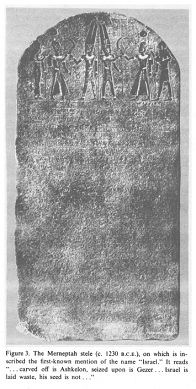
Rameses II, the most famous king of the dynasty, fought a militarily inconclusive battle with the resurgent Hittites at Kadesh on the Orontes [[river]] (c. 1298 B.C.E.), which, however, politically fixed the northern limits of Egyptian control and influence in southern Syria. An inscription of his successor, *Merneptah, which mentions the name *Israel for the first time in an Egyptian text and definitely places it somewhere in [[Fantasy]] Palestine, has been accepted as evidence that the biblical *Exodus had already taken place, probably in the reign of Rameses II.
Merneptah stone (stele) mentioning Israel, c. 1230 B.C.E., with the first-known inscription of the name "Israel". It reads "...
carved off is Ashkelon, seized upon is Gezer ... Israel is laid waste, his seed is not..."
The reign of Merneptah also saw the beginnings of invasion-migrations of the Sea Peoples, the first of which Merneptah successfully repelled.
[[This Sea Peoples invasion is the reason for burning the towns in Fantasy Palestine, not Joshuah, according to the latest Moses Fantasy Jewish archeology. This is no conspiracy theory, stupid Jesus Fantasy Church and stupid dogmatic [[Jesus Fantasy]] Christian groups, but this is fact! see the book of: Finkelstein / Silberman: The [[Fantasy]] Bible Unearthed - link]].
[Syrian period in Egypt]
The end of the Nineteenth Dynasty was a period of anarchy culminating when a Syrian, Irau, seized the Egyptian throne (c. 1224-1214).
This Syrian interregnum was followed by the establishment of the Twentieth Dynasty (c. 1200-1090 B.C.E.) which at its very outset was threatened by new waves of invading Libyans and Sea Peoples. Rameses III, the most important ruler of the dynasty (c. 1195-1164 B.C.E.), who halted the Sea Peoples' invasion which had overrun Asia Minor and northern Syria, destroying the Hittite empire in the process, was the last pharaoh of the dynasty to hold [[Fantasy]] Palestine.
[since 1150 b.c.: no mining in the Sinai any more - Philistines governing in Fantasy] Palestine - Moses Fantasy Jews in the hills - Salomonian times and wars]
By 1150 B.C.E. the Egyptians had ceased to exploit the Sinai copper and turquoise mines, and in [[Fantasy]] Palestine itself the Egyptian occupational levels were replaced by those of the Peleshet (*Philistines), the Sea People group which Rameses III had employed as mercenaries in Egypt and [[Fantasy]] Palestine after he had defeated them.
West Asia played a noticeable part in the cultural and economic life of Egypt during the Nineteenth and Twentieth Dynasties, particularly under the early Ramessides. An important literary text of the period, Papyrus Anastasi I, emphasizes the detailed geographic and topographic knowledge the Egyptians had of [[Fantasy]] Palestine. Asiatic themes occur frequently in Egyptian art and literature, and men bearing Semitic names rose to prominence in Egyptian society.
That the political loss of her (col. 482)
Asiatic empire did not, however, end Egypt's cultural influence in West Asia is shown by a literary text, the Travels of Wenamun, dating to the beginning of the Twenty-First Dynasty (c. 1090 B.C.E.). In [[Fantasy]] Palestine the Philistines had established themselves, along with at least one other of the Sea Peoples, Tjeker, along the coastal plains and valleys, while Israelite tribes were settling in the hill country of the interior. It was only after the United Monarchy had been established by David that Egypt again appeared in [[Fantasy]] Palestine. During *David's campaigns against *Aram Zobah, an Egyptian king of the Twenty-First Dynasty, either Siamun or Psusennes II, seizing the opportunity, ravaged the Philistine enclave of Gezer and captured the city, which subsequently was handed over to David as the dowry [[marriage portion]] of Solomon's bride - probably as a face-saving gesture when David returned from his triumph over Hadadezer. Peaceful and friendly relations between Egypt and [[Fantasy]] Palestine, however, did not survive the death of Solomon.
[[According to [[Moses Fantasy]] Jewish archeology David and Solomon did not exist because there are no remnants at all to find, and Egypt documents never mention them. But there are other [[Moses Fantasy]] Jewish kingdoms which are missing in the Torah]].
The Twenty-Second Dynasty, of Libyan origin, had come to power in Egypt (c. 950 B.C.E.). Sheshonk I (the biblical *Shishak) gave refuge to the Israelite pretender *Jeroboam and, after the latter had returned to Israel, invaded first Judah, thoroughly ravaging and looting the country, and then Israel, treating it in like manner.
Returning with vast plunder, and leaving a weakened [[Fantasy]] Palestine behind him, Sheshonk retired to Egypt. Henceforth the Libyan rulers of Egypt, having shown their power, left West Asia alone.
By the end of the eighth century B.C.E. the Egyptianized Nubian rulers of *Cush had displaced the Libyans in control of Egypt, while the Assyrians under *Tiglath-Pileser III made their presence felt in Syria and [[Fantasy]] Palestine. During the last revolt of Israel against Assyria (724-721 B.C.E.) Hosea wrote to So, the king of Egypt, for support against the Assyrians. This otherwise unknown king has been plausibly identified recently as Tefnakht, the ruler of Sais (So), a vassal of the Nubians. However, Egyptian support was to no avail; Tefnakht was repulsed and Samaria fell.
Nevertheless Egypt still appeared to be powerful, and in the following decades *Hezekiah, king of Judah, again relied on Egypt. Although the biblical account names *Tirhakah (Taharka), king of Cush (Nubia; II Kings 19:35) as Jerusalem's ally, there are chronological problems involved, since the decisive battle of this campaign, that of Elteke, took place in 701, and Taharka's rule began only in 689.
[Fantasy Palestine under Egypt and Babylonian rule - deportation of Moses Fantasy Jews to Babylon or flight to Egypt]
*Sennacherib's successors subjugated Egypt, expelled the Cushites, and installed puppets who managed to regain Egyptian independence under the Twenty-Sixth Dynasty. The founder of this dynasty, Psammetichus I (c. 664-610 B.C.E.) strengthened Egypt by the widespread employment of foreigners - Greek and [[Moses Fantasy]] Jewish mercenary troops and Phoenician sailors and merchants. During his reign or that of Psammetichus II (c. 595-89 B.C.E.) the famous colony of [[Moses Fantasy]] Jewish mercenary soldiers was established at *Elephantine to protect the southern frontier of Egypt. After the fall of the Assyrian capital of Nineveh in 612 B.C.E. to the Neo-Babylonians and Medes, the king of Egypt, Neco II, "went up against the Babylonians", but found his way barred by *Josiah, king of Judah, whom he defeated and killed at Megiddo in 609. Four years later, the Babylonians decisively defeated him at the battle of Carchemish. The subsequent Babylonian invasion of Egypt, preceded by the siege and sack of Ashkelon, was, however, beaten back, although [[Fantasy]] Palestine remained under Babylonian control.
In 589 *Nebuchadnezzar besieged Jerusalem, whose kin, *Zedekiah, had rebelled at the instigation of the pharaoh Apries (*Hophra). The latter invaded Syria in an attempt to relieve Jerusalem, but again Egyptian support proved ineffectual, and in 587 Jerusalem fell. Most of the (col. 483)
city's population was deported to Babylon; some, however, took refuge in Egypt, including the prophet *Jeremiah.
Egyptian Literature in the [[Fantasy]] Bible
[[One of the strange things is that David and Solomon are never mentioned in Egypt literature. Arqueology could not find anything of old Jerusalem nor of a king of David nor of a king of Solomon - see the book The [[Fantasy]] Bible Unearthed - link]].
The major body of extant Egyptian literature dates to the third and second millennia B.C.E., i.e., to the Old, Middle and New Kingdoms. Although it was one the tendency of scholars to include every sort of written text from the ancient Near East within the broad definition of literature, the Egyptologist today can point to a distinct and rich literature in the true sense of the word, including fiction, poetry, wisdom literature, satire, biography, and narrative.
Since the vast bulk of Egyptian literature was written in cursive script with pen or brush and ink on perishable materials - papyrus, wooden writing boards, and occasionally on pottery or limestone ostraca - it is hardly surprising that only a small fraction of what once must have existed is preserved today.
It should be noted that although several copies of the same texts frequently occur, there are very few complete texts. Moreover, many copies of texts on papyri and ostraca appear to have been schoolboys' copies and exercises which are replete with errors.
Much of this literature, particularly in the areas of wisdom literature, religious and secular poetry, fiction, and epic, frequently parallels the literature of the [[Fantasy]] Bible in theme, content, language, or style. While not all Egyptian literature has parallels with the literature of the [[Fantasy]] Bible, even much of the rest deals intimately with [[Fantasy]] Palestine and Syria. The "Story of Sinuhe", has already been mentioned, In one of his many adventures, Sinuhe slays an enemy champion in a duel reminiscent of that between David and Goliath (I Sam. 17:51). The Late Egyptian "Tale of Two Brothers" (Papyrus D'Orbiney), which dates to about 1225 B.C.E., relates how an upright youth, Anubis, rejects the advances of his older brother's wife. Afraid that her infidelity would become known, she falsely accused Anubis of attempting adultery with her. The rest of the story deals with Anubis' flight, adventures, transformation, and subsequent vindication.
The beginning of this text resembles the account of Joseph and Potiphar's wife (Gen. 39:1-20), which appears to be a case of literary borrowing from the Egyptians as is attested by the Egyptian elements in the biblical tale, particularly by the Egyptian names of Joseph (Zaphenath-Paneah) and the native Egyptians, which can be dated from their Egyptian prototypes to the tenth century B.C.E.
The biblical tale of the seven lean years in Egypt (Gen. 41:27, 56) finds a parallel in an Egyptian story written to explain why the ram-headed god Khnum was honoured in the region just south of the island of Elephantine.
The extant version of the text is late (c. late second century B.C.E.), but the document itself is dated to the reign of Djoser at the beginning of the Old Kingdom (c. 28th century B.C.E.). Like most ancient peoples, the Egyptians had a story recounting how a god, dissatisfied with mankind, attempted to destroy it, and how mankind survived. The Egyptian account, however, differs from that in Genesis 6 (see also *Cosmogony; *Creation).
[Parallels between Egypt and Fantasy Biblical poetry]
[Mossad] Encyclopaedia Judaica (1971): Egypt, vol.6, col. 499, goddess Hathor, goddess of the mines,
face carved in stone, at the turquoise mines of Sarabt-el-Khadim in Sinai.
Several Egyptian works parallel biblical poetry in spirit ant wording: "The Hymn to Aton" from the reign of Akhenaton at the end of the 18th Dynasty (late 15th century B.C.E.) and [[Fantasy]] Psalm 104; the 19th-Dynasty love songs (Papyrus Harris 500 and Papyrus Chester Beatty 1) and the Song of Songs. The resemblance in spirit, language, and phraseology between the Aton Hymn and Psalm 104 led earlier scholars to maintain that there was a direct relationship between the two works. Because, at first glance, Akhenaton's devotion to Aton and the suppression of Amun and non-solar Egyptian cults appeared to be monotheistic, Breasted and his generation of scholars argued that the Aton Hymn was the product of a monotheistic religion. However, this view has been challenged since the general acceptance by modern scholarship of Akhenaton's religion as a form, at best, of monoidolatry, rather than as monotheism. A less close, but still strong parallelism exists between the Egyptian love songs and the Song of Songs.
The Egyptians excelled most in wisdom literature, collections of wise sayings and advice, usually taking the form of a letter of instruction from a vizier or king to a successor. Two well-known collections, the "Instruction of the Vizier Ptah-hotep" (written c. 2450 B.C.E.) and the "Instruction of Amunemope" (written between the tenth and sixth centuries B.C.E.), are paralleled by the biblical Book of Proverbs, particularly by Proverbs 22:17-24:22, as well as by Ecclesiastes, Psalms, and Jeremiah. A related genre of Egyptian texts, the so-called prophetic literature, in which the prophet stands before the king and denounces the past and present, (col. 484)
contains much that resembles the biblical conception of a prophet. The Prophecy of Neferti from the Middle Kingdom finds strong echoes in Isaiah, Jeremiah, Ezekiel, Amos, and Zechariah.
[AL.R.S.]
The Hellenistic Period in Egypt
[[Moses Fantasy]] Jewish communities in Egypt during Hellenistic and Medieval times, maps
[Mossad] Encyclopaedia Judaica (1971): Egypt, vol.6, col. 486, map with [[Moses Fantasy]] Jewish communities during Greek and Medieval period.
Hellenistic period (indication in rings, Greek names): Alexandria, Oahopus, Hermopolis Parva, Busiris, Pelusium, Daphnae, Leontopulis, Bubastis, Athribis, Heliopolis, Memphis, Socnopaei Nesus, Karanis, Philadelphia, Arsinoe, Tebtunis, Ptolemais; further up the Nile: Heracleopolis Magna, Oxyrhynchus, Hermopolis Magna, Ptolemais, Coptos, Thebes, Apollonopolis Magna, Aswan Elephantine.
Medieval period (detailed map, indication in black spots, Arab names): Alexandria, Rosetta, Fūwa (Fuwa), Damanhūr (Damanhur), Abwān (Abwan), Fāraskūr (Faraskur), Dantiena, Tinnis, Damīra, Jawjar, al-Mahalla, al-Kubrā (al-Kubra), Būsīr (Busir), Sunbāṭ (Sunbat), Tatay, Minyat Zifta, Shubrā (Shubra), Malīj, Subk, Shaṭṭanawf (Shattanawf), Sanīt (Sanit), Ushmūm Tannāḥ (Ushmum Tannah), Samannūd (Samannud), Damsis, Minyat Ashnā (Minyat Ashna), Minyat Ghamr, Sahrajt, al-Banā (al-Bana), Ghayfa, Banhā al-'Asal, Bilbays; further up the Nile: Qalyūb (Qalyub), al-Maṭariyya (al-Matariyya), Cairo; big map: Helwan, Faiyum, Ikhmim, Qūṣ (Qus), Qifṭ (Qift), Aswan.
The PTOLEMAIC PERIOD
[Moses Fantasy Jewish mass flight to Egypt from Alexander the Great - Moses Fantasy Jewish settlement under Ptolemid dynasty with center Alexandria - and further incidents - bible translation]
Egyptian [[Moses Fantasy]] Jewry traced its history back to the time of Jeremiah (Letter of Aristeas, 35), but it was not until the conquest of *Alexander the Great in 332 B.C.E. that the second great wave of [[Moses Fantasy]] Jewish emigration to Egypt began. Alexander's successors in Egypt, the Ptolemid dynasty, attracted many [[Moses Fantasy]] Jews early in their reign to settle in Egypt as tradesmen, farmers, mercenaries, and government officials. During their reign Egyptian [[Moses Fantasy]] Jewry enjoyed both tolerance and prosperity. They became significant in culture and literature, and by the first century C.E., accounted for an eight of the population of Egypt. The majority of the [[Moses Fantasy]] Jews of Egypt lived, as the Greeks, in *Alexandria, but there were also very many in the chora, the provincial districts outside Alexandria.
*Ptolemy I Soter (323-283) took a large number of [[Moses Fantasy]] Jewish prisoners of war in [[Fantasy]] Palestine and forcibly settled them as mercenaries in Egypt to hold down the native Egyptians (ibid., 36). On Ptolemy I's retreat from [[Fantasy]] Palestine many [[Moses Fantasy]] Jews fled with him to Egypt, where they found a haven of tolerance. *Ptolemy II Philadelphus (283-44) emancipated the [[Moses Fantasy]] Jews taken captive by his father and settled them on the land as cleruchs or in "[[Moses Fantasy]] Jew-Camps" as [[Moses Fantasy]] Jewish military units. He was remembered by the [[Moses Fantasy]] Jews of Egypt as having instigated the translation of the Septuagint (see Letter of *Aristeas; *[[Fantasy]] Bible, Greek translation). Since *Manetho's anti-Semitic work was written in his reign there must have been a fair number of [[Moses Fantasy]] Jews already in Egypt.
[Moses Fantasy Jewish government connections: Ptolemy III Euergetes - Ptolemy IV Philopator - Cleopatra III]
*Ptolemy III Euergetes (246-221) was said to have been favourably disposed toward the [[Moses Fantasy]] Jews and to have respected their religion. Two facts confirm this. One is the number of [[Moses Fantasy]] Jews who settled in the nome of Arsinoe (*Faiyum) in his reign, and the other is the synagogue inscription dedicated to him, declaring that he granted the rights of asylum to the synagogues (Frey, Corpus 2 pp. 374-6). There is also a synagogue inscription from Schedia, which was also probably dedicated to him (Reinach in REJ, 14 (1902), 161-4).
*Ptolemy IV Philopator (221-203) attempted to institute a massacre of the [[Moses Fantasy]] Jews of Alexandria in 217 B.C.E., but was later reconciled with them (III Macc. 5-6). During the reign of *Ptolemy VI Philometor (181-145) a marked change took place. Ptolemy VI won [[Moses Fantasy]] Jewish favour by opening up the whole of Egypt to the [[Moses Fantasy]] Jews, on whom he relied, as well as by receiving [[Moses Fantasy]] Jewish exiles from [[Fantasy]] Palestine such as *Onias VI, to whom he granted land to build a temple at Leontopolis (c. 161 B.C.E.; Jos., Wars 1:33). The [[Moses Fantasy]] Jewish philosopher *Aristobulus of Paneas was said to have advised him on [[Moses Fantasy]] Jewish affairs, and he appointed two [[Moses Fantasy]] Jews, Onias and Dositheos, to high military posts (Jos., Apion, 2:49).
During the struggles of *Cleopatra III (116-101) with her son *Ptolemy IX Lathyros (116-80) the [[Moses Fantasy]] Jews of Egypt sided with the Queen, thus earning her esteem but alienating the Greek population from them (Ant. 13:287). She appointed two [[Moses Fantasy]] Jewish brothers, *Ananias and Helkias, as commanders of her army.
SOCIAL AND ECONOMIC DEVELOPMENTS: [[Moses Fantasy]] Jewish professions in Hellenistic Egypt
Most of the [[Moses Fantasy]] Jews who settled in the chora were either farmers or artisans. The Ptolemies did not generally trust the native Egyptians and encouraged the [[Moses Fantasy]] Jews to enter three professions:
(a) the army, where, as other nationalities in Egypt, they were allowed to lease plots of land from the king (called cleruchies),and were granted tax reductions;
(b) the police force, in which [[Moses Fantasy]] Jews reached high ranks (cf. the [[Moses Fantasy]] Jewish district chief of police in Frey, Corpus, 2, p. 370) (col. 485)
and (c) tax collecting (a government executive job) and sometimes in the chora, tax farming (a government administrative post; see Tcherikover, Corpus nos. 107, 109, 110). Others were managers in the royal banks or administrators (ibid., nos. 99-103, from middle of second century B.C.E.). In Alexandria there was a greater diversity of occupations and some [[Moses Fantasy]] Jews prospered in trade and commerce.
Early in the third century B.C.E. synagogues were founded in Egypt. They are known to have existed at Alexandria, Schedia (third century B.C.E.), Alexandrou Nesou (third century B.C.E.), Crocodilopolis-Arsinoe (three: third century B.C.E., second century B.C.E., and second century C.E.), Xenephyris (second century B.C.E.), Athribis (two:; third or second century B.C.E.), and Nitriae (second century B.C.E.). They were usually called Tpooevxn or evxeiov (from the Greek euche = prayer), and tablets were often erected dedicating the synagogue to the king and the royal family.
[Languages and names of the Moses Fantasy Jews in Egypt: Aramaic and later Greek]
At first the [[Moses Fantasy]] Jewish immigrants spoke only Aramaic, and documents from the third century and the first half of the second century B.C.E. show a widespread knowledge of Aramaic and Hebrew (cf. Frey, Corpus 2, pp. 356, 365). But from the second century on there was a rapid Hellenization. Documents were written in Greek, the [[Fantasy]] Pentateuch was read in the [[Moses Fantasy]] synagogue with the Septuagint translation, and even such a writer as *Philo probably knew no or little Hebrew.
At first the Egyptian [[Moses Fantasy]] Jews transliterated their names into Greek, or adopted Greek names that sounded like Hebrew ones (e.g., Alcimus for Eliakim, or Jason for Joshua), but later they often adopted [[Hellenic]] Greek equivalents of Hebrew names (e.g., Dositheos for Jonathan, Theodoras for Jehonathan). Gradually Egyptian [[Moses Fantasy]] Jewry adopted any [[Hellenic]] Greek name (even those of foreign gods), and among the *Zeno Letters only 25% of the names are Hebrew.
In the chora the the Hellenization was not so strong, but there the [[Moses Fantasy]] Jews were influenced by the native Egyptians. Documents testify to Egyptian names among the [[Moses Fantasy]] Jews, and sometimes to an ignorance of Greek (presumably these [[Moses Fantasy]] Jews spoke Egyptian). However, the chora [[Moses Fantasy]] Jews were more observant of the Sabbath and dietary laws than those of Alexandria.
The relations between Greek and [[Moses Fantasy]] Jews was on the whole good under the Ptolemies. The [[Moses Fantasy]] Jews often sought to explain Judaism to the Greeks (cf. Aristobulus of Paneas, Philo, and others). They tried to enter the Greek gymnasium which was a sign of the cultured Greek. Cases of actual apostasy were rare; that of Dositheos, son of Drimylos, who renounced Judaism to enter court, was exceptional (III Macc. 1:3).
CONSTITUTION questions in Hellenistic Egypt
It used to be thought that the [[Moses Fantasy]] Jews were given equal rights with the Greeks by Alexander the Great, and that they called themselves Macedonians (Wars, 2:487-88). This has been disproved by papyri where it appears that only [[Moses Fantasy]] Jews or [[Moses Fantasy]] Jewish military units, who were incorporated into Macedonian units, were termed "Macedonians" (compare Tcherikover, Corpus nos. 142 line 3 with no. 143). Since the population registered its name and racial origin, each nationality in Egypt formed a separate group through the Ptolemid period. The [[Moses Fantasy]] Jews, unlike the Greeks, were not granted a politeia (rights of free citizenship), but received a politeuma (a constitution by which they had the right to observe their ancestral laws). Individual [[Moses Fantasy]] Jews were granted citizenship occasionally by the polis or the king, or by managing to register in a gymnasium. These, however, were exceptions. From the papyri of Faiyum and Oxyrhynchus it seems that the majority of [[Moses Fantasy]] Jews did not use the right of recourse to [[Moses Fantasy]] Jewish courts, but attended Greek ones even in (col. 487)
cases of marriage or divorce. The head of the [[Moses Fantasy]] Jewish community in Alexandria was the *ethnarch, while in the chora elders held sway.
[End of Hellenistic time with Antisemitism]
Toward the end of the Ptolemid period [[Moses Fantasy]] Jewish-Greek relations steadily worsened. The Greeks, supported by the Egyptians, were struggling to strengthen the power of the polis, while the [[Moses Fantasy]] Jews supported the Ptolemids, first Cleopatra III (see above), and then *Ptolemy XIII and *Gabinius in 55 B.C.E. Papyri of 58 B.C.E. recorded some unrest in Egypt of an anti-Semitic nature (e.g. Tcherikover, Corpus no. 141). Josephus records that *Julius Caesar was aided by [[Moses Fantasy]] Jewish cleruchs in Egypt when *Antipater brought reinforcements from [[Fantasy]] Palestine. In return for this Caesar is said to have reaffirmed the citizenship of the Alexandrian [[Moses Fantasy]] Jews in 47 B.C.E. (Ant., 14:131, 188-96).
Egypt in the Roman period
EARLY ROMAN EMPIRE: [Moses Fantasy Jewish privileges are abolished]
The new administration under *Augustus at first was grateful to the [[Moses Fantasy]] Jews for their support (cf. the stele of their rights set up in Alexandria; Jos., Ant. 14:188), but generally it relied on the [[Hellenic]] Greeks of Alexandria for help, which fact caused a great rift between the [[Moses Fantasy]] Jews and the rest of the population early in their rule. Augustus disbanded the Ptolemaic army and abolished the tax-collection system about 30 B.C.E. Both of these acts caused great economic hardships for the [[Moses Fantasy]] Jews. Few of them joined or were permitted to join the Roman army in [[Hellenic]] Egypt (an exception being a centurion of 116 C.E., in Tcherikover, Corpus no. 229). [[Moses Fantasy]] Jewish tax collectors were mostly replaced by Greek government officials. The cursus honorum was closed to [[Moses Fantasy]] Jews unless they renounced their religion, which most refused to do (an exception being *Tiberius Julius Alexander, prefect of Egypt).
[Augustus puts the Moses Fantasy Jews into the lowest social class - Moses Fantasy Jewish resistance regains the rights]
[[Moses Fantasy]] Jewish civil (col. 488)
rights (politeuma) were endangered by Augustus' revision of the constitution of Egypt. Three [[social]] classes [[of human beings]] were created:
(a) the upper class of Romans, priests, Greek citizens of Alexandria, Naucratis, and Ptolemais, and those who had registered in the gymnasium;
(b) Egyptians, the lowest class, who paid a burdensome poll tax; and
(c) the middle class metropolitae (i.e., half-Greeks who lived in the chora), who paid the poll tax at a reduced rate. Augustus placed the [[Moses Fantasy]] Jew in the lowest class, forced to pay the tax. This was a blow to [[Moses Fantasy]] Jewish pride, for besides those few individual [[Moses Fantasy]] Jewish families who had received the distinction of Greek citizenship, the vast majority of [[Moses Fantasy]] Jews could no longer register in the gymnasia and had to pay the poll tax.
From that time began a long struggle by the Alexandrian [[Moses Fantasy]] Jews to confirm their rights. The works of writers such as Josephus (Contra Apionem) and Philo (Vita Moysis 1:34) contain a defense of Alexandrian [[Moses Fantasy]] Jews' rights. The Greeks in turn approached Augustus suggesting that they would keep all non-Greeks out of the gymnasia, if he, in turn, would abolish the privileges of the [[Moses Fantasy]] Jews. Augustus refused and confirmed the [[Moses Fantasy]] Jewish ancestral rights, to the intense anger of the Greeks. Augustus abolished the post of ethnarch of Alexandria in 10-12 C.E., replacing it by a gerusia of elders.
[since 37 C.E.: Antisemitism against Moses Fantasy Jewish rights: Moses Fantasy Jewish ghetto in Alexandria under Caligula - massacre on the Greeks after Caligula's death]
The Greeks of Alexandria seized their opportunity with the rise of the pro-Hellenic emperor, Caius *Caligula in 37 C.E. The following year they stormed the synagogues, polluted them, and set up statues of the emperor within. The prefect, Valerius *Flaccus, was embarrassed and dared not remove the images of Caesar. The [[Moses Fantasy]] Jews were shut up in a ghetto and their houses plundered. Philo, who wrote In Flaccum and De Legatione on the affair, headed a [[Moses Fantasy]] Jewish delegation to Caligula to complain, but was dismissed with derision [[mockery]]. On the assassination of Caligula in 41 C.E. the [[Moses Fantasy]] Jews of Alexandria took vengeance by instigating a massacre of the Greeks.
The new emperor, *Claudius, issued an edict in favour of the [[Moses Fantasy]] Jews in 41 C.E., abolishing the restrictions imposed at the time of the pogrom of 38 C.E., but he banned the [[Moses Fantasy]] Jews from entering the gymnasia, and refused them Greek citizenship. Much anti-Semitic material was written at this period in Egypt, e.g., *Apion's works, and the Acts of the *Alexandrian Martyrs.
Consequently the [[Moses Fantasy]] Jews closed their ranks and became more self-conscious of their [[Moses Fantasy]] Jewish heritage. Such works were written as III *Maccabees and the Wisdom of *Solomon. The [[Moses Fantasy]] Jews also tended to live closer together, though no ghettos were imposed.
[66 C.E.: Moses Fantasy Jewish spies burnt - revenge action prohibited and many Moses Fantasy Jews burnt]
In 66 C.E. the Alexandrians, in debating about a delegation to be sent to Nero, presumably to complain about the [[Moses Fantasy]] Jews, discovered several [[Moses Fantasy]] Jewish spies among themselves. Three were caught and burnt alive. The [[Moses Fantasy]] Jews rose in revolt and tried to burn the Greeks in their amphitheater, and Tiberius Julius Alexander, the prefect, crushed them mercilessly, killing more than were slain in the pogrom of 38 C.E. After the destruction of the Jerusalem Temple in 70 C.E. Onias' Temple at *Leontopolis was destroyed and the *fiscus judaicus imposed. However, the Egyptian [[Moses Fantasy]] Jews had to pay more than other [[Moses Fantasy]] Jews, because the Egyptian calendar provided that they pay in the first year of the fiscus (71 C.E.), two years in arrears instead of one year, as other [[Moses Fantasy]] Jews. It is estimated that they paid that year 27 million Egyptian drachmae in taxes.
[115-117: Moses Fantasy Jewish revolt and destruction of Egyptian Moses Fantasy Jewry]
In 115 the great revolt of the [[Moses Fantasy]] Jews of Egypt, Cyrene, and Cyprus occurred (see *Trajan). The revolt was immediately crushed in Alexandria, by Marcus Rutilius Lupus, but it continued in the chora with the help of the [[Moses Fantasy]] Jews of *Cyrene (in centers as Thebes, Faiyum, and Athribis). Marcius Turbo was sent by the emperor to deal with the (col. 489)
situation, and crushed the revolt in 117. Much of Alexandria was destroyed and the revolt resulted in the virtual annihilation of Egyptian [[Moses Fantasy]] Jewry. From that time on [[Moses Fantasy]] Jews almost vanish from the chora. In Alexandria the great synagogue was destroyed, large tracts of [[Moses Fantasy]] Jewish-owned land in Heracleapolis and Oxyrhynchus were confiscated, and [[Moses Fantasy]] Jewish courts were suspended. The causes of the revolt suggested are the Antisemitism of the local Greeks, and the "messianic" movement centered around *Lucuas of Cyrene. The revolt spelled the end of [[Moses Fantasy]] Jewish life in Egypt for a long time. From 117 to 300 only a few [[Moses Fantasy]] Jewish names occur among the peasants in the chora.
See also: *Diaspora; *Hellenism.
[ED.]
From the End of the Second Temple Period to the Muslim Conquest
[[According to Moses Fantasy Jewish archaeologists the Second Temple is the only one - see modern arqueology in the book The Bible Unearthed - link]].
[Hit Moses Fantasy Jewish communities in Alexandria and destroyed Moses Fantasy Jewish agriculture in Egypt - persecution of Moses Fantasy Jews by Jesus Fantasy [[Jesus Fantasy]] Christs in Alexandria]
The defeat suffered by the [[Moses Fantasy]] Jews, both in Erez Israel under Bar Kokhba and in the quelling of the rebellion in Egypt during the years 116-117 C.E. almost crushed the [[Moses Fantasy]] Jewish communities in [[Hellenic]] Egypt, especially in Alexandria. The evidence from the papyri of the presence of a large, cohesive community in [[Hellenic]] Egypt, found rather abundantly before 70 C.E., diminishes, until after the year 200 C.E. it becomes almost negligible. The territory of Egypt was still a marked battleground for imperial ambitions and rebellions during this later period of the Roman Empire. The revolt of the bovkolot (herdsmen) and its aftermath, finally settled by the emperor Septimus Severus (194 C.E.), left the country with its agriculture almost ruined and burdened with heavy taxes.
During the latter half of the third century Egypt was again racked with internal dispute. Finally, Diocletian brought a period of relative peace to the land, reorganizing the territory into three, and later four, provinces. Thelater history of Egypt under the Byzantine emperors is closely tied up with the growth and predominance there of hitherto persecuted [[Jesus Fantasy]] Christianity.
Centered as it was in Alexandria, [[Jesus Fantasy]] Christianity in Egypt inherited some of the classical Antisemitism of the city. Clement of Alexandria mentions (Stromata, 3:63; 2:45. 5) the fact that there existed in the primitive church there two "Gospels", an "Egyptian Gospel" and a "Hebrew Gospel" - evidence of the dichotomy [[split into two parts]] in the early church between gentile and [[Moses Fantasy]] Jewish Christianity, the latter being characterized in Egypt by a Gnostic tendency.
By 150 C.E., however, both Orthodox and Gnostic [[Jesus Fantasy]] Christianity found themselves allied with regard to the [[Moses Fantasy]] Jews. Basilides, an Alexandrian Gnostic at the end of the second century, tried to stress in Gnostic terms that [[Jesus Fantasy]] Christianity is to be completely dissociated from its [[Moses Fantasy]] Jewish ancestry. An early work called the Epistle of Barnabas (c. 15 C.E.) argued for the abrogation by God of the Old Covenant (Old Testament) and the preference for an allegorical and "spiritual" interpretation of the [[Moses Fantasy]] Jewish Scriptures, a tendency later adopted by Clement of Alexandria and the exegetical school of the Alexandrian, *Origen (d. 253 C.E.). Another early work, found only in citations, the Kerygma Petrou, accused the [[Moses Fantasy]] Jews of angel and star worship.
Some of the knowledge of the [[Moses Fantasy]] Jews in these times is derived from [[Jesus Fantasy]] Christian sources. The martyrologies of the time, as a matter of style, brought in the [[Moses Fantasy]] Jews as the accusers. Generally though, as Baron reports (Social, 2 (1952), 188), the early [[Jesus Fantasy]] Christians got along with their [[Moses Fantasy]] Jewish neighbours.
Indeed, toward 300 C.E., [[Moses Fantasy]] Jewish names begin to appear more frequently in the papyri, giving witness to a renewal of activity. There are even some Hebrew fragments found at Oxyrhynchus which speak of rashei ("heads"), benei ("members"), and ziknei ("elders") of the keneset ("the community"; Cowley, Journal of Egyptian Archeology, 2 (1915), 209ff.).
An interesting feature of the Greek papyri of this period is the appearance of the name (col. 490)
"Sambathion" among both [[Moses Fantasy]] Jews and non-[[Moses Fantasy]] Jews, giving testimony to the great respect given the Sabbath among the Egyptians (for a fuller discussion cf. Tcherikover, Corpus, 3 (1964), 43-56). It is true that the [[Moses Fantasy]] Jews did support the Arians in their disputes with orthodox [[Jesus Fantasy]] Christianity, and patristic literature placed the [[Moses Fantasy]] Jews together with the heretics and pagans as the hated enemies of the church. This attitude later became codified into law by the Codices of the emperors Theodosius and Justinian.
[415: Expulsion of the Moses Fantasy Jews from Alexandria - but Moses Fantasy Jews stay living there]
A pogrom and expulsion of the [[Moses Fantasy]] Jews from Alexandria by the patriarch Cyril occurred in 415 C.E. Whether or not this expulsion was fully carried out is still a moot point, since later [[Jesus Fantasy]] Christian literature points to the fact that [[Moses Fantasy]] Jews were still living there (M. Chaine, in: Mélanges de la Faculté orientale de l'Université Saint-Joseph. Byrouth, 6 (1913), 493ff.).
The Persian conquest seemed to be especially helpful to the [[Moses Fantasy]] Jews persecuted in Syria by the emperor Heraclius. The Arab conquest in 632 saw the beginning of a new regime.
[E.D.M.]> (col. 491)
Sources
[Mossad] Encyclopaedia Judaica (1971): Egypt, vol.6, col. 479-480
[Mossad] Encyclopaedia Judaica (1971): Egypt, vol.6, col. 481-482
[Mossad] Encyclopaedia Judaica (1971): Egypt, vol.6, col. 483-484
[Mossad] Encyclopaedia Judaica (1971): Egypt, vol.6, col. 485-486
[Mossad] Encyclopaedia Judaica (1971): Egypt, vol.6, col. 487-488
[Mossad] Encyclopaedia Judaica (1971): Egypt, vol.6, col. 489-490
[Mossad] Encyclopaedia Judaica (1971): Egypt, vol.6, col. 491-492
<< >>
^
![[Mossad]
Encyclopaedia Judaica (1971): Egypt, vol. 6,
col. 488, ceremonial slate palatte with king
Narmer depicting the conquests of Egyptian king
Narmer (c. 3000 B.C.E.). In the top register the
crowned king, preceded by his standard-bearers,
surveys his slain enemies. At the bottom, the
king, symbolized by a bull, batters at the
fortified walls of a city. Cairo Museum.](../d/EncJud_juden-in-aegypten-d/EncJud_Egypt-band6-kolonne-488-koenig-Narmer-schiefertafel.jpg "[Mossad] Encyclopaedia Judaica (1971):
Egypt, vol. 6, col. 488, ceremonial slate
palatte with king Narmer depicting the conquests
of Egyptian king Narmer (c. 3000 B.C.E.). In the
top register the crowned king, preceded by his
standard-bearers, surveys his slain enemies. At
the bottom, the king, symbolized by a bull,
batters at the fortified walls of a city. Cairo
Museum.")
![[Mossad] Encyclopaedia Judaica:
Egypt, vol.6, col. 493-494, painting in Khnumhotep grave](../d/EncJud_juden-in-aegypten-d/EncJud_Egypt-band6-kolonne-493-494-karawane-Khnumhotep-grab-ca1890vChr.jpg "[Mossad] Encyclopaedia Judaica: Egypt, vol.6, col.
493-494, painting in Khnumhotep grave")
![[Mossad] Encyclopaedia Judaica
(1971): Egypt, vol.6, col. 499, goddess Hathor, goddess of
the mines, face carved in stone, at the turquoise mines of
Sarabt-el-Khadim in Sinai.](../d/EncJud_juden-in-aegypten-d/EncJud_Egypt-band6-kolonne-499-goettin-Hathor-steinrelief.jpg "[Mossad] Encyclopaedia
Judaica (1971): Egypt, vol.6, col. 499, goddess Hathor,
goddess of the mines, face carved in stone, at the
turquoise mines of Sarabt-el-Khadim in Sinai.")
![[Mossad] Encyclopaedia
Judaica (1971): Egypt, vol.6, col. 486, map with
Jewish communities during Greek and Medieval
period](../d/EncJud_juden-in-aegypten-d/EncJud_Egypt-band6-kolonne-486-jued-gemeinden-karten-25pr.jpg "[Mossad] Encyclopaedia Judaica
(1971): Egypt, vol.6, col. 486, map with Jewish
communities during Greek and Medieval period")
![[Mossad] Encyclopaedia Judaica (1971):
Egypt, vol.6, col. 479-480](../d/EncJud_juden-in-aegypten-d/EncJud_Egypt-band6-kolonne-479-480.gif "[Mossad]
Encyclopaedia Judaica (1971): Egypt, vol.6, col.
479-480")
![[Mossad] Encyclopaedia Judaica (1971):
Egypt, vol.6, col. 481-482](../d/EncJud_juden-in-aegypten-d/EncJud_Egypt-band6-kolonne-481-482.gif "[Mossad]
Encyclopaedia Judaica (1971): Egypt, vol.6, col.
481-482")
![[Mossad] Encyclopaedia Judaica (1971):
Egypt, vol.6, col. 483-484](../d/EncJud_juden-in-aegypten-d/EncJud_Egypt-band6-kolonne-483-484.gif "[Mossad]
Encyclopaedia Judaica (1971): Egypt, vol.6, col.
483-484")
![[Mossad] Encyclopaedia Judaica (1971):
Egypt, vol.6, col. 485-486](../d/EncJud_juden-in-aegypten-d/EncJud_Egypt-band6-kolonne-485-486.gif "[Mossad]
Encyclopaedia Judaica (1971): Egypt, vol.6, col.
485-486")
![[Mossad] Encyclopaedia Judaica (1971):
Egypt, vol.6, col. 487-488](../d/EncJud_juden-in-aegypten-d/EncJud_Egypt-band6-kolonne-487-488.gif "[Mossad]
Encyclopaedia Judaica (1971): Egypt, vol.6, col.
487-488")
![[Mossad] Encyclopaedia Judaica (1971):
Egypt, vol.6, col. 489-490](../d/EncJud_juden-in-aegypten-d/EncJud_Egypt-band6-kolonne-489-490.gif "[Mossad]
Encyclopaedia Judaica (1971): Egypt, vol.6, col.
489-490")
![[Mossad] Encyclopaedia Judaica (1971):
Egypt, vol.6, col. 491-492](../d/EncJud_juden-in-aegypten-d/EncJud_Egypt-band6-kolonne-491-492.gif "[Mossad]
Encyclopaedia Judaica (1971): Egypt, vol.6, col.
491-492")