Encyclopaedia Judaica
Jews in Fez
Taxed Jews - prospering Jewish communities - Jews in sultan governments - scholars - Jewish quarter "mellah" - pogroms of fanatic Muslims - 22,484 Jews in Fez in 1947
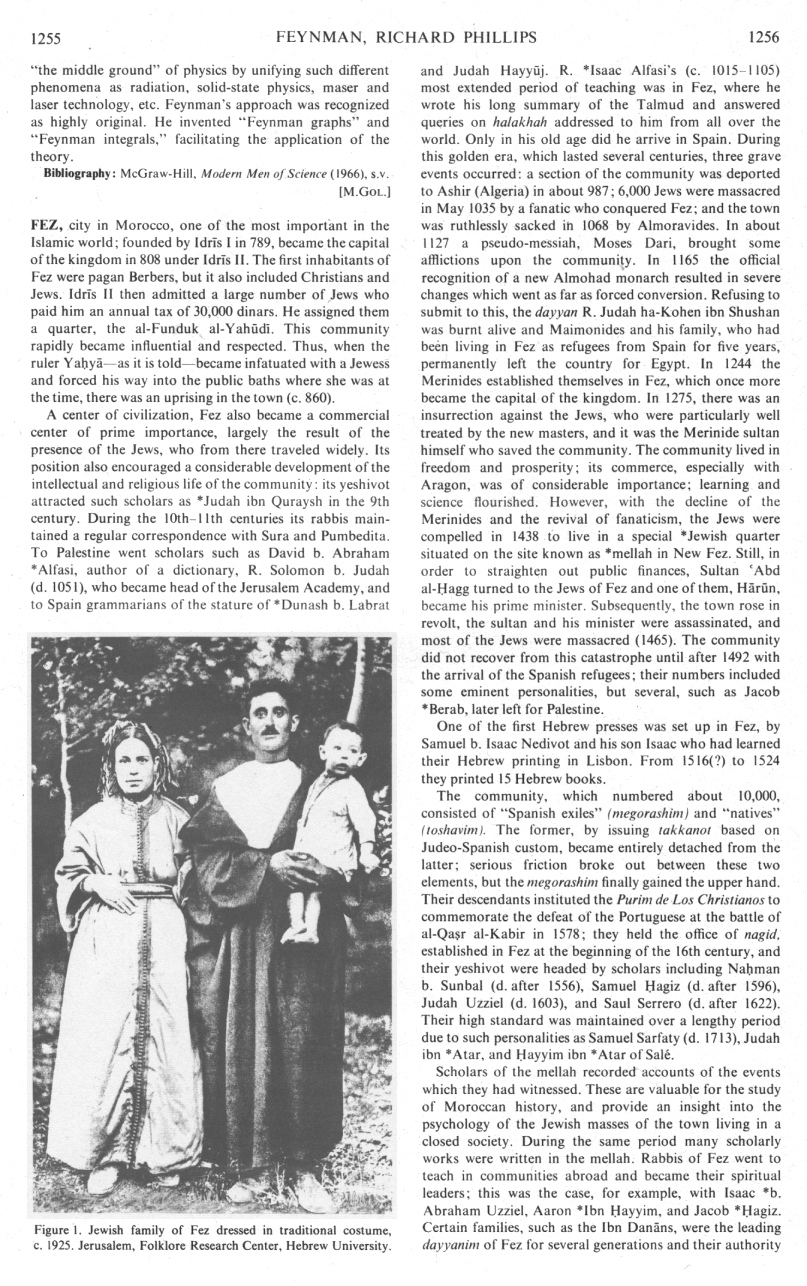
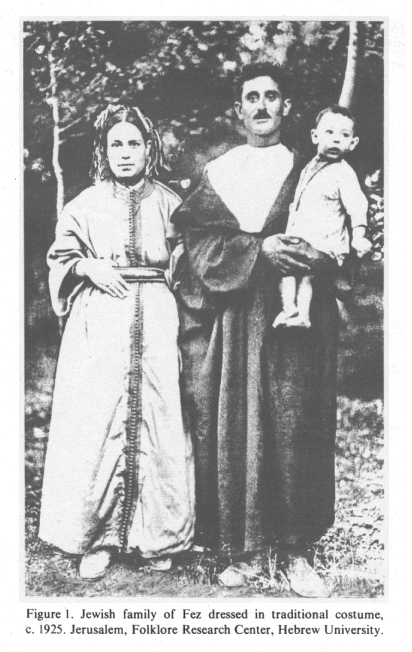
Encyclopaedia Judaica: Jews in Fez, vol.6, col.1255: Jewish family of Fez dressed in traditional costume,
c. 1925. Jerusalem, Folklore Research Center, Hebrew University
from: Fez; In: Encyclopaedia Judaica 1971, vol. 6
presented by Michael Palomino (2008)


| Share: |
Facebook |
|
Twitter
|
[Fez from the beginning with three religions - taxed Jews in a special quarter - ruler Yahya with a Jewess]
<FEZ,
city in Morocco, one of the most important in the Islamic world; founded by Idris I in 789, became the capital of the kingdom in 808 under Idris II. The first inhabitants of Fez were pagan Berbers, but it also included Christians and Jews. Idris II then admitted a large number of Jews who paid him an annual tax of 30,000 dinars. He assigned them a quarter, the al-Funduk al-Yahudi. This community rapidly became influential and respected. Thus, when the ruler Yahya - as it is told - became infatuated with a Jewess and forced his way into the public baths where she was at the time, there was an uprising in the town (c. 860).
[Fez: development of Jewish commerce, spiritual life and schools - scholars - "golden era" with three interruptions]
A center of civilization, Fez also became a commercial center of prime importance, largely the result of the presence of the Jews, who from there traveled widely. Its position also encouraged a considerable development of the intellectual and religious life of the community: its yeshivot [[religious Torah schools]] attracted such scholars as *Judah ibn Quraysh in the 9th century. During the 10th-11th centuries its rabbis maintained as regular correspondence with Sura and Pumbedita. To Palestine went scholars such as David b. Abraham *Alfasi, Author of a dictionary, R. Solomon b. Judah (d. 1051), who became head of the Jerusalem Academy, and to Spain grammarians of the stature of *Dunash b. Labrat (col. 1255)
and Judah Hayyuj. R. *Isaac Alfasi's (c. 1015-1105) most extended period of teaching was in Fez, where he wrote his long summary of the Talmud and answered queries on halakhah addressed to him from all over the world. Only in his old age did he arrive in Spain.
During this golden era, which lasted several centuries, three grave events occurred:
-- a section of the community was deported to Ashir (Algeria) in about 987;
-- 6,000 Jews were massacred in May 1035 by a fanatic who conquered Fez;
-- and the town was ruthlessly sacked in 1068 by Almoravides.
[1127 approx.: pseudo-messiah Moses Dari - 1165: severe changes with forced conversions - Jews on stake]
In about 1127 a pseudo-messiah, Moses Dari, brought some afflictions upon the community. In 1165 the official recognition of a new Almohad monarch resulted in severe changes which went as far as forced conversion. Refusing to submit to this, the dayyan [[judge]] R. Judah ha-Kohen ibn Shushan was burnt alive and Maimonides and his family, who had been living in Fez as refugees from Spain for five years, permanently left the country for Egypt.
[since 1244: protected Jews under the Merinides - growing commerce, schools, and science]
In 1244 the Merinides established themselves in Fez, which once more became the capital of the kingdom.
In 1275, there was an insurrection against the Jews, who were particularly well treated by the new masters, and it was the Merinide sultan himself who saved the community. The community lived in freedom and prosperity; its commerce, especially with Aragon, was of considerable importance; learning and science flourished.
[Decline of the Merinides - new Muslim fanaticism - Jewish quarter "mellah" since 1438 - mass revolt against Jewish prime minister and massacre on the Jews in 1465 - Jewish influx from Spain since 1492]
However, with the decline of the Merinides and the revival of fanaticism, the Jews were compelled in 1438 to live in a special *Jewish quarter situated on the site known as *mellah in New Fez. Still, in order to straighten out public finances, Sultan 'Abd al-Hagg turned to the Jews of Fez and one of them, Harun, became his prime minister. Subsequently, the town rose in revolt, the sultan and his minister were assassinated, and most of the Jews were massacred (1465). The community did not recover from this catastrophe until after 1492 with the arrival of the Spanish refugees; their numbers included some eminent personalities, but several, such as Jacob *Berab, later left for Palestine.
[Hebrew press]
One of the first Hebrew presses was set up in Fez, by Samuel b. Isaac Nedivot and his son Isaac who had learned their Hebrew printing in Lisbon. From 1516 (?) to 1524 they printed 15 Hebrew books.
[The Spanish Jewish immigrants become dominant in Fez: battle Purim against Portugal - nagid post - leading religious schools]
The community, which numbered about 10,000, consisted of "Spanish exiles" (megorashim) and "natives" (toshavim). The former, by issuing takkanot [[community constitution]] based on Judeo-Spanish custom, became entirely detached from the latter; serious friction broke out between these two elements, but the megorashim finally gained the upper hand. Their descendants instituted the Purim de Los Christianos [[Purim of the Christians]] to commemorate the defeat of the Portuguese at the battle of al-Qasr al-Kabir in 1578; they held the office nagid [[prince, leader]], established in Fez at the beginning of the 16th century, and their yeshivot [[religious Torah schools]] were headed by scholars including Nahman b. Sunbal (d. after 1556), Samuel Hagiz (d. after 1596), Judah Uzziel (d. 1603), and Saul Serrero (d. after 1622). Their high standard was maintained over a lengthy period due to such personalities as Samuel Sarfaty (d. 1713), Judah ibn *Atar, and Hayyim ibn *Atar of Salé.
[Reports about the Jewish quarter in Fez - rabbis traveling abroad - judges of Fez]
Scholars of the mellah [[Jewish quarter]] recorded accounts of the events which they had witnessed. These are valuable for the study of Moroccan history, and provide an insight into the psychology of the Jewish masses of the town living in a closed society. During the same period many scholarly works were written in the mellah.
Rabbis of Fez went to teach in communities abroad and became their spiritual leaders; this was the case, for example, with Isaac *b. Abraham Uzziel, Aaron *Ibn Hayyim, and Jacob *Hagiz. Certain families, such as the Ibn Danans, were the leading dayyanim [[judges]] of Fez for several generations and their authority (col. 1256)
was recognized by the Jews of the whole country.
[[...]]
[1550: short economic slow-down for Fez - the rich Jews go - the community in poverty - 1668: sultan Moulay Rashid transfers the Jewish community of Dila to Fez - Fez is center again]
A short while after its conquest by the Sa'di Sharifs (in 1550), Fez lost its political and economic importance. As a result, the Jewish community was deserted by its wealthiest and most influential elements and gradually fell into poverty. To secure Fez, where he was enthroned (in 1665), Moulay Rashid, the founder of the Alawite dynasty, entered the town by way of the mellah, where the Jews enabled him to spend the night. Having destroyed the bastion of the power of his enemies, the Zawiya of Dila, this sultan in 1668 transferred the rich Jewish community of Dila with all its belongings to Fez: these 1,300 families changed the composition of the mellah, which lost its Spanish character and became more prosperous.
[1720-1750: anarchy times - Jewish monopolies are held]
In the period of anarchy between 1720 and 1750, a few of them barely managed to obtain monopolies, e.g., over tobacco or the stamping of coins; many of them continued to practice such traditional crafts as goldsmithing, the manufacture of gold thread, lace making, embroidery, and tailoring. But the community mostly lived in a state of spiritual and intellectual seclusion.
[[...]]
[since 1753: the end of the leading role of Fez - calamity in Sefrou]
The preeminence of Fez only ended after the death of Jacob *Ibn Zur in 1753. Rabbis of Fez found refuge, whenever their communities were struck by a calamity, in the small town of Sefrou which was nearby Fez.
During the 18th and 19th centuries, rabbis of the Hota, Abitbol, and Elbaz families attracted many disciples from other parts of Morocco.
[[...]]
[1790: pogrom and plunder of the Jewish quarter - new begin since 1792 - bombs on New Fez in 1832]
In 1790 Moulay Yazid destroyed its synagogues, ordered the plunder of the mellah, and expelled its inhabitants. The return of the Jews was authorized in 1792 by Moulay Suleiman, but the mellah was reduced to a quarter of its former size. Moreover, the Udayas stationed in New Fez (Fezal-Jadid) persecuted the Jews; however, when these soldiers rebelled the sharif did not hesitate to bombard New Fez and defeated Udayas were dispersed (1832). In commemoration of this deliverance the community instituted the "Purim del Kor" ("of the cannonballs"), celebrated every year on Kislev 22.
[since 1832: consistent Jewish life in the Jewish quarter - French school since 1884 - pogrom of 1912 - development until Vichy - traditional occupations since 1947 only in metals and cereals]
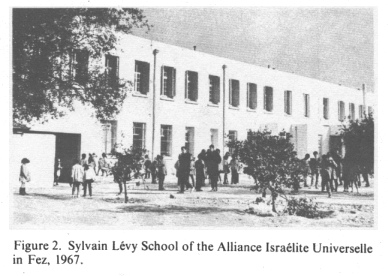
Life in the mellah improved and the interest in studies was reawakened by such remarkable men as Abner Sarfaty (d. 1884) and Isaac ibn Danan (d. 1900). The community possessed many schools, five yeshivot [[religious Torah schools]], and an important benevolent society. A French school, which received the financial support of the notables of the community, was founded in 1884 by the Alliance Israélite Universelle.
In 1912, two weeks after the establishment of the French Protectorate, a revolt broke out in Fez. The mellah with a population of 12,000 was completely ransacked and set on fire by the mob; about 60 persons lost their lives. Under the pretext of munitions smuggling, the French military authorities had previously confiscated all the weapons of the Jews, who were left defenseless. The Sharif received them within the precincts of the palace and ordered the distribution of food and clothes among them.
From 1925 (col. 1257)
many Jews established themselves in the new town of Fez, together with the Europeans; its was only the poor and some Orthodox families who remained in the mellah where in 1942 the Vichy laws sought to reintegrate all those who had left it.
In 1947 there were 22,484 Jews living in Fez and its surroundings. This population included several physicians, advocates, industrialists, and owners of agricultural estates. The traditional occupations disappeared with modernization and commerce came under Muslim domination, with the exception of the precious metals and cereals businesses in which the Jews retained the leading role.
[D. CO.]
Contemporary Period.
In 1951, 12,648 Jews, or 5.8% of Moroccan jewry, live din Fez. Unitl the community was dissolved, the town had many Jewish educational institutions run by the Alliance Israélite Universelle, by Ozar ha-Torah, which had 700 pupils in 1961, and Em ha-Banim. In 1961 these and other Jewish schools had a total of 2,823 pupils. Before the emigration in the 1950s and 1960s, there were also general Jewish organizations, such as the Zionist Benei Akiva, a Hovevei ha-Safah for the study of Hebrew, several social welfare organizations, branches of WIZO, and a branch of the World Jewish Congress. Most of the Jews who left Fez [[among them almost the whole young generation]] made their way to Israel; others went to France and Canada. In 1969 there were about 1,000 Jews in Fez.
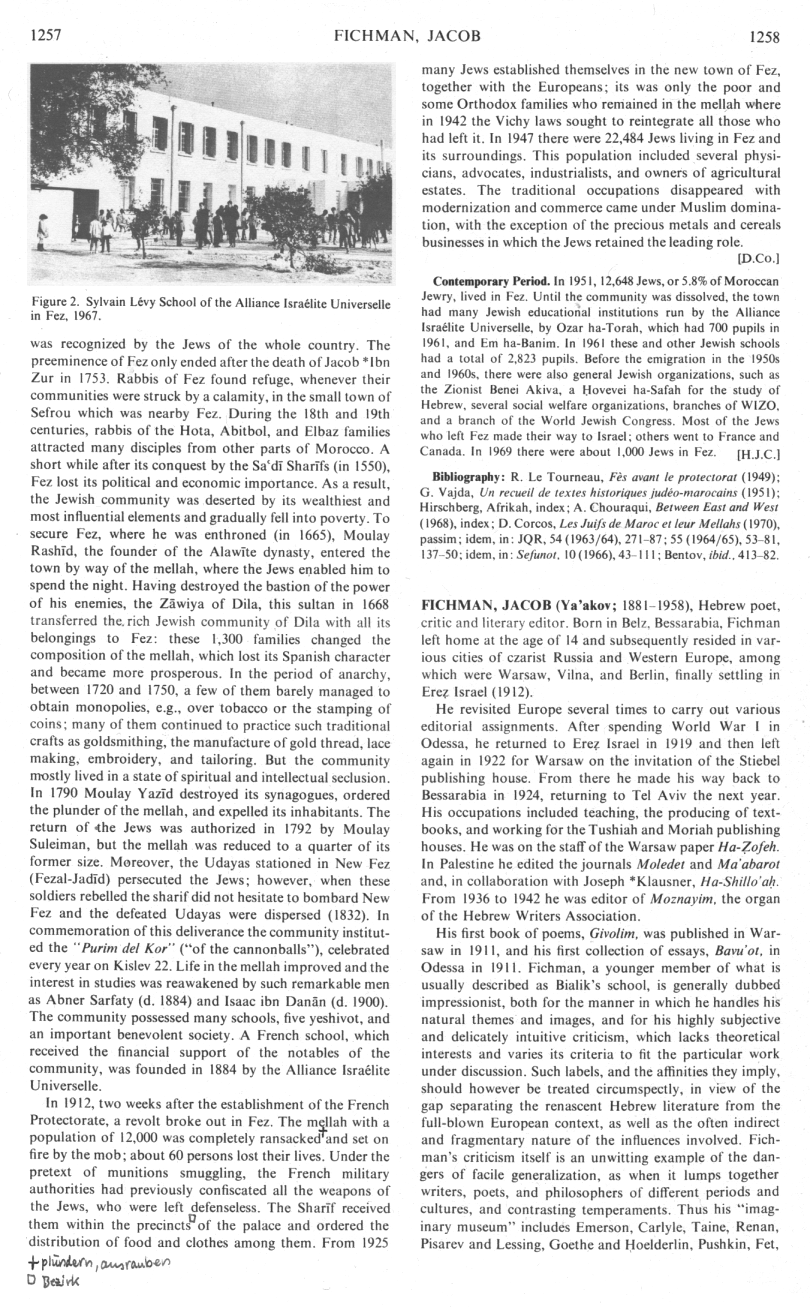
Encyclopaedia Judaica: Jews in Fez, vol.6, col. 1257: Sylvain Lévi School of the Alliance Israélite Universelle in Fez, 1967
[H.J.C.]
Bibliography: Fez
(from: Fez; In: Encyclopaedia Judaica 1971, vol. 6)
<-- R. Le Tourneau: Fès avant le protectorat (1949)
-- G. Vajda: Un recueil de textes historiques judéo-marocains (1951)
-- Hirschberg, Afrikah, index
-- A. Chouraqui: Between East and West (1968), index
-- D. Corcos: Les Juifs de Maroc et leur Mellahs (1970), passim
-- idem, in: JQR, 54 (1963/64), 271-87; 55 (1964/65), 53-81, 137-50
-- idem, in: Sefunot, 10 (1966), 43-111
-- Bentov, ibid, 413-82> (col. 1258)
Encyclopaedia Judaica 1971: Fez, sources
Encyclopaedia Judaica 1971: Fez, vol. 6, col. 1255-1256
Encyclopaedia Judaica 1971: Fez, vol. 6, col. 1257-1258
^