Encyclopaedia Judaica
Jews in Morocco 02: 581-1500 approx.
Visigoth persecution - tolerant or fanatic Muslim rules - Jewish refugees from Spain and Portugal - split Jewry
from: Morocco; In: Encyclopaedia Judaica 1971, vol. 12
presented by Michael Palomino (2008)


| Share: |
Facebook |
|
Twitter
|
[581-693: Visigoth persecution and expulsion of the Jews from Spain - tolerant Muslims - Muslim expansion to Spain]
<Between 581 and 693 many Jews were compelled to leave Spain as a result of the persecutions of the Visigoth kings who, while forcing them to accept baptism, also adopted draconian measures against them. According to later traditions, thousands of Spanish Jews had settled in Africa by 693. It is told that theses Jews, together with their Moroccan coreligionists, plotted to conquer or deliver Spain into the hands of the more tolerant Muslims (694).
Some historians maintain that there were Jews among the Berber-Muslim invaders of Spain in 711.
Arab Conquest and Rule.
[Good Jewish existence under the Idrisides]
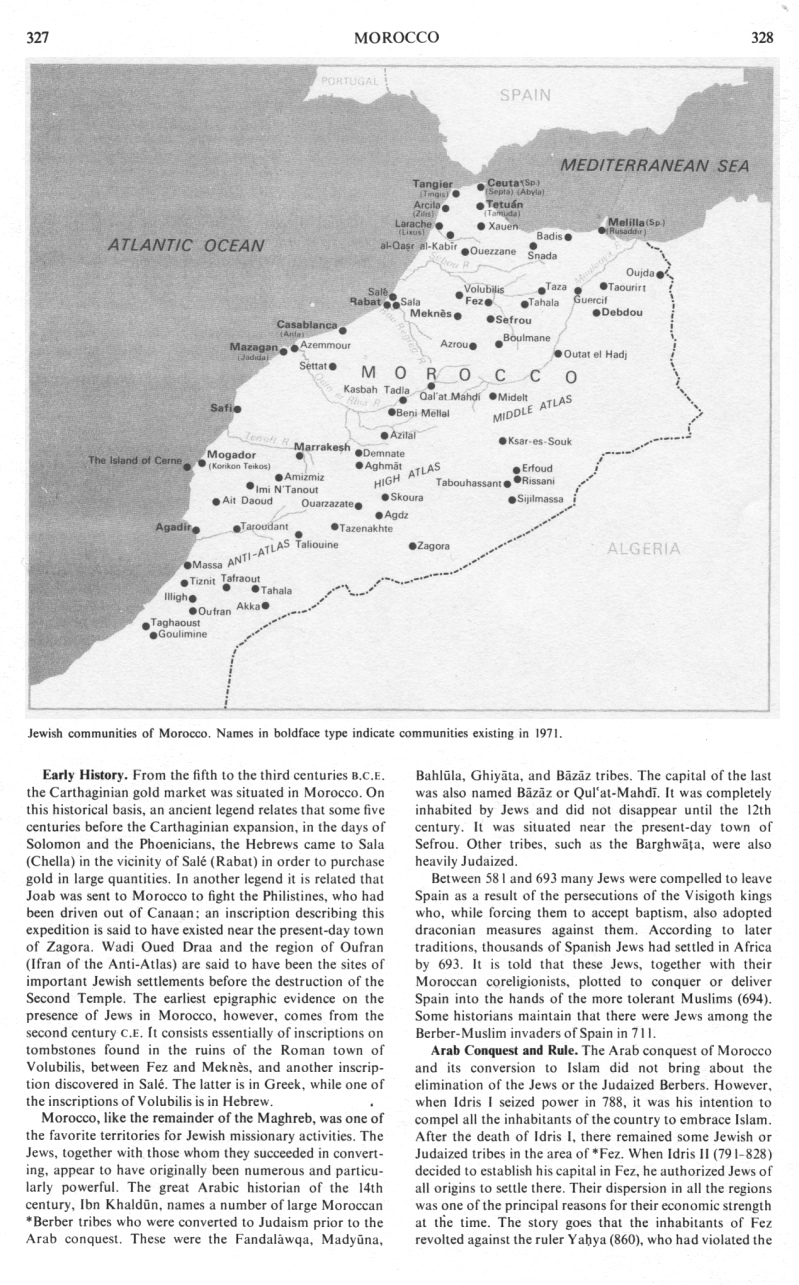
The Arab conquest of Morocco and its conversion to Islam did not bring about the elimination of the Jews or the Judaized Berbers. However, when Idris I seized power in 788, it was his intention to compel all the inhabitants of the country to embrace [[convert to]] Islam. After the death of Idris I, there remained some Jewish or Judaized tribes in the area of *Fez.
When Idris II (791-828) decided to establish his capital in Fez, he authorized Jews of all origins to settle there. Their dispersion in all the regions was one of the principal reasons for their economic strength at the time. The story goes that the inhabitants of Fez revolted against the ruler Yahya (860), who had violated the (col. 328)
chastity of a Jewish girl. The pogrom in Fez in 1033 is to be seen as an isolated event due to the Jewish support for the Maghrawas, the rivals of the Ifrenids. At a later date, the *Almoravides prohibited the Jews to live in their capital *Marrakesh.
THE ALMORAVIDES AND THE ALMOHADS.
The most brilliant period of the Jews of Morocco from the spiritual and intellectual point of view belongs to the reigns of the Idrisids and their successors. The numerous departures for Spain drained neither the strengths of Moroccan Jewry nor its intellectual activity. Even after the departure of R. Isaac *Alfasi from Fez for Cordoba (1088), Judaism in Morocco retained its vigor.
[Legal Judaism under the Almoravides and Jews in the government]
Under the Almoravides there was even a trend in the opposite direction. Two of the physicians of the Almoravide sovereigns, *Meir ibn Kamniel and Solomon Abuab Mu'allim in Marrakesh, were of Spanish origin, one from Seville and the other from Saragossa. Both were distinguished Torah scholars. There were also scholars in *Ceuta, the native town of Joseph ibn Aknin, the disciple of Maimonides. There was also an important center of learning in *Sijilmassa (ancient capital of Tafilalet oasis). Scholars were to be found in the Atlas region, in Aghmat; of these, there is information on the talmudist Zechariah b. Judah Aghmati. In Fez studies were carried on continuously; it was for this reason that *Maimonides and his family settled there after leaving Spain during the persecution of the Almohads.
[Persecution of the Jews under the Almohads: massacres - converted Jews - Jews at stake - sign (shikla) - Jewish exodus to Christian Spain and Majorca]
The doctrine of the mahdi Ibn Tumart, which inaugurated the *Almohad movement, did not tolerate the existence of non-Muslims. At the beginning, the latter were among the victims of the Almohad soldiers, who were highlanders in search of plunder. Indeed, many of the Jews were wealthy. By the time that Abd al-Mu'min (1128-63) had finally imposed Almohad domination in 1154, many Jews had already converted under the threat of the sword.
After that, there was a short period of improvement in the situation of the Jews in Fez. Those who had been spared from the massacres and the conversions were then able to resume a relatively normal life.
This situation changed with the advent of Abu Ya'qub Yusuf (1165-84). The recrudescence of fanaticism once more resulted in the forced conversion of Jews.
The dayyan [[religious judge]] of Fez, R. Judah ha-Kohen ibn Shushan, who refused to submit to this, was burnt alive, and at that time Maimonides left Morocco. The situation deteriorated even further under al-Mansur (1184-99) who imposed on the Jews, including those already converted, the wearing of a distinctive sign, the Shikla, because he did not believe in the sincerity of their conversion.
The presence of Jews was authorized once more by al-M'amun (1227-32), but their appearance drew the anger of the Muslims who massacred all of them in Marrakesh (1232).
The Jews did not return in considerable numbers until the time of the dynasty of the *Merinids, who replaced the Almohads in 1269. During Almohad rule many Moroccan Jews had left the country for the East, above all for Christian Spain. Large numbers of them settled in the territories of the kings of Aragon, in Catalonia and Majorca, where they were favorably received.
[[The prophet Muhammad never authorized the murder of non-Muslims. All persecution of non-Muslims is against Muhammad]].
THE MERINIDS AND THE WATTASIDS.
[Good Jewish existence under the Merinids - Sahara gold trade - trade with Christian countries]
The Merinids proved themselves particularly friendly toward the Jews. When the still-fanatic mobs attacked them in 1275, the Merinid sultan intervened personally to save them. The sovereigns of this dynasty benevolently received the Jewish ambassadors of the Christian kings of Spain and admitted Jews among their closest courtiers. Of these Jews, Khalifa b. Waqqasa (Ruqqasa) became steward of the household of the sultan Abu Ya'qub and his intimate counselor. A victim of palace intrigues, he was put to death in 1302.
His nephew, who was also named Khalifa, held the same office and suffered the same fate (1310). However, there were no repercussions against the Moroccan Jews as a result of the executions of their powerful coreligionists. They were the principal factors in the prosperity of the country.
The Sahara gold trade, which was of primary importance, and the exchanges with the Christian countries were completely under their control. Their relatives and (col. 330)
associates in the kingdom of Aragon financed, when necessary, the navies which defended the Moroccan ports. In addition to the *jizya (poll tax) they paid enormous sums to the treasury in customs duties for their imports and exports.
[Jews in the outlying areas of Morocco]
In the outlying areas, particularly in the Atlas region where there were large concentrations of Jews of early origin, the Jews wielded great influence in both the political and spiritual domains. Jewish physicians enjoyed well deserved renown. the study of Kabbalah, as well as philosophy, was then in vogue. The last Moroccan philosopher of the Middle Ages was Judah b. Nissim ibn *Malka, who was still alive in 1365.
[since 1391: No great Jewish influx from Spain - fanatic Muslim Marabout movement - persecution of the Jews - special Jewish quarter]
From 1375 the Muslim world of the West clearly entered into its period of decline. The Jews of Morocco were all the more affected by this development because, unlike in *Algeria, there was no revival due to the arrival of important Jewish personalities fleeing from the Spanish persecutions of 1391. The Jews who came to Morocco during this period were mainly of average erudition; moreover, just like their native brothers, they encountered the fanaticism which had been introduced among the Muslim masses by the mystics who had then founded the Marabout movement. This movement eroded the authority of the last Merinid sovereigns, and a serious deterioration in the condition of the Jews ensued.
In 1438 the Jews of Fez were enclosed within a special quarter (see *Jewish Quarters), the first Moroccan *mellah [[Jewish quarter]].
[1465: end of the Merinid dynasty - persecution and massacre on the Jews during the revolution - refuge in Spain - and return since 1492]
The political and economic situation in Morocco during the 15th century was bad. The sultan Abd al-Haqq turned to the Jews in order to straighten out his finances. He chose the Jew Aaron ben Battas as his prime minister, but a short while later the Merinid dynasty was ended (1465) with the assassination of its last representative and his Jewish minister. A large number of Jews lost their lives in this revolution, and many others were forcibly converted. They were authorized, however, to return to Judaism when (col. 331)
Muhammad al-Shaykh al-Wattasi came to power in 1471. According to local traditions, groups of Jews had in the meantime taken refuge in Spain. Among these were the family of the scholar and poet Saadiah *ibn Danan, who settled in Granada, as well as Hayyim *Gagin, who became the leader of the native Jews upon his return to Morocco in 1492.
[1492 and 1496: Sultan Muhammad al-Shaykh al-Wattasi welcomes the Jews from Spain and Portugal - plunderers on the road to Fez - camps around Fez - mass death of 20,000 Jews - remigration and emigration]
The Jewish chroniclers are unanimous in their description of the welcome accorded by the sultan Muhammad al-Shaykh al-Wattasi to the Spanish and Portuguese refugees (megorashim) in 1492 and 1496. Bands of plunderers, however, attacked the numerous Jews on the roads to Fez, the town to which they had been attracted. Once they arrived there, they found a lack of accommodations and they camped in the surrounding fields. About 20,000 of them died as a result of disasters, famine, and diseases.
Many of them returned to Spain. Under the influence of powerful religious personalities, the majority of them, both distinguished families and the common people, permanently settled in the country. Among this new population there were such eminent men as Jacob Qénizal, Abraham *Saba, Abraham of Toviutiel, Joshua *Corcos, Naham Sunbal, and others.
There was, however, also a trend for emigration to Italy, Turkey, and Palestine. Among those who left Morocco at that time were Abraham *Zacuto, Jacob (I) *Berab, *David ibn Abi Zimra, and Judah Hayyat.
[Spanish and Portuguese Jews take the lead in the Moroccan south - are hindered in the Moroccan north by the Jews there - Fez as spiritual Jewish center for the Jewish refugees from Spain (megorashim) - split of Jewry in Morocco for 450 years - Hakétia language]
The newcomers were generally ill received by their native coreligionists (toshavim). In spite of the fact that the megorashim [[refugees from Spain and Portugal]] rapidly assumed the leadership in southern communities, such a possibility was for a long time withheld from them in the north. The toshavim [[coreligionists]] feared their commercial rivalry and their technical superiority. Controversies broke out between the two elements. The former went so far as to question the faith of the megorashim. The latter, however, succeeded in strengthening their position and in due course dominated all the communities where they were represented.
Fez became their spiritual center. Their rabbis issued a large number of takkanot [[takkanah: legislative enactment]] which were known by the name of "takkanot of the exiles of Castile". These dealt essentially with the laws of marriage, divorce, and inheritance and were based on Spanish tradition. For 450 years they separated themselves in this manner from the toshavim [[coreligionists]].
The descendants of the megorashim [[refugees]] jealously adhered to their ways and customs. They worshiped in their own synagogues and sometimes had their own lots in the cemeteries. In such northern communities as Tetuán and tangier the native Jews were completely assimilated among the descendants of the megorashim. Oblivious to their own origin, they disdainfully referred to their brothers of the interior as Forasteros ("aliens", i.e., to the Castilian community).
Until recently, most of these communities spoke Hakétia, a mixture of Spanish, Hebrew, and an Arabic dialect. The ancient Castilian language, which differs from the Ladino spoken in the Orient, was, until the 19th (col. 332)
century, in current usage among a large number of families of Spanish origin in both the north and south of the country.> (col. 333)
Sources
Encyclopaedia Judaica 1971: Morocco, vol. 12, col. 327-328
Encyclopaedia Judaica 1971: Morocco, vol. 12, col. 329-330
Encyclopaedia Judaica 1971: Morocco, vol. 12, col. 331-332
Encyclopaedia Judaica 1971: Morocco, vol. 12, col. 333-334