Encyclopaedia Judaica
Jews in Morocco 07: Alawid rule confronted by Christian pressure
Jews in the government - Spanish-Moroccan war - Jews blamed for their influence by Muslim masses - safe time 1873-1900 - migration into cities with overcrowded Jewish quarters
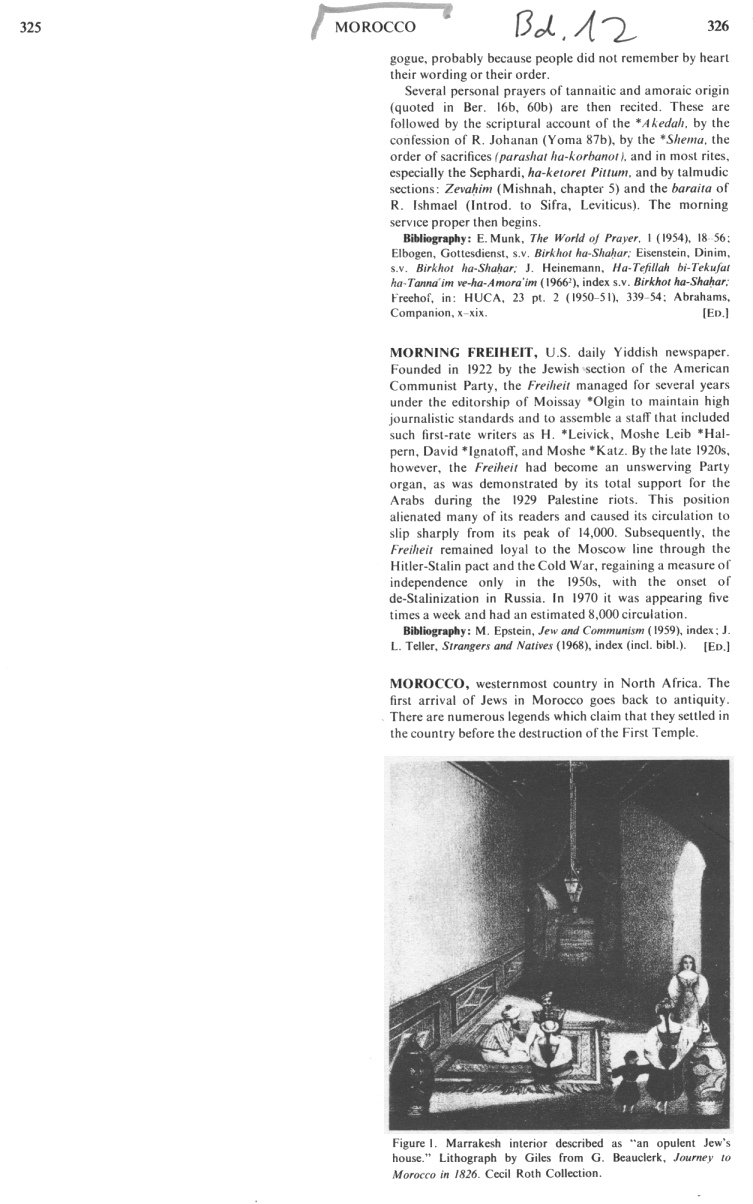
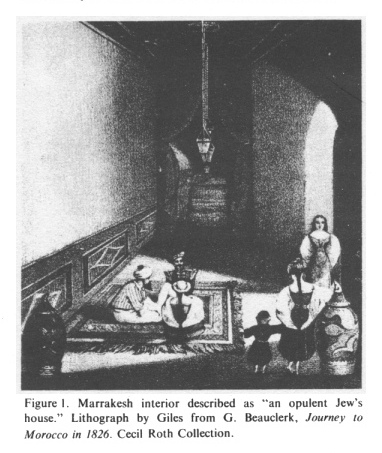
Encyclopaedia Judaica: Jews in Morocco, vol.12, col. 326: Jewish house in Marrakesh in 1826: Marrakesh interior described
as "an opulent Jew's house." Lithograph by Giles from G. Beauclerk, Journey to Morocco in 1826. Cecil Roth Collection
from: Morocco; In: Encyclopaedia Judaica 1971, vol. 12
presented by Michael Palomino (2008)


| Share: |
Facebook |
|
Twitter
|
[since 1822: Christian pressure on Morocco - Jews active in economy and diplomacy - 1860: Spanish-Moroccan war - Jewish emigration wave - exit tax]
[[...]] BEGINNINGS OF EUROPEAN INTERVENTION. [[...]]
The reigns of Mulay Abd al-Rahman (1822-59) and his successors Mulay Muhammad b. Abd al-Rahman (1859-73) and Mulay al-Hasan (1873-94) were marked by the pressure of the Christian powers on Morocco and an increased activity of the Jews in the economic and diplomatic fields. Meyer *Macnin was appointed ambassador in London (1827); Judah *Benoliel, consul in Gibraltar, successfully negotiated several treaties; Abraham *Corcos and Moses Aflalo were entrusted with several delicate missions; many other Jews, such as the families of *Altaras, *Benchimol, and *Abensur, played important roles in Moroccan affairs.
Until 1875 consular representation in the Moroccan towns was almost entirely assumed by Jewish merchants, and many of them held such functions into the 20th century. The European powers, concerned with their economic interests, granted protection to a large number of Jews. By often exploiting the defense of their protégés as a pretext, they interfered with the internal affairs of Morocco.
A Jewish consular agent, Victor *Darmon, was summarily executed on a trumped-up charge (1844). This became one of the causes of the Spanish-Moroccan War of 1860, when Jews were compelled to take refuge in Gibraltar, while those of Tetuán were the victims of a pogrom. Tangier and Mogador were bombarded by the French fleet. In Mogador the Jews, assailed by the tribes who came to plunder the town, defended themselves by force of arms. In Tangier, which only suffered some material damage, the Jews celebrated with a Purim (Purim de las bombas [[Purim of the bombs]]).
Emigration nevertheless rose and the sultan reintroduced the exit tax which was to be paid by every individual who left the country. However, those who desired to settle in the Holy Land were exempted from this tax (1858). A number of families, many of them wealthy, then established themselves in Palestine.
[Fanatic Moroccan Muslims attack the Jews blaming them for the European influence in Morocco - pro-Jewish decree is not respected]
The Moroccan people, already fanaticized by the French conquest of Algeria, accused the Jews of being the agents of European influence in Morocco. In some of the regions populated by the Berbers, the situation of the Jews became quite precarious. Measures which even went beyond the restrictions of Muslim law were imposed against the Jewish masses of the interior, which were more vulnerable than those living along the coasts: Jews were often sentenced to bastinado [[beats on the sole of the feet]] for trifling reasons.
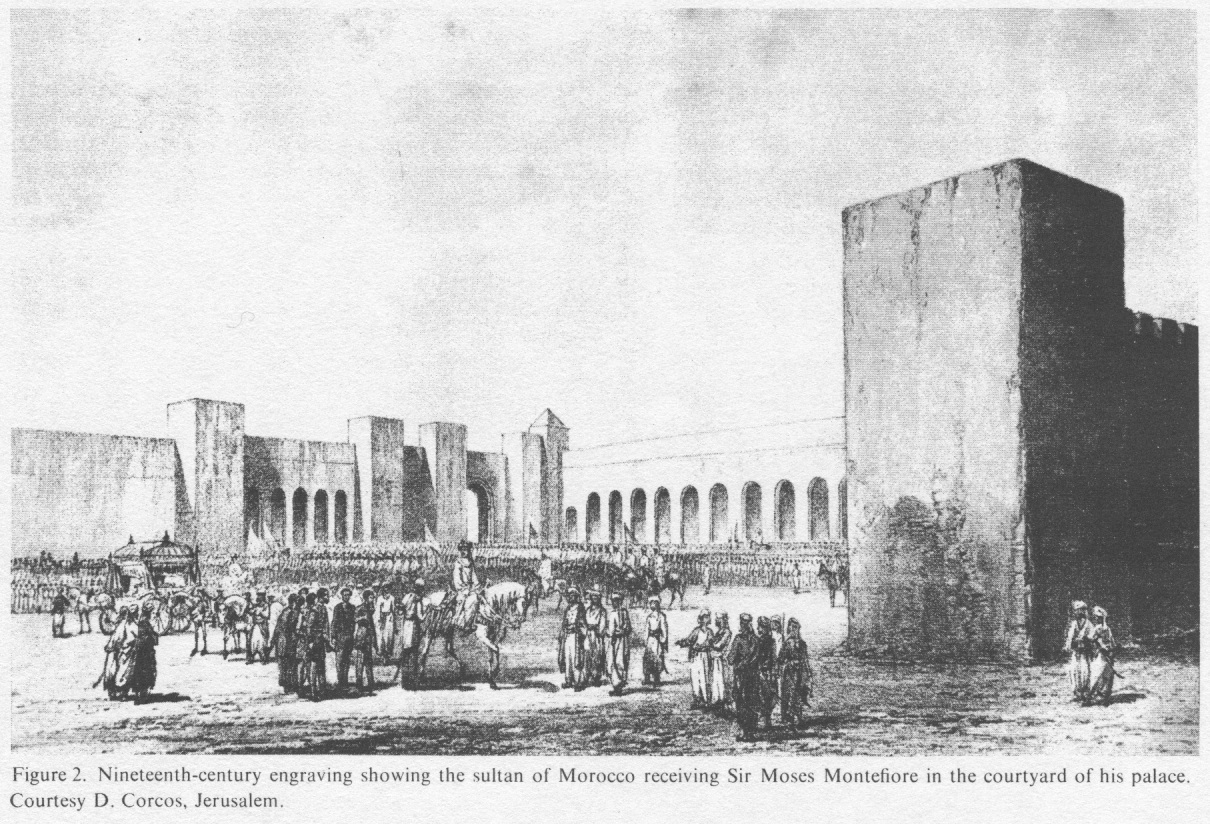
This situation prompted a visit by Sir Moses Montefiore to the court of Mulay Muhammad in Marrakesh; the later promulgated a dahir ("royal decree"; February 1864) which was marked by extreme benevolence toward the Jews and granted them equality of rights with all Moroccans. Nevertheless, this decree was never respected by the qa'ids and pashas.
Encyclopaedia Judaica: Jews in Morocco, vol.12, col. 329-330: Moses Montefiore visiting Sultan of Morocco: Nineteenth-century engraving
showing the sultan of Morocco receiving Sir Moses Montefiore in the courtyard of his palace. Courtesy D. Corcos, Jerusalem
An energetic protest was then made by the consul general of the United States and other powers intervened on behalf of the Jews. France reinforced the system of consular protection and the other nations followed in her wake. (col. 339)
[Safe time for Jews in Morocco 1873-1900 - 200,000-400,000 Jews in Morocco - scholars - dispute about secular schools for Jews - overcrowded Jewish quarters by migration into cities]
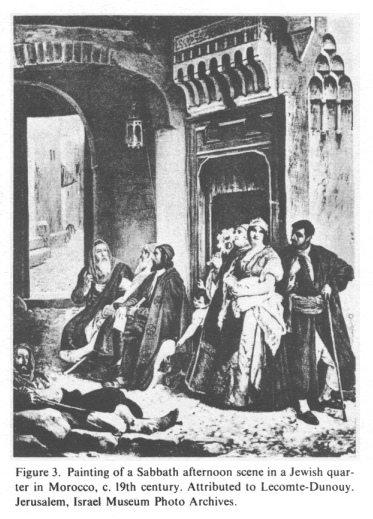
Encyclopaedia Judaica: Jews in Morocco, vol.12, col.331: Sabbat in 19th century: Painting of a Sabbath afternoon scene in a
Jewish quarter in Morocco, c. 19th century. Attibuted to Lecomte-Dunouy. Jerusalem, Israel Museum Photo Archives.
During the reign of Mulay al-Hasan [[1873-1894]] and at the beginning of that of Mulay Abd al-Aziz (1894-1908), the Jews lived in tranquility. Mulay al-Hasan held a positive attitude toward his Jewish subjects, receiving their deepest respect in return. Upon the death of the sultan, the chamberlain (vizier) Ba Ahmad treated the Jews with justice and fairness.
During the 19th century Moroccan Jewry, whose number has been variously evaluated as being between 200,000 and 400,000, produced many renowned rabbis, poets, and talmudists, as well as a number of legal authorities whose works continued to serve as the basis for the justice dispensed by Jewish tribunals under the French Protectorate. These scholars included R. Abraham *Coriat and R. Mas'ud Knafo of Mogador, R. Mas'ud Ben-Moha and R. Mordecai Serfaty of Marrakesh, R. Joseph *Elmaleh of Rabat, R. Raphael Encaoua of Salé, R. Vidal Serfaty of Fez, R. Isaac Ben-Walid of Tetuán , and R. Mordecai Bengio of Tangier.
Many of these leaders realized the importance of secular studies for the masses and they assisted the *Alliance Israélite Universelle of Paris in founding its first schools in Tetuán in 1862, in Tangier in 1865, in Mogador in 1867, and in other Moroccan towns from 1874. In contrast, other rabbis violently opposed the establishment of these schools, which they foresaw, quite correctly, would encourage an estrangement from Judaism.
[[...]]
During the entire second half of the 19th century thousands of impoverished Jews swelled the Jewish populations of the large urban centers. The overcrowding of the Jewish quarters became indescribable.
[[...]]
[1900: epidemic - anarchy in Morocco and restrictions for the Jews - migration into cities without adaption to the town life and catastrophe in the Jewish quarters]
Upon the death of Ba Ahmad (1900) an epidemic of plague ravaged Morocco. In the mellah [[Jewish quarter]] of Fez alone, there were more than 3,000 victims; the country then entered a period of anarchy during which the Jewish population suffered greatly.
[[...]]
This exodus [[the migration into cities]] went on uninterruptedly into the 20th century. *Casablanca, which underwent a tremendous expansion, was its final halting place. The misery which prevailed in the Jewish quarters and which was partly due to the inability of the ex-villagers to adapt themselves to urban life, became one of the social stains of Morocco. (col. 340)
Sources
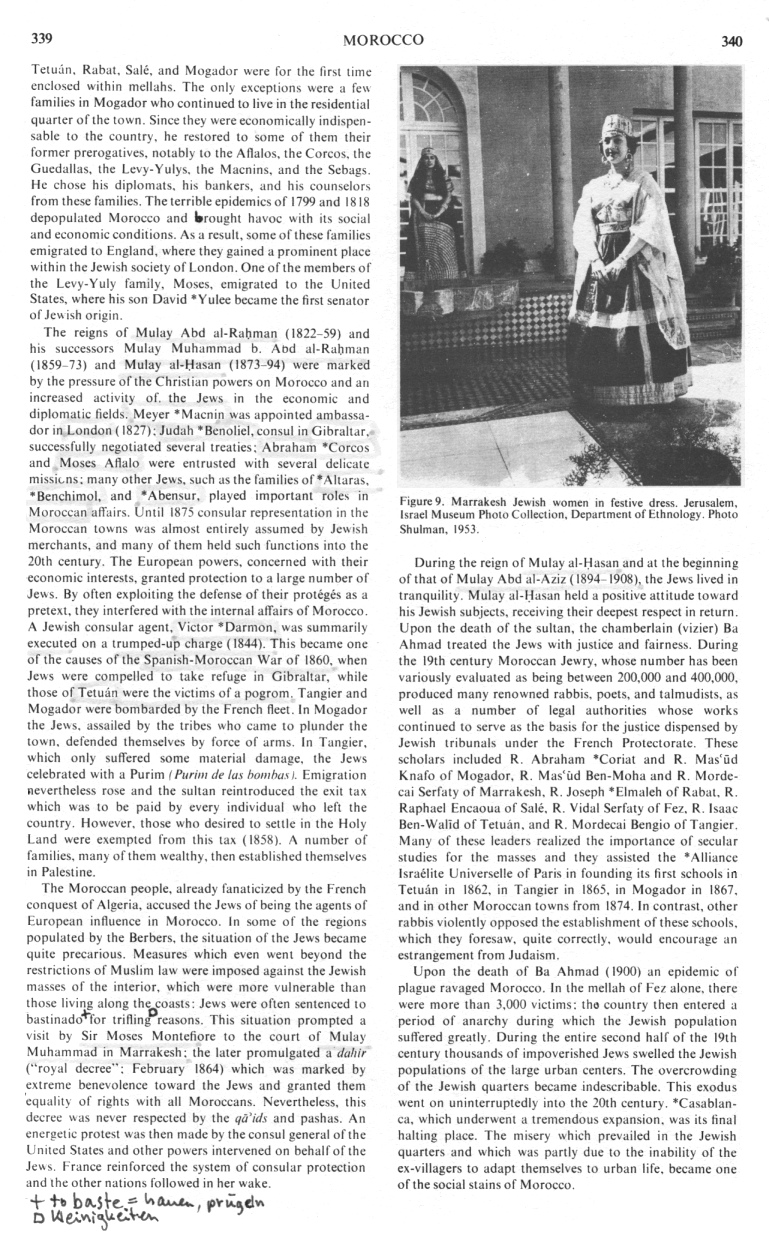
Encyclopaedia Judaica 1971: Morocco, vol. 12, col. 326
Encyclopaedia Judaica 1971: Morocco, vol. 12, col. 339-340
Encyclopaedia Judaica 1971: Morocco, vol. 12, col. 341-342
Encyclopaedia Judaica 1971: Morocco, vol. 12, col. 343-344
^