Encyclopaedia Judaica
Jews in South Africa 10: Relations with racist Herzl Free Mason anti-Muslim CIA Israel
Congratulations 1948 - economic relationship - apartheid questions - Jewish racism not mentioned
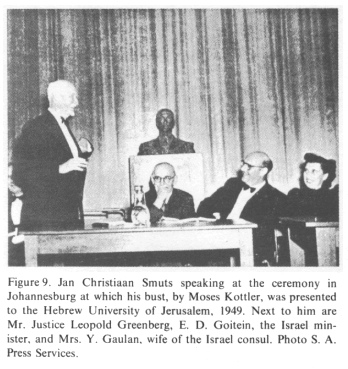
Encyclopaedia Judaica (1971): Jews in South Africa, vol. 15, col. 205: Jan Christiaan Smuts presenting his bust for Hebrew University of Jerusalem,
1949, made by Moses Kottler, presented to Mr. Justice Leopold Greenberg, E.D. Goitein, the Israel minister, and
Mrs. Y. Gaulan, wife of the Israel consul. Photo: S.A. Press Services
from: South Africa; In: Encyclopaedia Judaica 1971, vol. 15
presented by Michael Palomino (2008)


| Share: |
Facebook |
|
Twitter
|
<Relations with Israel.
[South Africa's sympathy for Herzl Free Mason CIA Israel - state visit in 1952]
South Africa's official relations with Israel were founded, significantly, in a month decisive for the destinies of both people, May 1948. Chaim Weizmann, describing May 15, the day after the establishment of the State of Israel, wrote:
"I bethought myself of one surviving author of the Balfour Declaration and addressed a cable to General Smuts. This was closely followed by South African recognition (of Israel)" (Trial and Error, p. 585). In the same month, however, Smuts and his United Party were defeated in the South African elections and succeeded by Malan's Nationalist Party. Smuts had had a long-standing familiarity with Zionism, whereas the new government was less involved with the story of Zionism and the cause of Jewish statehood. The Smuts administration had steadfastly supported the Zionist cause in international forums and was among the governments which had voted in the United Nations for the partition of Palestine on Nov. 29, 1947. Under the Nationalists, South Africa continued to support Israel, voted for its admission to the United Nations in 1949, and backed it on a number of subsequent issues in that forum.
South Africa's recognition of Israel was followed by the establishment of an Israel consulate-general in Johannesburg and an Israel legation in Pretoria. Out of consideration for its economic interests and ties with the Arab States, however, South Africa was for long reluctant to establish any diplomatic mission in Israel. nevertheless, Prime Minister Malan made a personal visit to Israel in 1952. (col. 206)
[Economic relationship]
Israel's relations with South Africa have to a large degree been a function of the intimate ties that connect South African Jewry with Israel. This factor was also the impetus behind the air links of Israel's airline, El Al, with South Africa. This air traffic is effectively one-sided (South African Airways does not fly on Israel routes), serving mainly Jewish tourists to Israel, which in 1969 represented 2.4% of Israel's total tourist traffic. The closure of the Suez Canal to Israel and Israel-bound shipping inhibited economic relations between the two countries until the opening of the Straits of Tiran after the Sinai Campaign (1956) and the consequent development of the port of Eilat. Since then trade between the two countries has risen steadily, reaching in 1970 a total of $19 million. Israel exports to South Africa, mainly of manufactured goods, amounted in 1970 to $9,400,000, as against imports from South Africa of $9,600,000 (exclusive of diamonds).
[Herzl Israel officially states against apartheid - the own apartheid against Arabs is not mentioned]
While Israel-South African relations are based on the two pillars of Jewry and trade, difficulties were experienced on the international level. The growing concern of the international community over South Africa's racial policies and the doctrine of apartheid did not leave Israel-South African relations untouched. Israel, whose policies are opposed to racialism in any form
[[this is a big lie: Herzl Israel bases on racism and hatred against any Arab, which is an apartheid against Arabs. Herzl Israel was also working with Ethiopia against Eritrea etc.]]
took a consistent stand against apartheid and found itself aligned in the United Nations and other bodies with those countries voting against South Africa on the principle and practice of apartheid. Israel and South Africa have also taken opposite views on such issues as South-West Africa, Rhodesia, and the Portuguese colonies in Africa. This development must also be viewed against the background of Israel's close ties with most of the countries of Africa, which belong to the "Third World". From 1963, in response to a United Nations' resolution, Israel's representation in South Africa was at the level of a chargé d'affaires at the head of its legation.
These developments have somewhat affected South African Jewry and made some of its members apprehensive about the impact of Israel's voting record on the position of their community. On the other hand, Israel remains sensitive to the possible influence of its policies in the international area upon the South African Jewish community. As long as the policies of the two countries have diverged on such issues as apartheid and colonialism and on the role of the independent states of Africa, the relations between them have remained at a muted level. This has not, however, impeded the development of certain practical aspects, such as trade and tourism.
[ED.]> (col. 207)
Sources
Encyclopaedia Judaica 1971: South Africa, vol. 15, col. 183-184
Encyclopaedia Judaica 1971: South Africa, vol. 15, col. 185-186
Encyclopaedia Judaica 1971: South Africa, vol. 15, col. 187-188
Encyclopaedia Judaica 1971: South Africa, vol. 15, col. 189-190
Encyclopaedia Judaica 1971: South Africa, vol. 15, col. 191-192
Encyclopaedia Judaica 1971: South Africa, vol. 15, col. 193-194
Encyclopaedia Judaica 1971: South Africa, vol. 15, col. 195-196
Encyclopaedia Judaica 1971: South Africa, vol. 15, col. 197-198
Encyclopaedia Judaica 1971: South Africa, vol. 15, col. 199-200
Encyclopaedia Judaica 1971: South Africa, vol. 15, col. 201-202
Encyclopaedia Judaica 1971: South Africa, vol. 15, col. 203-204
Encyclopaedia Judaica 1971: South Africa, vol. 15, col. 205-206
Encyclopaedia Judaica 1971: South Africa, vol. 15, col. 207-208
<< >>
^


