Encyclopaedia Judaica
Jews in the "USA" 03: 1860-1880
Jews in the armies of Civil War 1861-1865 - anti-Semitic agitation during Civil War - German Jewry and reform Judaism since 1865 - immigration - careers - anti-Semitism 1865-1880 - community life - writing
from: Encyclopaedia Judaica (1971): USA; vol. 15
presented by Michael Palomino (2008)


| Teilen / share: |
Facebook |
|
Twitter
|
<THE CIVIL WAR. [[1861-1865]]
[Jews in the Northern and in the Southern army - Jewish German-born soldiers - Jewish chaplains since 1862]
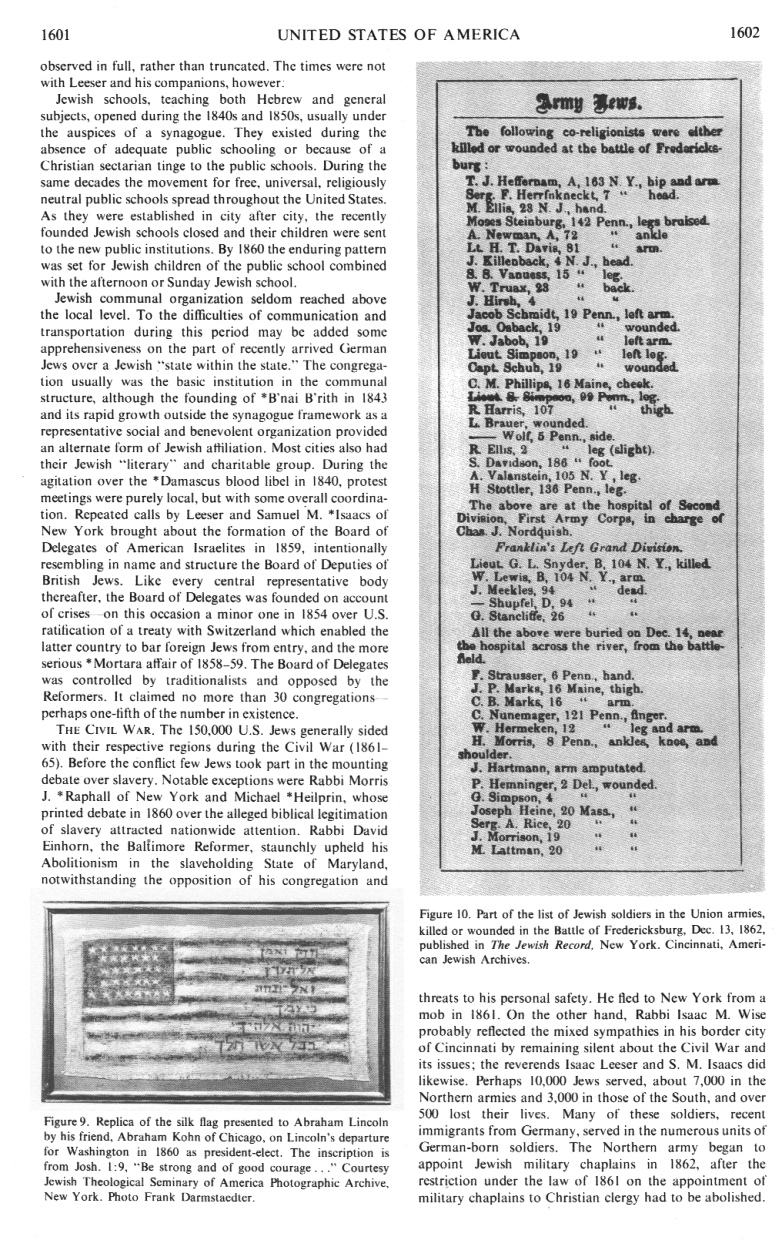
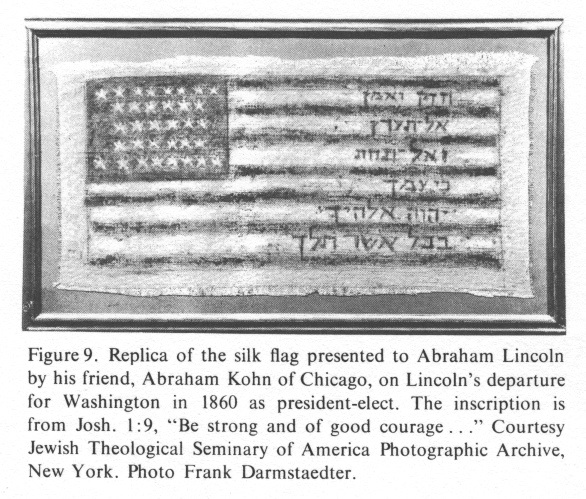
Encyclopaedia Judaica (1971): "USA", vol. 15, col. 1601: Replica of the silk flag presented to Abraham Lincoln by his friend, Abraham Kohn of Chicago, on Lincoln's departure for Washington in 1860 as president-elect. The inscription is from Josh. 1:9, "Be strong and of good courage ..." Courtesy Jewish Theological Seminary of America Photographic Archive, New York. Photo Frank Darmstaedter
The 150,000 U.S. Jews generally sided with their respective regions during the Civil War (1861-65). Before the conflict few Jews took part in the mounting debate over slavery. Notable exceptions were Rabbi Morris J. *Raphall of New York and Michael *Heilprin, whose printed debate in 1860 over the alleged biblical legitimation of slavery attracted nationwide attention. Rabbi David Einhorn, the Baltimore Reformer, staunchly upheld his Abolitionism in the slaveholding State of Maryland, notwithstanding the opposition of his congregation and (col. 1601)
threats to his personal safety. He fled to New York from a mob in 1861. On the other hand, Rabbi Isaac M. Wise probably reflected the mixed sympathies in his border city of Cincinnati by remaining silent about the Civil War and its issues; the reverends Isaac Leeser and S.M. Isaacs did likewise. Perhaps 10,000 Jews served, about 7,000 in the Northern armies and 3,000 in those of the South, and over 500 lost their lives.
Many of these soldiers, recent immigrants from Germany, served in the numerous units of German-born soldiers. The Northern army began to appoint Jewish military chaplains in 1862, after the restriction under the law of 1861 on the appointment of military chaplains to Christian clergy had to be abolished. (col. 1602)
[[Every war needs it's bankers financing the war, and it can be admitted that also Jewish bankers were financing the war and by this financed the death of over 500 Jews. It was a "Christian" Jewish war game on foreign soil. The natives were never asked but driven away, shoot or put into concentration camps]].
Encyclopaedia Judaica (1971): "USA", vol. 15, col. 1602: Part of the list of Jewish soldiers in the Union armies, killed or wounded in the Battle of Fredericksburg, Dec. 13, 1862, published in "The Jewish Record", New York. Cincinnati, American Jewish Archives.
"Army News.
The following co-religionists were either killed or wounded at the battle of Fredericksburg:
T.J. Heffernam, A, 163 N.Y., hip and arm
Serg. F. Herrfnkneckt, 7 " head
M. Ellis, 23 N.J., hand
Moses Steinburg, 142 Penn., legs bruised
A. Newman, A, 72 " ankle
Lt H.T. Davis, 81 " arm
J. Killenback, 4 N.J., head
S.S. Vanuess, 15 " leg
W. Truax, 23 " back
J. Hirsh, 4 " back
Jacob SSchmidt, 19 Penn., left arm
Jos. Osback, 19 " wounded
W. Jabob, 19 " left arm
Lieut. Simpson, 19 " left leg
Capt. Schuh, 19 " wounded
C.M. Phillips, 16 Maine, cheek.
Lieut. S. Simpson, 99 Penn., leg
R. Harris, 107 " thigh
L. Brauer, wounded
- Wolf, 5 Penn., side
R. Ellis, 2 " leg (slight)
S. Davidson, 186 " foot
A. Valanstein, 105 N.Y., leg
H. Stottler, 136 Penn., leg.
The above are at the hospital of Second Division, First Armyy Corps, in charge of Chas. J. Nordquish.
xxxxxxxxxxxxxxxxxxxxxxxxxxxxxxxxxxxxxxxxxx
Franklin's Left Grand Division.
Lieut. G.L. Snyder, B, 104 N.Y., killed
W. Lewis, B, 104 N.Y., arm
J. Meekles, 94 " dead
Shupfel, D, 94 " "
G. Stancliffe, 26 " "
All the above were buried on Dec. 14, near the hospital across the river, from the battlefield.
F. Strausser, 6 Penn., hand
J.P. Marks, 16 Maine, thigh
C.B. Marks, 16 " arm
C. Nunemager, 121 Penn., finger
W. Hermeken, 12 " leg and arm
H. Morris, 8 Penn., ankles, knee, and shoulder
J. Hartmann, arm amputated
P. Hemninger, 2 Del., wounded
G. Simpson, 4 " "
Joseph Heine, 20 Mass., "
Serg. A. Rice, 20 " "
J. Morrison, 19 " "
M. Lattman, 20 " "
xxxxxxxxxxxxxxxxxxxxxxxxxxxxxxxxxxxxxxxxxxx
[Anti-Semitic agitation during Civil War - stopped by the Jewish President Abraham Lincoln]
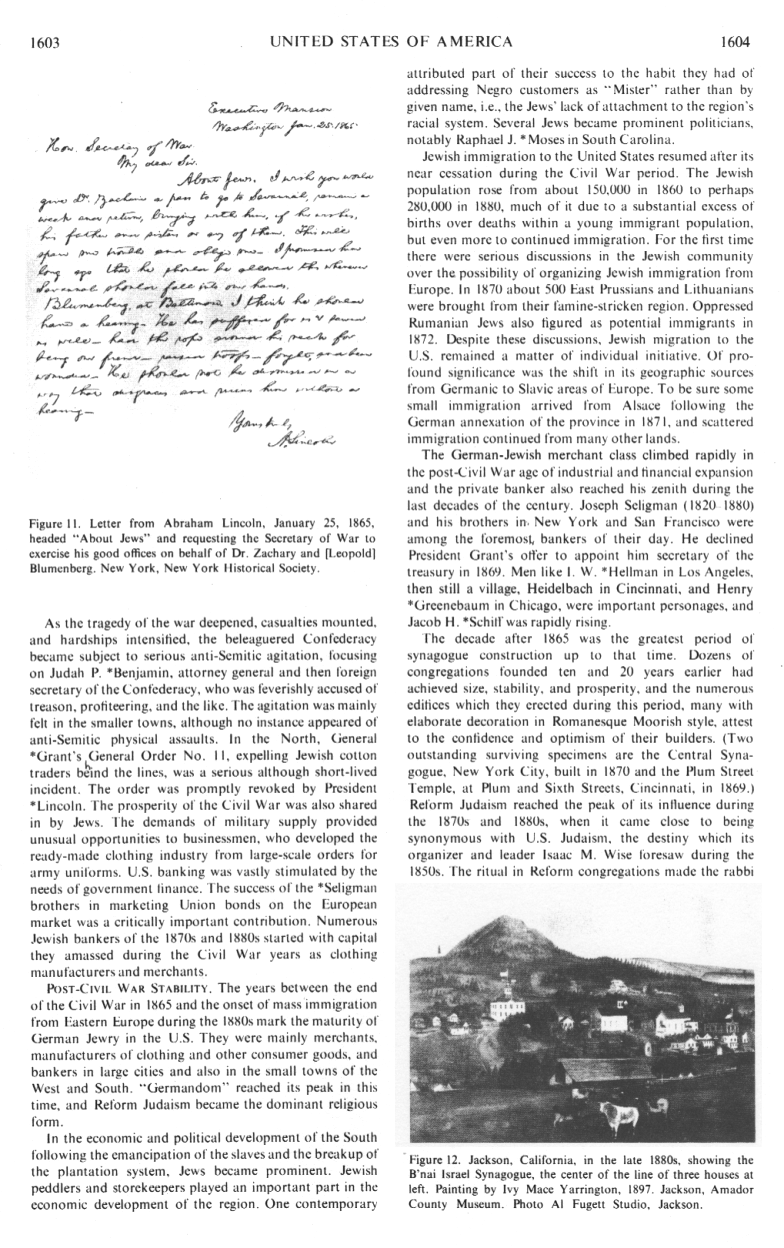
As the tragedy of the war deepened, casualties mounted, and hardships intensified, the beleaguered Confederacy became subject to serious anti-Semitic agitation, focusing on Judah P. *Benjamin, attorney general and then foreign secretary of the Confederacy, who was feverishly accused of treason, profiteering, and the like. The agitation was mainly felt in the smaller towns, although no instance appeared of anti-Semitic physical assaults. In the North, General *Grant's General Order No. 11, expelling Jewish cotton traders behind the lines, was a serious although short-lived incident. The order was promptly revoked by President *Lincoln.> (col. 1603)
[[Details]]:
<The first substantial and (col. 1648)
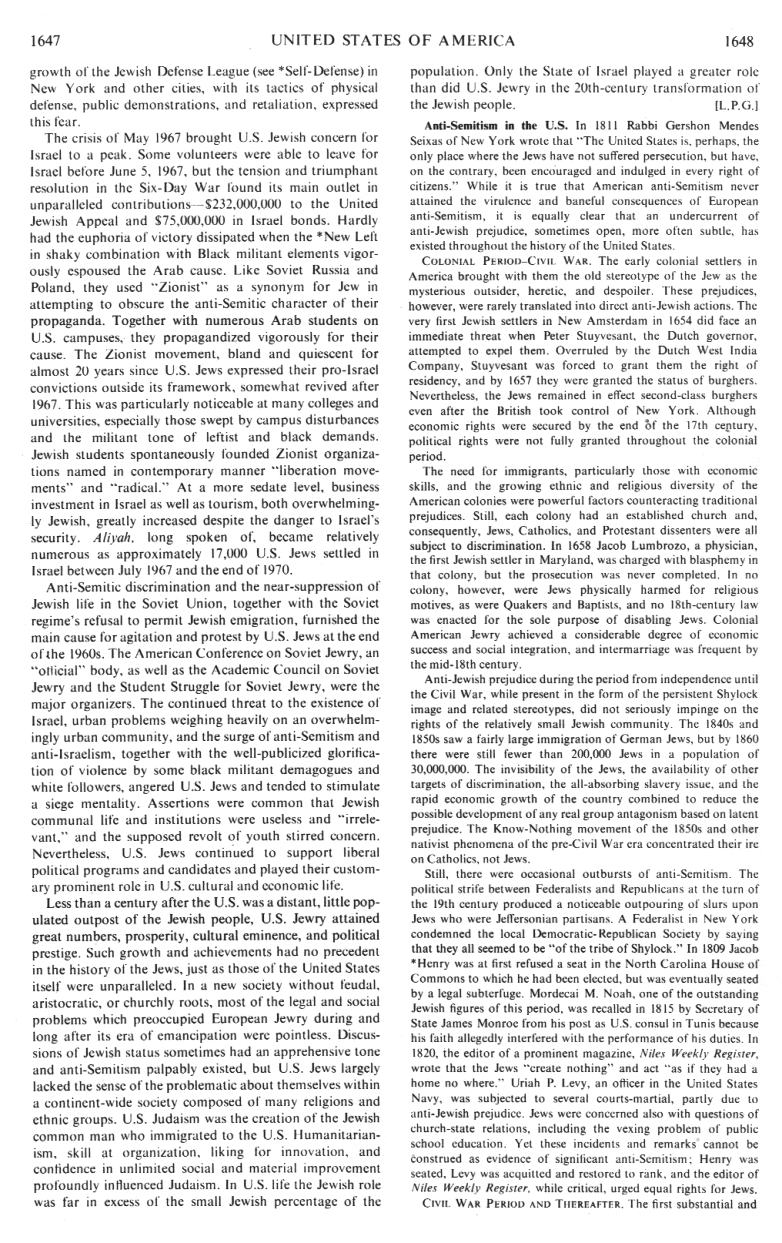
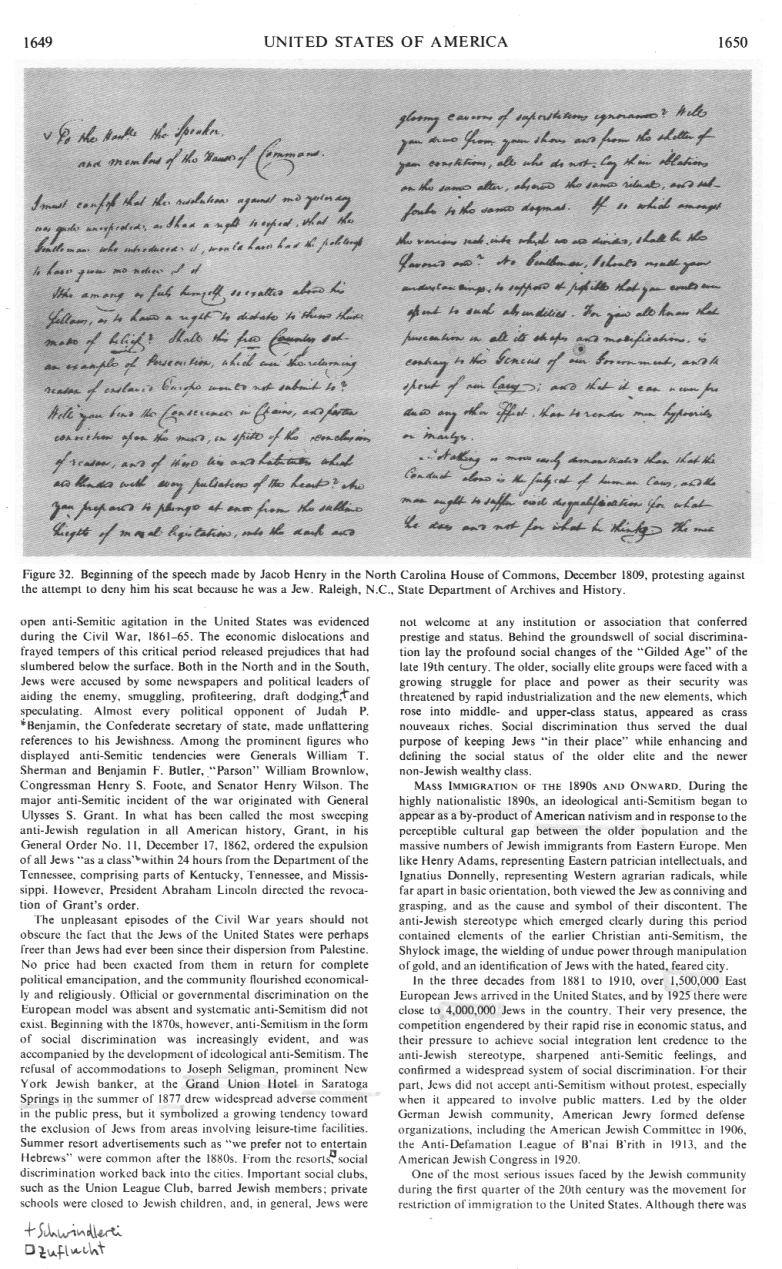
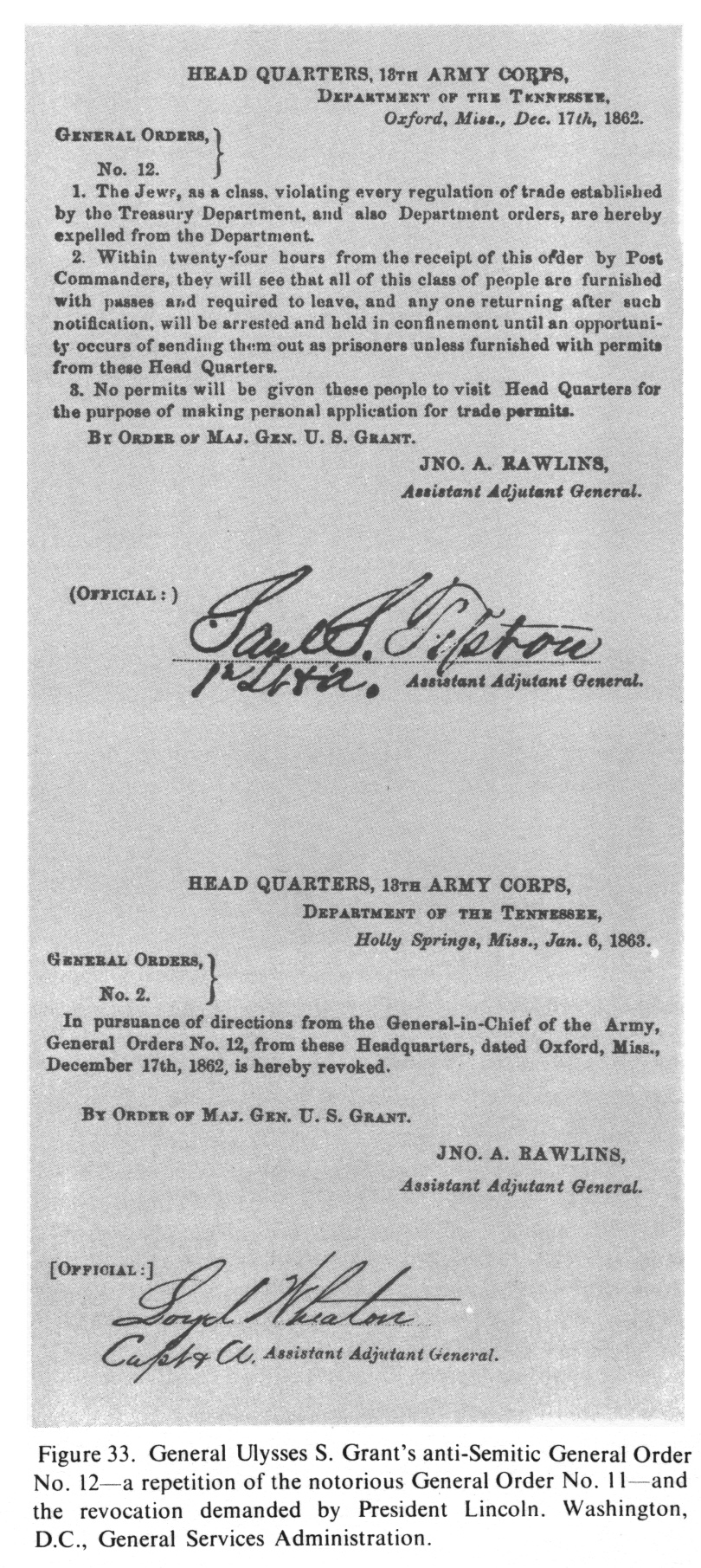
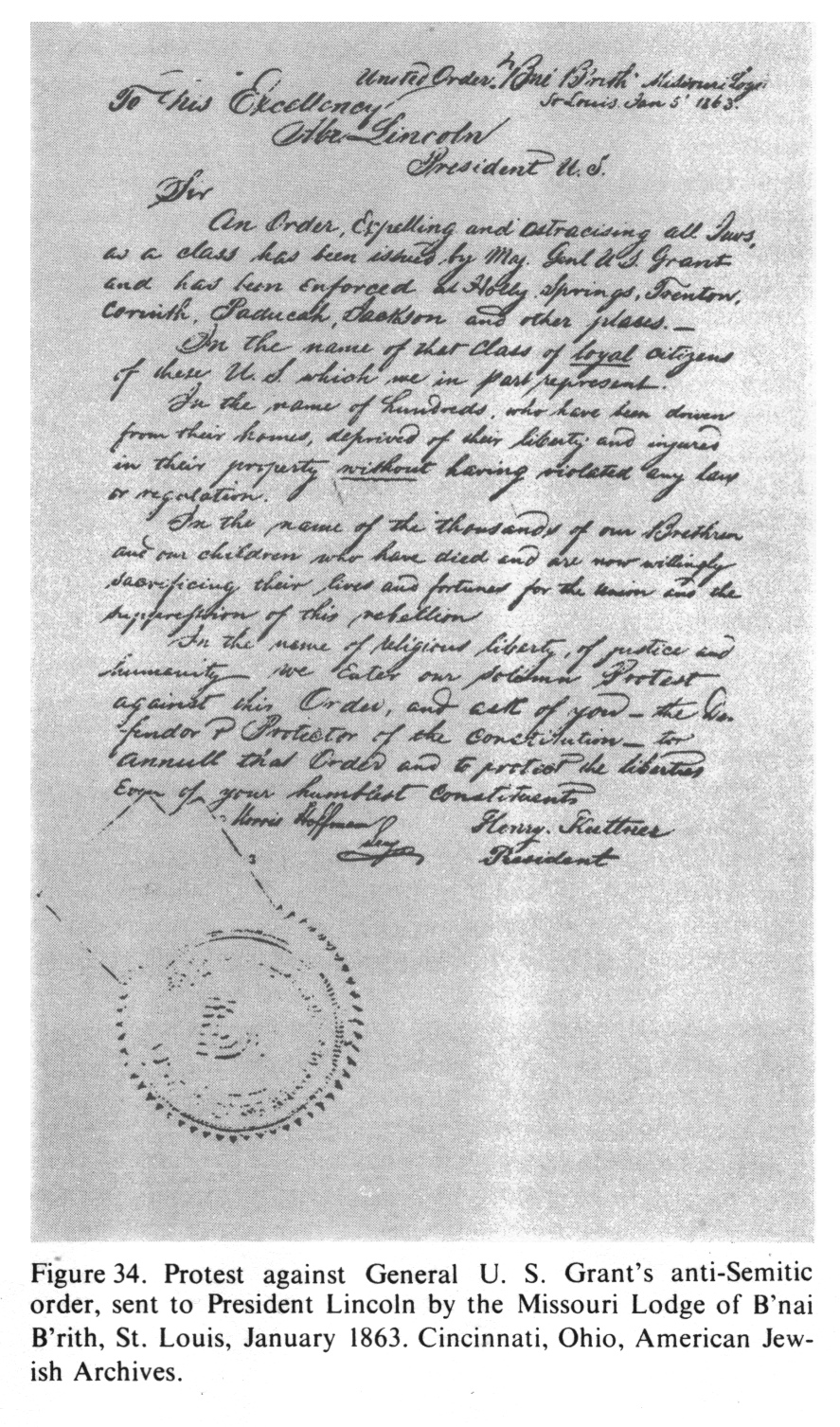
open anti-Semitic agitation in the United States was evidenced during the Civil War, 1861-65. The economic dislocations and frayed tempers of this critical period released prejudices that had slumbered below the surface. Both in the North and in the South, Jews were accused by some newspapers and political leaders of aiding the enemy, smuggling, profiteering, draft dodging [[lying]], and speculating. Almost every political opponent of Judah P. *Benjamin, the Confederate secretary of state, made unflattering references to his Jewishness. Among the prominent figures who displayed anti-Semitic tendencies were Generals William T. Sherman and Benjamin F. Butler, "Parson" William Brownlow, Congressman Henry S. Foote, and Senator Henry Wilson. The major anti-Semitic incident of the war originated with General Ulysses S. Grant. In what has been called the most sweeping anti-Jewish regulation in all American history, Grant, in his General Order No. 11, December 17, 1862, ordered the expulsion of all Jews "as a class" within 24 hours from the Department of the Tennessee, comprising parts of Kentucky, Tennessee, and Mississippi.
Encyclopaedia Judaica (1971): "USA", vol. 15, col. 1651: General Ulysses S. Grant's anti-Semitic General Order No. 12 - a repetition of the notorious General Order No. 11 - and the revocation demanded by President Lincoln. Washington, D.C., General Services Administration.
Text:
"HEAD QUARTERS, 13TH ARMY CORPS,
DEPARTMENT OF THE TENNESSEE,
Oxford, Miss, Dec. 17th, 1862.
General Orders, No. 12
1. The Jews, as a class, violating every regulation of trade established by he Treasury Department, and also Department orders, are hereby expelled from the Department.
2. Within twenty-four hours from the receipt of this order by Post Commanders, they will see that all of this class of people are furnished with passes and required to leave, and any one returning after such notification, will be arrested and held in confinement until an opportunity occurs of sending them out as prisoners unless furnished with permits from these Head Quarters.
3. No permits will be given these people to visit Head Quarters for the purpose of making personal application for trade permits.
BY ORDER OF MAJ. GEN. U.S. GRANT
JNO. A. RAWLINS,
Assistant Adjutant General."
"HEAD QUARTERS, 13TH ARMY CORPS,
DEPARTMENT OF THE TENNESSEE,
Holly Springs, Miss., Jan. 6, 1863.
GENERAL ORDERS, No. 2
In pursuance of directions from the General-in-Chief of the Army, General Orders No. 12, from these Headquarters, dated Oxford, Miss., December 17th, 1862, is hereby revoked.
BY ORDER OF MAJ. GEN. U.S. GRANT.
JNO. A. RAWLINS,
Assistant Adjutant General."
Encyclopaedia Judaica (1971): "USA", vol. 15, col. 1652: Protest against General U.S. Grant's anti-Semitic order, sent to President Lincoln by the Missouri Lodge of B'nai B'rith, St. Louis, January 1863. Cincinnati, Ohio, American Jewish Archives.
However, President Abraham Lincoln directed the revocation of Grant's order. The unpleasant episodes of the Civil War years should not obscure the fact that the Jews of the United States were perhaps freer than Jews had ever been since their dispersion from Palestine. No price had been exacted from them in return for complete political emancipation, and the community flourished economically and religiously. Official or governmental discrimination on the European model was absent and systematic anti-Semitism did not exist.> (col. 1649)
Letter from Abraham Lincoln, January 25, 1865, headed "About Jews" and requesting the Secretary of War to exercise his good offices on behalf of Dr. Zachary and [Leopold] Blumenberg. New York, New York Historical Society.
[War profits by Jews: clothing industry, Jewish banking]
The prosperity of the Civil War was also shared in by Jews. The demands of military supply provided unusual opportunities to businessmen, who developed the ready-made clothing industry from large-scale orders for army uniforms. U.S. banking was vastly stimulated by the needs of government finance. The success of the *Seligman brothers in marketing Union bonds on the European market was a critically important contribution. Numerous Jewish bankers of the 1870s and 1880s started with capital they amassed during the Civil War years as clothing manufacturers and merchants.
POST-CIVIL WAR STABILITY.
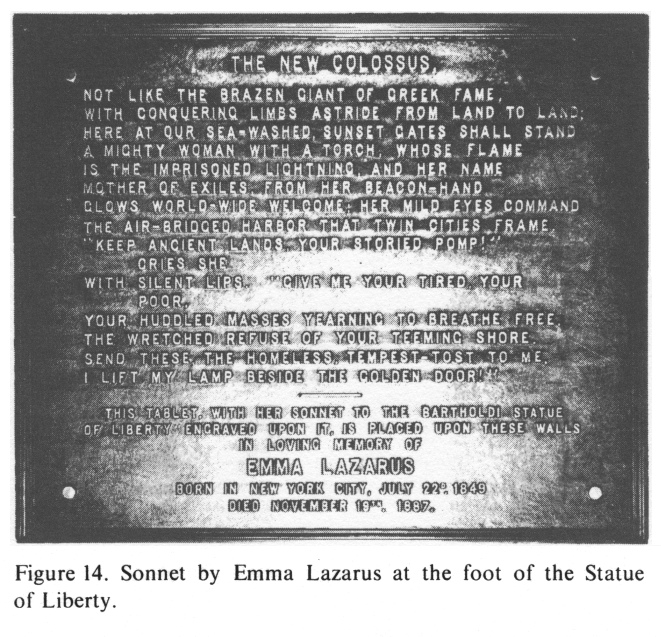
Encyclopaedia Judaica (1971): "USA", vol. 15, col. 1608: Sonnet by Emma Lazarus at the foot of the Statue of Liberty.Text:
"The new colossus.
Not like the brazen giant of Greek fame,
with conquering limbs astride from land to land,
here at our sea-washed sunset gates shall stand
a mighty woman with a torch, whose flame
is the imprisoned lightning and her name
mother of exiles, from her beacon-hand
glows worldwide welcome her mild eyes command.
The air-bridged harbor that twin cities frame
"Keep ancient lands your storied pomp!"
cries she
with silent lips: "Give me your tired, your poor,
your huddled masses yearning to breathe free
the wretched refuse of your teeming shore
send these the homeless tempest-tost to me.
I lift my lamp beside the golden door!"This tablet with her sonnet to the Bartoldi statue of liberty engraved upon it, is placed upon these walls in loving memory of
Emma Lazarus,
born in New York City, July 22D 1849
died November 19TH, 1887."
[[The natives - of course - were never mentioned by the racist white "Americans" of that time...]]
[German Jewry and Reform Judaism dominating the Jewish scenery 1865-1880 - end of slavery]
The years between the end of the Civil War in 1865 and the onset of mass immigration from eastern Europe during the 1880s [[after the murder of the czar and the outbreak of vast anti-Semitic agitation in Russia and eastern Europe]] mark the maturity of German Jewry in the U.S. They were mainly merchants, manufacturers of clothing and other consumer goods, and bankers in large cities and also in the small towns of the West and South. "Germandom" reached its peak in this time, and Reform Judaism became the dominant religious form.
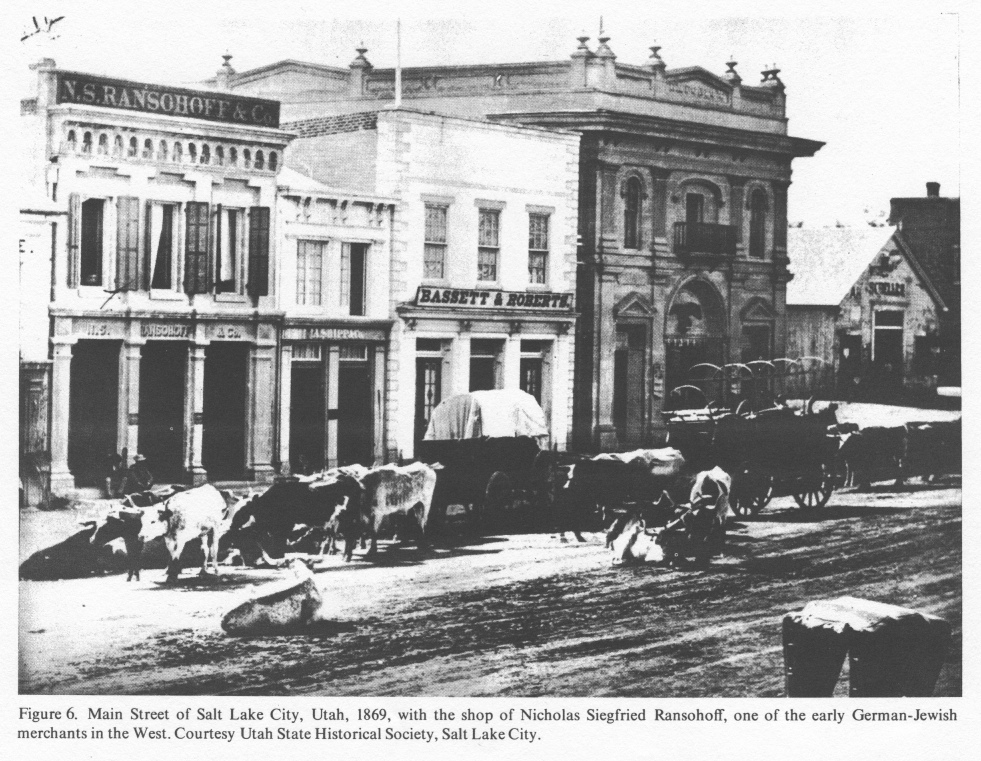
Encyclopaedia Judaica (1971): "USA", vol. 15, col. 1597-1598: Main Street of Salt Lake City, Utah, 1869, with the shop of Nicholas Siegfried Ransohoff, one of the early German-Jewish merchants in the West. Courtesy Utah State Historical Society, Salt Lake City.
[[Characteristic for white racist colonial architecture are the forms of the houses, like little castles]].
In the economic and political development of the South following the emancipation of the slaves and the breakup of the plantation system, Jews became prominent. Jewish peddlers and storekeepers played an important part in the economic development of the region. One contemporary (col. 1603)
attributed part of their success to the habit they had of addressing Negro customers as "Mister" rather than by given nave, i.e., the Jews' lack of attachment to the region's racial system. Several Jews became prominent politicians, notably Raphael J. *Moses in South Carolina.
[[Addition: Slavery lifted - slavery of money not lifted
Slavery was lifted but slavery by money was not lifted, and racist regulations were not at all lifted. The blacks were streaming from the southern to the northern states for work in the industries and had to live in ruins and were confronted with discriminating laws from using a public toilet (separated between black and white) to purchasing a house (all whites left the street when a black had purchased a house). At the same time the racist white colonels of the Northern armies (e.g., Custer) could not stop their war activity and were eliminating the last free native tribes and putting them into concentration camps (called "reservations") for selling the last "free land" to the whites, e.g., in the Seattle region. It can be admitted that this destruction of the natives and their nature cultures was not performed without Jewish banking and speculating "work", in the name of a "Christian" state named on foreign soil, named "USA"...]]
[Immigration]
Jewish immigration to the United States resumed after its near cessation during the Civil War period. The Jewish population rose from about 150,000 in 1860 to perhaps 280,000 in 1880, much of it due to a substantial excess of births over deaths within a young immigrant population, but even more to continued immigration. For the first time there were serious discussions in the Jewish community over the possibility of organizing Jewish immigration from Europe. IN 1870 about 500 East Prussians and Lithuanians were brought from their famine-stricken region. Oppressed Rumanian Jews also figured as potential immigrants in 1872. Despite these discussions, Jewish migration to the U.S. remained a matter of individual initiative. Of profound significance was the shift in its geographic sources from Germanic to Slavic areas of Europe. To be sure some small immigration arrived from Alsace following the German annexation of the province in 1871, and scattered immigration continued from many other lands. [[Alsace Jews were mostly Orthodox, see *Alsace]].
[Careers]
The German-Jewish merchant class climbed rapidly in the post-Civil War age of industrial and financial expansion and the private banker also reached his zenith during the last decades of the century. Joseph Seligman (1820-1880) and his brothers in New York and San Francisco were among the foremost bankers of their day. He declined President Grant's offer to appoint him secretary of the treasury in 1869. Men like I.W. *Hellman in Los Angeles, then still a village, Heidelbach in Cincinnati, and Henry *Greenebaum in Chicago, were important personages, and Jacob H. *Schiff was rapidly rising. (col. 1604) [[...]]
[Anti-Semitism in clubs, in leisure-time facilities, and in state's institutions]
The phenomenon of Jewish exclusion from upper-level social circles made its first appearance during the 1870s. It erupted notoriously in 1877, with the refusal of admission to the fashionable Grand Union Hotel at Saratoga Springs to Joseph Seligman. This act aroused widespread anger and indignation, not only among Jews but in the general press and among such liberal Protestants as Henry Ward Beecher. The social clubs for the wealthy which were being established during the 1870s and later mostly kept Jews out, and the German gymnastic and social Turnvereine [[sports congregations]] were also inhospitable.
It generally appears that during the early development of cities Jews had the freest opportunities for social mingling and political advancement. It was quite usual for a Jew, as one of the few literate, stable settlers, to become mayor or a leading official of a frontier town. However, once these pioneer years ended and more fixed social groupings were formed, a tendency to exclude Jews from elite social and business circles became evident. (col. 1607) [[...]]
[[Details]]:
Beginning with the 1870s, however, anti-Semitism in the form of social discrimination was increasingly evident, and was accompanied by the development of ideological anti-Semitism. The refusal of accommodations to Joseph Seligman, prominent New York Jewish banker, at the Grand Union Hotel in Saratoga Springs in the summer of 1877 drew widespread adverse comment in the public press, but it symbolized a growing tendency toward the exclusion of Jews from areas involving leisure-time facilities. Summer resort advertisements such as "we prefer not to entertain Hebrews" were common after the 1880s. From the resorts, social discrimination worked back into the cities. Important social clubs, such as the Union League Club, barred Jewish members; private schools were closed to Jewish children, and, in general, Jews were (col. 1649)
not welcome at any institution or association that conferred prestige and status. Behind the groundswell of social discrimination lay the profound social changes of the "Gilded Age" of the late 19th century. The older, socially elite groups were faced with a growing struggle for place and power as their security was threatened by rapid industrialization and the new elements, which rose into middle- and upper-class status, appeared as crass nouveaux riches. Social discrimination thus served the dual purpose of keeping Jews "in their place" while enhancing and defining the social status of the older elite and the newer non-Jewish wealthy class. (col. 1650) [[...]]
[[Addition: Stock exchange collapses and racist Darwinist literature in the criminal racist "USA"
In general the anti-Semitic waves in the "USA" were mainly provoked by the worldwide collapse of the stock exchange of 1873, and add to this there came two more stock exchange crashes and a heavy rightist wave of the farmer lobby until the 1890s, combined with a Socialist wing flash which was blamed to be "Communist" but never was. There was a dramatic racist Darwinist literature in the "USA" (Strong, Burgess, Fiske, Hosmer, Adams, Kidd) which was the base for the ideology of later Hitler Germany against the Jews. It seems strange that this is not mentioned in the Encyclopaedia Judaica article]].
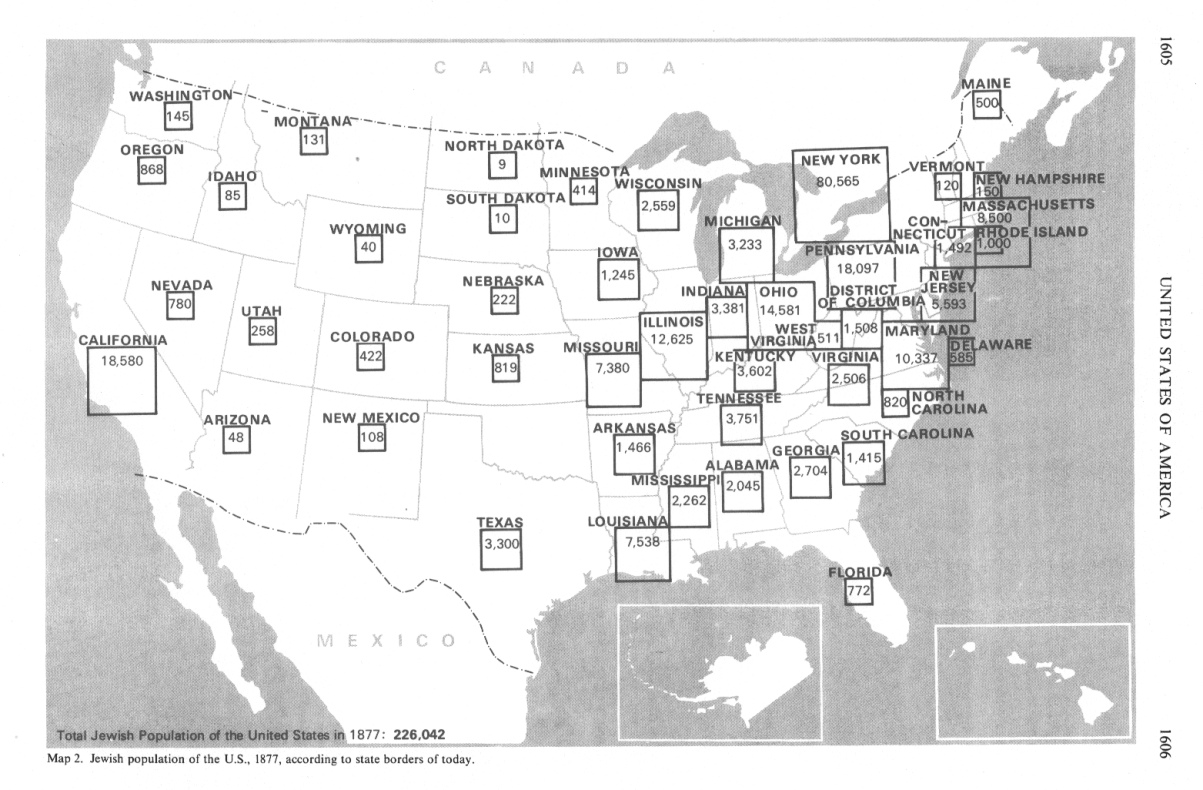
Encyclopaedia Judaica (1971): "USA", vol. 15, col. 1605-1606: Jewish population
of the U.S., 1877, according to state borders of today.
[Community life: synagogues - reforms]
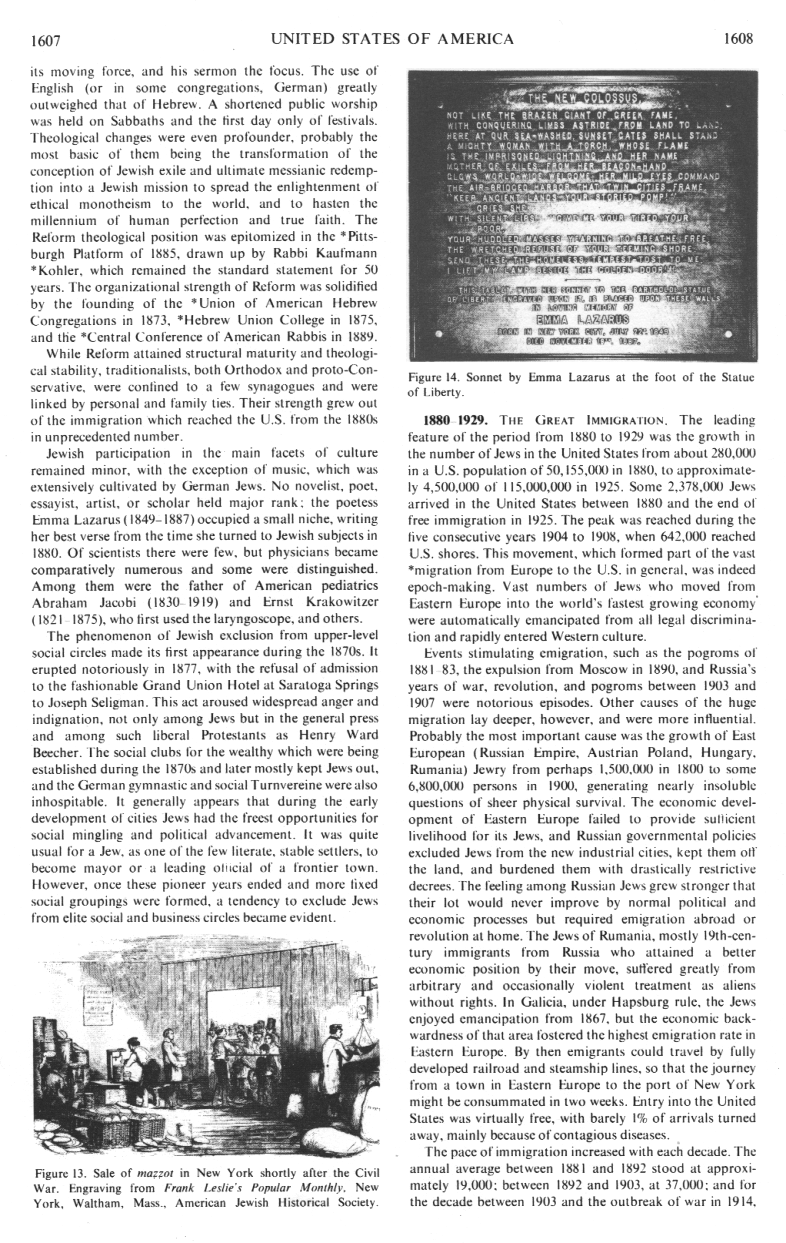
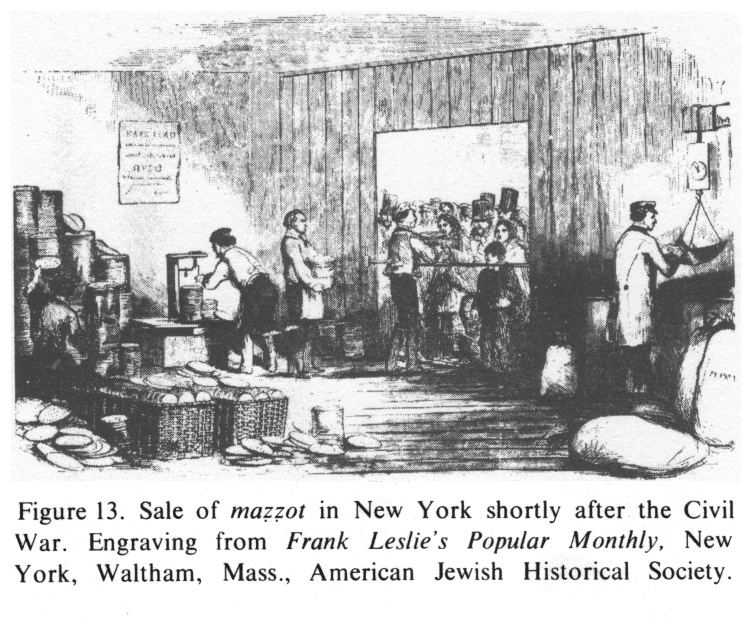
Encyclopaedia Judaica (1971): "USA", vol. 15, col. 1607: Sale of mazzot in New York shortly after the Civil War. Engraving from "Frank Leslie's Popular Monthly", New York, Waltham, Mass., American Jewish Historical Society. The decade after 1865 was the greatest period of synagogue construction up to that time. Dozens of congregations founded ten and 20 years earlier had achieved size, stability, and prosperity, and the numerous edifices which they erected during this period, many with elaborate decoration in Romanesque Moorish style, attest to the confidence and optimism of their builders. (Two outstanding surviving specimens are the Central Synagogue, New York City, built in 1870 and the Plum Street Temple, at Plum and Sixth Streets, Cincinnati, in 1869).
Reform Judaism reached the peak of its influence during the 1870s and 1880s, when it came close to being synonymous with U.S. Judaism, the destiny which its organizer and leader Isaac M. Wise foresaw during the 1850s. The ritual in Reform congregations made the rabbi (col. 1604)
its moving force, and his sermon the focus. The use of English (or in some congregations, German) greatly outweighed that of Hebrew. A shortened public worship was held on Sabbaths and the first day only of festivals. Theological changes were even profounder, probably the most basic of them being the transformation of the conception of Jewish exile and ultimate messianic redemption into a Jewish mission to spread the enlightenment of ethical monotheism to the world, and to hasten the millennium of human perfection and true faith. The Reform theological position was epitomized in the *Pittsburgh Platform of 1885, drawn up by Rabbi Kaufmann *Kohler, which remained the standard statement for 50 years. The organizational strength of Reform was solidified by the founding of the *Union of American Hebrew Congregations in 1873, *Hebrew Union College in 1875, and *Central Conference of American Rabbis in 1889.
While Reform attained structural maturity and theological stability, traditionalists, both Orthodox and proto-Conservative, were confined to a few synagogues and were linked by personal and family ties. Their strength grew out of the immigration which reached the U.S. from the 1880s in unprecedented number.
[Jewish writing - Jewish scientists]
Jewish participation in the main facets of culture remained minor, with the exception of music, which was extensively cultivated by German Jews. No novelist, poet, essayist, artist, or scholar held major rank; the poetess Emma Lazarus (1849-1887) occupied a small niche, writing her best verse from the time she turned to Jewish subjects in 1880. Of scientists there were few, but physicians became comparatively numerous and some were distinguished. Among them were the father of American pediatrics Abraham Jacobi (1830-1919) and Ernst Krakowitzer (1821-1875), who first used the laryngoscope, and others. (col. 1607)
[[Addition: No learning process from the natives
It can be stated that the Jews never learned anything from the natives but were only organizing wars and the destruction of the natives in "reservations" resp. open air concentration camps. The Jews were strictly in the racist line of the whites and stuck in their Bible and never opened for native cultures, native wisdom, native gods, native life protecting land and nature etc. Instead the "Christians" and the Jews were fighting each other with the Bible. This racism against the natives in the "USA" was later the model for racist Theodor Herzl and his booklet of a "Jewish State" against all Arabs who should be driven away like the natives in the "USA"...]]

![Letter from Abraham Lincoln, January 25,
1865, headed "About Jews" and
requesting the Secretary of War to exercise
his good offices on behalf of Dr. Zachary and
[Leopold] Blumenberg. New York, New York
Historical Society](EncJud_juden-in-USA-d/EncJud_USA-band15-kolonne1603-brief-Lincoln1865.gif "Letter from Abraham
Lincoln, January 25, 1865, headed \"About
Jews\" and requesting the Secretary of War
to exercise his good offices on behalf of Dr.
Zachary and [Leopold] Blumenberg. New York,
New York Historical Society")
| Teilen / share: |
Facebook |
|
Twitter
|
Sources
Encyclopaedia Judaica (1971): "USA", vol. 15, col. 1601-1602
Encyclopaedia Judaica (1971): "USA", vol. 15, col. 1603-1604
Encyclopaedia Judaica (1971): "USA", vol. 15, col. 1605-1606
Encyclopaedia Judaica (1971): "USA", vol. 15, col. 1607-1608
Encyclopaedia Judaica (1971): "USA", vol. 15, col. 1647-1648
Encyclopaedia Judaica (1971): "USA", vol. 15, col. 1649-1650