[Jewish
businessmen in New Zealand: Kororareka, Auckland]
<NEW ZEALAND, member of the
Commonwealth of Nations in the S. Pacific.
In 1829, some 60 years after the rediscovery of New Zealand,
the Sydney firm of Cooper and Levy established itself in the
South Island at Port Cooper (Lyttleton) and Port Levy, a
little to the north. Solomon Levy, the Jewish partner, later
became a benefactor of both Jewish and Christian educational
and charitable institutions.
During the next decade, other Jewish traders (col. 1127)
began to arrive. In 1830 Joseph Barrow Montefiore (a member
of the English *Montefiore family) from Sydney established
Montefiore Brothers, dealing largely in flax and whale oil.
In 1831 Joel Samuel *Polack, author of two books on New
Zealand, came first to Hokianga to trade and deal in land.
He shortly transferred to Kororareka, Bay of Islands, where
a cousin of J.B. Montefiore had established a trading post
in 1831.
Four other Jews were resident at Kororareka in 1838, but
along with David *Nathan who had arrived in 1839 they moved
to Auckland after it was made the capital in 1840. With a
handful of other Jewish storekeepers and traders, David
Nathan founded the Auckland Jewish community. Members of the
congregation read the services and conducted religious
functions - a pattern to be followed elsewhere in New
Zealand.
The first ordained minister (J.E. Myers of Auckland) was
appointed to a New Zealand congregation in 1859.
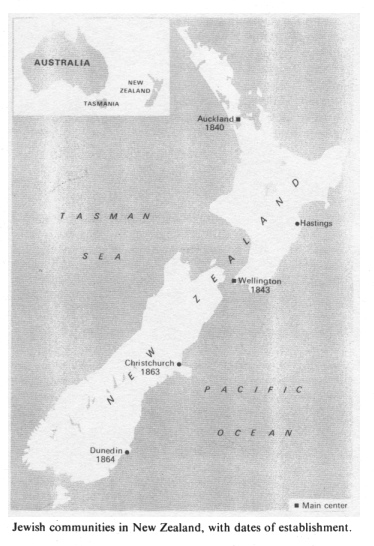
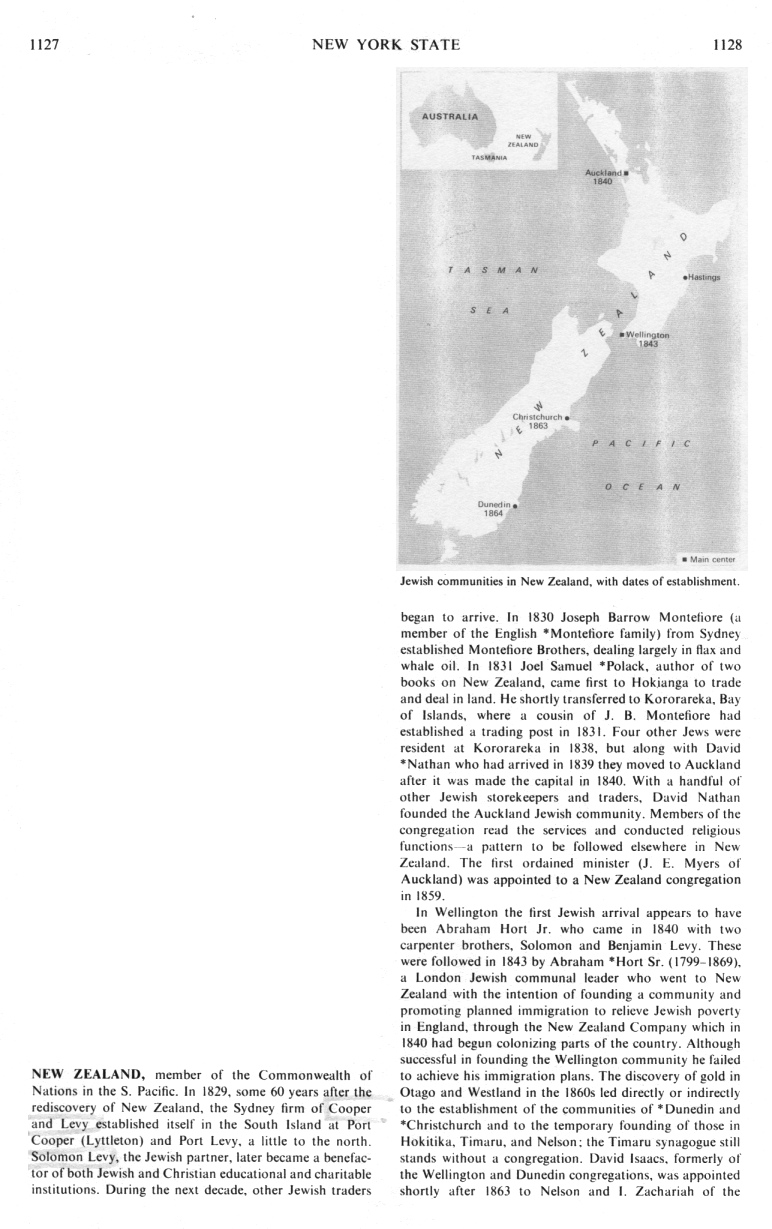
Encyclopaedia Judaica (1971): New Zealand, vol. 12, col.
1128, map with Jewish communities
(main centers) in New Zealand, with year of establishment
[Jewish
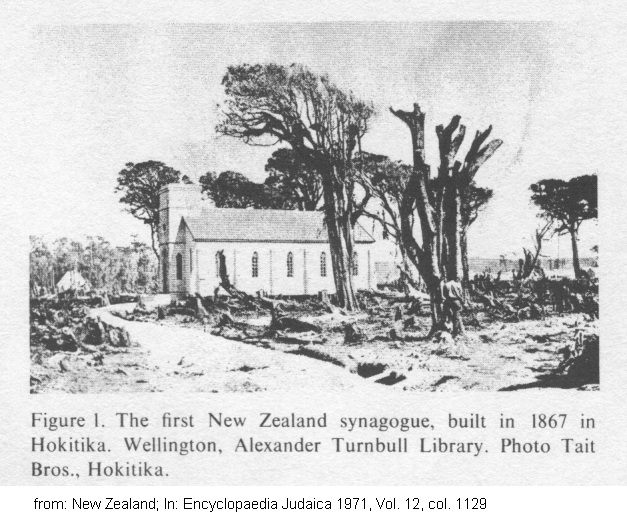
businessmen in Wellington - gold in Otago and Westland -
communities of Dunedin and Christchurch - gold-mining town
Hokitika]
In Wellington the
first Jewish arrival appears to have been Abraham Hort
Jr. who came in 1840 with two carpenter brothers,
Solomon and Benjamin Levy. These were followed in 1843
by Abraham *Hort Sr. (1799-1869), a London Jewish
communal leader who went to New Zealand with the
intention of founding a community and promoting planned
immigration to relieve Jewish poverty in England,
through the New Zealand Company which in 1840 had begun
colonizing parts of the country.
Although successful in founding the Wellington community
he failed to achieve his immigration plans.
The discovery of gold in Otago and Westland in the 1860s
led directly or indirectly to the establishment of the
communities of *Dunedin and *Christchurch and to the
temporary founding of those in Hokitika, Timaru, and
Nelson; the Timaru synagogue still stands without a
congregation. David Isaacs, formerly of Wellington and
Dunedin congregations, was appointed shortly after 1863
to Nelson and I. Zachariah of the (col. 1128)
gold-mining town of Hokitika was appointed in 1870 to
the Christchurch congregation. Most of the ordained
ministers came from Jews' College, England, including H.
*Van Staveren (Wellington, 1877-1930) and A. Astor
(Dunedin and Auckland, 1926-71). C. Pitkowsky
(Wellington, 1905-30) and the brothers N. Salas
(Auckland and Christchurch, 1929-58) and M. Salas
(Auckland, 1934-55) came from Erez Israel.
[1860s: Fund raising
for Jews in Israel]
New Zealand's links with Erez Israel date from the time
of the Crimean War, when money was being collected in
Auckland and Wellington for starving Jews in Erez
Israel. In 1862 Jacob *Saphir of Jerusalem visited
Dunedin on a similar mission. Before New Zealand became
a British colony in 1840, the Jewish population numbered
less than 30. By 1861 it had risen to 326 (0.3% of the
total), and six years later to 1,262 (0.6%).
[Population figures -
Jewish centers Auckland and Wellington - immigration
restrictions and only little immigration]
The gold rushes brought hundreds of Jews there, but by
the 1870s their number had fallen to approximately 0.2%
above which it has never risen. The Jewish population
numbered 1,611 in 1901, 2,380 in 1921, 3,470 in 1945,
4.006 (out of 2,750,000) in 1961, and just over 4,000 in
1968.
The vast majority of Jews are distributed equally in
Auckland and Wellington. There has always been a highly
restrictive government policy on immigration except by
those of British stock, and only a small number of
Jewish refugees from persecution in Russia and Eastern
Europe were admitted. Similarly, the numbers admitted in
the wake of Nazism were inconsiderable, but these had an
invigorating effect on the New Zealand community.
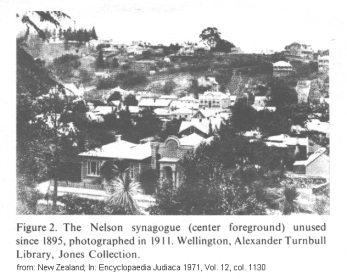
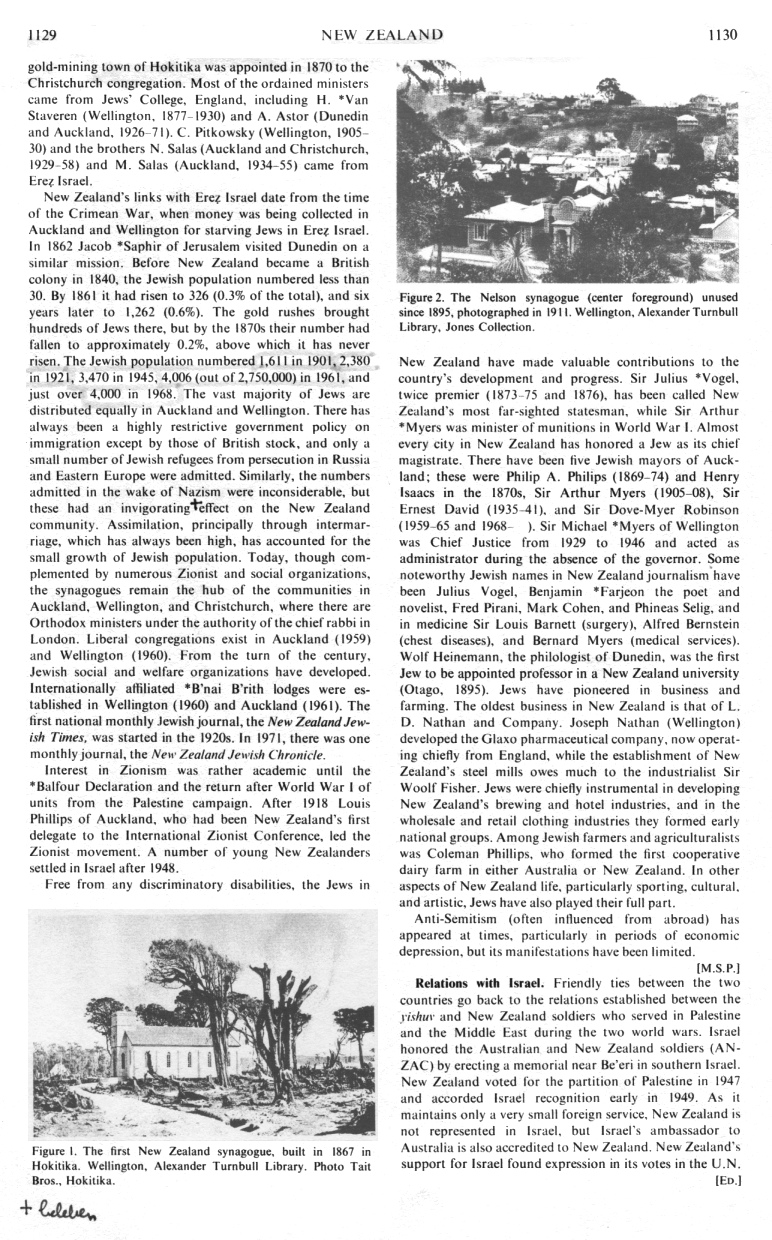
Encyclopaedia Judaica 1971: New Zealand, vol. 12, col.
1130, Nelson synagogue
at Wellington which is not used since 1895, foto from 1911
[after 1945:
intermarriage as important factor - chief rabbi is in
London]
Assimilation, principally through intermarriage, which
has always been high, has accounted for the small growth
of Jewish population. Today, though complemented by
numerous Zionist and social organizations, the
synagogues remain the hub of the communities in
Auckland, Wellington, and Christchurch, where there are
Orthodox ministers under the authority of the chief
rabbi in London.
Liberal congregations exist in Auckland (1959) and
Wellington (1960). From the turn of the century, Jewish
social and welfare organizations have developed.
Internationally affiliated *B'nai B'rith lodges were
established in Wellington (1960) and Auckland (1961).
[Newspapers]
The first national monthly Jewish journal, the New Zealand Jewish Times,
was started in the 1920s. In 1971, there was one monthly
journal, the New
Zealand Jewish Chronicle.
[Herzl Zionism]
Interest in Zionism was rather academic until the
*Balfour Declaration and the return after World War I of
units from the Palestine campaign. After 1918 Louis
Philips of Auckland, who had been New Zealand's first
delegate to the International Zionist Conference, led
the Zionist movement. A number of young New Zealanders
settled in Israel after 1948.
[Developments of the
country by Jews]
Free from any discriminatory disabilities, the Jews in
(col. 1129)
New Zealand have made valuable contributions to the
country's development and progress. Sir Julius *Vogel,
twice premier (1872-75 and 1876), has been called New
Zealand's most far-sighted statesman, while Sir Arthur
*Myers was minister of munitions in World War I. Almost
every city in New Zealand has honored a Jew as its chief
magistrate. There have been five Jewish mayors of
Auckland; these were Philip A. Philips (1869-74) and
Henry Isaacs in the 1870s, Sir Arthur Myers (1905-08),
Sir Ernest David (1935-41), and Sir Dove-Myer Robinson
(1959-65 and 1968- ).
Sir Michael *Myers of Wellington was Chief Justice from
1929 to 1946 and acted as administrator during the
absence of the governor. Some noteworthy Jewish names in
New Zealand journalism have been Julius Vogel, Benjamin
*Farjeon the poet and novelist, Fred Pirani, Mark Cohen,
and Phineas Selig, and in medicine Sir Louis Barnett
(surgery), Alfred Bernstein (chest diseases), and
Bernard Myers (medical services).
Wolf Heinemann, the philologist of Dunedin, was the
first Jew to be appointed professor in a New Zealand
university (Otago, 1895). Jews have pioneered in
business and farming. The oldest business in New Zealand
is that of L.D. Nathan and Company. Joseph Nathan
(Wellington) developed the Glaxo pharmaceutical company,
now operating chiefly from England, while the
establishment of New Zealand's steel mills owes much to
the industrialist Sir Woolf Fisher.
Jews were chiefly instrumental in developing New
Zealand's brewing and hotel industries, and in the
wholesale and retail clothing industries they formed
early national groups. Among Jewish farmers and
agriculturalists was Coleman Phillips, who formed the
first cooperative dairy farm in either Australia or New
Zealand. In other aspects of New Zealand life,
particularly sporting, cultural, and artistic, Jews have
also played their full part.
Anti-Semitism (often influenced from abroad) has
appeared at times, particularly in periods of economic
depression, but its manifestations have been limited.
[M.S.P.]
[[The discrimination of the natives, the elimination of
native animals, and the ecological destruction by
clearings and importation of foreign animals are
mentioned]].
Relations with
[[Herzl]] Israel.
Friendly ties between the two countries go back to the
relations established between the yishuv and New
Zealand soldiers who served in Palestine and the Middle
East during the two world wars. Israel honored the
Australian and New Zealand soldiers (AN-ZAC) by erecting
a memorial near Be'eri in southern Israel. New Zealand
voted for the partition of Palestine in 1947 and
accorded Israel recognition early in 1949. As it
maintains only a very small foreign service, New Zealand
is not represented in Israel, but Israel's ambassador to
Australia is also accredited to New Zealand. New
Zealand's support for Israel found expression in its
votes in the U.N.
[ED.]> (col. 1130)
[[Herzl Israel has it's base on the statement of Theodor
Herzl's book "The Jewish State" which states that the
Arabs can be driven away as the natives in the "USA" had
been driven away. So there is an eternal war without
end]].
Encyclopaedia Judaica 1971: New Zealand,
sources
|
Encyclopaedia Judaica 1971: New Zealand, vol. 12,
col. 1127-1128
|
Encyclopaedia Judaica 1971: New Zealand, vol. 12,
col. 1129-1130
|