<<
<<
>>
Encyclopaedia Judaica
Jews in Belarus (BSSR) 02: 1921-1941
Soviet and Polish rule - Jewish section of the
communist party Yevsektsiya - emancipation of poor Jews -
persecution of the middle class - suppression of religion
and Zionism - Sovietization of Eastern Poland - gulag
never mentioned
from: Belorussia; In: Encyclopaedia Judaica 1971, vol. 4
presented by Michael Palomino (2008 / 2023)
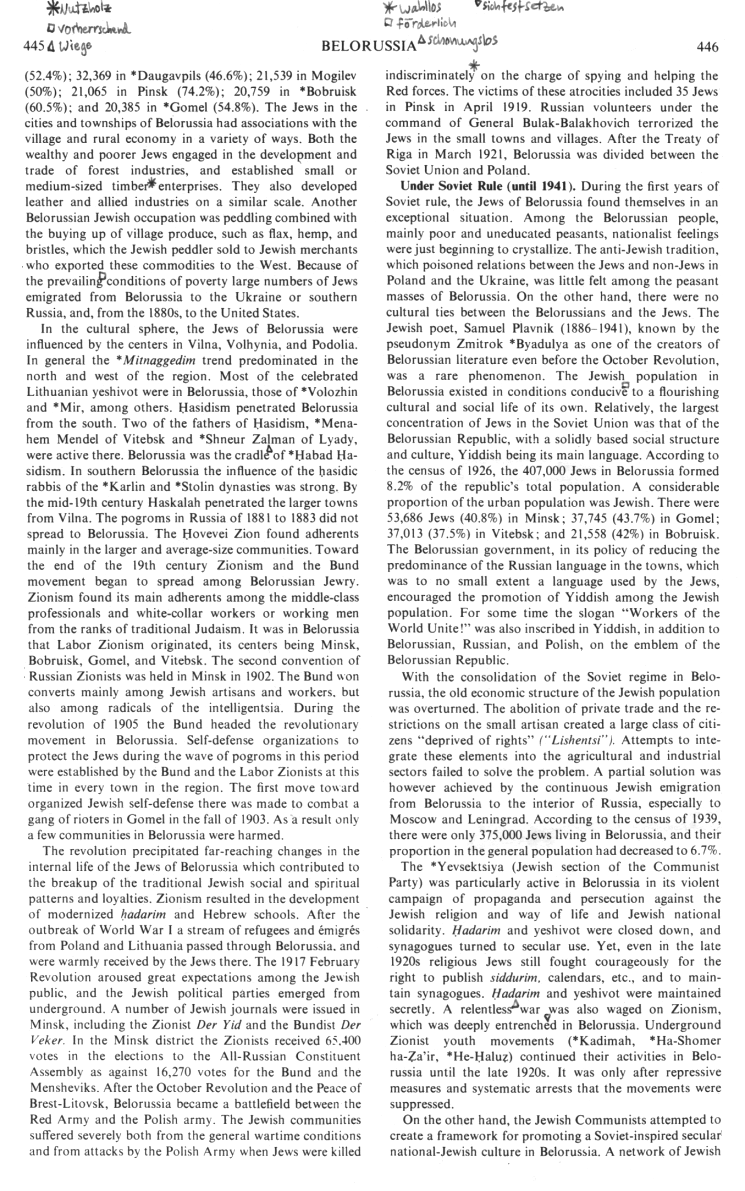
Under Soviet Rule (until
1941). [Eastern Part of Belarus with Minsk]
[[Supplement: Pale of
Settlement abolished - doubling the territory in 1924
The Pale of Settlement did not exist any more and Jews were
emancipated within the communist system. In 1924 Belarus got
much Russian territory back and more or less doubled it's
territory, so the number of Jews rose about the doublefold.
Soviet gulag system and mass murder in the gulag is never
mentioned by Encyclopaedia Judaica]].
During the first years of Soviet rule, the Jews of Belorussia
found themselves in an exceptional situation.
[[This is a big lie because now poor Jews got a chance for
good work, but the middle class was degraded by the
communists, and there were many Jews, see below]].
Among the Belorussian people, mainly poor and uneducated
peasants, nationalist feelings were just beginning to
crystallize. The anti-Jewish tradition, which poisoned
relations between the Jews and non-Jews in Poland and the
Ukraine, was little felt among the peasant masses of
Belorussia. On the other hand, there were no cultural ties
between the Belorussians and the Jews. The Jewish poet, Samuel
Plavnik (1886-1941), known by the pseudonym Zmitrok *Byadulya
as one of the creators of Belorussian literature even before
the October Revolution, was a rare phenomenon.
The Jewish population in Belorussia existed in conditions
conducive to a flourishing cultural and social life of its
own. Relatively, the largest concentration of Jews in the
Soviet Union was that of the Belorussian Republic, with a
solidly based social structure and culture, Yiddish being its
main language. According to the census of 1926, the 407,000
Jews in Belorussia formed 8,2% of the republic's total
population.
A considerable proportion of the urban population was Jewish.
There were
53,686 Jews (40.8%) in Minsk;
37,745 (43.7%) in Gomel;
37,013 (37.5%) in Vitebsk; and
231,558 (42%) in Bobruisk.
The Belorussian government, in its policy of reducing the
predominance of the Russian language in the towns, which was
to no small extent a language used by the Jews, encouraged the
promotion of Yiddish among the Jewish population. For some
time the slogan "Workers of the World Unite!" was also
inscribed in Yiddish, in addition to Belorussian, Russian, and
Polish, on the emblem of the Belorussian Republic.
[Degraded middle class - poor
Lishentsi]
With consolidation of the Soviet regime in Belorussia, the old
economic structure of the Jewish population was overturned.
The abolition of private trade and the restrictions on the
small artisan created a large class of citizens "deprived of
rights" ("Lishentsi").
Attempts to integrate these elements into the agricultural and
industrial sectors failed to solve the problem.
A partial solution was however achieved by the continuous
Jewish emigration from Belorussia to the interior of Russia,
especially to Moscow and Leningrad. According to the census of
1939, there were only 375,000 Jews living in Belorussia, and
their proportion in the general population had decreased to
6.7%.
Table. Jews
in Belarus (BSSR)
|
Year
|
number
of
Jews
|
source
|
1926
|
407,000
|
col.
446
|
1939
|
375,000
|
col.
446
|
Table by Michael Palomino; from: Belorussia;
In: Encyclopaedia Judaica 1971, vol. 4, col. 446
|
[Jewish Communist party
section Yevsektsiya against Jewish religion and Herzl
Zionism]
The *Yevsektsiya Jewish section of the Communist Party) was
particularly active in Belorussia in its violent campaign of
propaganda and persecution against the Jewish religion and way
of life and Jewish national solidarity. Hadarim [[little Jewish
schools]] and yeshivot [[religious Torah schools]] were closed
down, and synagogues turned to secular use. Yet, even in the
late 1920s religious Jews still fought courageously for the
right to publish siddurim
[[Jewish prayer books]], calendars, etc., and to maintain
synagogues. Hadarim and yeshivot were maintained secretly.
A relentless war was also waged on Zionism, which was deeply
entrenched in Belorussia. Underground [[Herzl]] Zionist youth
movements (*Kadimah, *Ha-Shomer ha-Za'ir, *He-Haluz) continued
their activities in Belorussia until the late 1920s. It was
only after repressive measures and systematic arrests that the
movement were suppressed.
[[This action against Herzl Zionism was reasonable, because
the Jews would be driven into an eternal war, and all Arabs
should be driven away as the natives had been driven away in
the "USA", as Herzl says in "The Jewish State". And there are
no borderlines indicated in Herzl's book. The borderline of a
"Greater Israel" should be the Euphrates according to First
Mose chapter 15 phrase 18 (look in the Bible). Add to this
since 1920s there was oil found in the Arab states and many
governments wanted to save their oil connections with the
Arabs. Anti-Semitism is a Church problem, which was not solved
until the 1960s and until now is not really solved...]].
[Cultural life for communist
loyal Jews]
On the other hand, the Jewish Communists attempted to create a
framework for promoting a Soviet-inspired secular
national-Jewish culture in Belorussia. A network of Jewish
(col. 446)
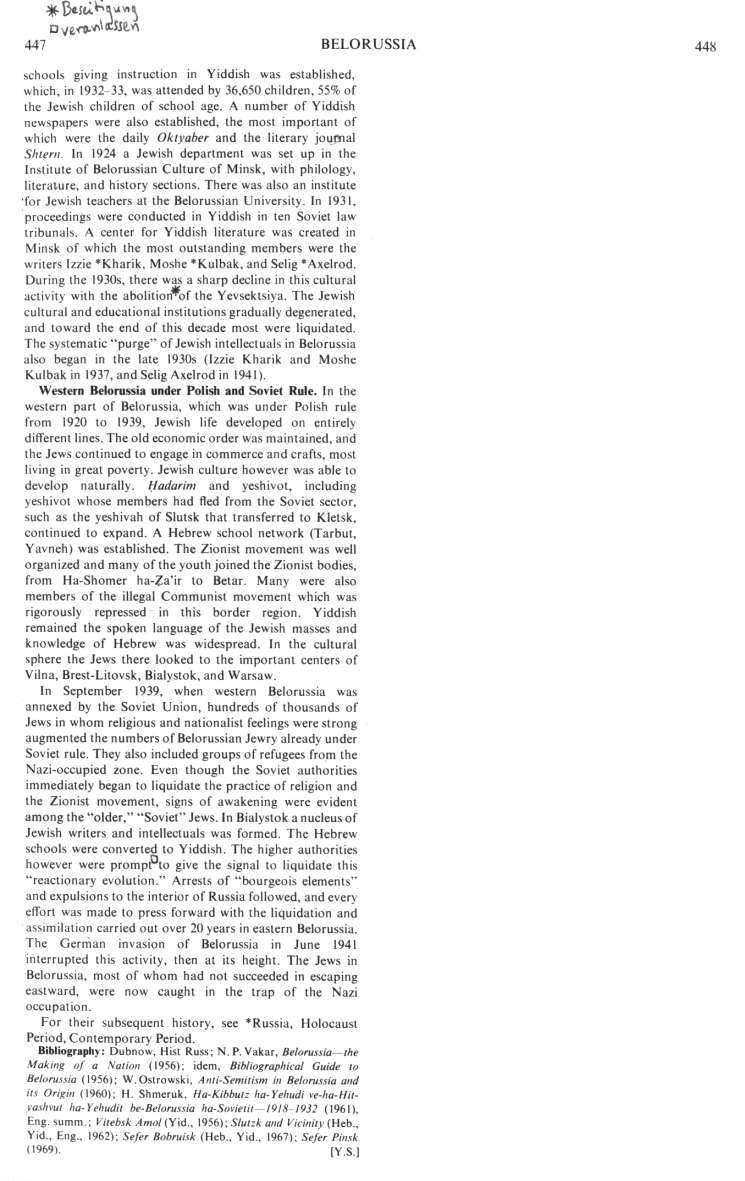
schools giving instruction in Yiddish was established, which,
in 1932-33, was attended by 36,650 children, 55% of the Jewish
children of school age. A number of Yiddish newspapers were
also established, the most important of which were the daily Oktyaber and the literary
journal Shtern
[[Yidd.: Star]]. In 1924 a Jewish department was set up in the
Institute of Belorussian Culture of Minsk, with philology,
literature, and history sections. There was also an institute
for Jewish teachers at the Belorussian University. In 1931,
proceedings were conducted in Yiddish in ten Soviet law
tribunals. A center for Yiddish literature was created in
Minsk of which the most outstanding members were the writers
Izzie *Kharik, Moshe *Kulbak, and Selig *Axelrod.
[Abolition of the Jewish
section of the Communist Party]
During the 1930s, there was a sharp decline in this cultural
activity with the abolition of the Yevsektsiya. The Jewish
cultural and educational institutions gradually degenerated,
and toward the end of this decade most were liquidated. The
systematic "purge" of Jewish intellectuals in Belorussia also
began in the late 1930s (Izzie Kharik and Moshe Kulbak in
1937, and Selig Axelrod in 1941).
Western Belorussia under
Polish and Soviet Rule.
[Jewish "national" Herzl
Zionist life under Polish rule]
In the western part of Belorussia, which was under Polish rule
from 1920 to 1939, Jewish life developed on entirely different
lines. The old economic order was maintained, and the Jews
continued to engage in commerce and crafts, most living in
great poverty. Jewish culture however was able to develop
naturally. Hadarim
[[little Jewish schools]] and yeshivot [[religious Torah
schools]], including yeshivot whose members had fled from the
Soviet sector such as the yeshivah of Slutsk that transferred
to Kletsk, continued to expand.
A Hebrew school network (Tarbut, Yavneh) was established. The
Zionist movement was well organized and many of the youth
joined the Zionist bodies, from Ha-Shomer ha-Za'ir to Betar.
Many were also members of the illegal Communist movement which
was rigorously repressed in this border region. Yiddish
remained spoken language of the Jewish masses and knowledge of
Hebrew was widespread. In the cultural sphere the Jews there
looked to the important centers of Vilna, Brest-Litovsk,
Bialystok, and Warsaw.
[Partition of Poland -
Sovietization of Western Belarus - liquidation of religion
and Herzl Zionism]
In September 1939, when western Belorussia [[= Eastern Poland]
was annexed by the Soviet Union, hundreds of thousands of Jews
in whom religious and nationalist feelings were strong
augmented the numbers of Belorussian Jewry already under
Soviet rule. They also included groups of refugees from the
Nazi-occupied zone. Even though the Soviet authorities
immediately began to liquidate the practice of religion and
the Zionist movement, signs of awakening were evident among
the "older", "Soviet" Jews.
In Bialystok a nucleus of Jewish writers and intellectuals was
formed. The Hebrew schools were converted to Yiddish. The
higher authorities however were prompt to give the signal to
liquidate this "reactionary evolution". Arrests of "bourgeois
elements" and expulsions to the interior of Russia followed
[[Stalin deportations of class enemies]], and every effort was
made to press forward with the liquidation and assimilation
carried out over 20 years in eastern Belorussia.
Stalin deportation of the Jewish refugees from
western Poland because of passport question
<The Jewish refugees from western Poland numbered about
300,000-400,000. They were ordered to choose between
accepting Soviet citizenship or returning to their previous
homes in the western sector [of Poland], though the Soviets
knew (but the refugees did not) that the Germans
categorically refused to accept them. The refugees were not
offered the alternative of a temporary asylum in Soviet
territory. Since the Soviet authorities extended practically
no assistance to the homeless refugees, most, particularly
those who left close relatives behind, felt compelled to
register for return to their previous places of residence in
German-occupied territory. For this "demonstration of
disloyalty" the Soviets punished the refugees by deporting
them to the Soviet interior. Most of the refugees were
arrested in June 1940: families were sent to small, isolated
villages in the far north of the Soviet Union, and single
people were sent to prisons and concentration camps.>
(from: Holocaust, Rescue from; In: Encyclopaedia Judaica
1971, vol. 8, col.
908)
[June 1941: NS German
occupation]
The German invasion of Belorussia in June 1941 interrupted
this activity, then at its height. The [[remaining]] Jews in
Belorussia, most of whom had not succeeded in escaping
eastward, were now caught in the trap of the Nazi occupation.
[[Supplement: Big Flight from
Barbarossa 1941
About 50% could flee with the Red army, or were deported into
Inner Russia, or could "organize" a flight into Inner Russia.
According to Christian Gerlach these were 150-180,000 Jews.
In: Kalkulierte Morde
("Calculated Murders", p.92 footnote. 338 und p. 380
footnote. 53 until p.381)]].
For their subsequent history, see *Russia, Holocaust Period,
Contemporary Period.
Bibliography
-- Dubnow, Hist Russ;
-- N.P. Vakar: Belorussia - the Making of a Nation (1956)
-- idem: Bibliographical Guide to Belorussia (1956)
-- W. Ostrowski: Anti-Semitism in Belorussia and its Origin
(1960)
-- H. Shmeruk: Ha-Kibbutz ha-Yehudi ve-ha-Hityashvut
ha-Yehudit be-Belorussia ha-Sovietit - 1918-1932 (1961), Eng.
summ.
-- Vitebsk Amol (Yid., 1956)
-- Slutzk and Vicinity (Heb., Yid., Engl., 1962)
-- Sefer Bobruisk (Heb., Yid., 1967);
-- Sefer Pinsk (1969).
[Y.S.]> (col. 447)