<GRODNO (Horodno), city in Belorussian S.S.R., formerly in *Poland-Lithuania.

Encyclopaedia Judaica
Jews in Grodno
(Lithuania, 1569-1795 part of Poland-Lithuania, since 1795 part of Russia, 1919-1939 eastern Poland, 1939-1941 Soviet western BSSR, 1941-1944 German Nazi rule, 1944-1970 Soviet BSSR)
Lithuania - expulsion 1495 and return 1503 - refugees 1648 - invasions - blood libels - Russians since 1793 - Hebrew printing - expulsion 1915 - communities - Herzl Zionism - Polish anti-Semitism - Soviet rule - Holocaust - Soviet rule
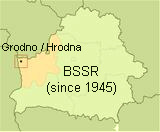
Map with BSSR and the position of Grodno
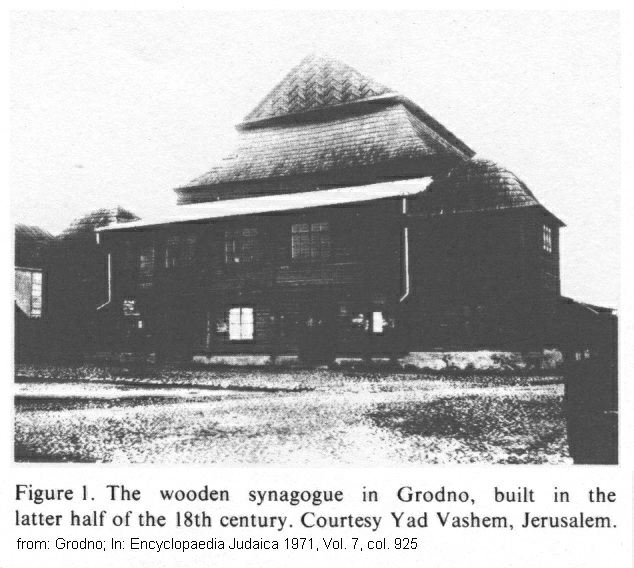
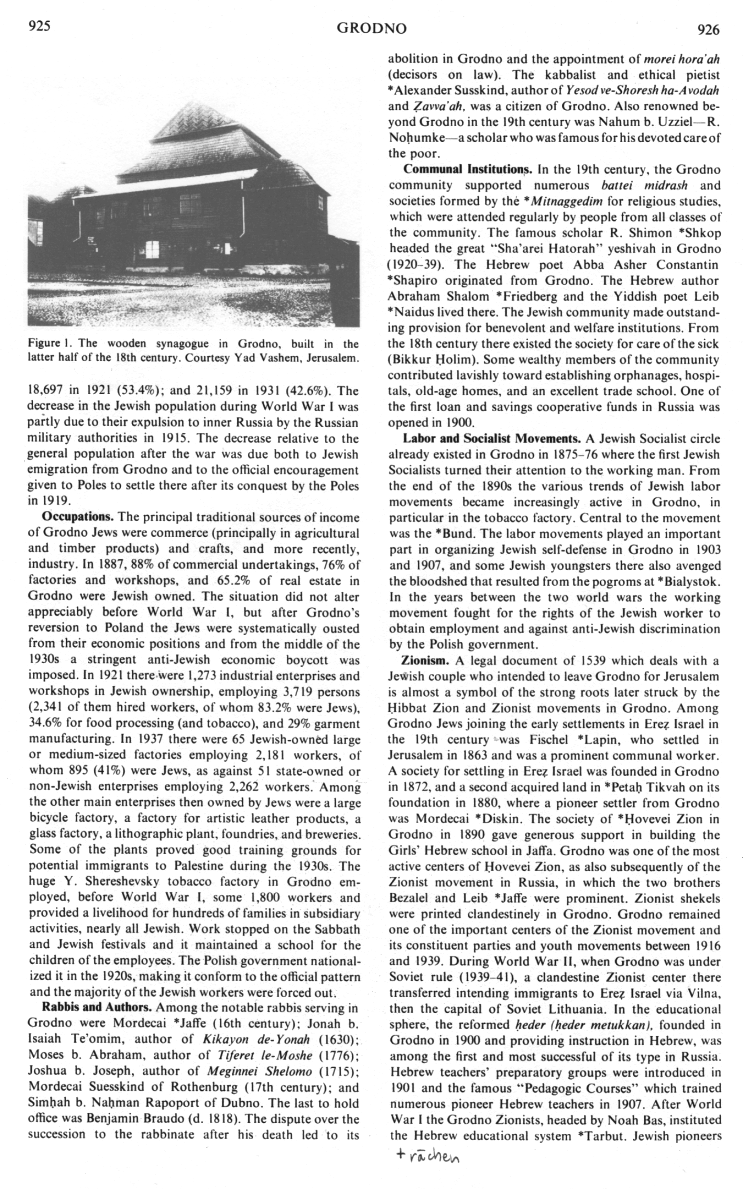
The wooden synagogue in Grodno, built in the latter half of the
18th century. Courtesy Yad Vashem, Jerusalem
from: Grodno; In: Encyclopaedia Judaica 1971, vol. 7
presented by Michael Palomino (2008 / 2023)
Share:
The solution for life is the Book of Life with Mother Earth - www.med-etc.com
[[Gulag is never mentioned in Encyclopaedia Judaica]].
One of the oldest Jewish communities in the former grand duchy of *Lithuania (see *Poland-Lithuania), the Grodno community received a charter from Grand Duke Witold in 1389. This indicates the existence of a synagogue and cemetery and shows that Jews owned real property in the city and its environs and engaged in commerce, crafts, and agriculture.
[Expulsion 1495 and return 1503 - community life - refugees from Chmielnicki massacres - Russian and Swedish invasions - Jesuits since 1616 with kidnapping of children]
They were banished by the general decree of expulsion of the Jews from Lithuania in 1495 and their property was sequestered, but were permitted to return and to claim their possessions in 1503.
During the 16th century the townsmen of Grodno were consistently hostile to the Jews, the artisans in particular. Grodno, however, became noted as a center of Jewish learning. By the end of the century a number of battei midrash [["House [of] Learning"]] and yeshivot [[religious Torah schools]] had been established and Horodno was written by the Jews as though it were Har-Adonai ("the holy mount" in Hebrew).
The community was spared during the *Chmielnicki massacres in 1648-49 and gave asylum to fugitives from the south, but later suffered from the Russian invasions of 1655-57 and subsequent invasions by the Swedes. The fanaticism of the Jesuits was from 1616 an additional spur to frequent calumnies against the Jews, and the kidnapping of Jewish children for forced conversion. The community became heavily involved in debt to pay for the defense and ransom of those victims.
[Blood libels - representation in the Council of Lithuania - Hebrew printing]
A *blood libel in 1790 resulted in the death of R. Eleazar b. Solomon of Virbalis (Verzhbolow). Another ritual murder accusation was made in 1816.
One of the three principal communities in Lithuania, Grodno was represented on the Council of Lithuania (see *Councils of the Lands). It thus assumed responsibility for the care of Jewish affairs in general, while undertaking Jewish defense in libel cases in particular, since it was the seat of the Lithuanian court of appeal.
The first Hebrew book to be published in Lithuania was printed in Grodno in 1788 in the Royal press. A second Hebrew press established in Grodno in 1793, formed the kernel of the celebrated publishing and printing house owned by the *Romm family, whose early publications were in "Vilna and Grodno" (subsequently in Vilna).> (col. 925) [[...]]
[1915: expulsion of the Jews by the Russian army - since 1919 emigration movement]
<The decrease in the Jewish population during World War I was partly due to their expulsion to inner Russia by the Russian military authorities in 1915. The decrease relative to the general population after the war was due both to Jewish emigration from Grodno and to the official encouragement given to Poles to settle there after its conquest by the Poles in 1919.> (col. 926) [[...]]
<Population Figures.
In 1549 the Jewish population formed 17% of the total; in 1560 it numbered 1,000 according to one estimate, in 1764, 2,418 and in 1793, some 4,000. When Grodno passed to Russia with the third partition of Poland in 1795, the Jewish community was the largest in Lithuania after Vilna. The Jewish population numbered 8,422 in 1816 (85.3% of the total); approximately 10,300 in 1856-57 (63.3%); 27,343 in 1887 (68.7%); 27,874 in 1904 (64.1%); 34,461 in 1912 (c. 60%); 15,504 in 1916 (64.4%); (col. 924)
18,697 in 1921 (53.4%); and 21,159 in 1931 (42.6%). [[...]]
Table. Jews in Grodno 1549-1931
xxxYearxxx xxxnumber of Jewsxxx xxxsourcexxx xxxremarkxxx
1549
col. 924 17% of the total
1560
1,000xxxxxxxxxxxx
col. 924 estimation
1764
2,418xxxxxxxxxxxx col. 924
1793
4,000xxxxxxxxxxxx col. 924
1816
8,422xxxxxxxxxxxx col. 924 85.3% of the total
1856-57
approx. 10,300xxxxxxxxxxxx col. 924 63.3% of the total
1887
27,343xxxxxxxxxxxx col. 924 68.7%
1904
27,874xxxxxxxxxxxx col. 924 64.1%
1912
34,461xxxxxxxxxxxx col. 924 c. 60%
col. 925
expulsion by the Russian army
1916
15,504xxxxxxxxxxxx col. 924 64.4%
1921
18,697xxxxxxxxxxxx col. 925 53.4%
1931
21,159xxxxxxxxxxxx col. 925 42.6%
Table by Michael Palomino; from: Grodno; In: Encyclopaedia Judaica 1971, vol. 7
Occupations.
[Agriculture - timber products - industrialization - anti-Jewish policy and anti-Jewish boycott under Polish rule since 1921]
The principal traditional sources of income of Grodno Jews were commerce (principally in agricultural and timber products) and crafts, and more recently, industry. In 1887, 88% of commercial undertakings, 76% of factories and workshops, and 65.2% of real estate in Grodno were Jewish owned. The situation did not alter appreciably before World War I, but after Grodno's reversion to Poland the Jews were systematically ousted from their economic positions and from the middle of the 1930s a stringent anti-Jewish economic boycott was imposed.
In 1921 there were 1,273 industrial enterprises and workshops in Jewish ownership, employing 3,719 persons (2,341 of them hired workers, of whom 83.2% were Jews), 34.6% for food processing (and tobacco), and 29% garment manufacturing.
In 1937 there were 65 Jewish-owned large or medium-sized factories employing 2,181 workers, of whom 895 (41%) were Jews, as against 51 state-owned or non-Jewish enterprises employing 2,262 workers. Among the other main enterprises then owned by Jews were a large bicycle factory, a factory for artistic leather products, a glass factory, a lithographic plant, foundries, and breweries.
Some of the plants proved good training grounds for potential immigrants to Palestine during the 1930s. The huge Y. Shereshevsky tobacco factory in Grodno employed, before World War I, some 1,800 workers and provided a livelihood for hundreds of families in subsidiary activities, nearly all Jewish. Work stopped on the Sabbath and Jewish festivals and it maintained a school for the children of the employees.
The Polish government nationalized it in the 1920s, making it conform to the official pattern and the majority of the Jewish workers were forced out.
[Community life]
Rabbis and Authors.
Among the notable rabbis serving in Grodno were
-- Mordecai *Jaffe (16th century);
-- Jonah b. Isaiah Te'omim, author of Kikayon de-Yonah (1630);
-- Moses b. Abraham, author of Tiferet le-Moshe (1776);
-- Joshua b. Joseph, author of Meginnei Shelomo (1715);
-- Mordecai Suesskind of Rothenburg (17th century); and
-- Simhah b. Nahman Rapoport of Dubno.
The last to hold office was Benjamin Braudo (d. 1818). The dispute over the succession to the rabbinate after his death led to its (col. 925)
abolition in Grodno and the appointment of morei horah'ah (decisors on law). The kabbalist and ethical pietist *Alexander Susskind, author of Yesod ve-Shoresh ha-Avodah and Zavva'ah, was a citizen of Grodno. Also renowned beyond Grodno in the 19th century was Nahum b. Uzziel - R. Nohumke - a scholar who was famous for his devoted care of the poor.
Communal Institutions.
[Jewish Schools - authors - care of the sick - orphanages, hospitals, old-age homes - trade school - cooperative bank]
In the 19th century, the Grodno community supported numerous battei midrash [["Houses of Learning"]] and societies formed by the *Mitnaggedim [["opponents"]] for religious studies, which were attended regularly by people from all classes of the community. The famous scholar R. Shimon *Shkop headed the great "Sha'arei Hatorah" yeshivah [[religious Torah school]] in Grodno (1920-39). The Hebrew poet Abba Asher Constantin *Shapiro originated from Grodno. The Hebrew author Abraham Shalom *Friedberg and the Yiddish poet Leib *Naidus lived there.
The Jewish community made outstanding provision for benevolent and welfare institutions. From the 18th century there existed the society for care of the sick (Bikkur Holim). Some wealthy members of the community contributed lavishly toward establishing orphanages, hospitals, old-age homes, and an excellent trade school. One of the first loan and savings cooperative funds in Russia was opened in 1900.
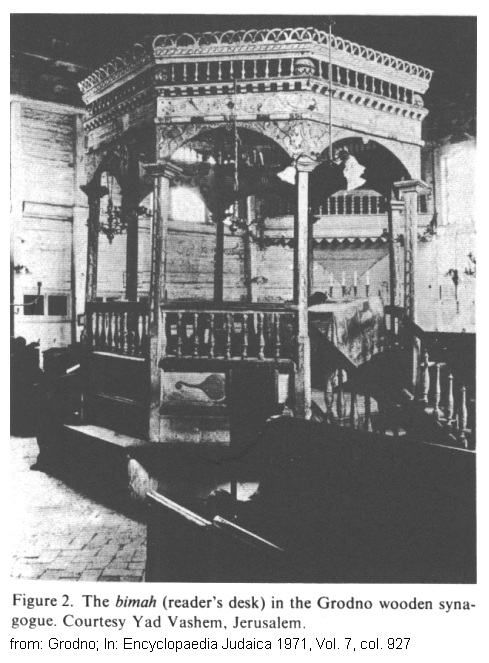
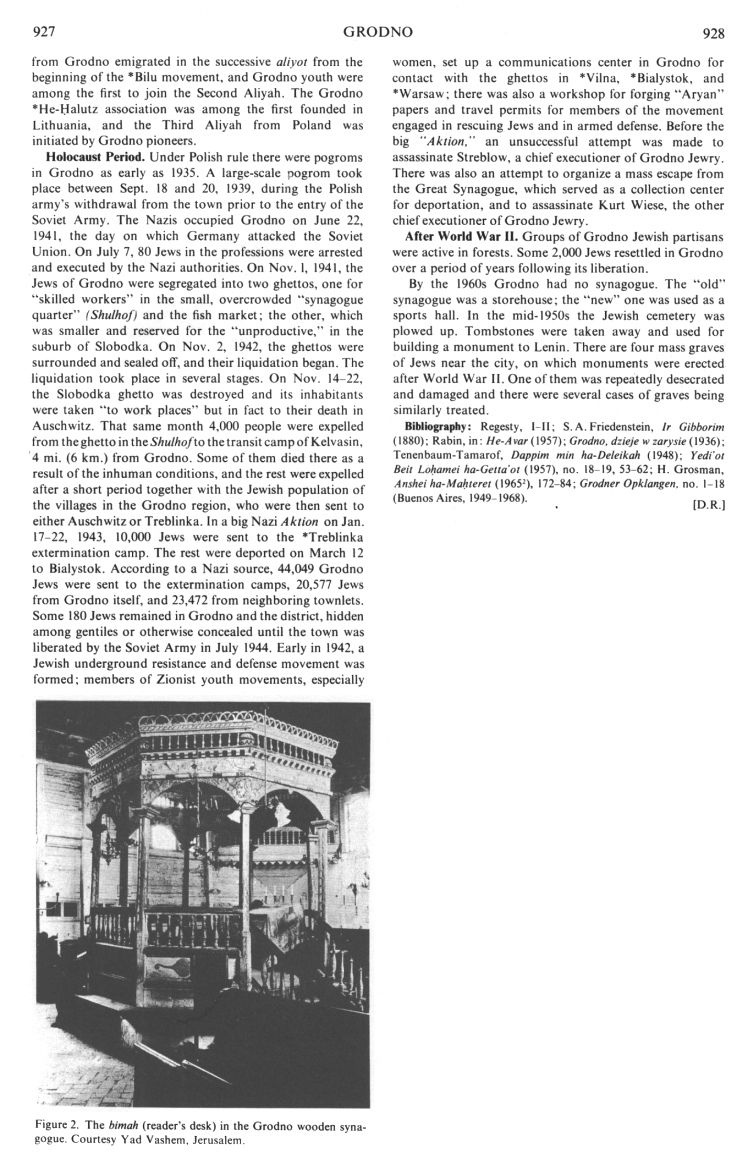
Synagogue in Grodno
Encyclopaedia Judaica 1971: Grodno, vol. 4, col. 925, the wooden synagogue of Grodno
Encyclopaedia Judaica 1971: Grodno, vol. 4, col. 927, the bimah (reader's desk) in the Grodno wooden synagogue. Courtesy Yad Vashem, Jerusalem
Labour and Socialist Movements.
[Tobacco factory - Bund - self-defense1903 and 1907 - activity against Polish anti-Jewish policy since 1921]
A Jewish Socialist circle already existed in Grodno in 1875-76 where the first Jewish Socialists turned their attention to the working man. From the end of the 1890s the various trends of Jewish labour movements became increasingly active in Grodno, in particular in the tobacco factory. Central to the movement was the *Bund. The labour movement played an important part in organizing Jewish self-defense in Grodno in 1903 and 1907, and some Jewish youngsters there also avenged the bloodshed that resulted from the pogroms at *Bialystok.
In the years between the two world wars the working movement fought for the rights of the Jewish worker to obtain employment and against anti-Jewish discrimination by the Polish government.
[[Herzl]] Zionism.
[Founding of organizations for settling in Palestine - land purchase foundation for Petah Tikvah - Hovevei Zion of Grodno - clandestine shekels - emigration movements to Palestine (aliyot)]
A legal document of 1539 which deals with a Jewish couple who intended to leave Grodno for Jerusalem is almost a symbol of the strong roots later struck by the Hibbat Zion and Zionist movements in Grodno. Among Grodno Jews joining the early settlements in Erez Israel in the 19th century was Fischel *Lapin, who settled in Jerusalem in 1863 and was a prominent communal worker.
A society for settling in Erez Israel was founded in Grodno in 1872, and a second acquired land in *Petah Tikvah on its foundation in 1880, where a pioneer settler from Grodno was Mordecai *Diskin. The society of *Hovevei Zion in Grodno in 1890 gave generous support in building the Girls' Hebrew school in Jaffa. Grodno was one of the most active centers of Hovevei Zion, as also subsequently of the Zionist movement in Russia, in which the two brothers Bezalel and Leib *Jaffe were prominent. Zionist shekels were printed clandestinely in Grodno.
Grodno remained one of the important centers of the Zionist movement and its constituent parties and youth movements between 1916 and 1939. During World War II, when Grodno was under Soviet rule (1939-41), a clandestine Zionist center there transferred intending immigrants to Erez Israel via Vilna, then the capital of Soviet Lithuania. In the educational sphere, the reformer heder [[Jewish religious school to age of 13]] (heder metukkan), founded in Grodno in 1900 and providing instruction in Hebrew, was among the first and most successful of its type in Russia.
Hebrew teachers' preparatory groups were introduced in 1901 and the famous "Pedagogic Courses" which trained numerous pioneer Hebrew teachers in 1907.
After World War I the Grodno Zionists, headed by Noah Bas, instituted the Hebrew educational system *Tarbut [["Culture"]]. Jewish pioneers (col. 926)
from Grodno emigrated in the successive aliyot from the beginning of the *Bilu movement, and Grodno youth were among the first to join the Second Aliyah. The Grodno *He-Halutz association was among the first founded in Lithuania, and the Third Aliyah from Poland was initiated by Grodno pioneers. [[...]]
[Pogroms 1935 and 1939 - soviet rule 1939-1941]
Under Polish rule there were pogroms in Grodno as early as 1935. A large-scale pogrom took place between Sept. 18 and 20, 1939, during the Polish army's withdrawal from the town prior to the entry of the Soviet Army. [[..]]]
[[Supplement: Soviet regime in Grodno 1939-1941
With the Soviet Army were connected:
-- sovietization with oppression of all religious and Herzl Zionist activities
-- deportation of class enemies (middle class) to Siberia (villages and concentration camps, gulag)
-- deportation of Jewish refugees of western Poland to Siberia (villages and concentration camps, gulag) because of the passport question
-- deportation of members of families of class enemies to Siberia (villages and concentration camps, gulag)
-- Big Flight from Barbarossa: organized removal of industries to Russian interior since April 1941 with many Jewish workers, and organized withdrawal and organized flight of many Jews to Inner Russia with the Red Army since 18 June 1941, partly in connection with a scorched earth policy
-- arbitrary flight of Jews who are blocked at the Soviet border, they have to survive in cellars or forests or die
-- eventually: pogroms against the Jews of the staying "Christian" population against the Jews between the withdrawal of the Red Army and the arrival of the NS Wehrmacht]].
Holocaust Period.
[Massacre - two ghettos since 1 Nov. 1941 - liquidation since 2 Nov. 1942 - deportations to Auschwitz, Kelvasin, and Treblinka]
[[...]] The Nazis occupied Grodno on June 22, 1941, the day on which Germany attacked the Soviet Union.
On July 7, 80 Jews in the professions were arrested and executed by the Nazi authorities.
On Nov. 1, 1941, the Jews of Grodno were segregated into two ghettos, one for "skilled workers" in the small, overcrowded "synagogue quarter" (Shulhof) [["schoolyard"]] and the fish market; the other, which was smaller and reserved for the "unproductive", in the suburb of Slobodka.
On Nov. 2, 1942, the ghettos were surrounded and sealed off, and their liquidation began. The liquidation took place in several stages. On Nov. 14-22, the Slobodka ghetto was destroyed and its inhabitants were taken "to work places" but in fact to their death in Auschwitz.
[[Normally the victims were shoot on a pit which had to be digged out before. When they were transferred to Auschwitz they probably were also transferred to tunnel systems for the underground weapon production and new Fuehrer bunkers, i.e. for the "Underground Reich", with high death rates]].
That same month 4,000 people were expelled from the ghetto in the Shulhof to the transit camp of Kelvasin, 4 mi. (6 km.) from Grodno. Some of them died there as a result of the inhuman conditions, and the rest were expelled after a short period together with the Jewish population of the villages in the Grodno region, who were then sent to either Auschwitz or Treblinka. In a big Nazi Aktion on Jan. 17-22, 1943, 10,000 Jews were sent to the *Treblinka extermination camp. The rest were deported on March 12 to Bialystok.
According to a Nazi source, 44,049 Grodno Jews were sent to the extermination camps, 20,577 Jews from Grodno itself, and 23,472 from neighbouring townlets. Some 180 Jews remained in Grodno and the district, hidden among gentiles or otherwise concealed until the town was liberated by the Soviet Army in July 1944.
[[There is the big question who all counted as a "Jew" after the Soviet withdrawal after June 1941. Many Poles were willing collaborators of the German Nazi forces and indicated "Jewish" houses to them. A false oral indication was enough to be damned as a "Jew" under the NS regime because every indication at the NS police was rewarded. Other Jews changed passports or names or indicated a false religion, or were hidden by Christian families etc. All this provoked a strong Herzl Zionism with a false hope for a "home" in Palestine, where the Arabs lived and prepared a big defense against a Jewish invasion...]].
[Jewish resistance movement]
Early in 1942, a Jewish underground resistance and defense movement was formed; members of Zionist youth movements, especially (col. 927)
women, set up a communications center in Grodno for contact with the ghetto s in *Vilna, *Bialystok, and *Warsaw; there was also a workshop for forging "Aryan" papers and travel permits for members of the movement engaged in rescuing Jews and in armed defense. Before the big "Aktion" [["Action"]], an unsuccessful attempt was made to assassinate Streblow, a chief executioner of Grodno Jewry. There was also an attempt to organize a mass escape from the Great Synagogue, which served as a collection center for deportation, and to assassinate Kurt Wiese, the other chief executioner of Grodno Jewry.
After World War II.
[Soviet rule since 1944 - Soviet rule destroys Judaizm since 1948]
Groups of Grodno Jewish partisans were active in forests. Some 2,000 Jews resettled in Grodno over a period of years following its liberation.
[[It can be admitted that a part of the deported Jews of Grodno has survived and was in the DP camps and emigrated to Palestine or overseas, because nobody wanted to get under Soviet rule again. Many Jews who were surviving in the forests were drawn into the Red Army and by this died at the front 1944-1945. There were many Hezl Zionist organizations organizing false passports and flight over Rumania to Palestine. Since 1948 Stalin and his successors implemented a harsh anti-Semitic policy suppressing religion and Herzl Zionism because of Herzl Free Mason CIA Israel which functioned as a puppet state of the "USA" to encircle the Soviet Union. So the numbers of Jews who openly stated to be Jewish declined in the Soviet sphere of influence, and the institutions were closed step by step]].
By the 1960s Grodno had on synagogue. The "old" synagogue was a storehouse; the "new" one was used as a sports hall. In the mid-1950s the Jewish cemetery was plowed up. Tombstones were taken away and used for building a monument to Lenin. there are four mass graves of Jews near the city, on which monuments were erected after World War II. One of them was repeatedly desecrated and damaged and there were several cases of graves being similarly treated.
Bibliography
-- Regesty, I-II
-- S.A. Friedenstein: Ir Gibborim (1880)
-- Rabin, in: He-Avar (1957)
-- Grodno, dzieje w zarysie (1936)
-- Tenenbaum-Tamarof: Dappim min ha-Deleikah (1948)
-- Yedi'ot Beit Lohamei ha-Getta'ot (1957), no. 18-19, 53-62
-- H. Grosman: Anshei ha-Mahteret (1965), 172-84
-- Grodner Opklangen, no. 1-18 (Buenos Aires, 1949-1968)> (col. 928)
Share:
The solution for life is the Book of Life with Mother Earth - www.med-etc.com
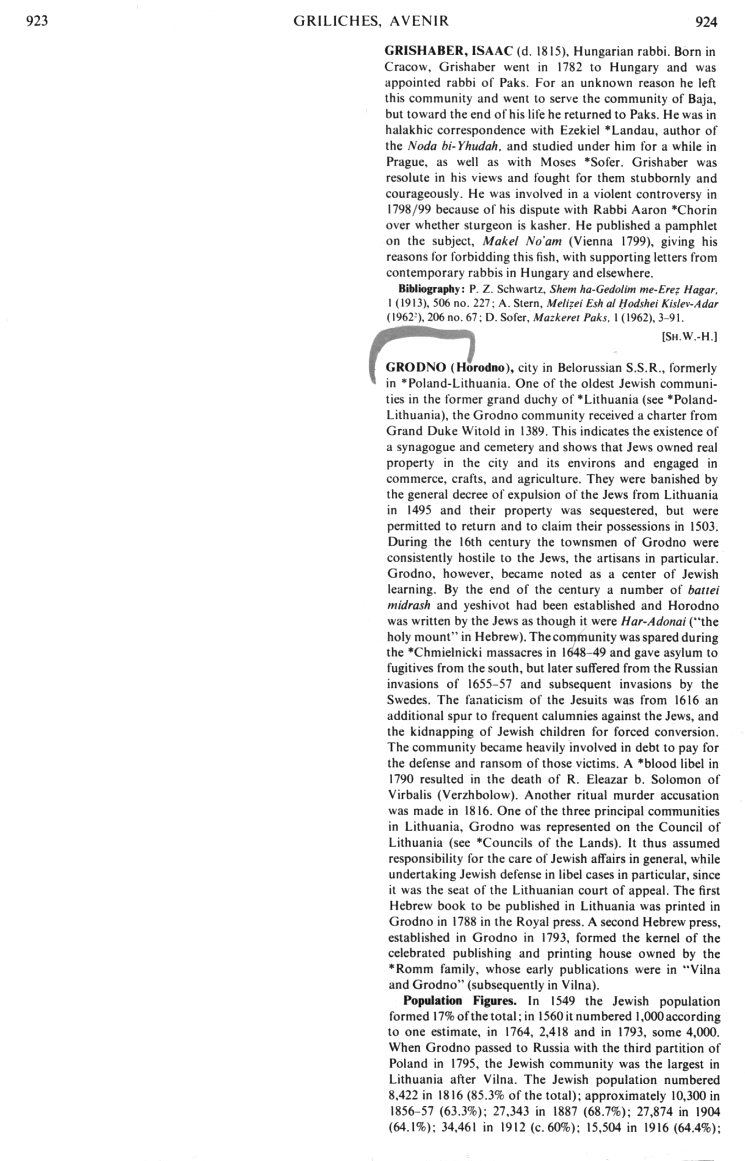
Encyclopaedia Judaica 1971: Grodno, sources
Encyclopaedia Judaica 1971: Grodno, vol. 4, col. 924
Encyclopaedia Judaica 1971: Grodno, vol. 4, col. 925-926
Encyclopaedia Judaica 1971: Grodno, vol. 4, col. 927-928
Picture credits
-- map with the position of Grodno: http://de.wikipedia.org/wiki/Grodno
^