Encyclopaedia Judaica
Jews in Mir
Trade and Jewish poll tax - cultural life - professions - pogroms, Bundists, and racist Zionists - Sovietization 1939-1941 - Holocaust 1941-1944 - resistance and flight to Shanghai - yeshivah transferred to New York in 1947
from: Mir; In: Encyclopaedia Judaica 1971, vol. 12
presented by Michael Palomino (2008 / 2023)
Share:
The solution for life is the Book of Life with Mother Earth - www.med-etc.com
<MIR, town in Grodno oblast, Belorussian S.S.R.
[Jewish trade since 16th century - fairs - Jewish poll tax]
From 1569 until 1813 the town and the surrounding estates were the property of the Radziwill princes. Jews first settled in Mir at the beginning of the 17th century. To begin with they were under the jurisdiction of the community of *Nesvizh, but within a few years their numbers had rapidly increased and it can be assumed that they then had their own communal organizations.
The Jews became an important factor in local trade and at the two annual fairs held in Mir. Many of them also earned their livelihood as carters. Jewish merchants from every part of Lithuania and Poland were attracted to the fairs of Mir, where they carried on an extensive trade in furs (exporting them especially to Leipzig), horses, oxen, spices, grain, textiles, tobacco (from 1672), and wine.
In the records of the Lithuanian council (see *Councils of the Lands) Mir is mentioned for the first time in 1662. From 1673, the taxes owed by the Jews of Lithuania to state institutions and debts to other creditors were occasionally collected at the Mir fairs.
In 1685 after complaints by the Jewish representatives, Catherine Sapicha of the Radziwill family instructed the administrator of the town to respect the rights of the Jews and to refrain from dispensing justice or arbitrating in their internal affairs.
During the early decades of the 18th century, the Jewish population of Mir increased considerably. The local Jewish contribution to the poll tax rose from 45 zlotys in 19673 to 1,160 zlotys in 1700 and 1,350 zlotys in 1720. During this period the merchants of Mir maintained fruitful commercial relations with *Leipzig, *Koenigsberg, *Memel, and Libau (*Liepaja). In 1697, 1702, and 1751, the community leaders of Lithuania Jewry conferred in Mir, which then acquired the status of an autonomous community. From the second half of the 18th century, the economic situation of the community declined. In 1760 the Jews of Mir paid 480 zlotys in poll tax; the census of 1765 recorded 607 Jews in the town and the vicinity who paid this tax.
[Cultural life - rabbis - Rappoport, Eisenstadt and Ajzensztat]
Prominent rabbis officiated in Mir during the 18th century. The first av bet din [[eldest court chairman]] known by name (in the late 1720s) was R. Meir b. Isaac *Eisenstadt, followed by R. Zevi (Ẓevi) Hirsch ha-Kohen *Rappoport; during the middle of that century, R. Solomon Zalman b. Judah Mirkish, author of Shulhan (Shulḥan) Shelomo (Frankfort on the Oder, 1771), held rabbinical office for 15 years. He was succeeded by R. Zevi (Ẓevi) Hirsh Eisenstadt. During the rabbinate of R. Joseph David Ajzensztat (1776-1826), the famous yeshivah [[religious Torah school]] of Mir was founded. At the beginning of the 19th century *Habad Hasidism (Ḥabad Ḥasidism) acquired considerable influence in the community.
[Professions]
In 1806 the Mir community numbered 807, including 106 tailors, five goldsmiths, six cord-makers, and about 30 merchants. In the 65 nearby villages, there were 494 Jews in 1818. The numbers in Mir itself rose to 2,273 in 1847 and 3,319 (bout 62% of the total population) in 1897. From the second half of the 19th century, with the exception of the wood, grain, horse, and textile merchants who formed the upper class, the majority of the local Jews were craftsmen such as scribes, carters, butchers, and tailors.
[Pogrom 1901 - danger of pogroms 1904-1905 - Socialist Bund - racist Zionists - institutions - WW I]
The wooden synagogue, which had been erected in the middle of the 18th century, was burnt down in 1901. With the threat of pogroms in 1904-05, Mir Jews organized a *self-defense organization. During this period, the [[Socialist party]] *Bund and [[Jewish racist]] *Po'alei Zion movement won many adherents in the town. The [[racist]] Zionist movement was organized there in 1914. In 1921 there were 2,074 Jews (c. 55% of the population) living in the town. Their difficult economic situation deteriorated (col. 70)
even further from the late 1920s. A Yiddish elementary school and kindergarten were founded in 1917, during the 1920s they were administered by CYSHO and during the 1930s by the Shul-Kult. During the same period, *Tarbut, *Yavneh, and *Beth Jacob schools functioned in Mir. The Jewish library was founded in 1908.
The yeshivah [[religious Torah school]] of Mir, founded by Samuel b. Hayyim (Ḥayyim) *Tiktinski in 1815 and directed by his son Abraham after his death, played a central role in the spiritual life of the community. From 1836 it was headed by Moses Abraham b. Joseph Ajzensztat and later by Hayyim (Ḥayyim) Zalman *Bresler, rabbi of the town, who resigned as the result of a dispute. From then on, the offices of town rabbi and rosh yeshivah [[dean of a Talmudical academy]] were separated.
From the 1880s, the rabbi was Yom Tov *Lipman (R. Lipa). In 1903 he was succeeded by R. Elijah David *Rabinowitz Teomim, who served until his aliyah [[emigration]] to Erez Israel (Ereẓ Israel). The last rabbi of Mir was Abraham Zevi (Ẓevi) Kamai (from 1917 until the Holocaust).
During World War I, the yeshivah [[religious Torah school]] of Mir was transferred to Poltava but returned to the town in 1921, and was then headed by R. Eliezer Judah Finkel. Mir was the birthplace of Zalman *Shazar (Rubashov).
[A.CY.]
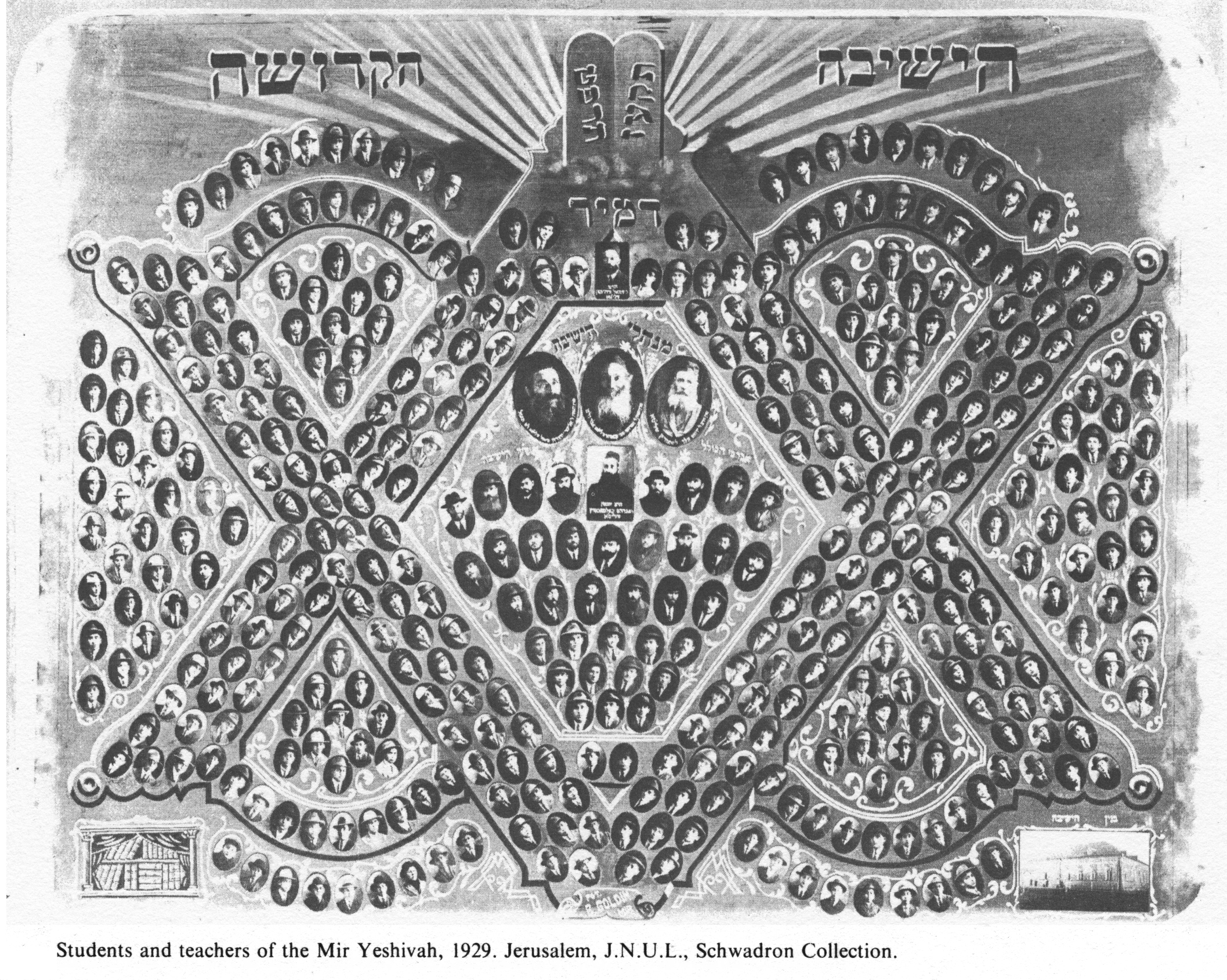
Encyclopaedia Judaica (1971): Mir, vol. 16, col. 71-72. Students and teachers of the Mir Yeshivah, 1929.
Jerusalem, J.N.U.L., Schwadron Collection.
[[The time from 1919 to 1939 is missing in the article]].
Holocaust Period.
[Sovietization 1939-1941]
Under Soviet rule (1939-41) private enterprise was gradually stifled and factories, businesses, and even large buildings were taken over by the state. The yeshivah students and rabbis, headed by R. Eliezer Judah Finkel, moved to Vilna in still independent Lithuania (Finkel managed to reach Palestine and founded the Mir Yeshivah in Jerusalem).
[Stalin deportations 1940-1941 and the Big Flight from Barbarossa with the withdrawal of the Russian army and the industrial and the administration staff with many Jews are not mentioned in the article. There are no numbers indicated, how many Jews lived in Mir in 1939]].
[German Nazi occupation 1941-1944 - massacres]
The Germans captured Mir on June 27, 1941. They immediately executed scores of Jews on charges of Soviet collaboration.
On November 9, 1941, 1,500 Jews were murdered on the outskirts of the town. The surviving 850 Jews were segregated into a ghetto, and (col. 71)
transferred in May 1942 to the ancient fortress in the city.
[Resistance movement and flight - Jewish students can escape to Shanghai]
A young Jew, Shemuel (Oswald) Rufeisen, born in the Cracow district, played a key role in the Mir resistance movement. After the removal of the Jews to the Mirski fortress, a resistance movement of 80 members was organized to offer armed resistance to the imminent Aktion ("action") against the Jewish population. Working in groups of five, they acquired weapons and trained themselves. Their central command was made up of Ha-Shomer ha-Za'ir, Deror, Bund, and Communists.
Early in August 1942 Rufeisen informed the underground that the Germans would begin their liquidation campaign on Aug. 13, 1942. On Aug. 9, 1942, about 200 young people left for the forests on the assumption that no effective resistance action against the Germans could be taken inside the ghetto. On August 13 the liquidation action began, and all those who had remained in the ghetto were murdered in Yablonoshchina and buried in mass graves. Those who had escaped to the forests were confronted with many difficulties. Russian partisan units often refused to accept Jews in to their ranks, and many of the Mir Jews who came to the forests were killed by anti-Semitic Russian partisans. Despite all these difficulties, Mir Jews managed to join Soviet partisan units, and took, part in sabotage activities. Following the arrival of the Soviet army the Jewish partisans from Mir joined the Soviet forces to continue the fight against the Nazis up till the end of the war.
The student body of the yeshivah was saved during the war by escaping to *Shanghai [[see also: *China]].
[Post-war times - yeshivah transferred to New York in 1947]
After the war (1947), the yeshivah [[religious Torah school]] was transferred to Brooklyn, New York (Mirrer Yeshivah Central Institute). Some of its scholars later joined the Mir Yeshivah in Jerusalem.
[AR.W.]> (col. 72)
[[Jews coming back from central Russia are missing in the article. Also the sovietization after 1948 are missing]].
Share:
The solution for life is the Book of Life with Mother Earth - www.med-etc.com
Sources
Encyclopaedia Judaica (1971): Mir, vol. 16, col. 70
Encyclopaedia Judaica (1971): Mir, vol. 16, col. 71-72