Encyclopaedia Judaica
Jews in Mogilev
Massacre of 1665 - letters patents since 1656 - growing community - Russian rule and growing community - sovietization since 1919 - Holocaust 1941-1944 - second sovietization since 1944
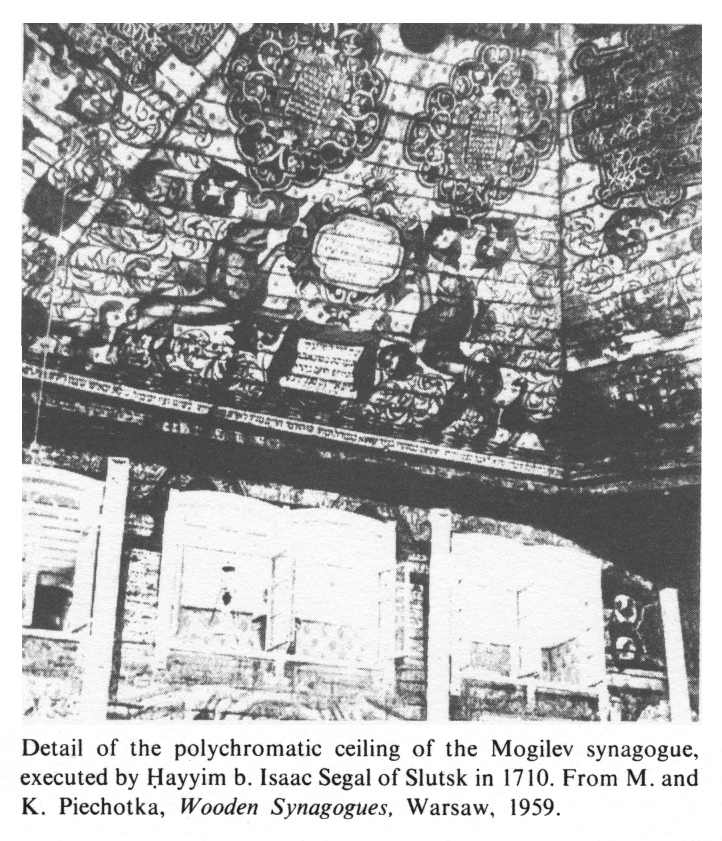
Encyclopaedia Judaica (1971): Mogilev, vol. 12, col. 215. Detail of the polychromatic ceiling of the Mogilev synagogue, executed by Hayyim b. Isaac Segal of Slutsk in 1710. From M. and K. Piechotka: "Wooden Synagogues", Warsaw, 1959
from: Mogilev; In: Encyclopaedia Judaica 1971, vol. 12
presented by Michael Palomino (2008 / 2023)
Share:
The solution for life is the Book of Life with Mother Earth - www.med-etc.com
<MOGILEV, [[...]]
[Massacre of 1655 - letters patent in 1656 - blood libel in 1692 - new restrictions since 1736, but growing community]
ately carried out, but as the Polish army approached Mogilev in 1655, the Russian commander drove the Jews out of the town and ordered their massacre. Those Jews who remained became apostates. After the end of the war the community was renewed and most of the apostates returned to Judaism.
In 1656 John II Casimir granted letters patent to the town according to which the Jews were forbidden to live within the walls of the city and to build houses or maintain shops there. There was a *blood libel in Mogilev in 1692.
In 1736 King Augustus III confirmed the earlier letters patent of John II Casimir, adding further anti-Jewish restrictions. Restrictive orders on settlement and occupations were later reissued, but were not applied in practice.
In spite of opposition, the community continued to develop. By 1692 there were two synagogues. In 1748 the municipality reprimanded the townspeople because they themselves had helped the Jews to settle in the center of the town and to engage in commerce. In 1766, 642 poll tax paying Jews were registered within the community of Mogilev and the surrounding villages. In the *Councils of the Lands Mogilev was subordinated to *Brest-Litovsk.
[Mogilev under Russian rule: judicial autonomy - cultural life]
The community developed to a considerable extent after Mogilev was annexed by Russia. The Jews of the annexed region were granted judicial autonomy, and the community of Mogilev was designated as the central community of the whole province, its bet din [[ecclesiastical court]] being given authority to hear appeals against the legal decisions of the province's communities.
The Jews played a principal role in Mogilev's extensive trade with Riga, Memel, Koenigsberg, and Danzig (*Gdansk) and later with southern Russia.
In 1847 there were 7,897 Jews registered in Mogilev. The Jews were greatly influenced by *Habad Hasidism (Ḥabad Ḥasidism) [[Orthodoxy, pietistic movement]], but by the end of the 18th century there were several maskilim [[followers of the Haskalah, enlightenment Jews, secularists]] among the wealthy merchants.
In 1783 one of them, Jacob Hirsch, addressed a memorandum to the Russian government in which he suggested that the hadarim (ḥadarim) [[Jewish religious school to age of 13]] and talmud torah schools in both the district of Mogilev and the town itself be converted into schools where secular studies would also be taught.
During the 1860s and early 1870s Pavel (Pesah, Pesaḥ) *Axelrod, who had studied at the local secondary school and later spread the ideas of the Haskalah [[enlightenment]] among Jewish youth, lived in Mogilev.
In 1870 the *Malbim (Meir Leib b. (col. 215)
Jehiel Michael) was invited to become rabbi of Mogilev, but was soon compelled to leave the town after the maskilim [[enlightenment Jews]] denounced him to the authorities as disloyal to Russia.
In 1897 there were 21,539 Jews in Mogilev (about 50% of the total population).
[Pogroms of 1904 - Socialist Bund and racist Zionists]
In October 1904 pogroms were initiated by soldiers mobilized for the war against Japan.
Mogilev was one of the important centers of the [[Socialist party]] *Bund, and of the [[racist]] Zionist Movement.
[WW I - sovietization with the elimination of Jewish life in Mogilev]
[[The events of World War I are not mentioned. It can be admitted that there was a huge wave of Jewish refugees, and eventually also a destruction of the town]].
Following World War I and the establishment of the Communist regime, the number of Jews decreased and by 1926 only 17,105 (34.1% of the population) remained. During the 1920s a violent struggle occurred between the religious circles and the [[racist]] Zionists on the one hand, and the *Yevsektsiya on the other, which terminated with the liquidation of Jewish communal life in the town.
Mogilev was the birthplace of *Mordecai b. Hillel Hakohen, Nachman *Syrkin, and Jacob *Mazeh.
[[The Big Flight of Barbarossa with the withdrawal of the Russian army with the administration and the industrial staff with many Jews is not mentioned in the article]].
[Holocaust under Nazi rule]
When Mogilev was occupied by the Germans during World War II (1941), those Jews who did not escape were massacred.
[[Resistance, change of name, change of religion and hideouts are not mentioned in this article. In 1945 the partisans probably fled with racist Zionist groups to the D.P. camps in western Europe or were emigrating directly to the Black Sea and from there Palestine]].
[Second Sovietization since 1944 - synagogues closed down]
[[Jews were coming back from central Russia in 1946. After the establishment of racist Zionist Free Mason CIA Herzl Israel in 1948 the Soviet governments started anti-Semitism waves generally against all Jews so many Jews lost the courage to be Jewish. Scandals with Jewish ambassadors and the blame of synagogues to be centers of espionage were another reason for many Jews to give up their religion]].
It was estimated that there were about 7,000 to 10,000 Jews in Mogilev in 1959. The last synagogue was closed down by the authorities in 1959 and turned into a sports gymnasium. There was a Jewish cemetery. (col. 216)
The Province of Mogilev.
Together with the province of Vitebsk, it was the first region with a large Jewish population to be annexed by Russia, later comprising the core of the *Pale of Settlement as one of the "western" provinces in which most of Russian Jewry was concentrated. The province of Mogilev was one of the two provinces where the prohibition concerning the settlement of Jews in the villages, included in the "Jewish Constitution" of 1804, was fully applied (in 1823).
In 1847, 87,739 Jews were registered in the communities of the province.
By 1897 the number had risen to 203,947 (12.1% of the total population), 37.9% living in the towns, 38.9% in the townlets, and 23.06% in the villages. The large communities of the province included (in addition to Mogilev):
-- *Gomel (20,385 Jews)
-- *Orsha (7,383 Jews)
-- *Shklov (5,422 Jews)
-- *Mstislavl (5,076 Jews), and
-- *Rogachev (5,047 Jews).
In 1897, 38.95% of the province's Jews earned their livelihood from commerce and 36.90% in crafts; 9,517 Jews (4.7% of the total Jewish population) depended on agriculture. There were about 70 small Jewish agricultural settlements in the province. Under the Soviet regime, most of the territory of the province was incorporated into the oblasts of Mogilev, Vitebsk, and Gomel. In 1926 there were 48,900 Jews in the oblast of Mogilev.
Bibliography
-- Belkind, in: Keneset Yisrael, 1 (1886), 699-704
-- Dubnow, in: Pardes, 3 (1896), 94-100
-- Darin-Drabkin, in: Haaretz (Dec. 6, 1963)
-- Mstislavskiy, in: Voskhod (Sept. 1-10, Oct. 1-16, Dec. 1-8, 1886)
-- P.B. Axelrod: Perezhitoye i peredumanoye (1923), 33-67.
[Y.S.]> (col. 216)
Share:
The solution for life is the Book of Life with Mother Earth - www.med-etc.com
Sources
Encyclopaedia Judaica (1971): Mogilev, vol. 12, col. 215-216
Č Ḥ Š Ṭ Ẓ
ā ć č ḥ ī ń š ū ž ẓ