<NOVOGRUDOK, (Pol. Nowogródek; also referred to by Jews as Novaredok), city in Grodno oblast, Belorussian S.S.R.

Encyclopaedia Judaica
Jews in Novogrudok
Community life under different rules - Sovietization - Holocaust - post-war times
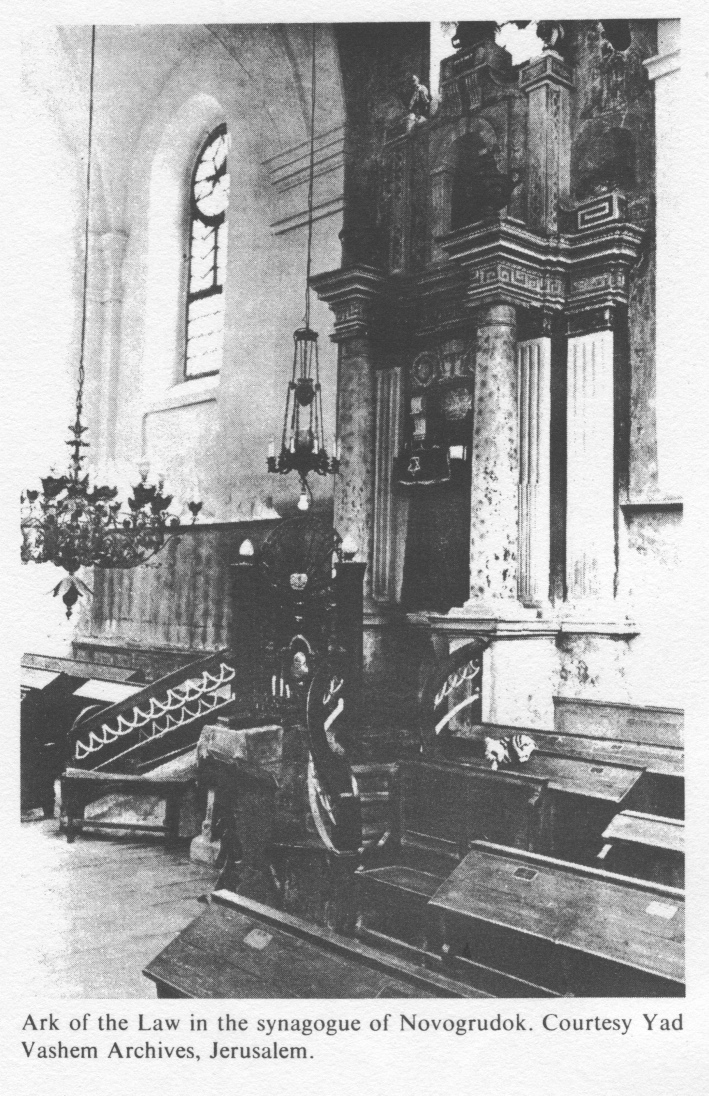
Encyclopaedia Judaica (1971): Novogrudok, vol. 12, col. 1238. Ark of the Law
in the synagogue of Novogrudok. Courtesy Yad Vashem Archives, Jerusalem.
from: Novogrudok; In: Encyclopaedia Judaica 1971, vol. 12
presented by Michael Palomino (2008 / 2023)
Share:
The solution for life is the Book of Life with Mother Earth - www.med-etc.com
[Poland-Lithuania - Polish law since 1795 - Russian law since 1842 - Polish law since 1921 - Sovietization 1939-1941]
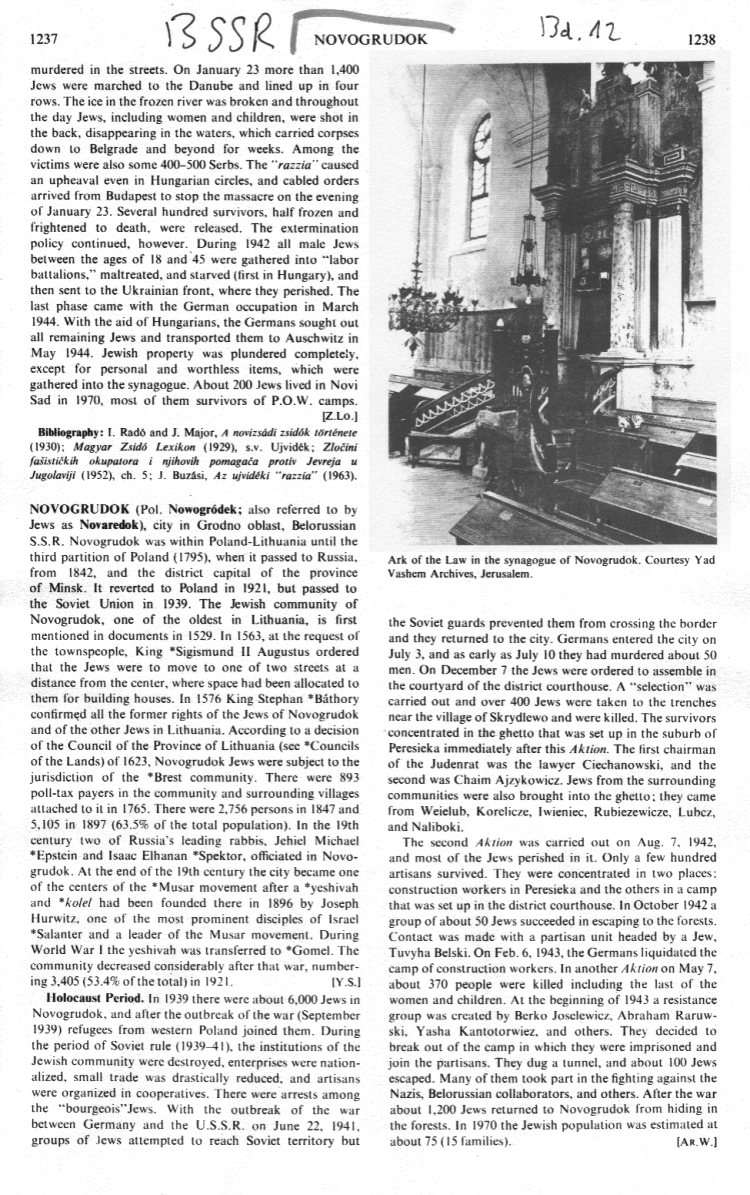
Novogrudok was within Poland-Lithuania until the third partition of Poland (1795), when it passed to Russia, from 1842, and the district capital of the province of Minsk. It reverted to Poland in 1921, but passed to the Soviet Union in 1939.
The Jewish community of Novogrudok, one of the oldest in Lithuania, is first mentioned in documents in 1529. In 1563, at the request of the townspeople, King *Sigismund II Augustus ordered that the Jews were to move to one of two streets at the distance from the center, where space had been allocated to them for building houses.
In 1576 King Stephan *Báthory confirmed all the former rights of the Jews of Novogrudok and of the other Jews in Lithuania. According to a decision of the Council of the Province of Lithuania (see *Councils of the Lands) of 1623, Novogrudok Jews were subject to the jurisdiction of the *Brest community. There were 893 poll-tax payers in the community and surrounding villages attached to it in 1765. There were 2,756 persons in 1847 and 5,105 in 1897 (63.5% of the total population).
In the 19th century two of Russia's leading rabbis, Jehiel Michael *Epstein and Isaac Elhanan *Spektor, officiated in Novogrudok. At the end of the 19th century the city became one of the centers of the *Musar movement after a *yeshivah [[religious Torah school]] and *kolel [[advanced Talmud and rabbinic literature institute for men]] had been founded there in 1896 by Joseph Hurwitz, one of the most prominent disciples of Israel *Salanter and a leader of the Musar movement.
During World War I the yeshivah was transferred to *Gomel. The community decreased considerably after that war, numbering 3,405 (53.4% of the total) in 1921.
[Y.S.]
[[The community decreased probably by the emigration movement]].
[Jewish refugees from western Poland 1939 - Sovietization 1939-1941]
In 1939 there were about 6,000 Jews in Novogrudok, and after the outbreak of the war (September 1939) refugees from western Poland joined them. During the period of Soviet rule (1939-41), the institutions of the Jewish community were destroyed, enterprises were nationalized, small trade was drastically reduced, and artisans were organized in cooperatives. There were arrests among the "bourgeois" Jews.
[[Stalin deportations 1940-1941 and the Big Flight from Barbarossa with the withdrawal of the Russian army with administration and industrial staff with many Jews are missing in the article]].
With the outbreak of the war between Germany and the U.S.S.R. on June 22, 1941, groups of Jews [[by arbitrary flight, not within the withdrawal of the Russian army, the persons are "not important for the war"]] attempted to reach Soviet territory but (col. 1237)
the Soviet guards prevented them from crossing the border and they returned to the city.
[Holocaust: massacres - ghetto - "actions" - resistance in the forest - flight by a tunnel]
Germans entered the city on July 3, and as early as July 10 they had murdered about 50 men. On December 7 the Jews were ordered to assemble in the courtyard of the district courthouse. A "selection" was carried out and over 400 Jews were taken to the trenches near the village of Skrydlewo and were killed. The survivors concentrated in the ghetto that was set up in the suburb of Peresieka immediately after this Aktion.
The first chairman of the Judenrat was the lawyer Ciechanowski, and the second was Chaim Ajzykowicz. Jews from the surrounding communities were also brought into the ghetto; they came from Weielub, Korelicze, Iwieniec, Rubiezewicze, Lubez, and Naliboki.
The second Aktion was carried out on Aug. 7, 1942, and most of the Jews perished in it. Only a few hundred artisans [[who were "important" for their work]] survived. They were concentrated in two places [[because the ghetto was too big for them now]]: construction workers in Peresieka and the others in a camp that was set up in the district courthouse.
In October 1942 a group of about 50 Jews succeeded in escaping to the forests. Contact was made with a partisan unit headed by a Jew, Tuvyah Belski [[also: Bielski]].
On Feb. 6, 1943, the Germans liquidated the camp of construction workers. In another Aktion on May 7, about 370 people were killed including the last of the women and children. At the beginning of 1943 a resistance group was created by Berko Joselewicz, Abraham Raruwski, Yasha Kantotorwiez, and others. They decided to break out of the camp in which they were imprisoned and join the partisans. They dug a tunnel, and about 100 Jews escaped. Many of them took part in the fighting against the Nazis, Belorussian collaborators, and others.
[[When the Russian army occupied Novogrudok the surviving male Jews were drawn into the Russian army to fight and to die against the German army]].
[Post-war times]
After the war about 1,200 Jews returned to Novogrudok from hiding in the forests.
[[The returning Jews from central Russia are missing in the article. Emigration movement is not mentioned in the article]].
In 1970 the Jewish population was estimated at about 75 (15 families).
[AR.W.] (col. 1238)
Share:
The solution for life is the Book of Life with Mother Earth - www.med-etc.com
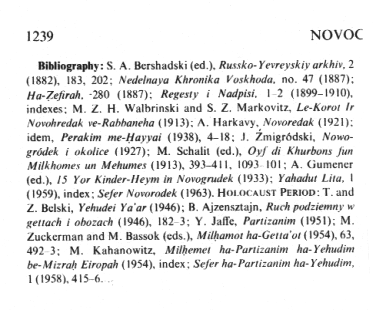
Bibliography
-- S.A. Bershadski (ed.): Russko-Yevreyskiy arkhiv, 2 (1882), 183, 202
-- Nedelnaya Khronika Voskhoda, no. 47 (1887)
-- Ha-Zefirah, 280 (1887)
-- Regesty i Nadpisi, 1-2 (1899-1910), indexes
-- M.Z.H. Walbrinski and S.Z. Markovitz: Le-Korot Ir Novohredak ve-Rabbaneha (1913)
-- A. Harkavy: Novoredak (1921)
-- idem: Perakim me-Hayyai (1938), 4-18
-- J. Zmigrodski: Nowogródek i okolice (1927)
-- M. Schalit (ed.): Oyf di Khurbons fun Milkhomes un Mehumes (1913), 393-411, 1093-101
-- A. Gumener (ed.): 15 Yor Kinder-Heym in Novogrudek (1933)
-- Yahadut Lita, 1 (1959), index
-- Sefer Novorodek (1963)
HOLOCAUST PERIOD
-- T. and Z. Belski: Yehudei Ya'ar (1946)
-- B. Ajzensztajn: Ruch podziemny w gettach i obozach (1946), 182-3
-- Y. Jaffe: Partizanim (1951)
-- M. Zuckerman and M. Bassok (eds.): Milhamot ha-Getta'ot (1954), 63, 492-3
-- M. Kahanowitz: Milhemet ha-Partizanim ha-Yehudim be-Mizrah Eiropah (1954), index
-- Sefer ha-Partizanim ha-Yehudim, 1 (1958), 415-6> (col. 1239)
Sources
Encyclopaedia Judaica (1971): Novogrudok, vol. 12, col. 1237-1238
Encyclopaedia Judaica (1971): Novogrudok, vol. 12, col. 1239