<PINSK, capital of Pinsk oblast, Belorussian S.S.R.

Encyclopaedia Judaica
Jews in Pinsk
Jews since 1506 - Lithuanian rule - Chmielnicki massacres and wars in 17th century - Russian rule and trade - Orthodox and Enlightenment - racist Zionists and Socialist Bund - Polish rule and emigration "pioneers" - sovietization - Holocaust - post-war times with new sovietization
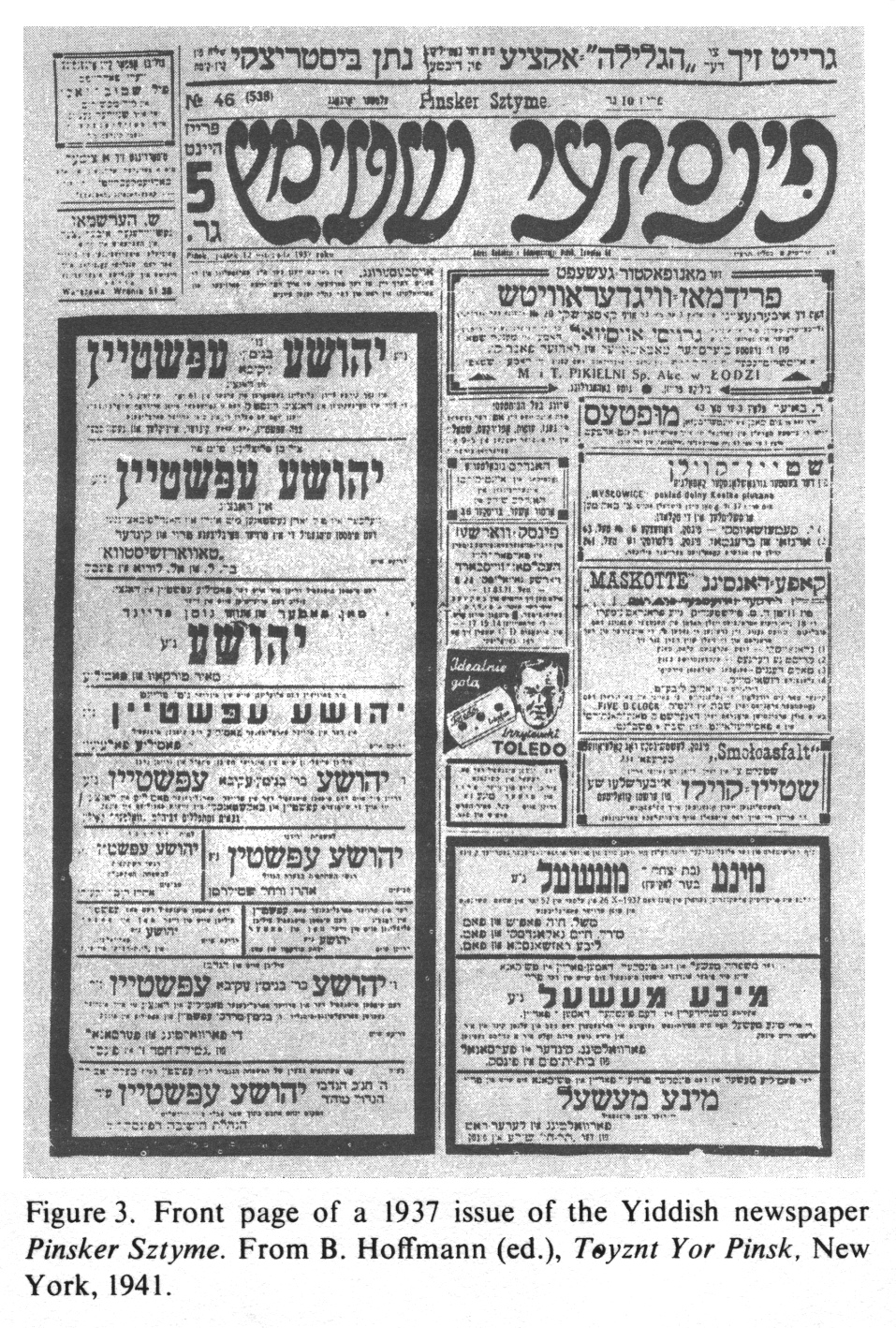
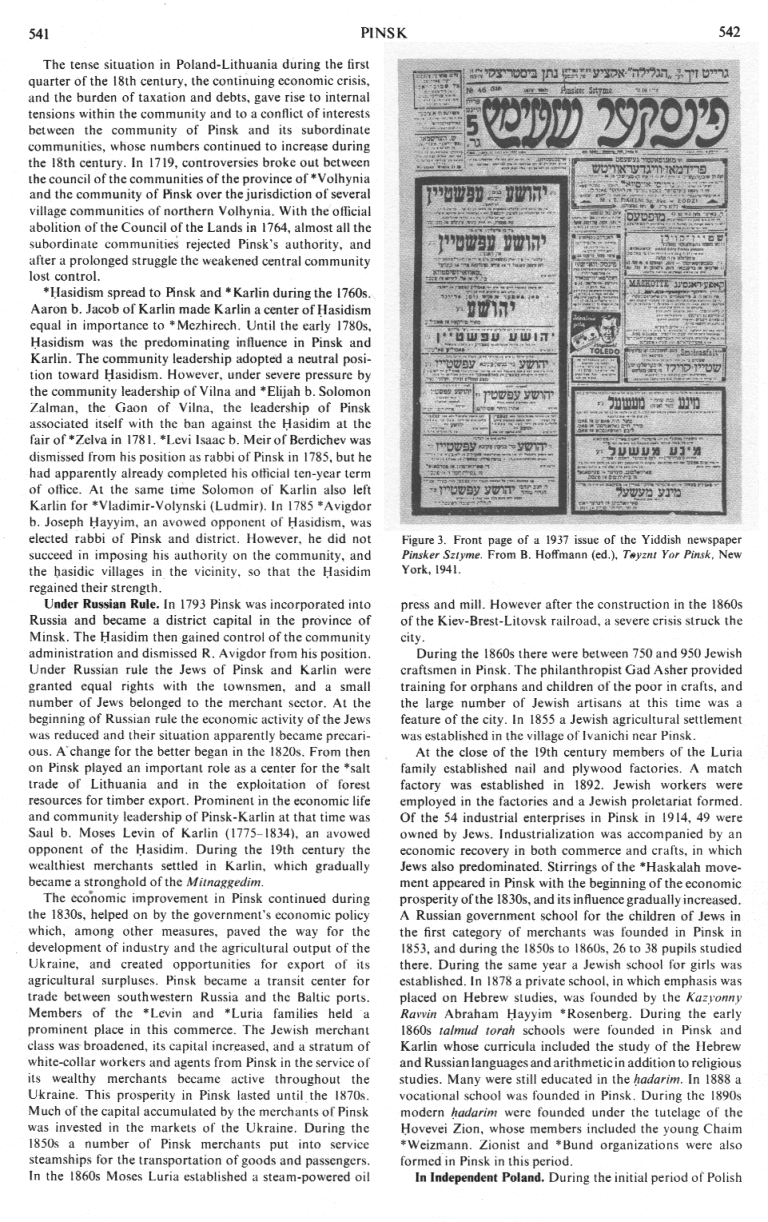
Encyclopaedia Judaica (1971): Pinsk, vol. 13, col. 542. Front page of a 1937 issue of the Yiddish newspaper
"Pinsker Sztyme". From B. Hoffmann (ed.): "Toyznt Yor Pinsk", New York, 1941
from: Pinsk; In: Encyclopaedia Judaica 1971, vol. 13
presented by Michael Palomino (2008 / 2023)
Share:
The solution for life is the Book of Life with Mother Earth - www.med-etc.com
[First Jews since 1506 - Pinsk as a part of Lithuania since 1521]
The Jewish community there was established before 1506 by some 12 to 15 families (about 60-75 persons) from *Brest-Litovsk who settled in Pinsk instead of returning to Lithuania after the Jews were granted permission to return.
Pinsk was then a Russian-Orthodox town and capital of a semi-independent principality. In 1506 Prince Feodor Yaroslavski granted the settlers the same rights enjoyed by the Jews of Lithuania, and the status of a community. The separate existence of the principality came to an end in 1521 and Pinsk was incorporated into Lithuania.
[Numbers]
By 1566 the community consisted of about 55 families (approximately 275 persons; c. 7% of the total population). It numbered over 1,000 (c. 20% of the total) in 1648, and about 2,000 at the beginning of the 18th century, when they constituted the large majority of the town and controlled most of its life, there having been a severe decline in the Christian population during the second half of the 17th century. [[...]] (col. 538)
[Development, freedom of commerce, and professions]
Until 1648 the Jews of Pinsk were guaranteed the legal status of citizens, complete protection of their persons and property, freedom to engage in commerce, moneylending, and crafts, and the right to organize their internal life according to the precepts of their religion. The favourable geographical position of the region of Pinsk on the junctions of roads and waterways, and colonizing activity there during the 16th century, encouraged its development. Jews engaged in varied activities including the ownership (later lease) of estates, the lease of taxes and customs duties, commerce, moneylending, and crafts. The community leaders, descendants of the founding nucleus, mainly dealt in business connected with estates and engaged in moneylending. Later they entered the wholesale trade also, as well as the leasing of tax collection and customs duties.
In the middle of the 16th century, Pinsk Jews took up the then thriving export of grain and forest products. In the 1560s Nahum Pesahovich was outstanding for the scope and variety of his business activities. As in the rest of the region, the Pinsk Jews benefited from the support of the Catholic nobles against the Russian-Orthodox Belorussian townsmen. In these circumstances the status granted to the Pinsk municipality under the *Magdeburg Law in 1581 did not greatly hamper the Jews though it contained several restrictions on their trade.
The leasing and subleasing of estates by Jews resulted in an increasing periphery of Jewish inhabitants who settled in villages and new townlets established around Pinsk which came under its jurisdiction within the structure of the *Councils of the Lands. The community consolidated and developed. As one of the three original leading communities of the Lithuanian Council, Pinsk played a prominent role in the shaping of the council's policy and activity.
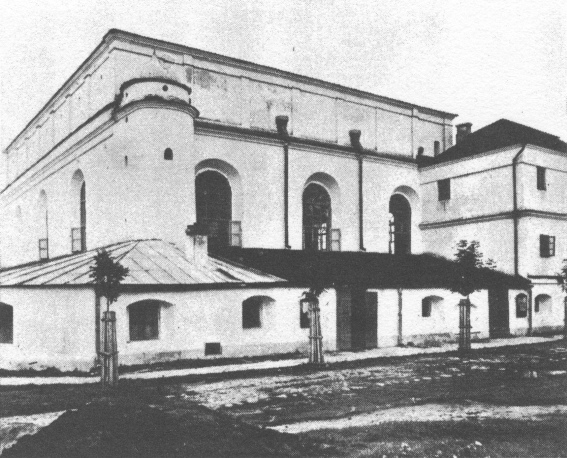
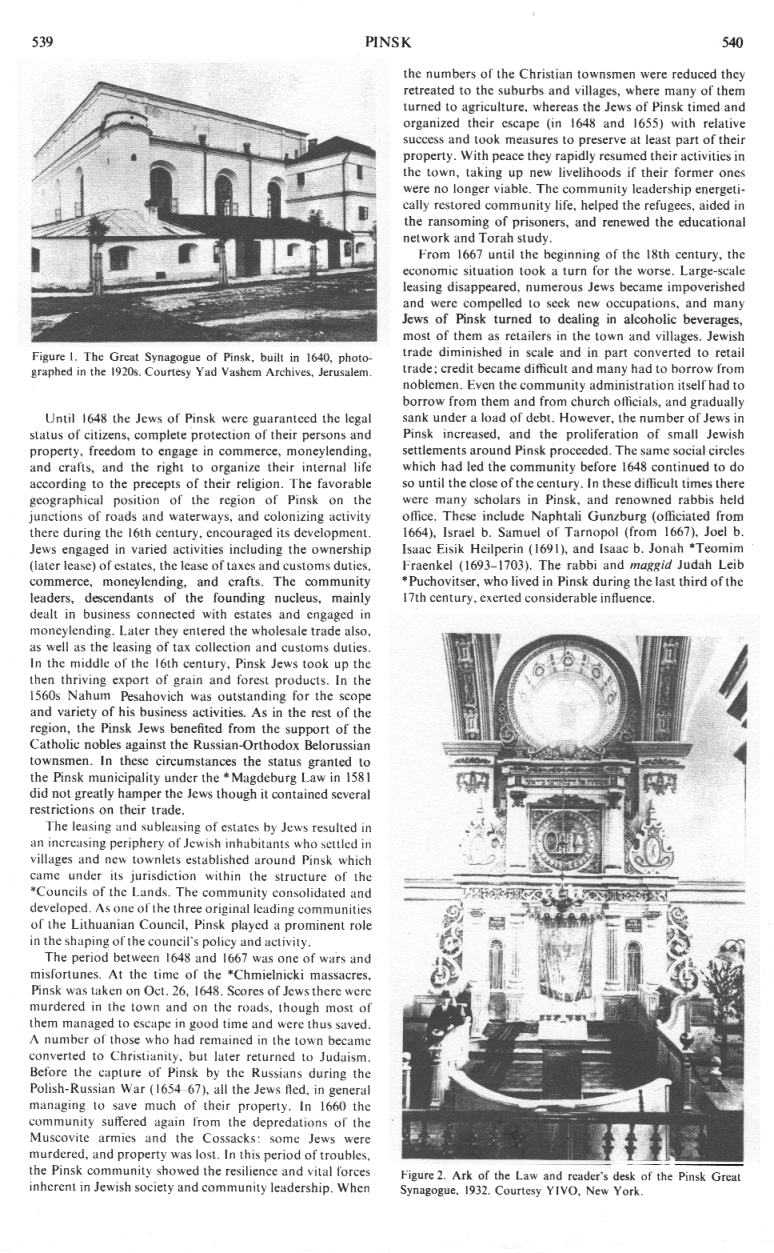
Pinsk: The Great Synagogue of 1640
Encyclopaedia Judaica (1971): Pinsk, vol. 13, col. 539. The Great Synagogue of Pinsk, built in 1640, photographed in the 1920s. Courtesy Yad Vashem Archives, Jerusalem.
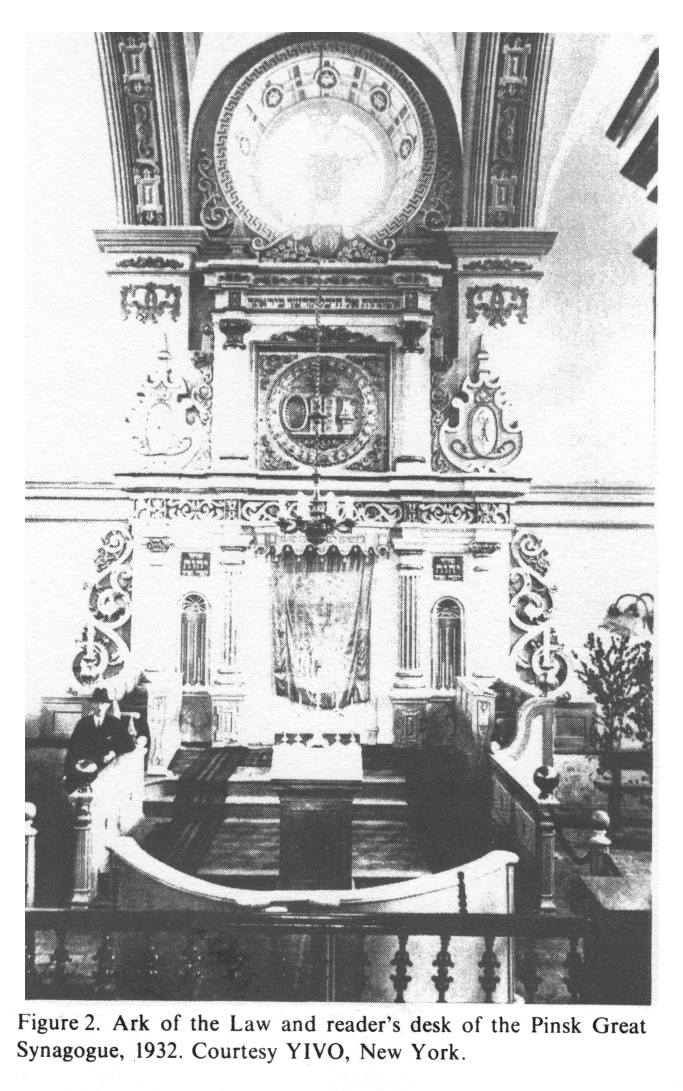
Encyclopaedia Judaica (1971): Pinsk, vol. 13, col. 540. Ark of the Law and reader's desk of the Pinsk Great Synagogue, 1932. Courtesy YIVO, New York.
[Wars and massacres 1648-1667: Chmielnicki massacres - Polish-Russian War - Cossacks]
The period between 1648 and 1667 was one of wars and misfortunes.
At the time of the *Chmielnicki massacres, Pinsk was taken on Oct. 26, 1648. Scores of Jews there were murdered in the town and on the roads, though most of them managed to escape in good time and were thus saved. A number of those who had remained in the town became converted to Christianity, but later returned to Judaism.
Before the capture of Pinsk by the Russians during the Polish-Russian War (1654-67), all the Jews fled, in general managing to save much of their property.
In 1660 the community suffered again from the depredations of the Muscovite armies and the Cossacks: some Jews were murdered, and property was lost.
In this period of troubles, the Pinsk community showed the resilience and vital forces inherent in Jewish society and community leadership. When (col. 539)
the numbers of the Christian townsmen were reduced they retreated to the suburbs and villages, where many of them turned to agriculture, whereas the Jews of Pinsk timed and organized their escape (in 1648 and 1655) with relative success and took measures to preserve at least part of their property. With peace they rapidly resumed their activities in the town, taking up new livelihoods if their former ones were no longer viable. The community leadership energetically restored community life, helped the refugees, aided in the ransoming of prisoners, and renewed the educational network and Torah study.
[Changing times since 1667 - alcoholic beverages, tax and depths - growing community - community life]
From 1667 until the beginning of the 18th century, the economic situation took a turn for the worse. Large-scale leasing disappeared, numerous Jews became impoverished and were compelled to seek new occupations, and many Jews of Pinsk turned to dealing in alcoholic beverages, most of them as retailers in the town and villages. Jewish trade diminished in scale and in part converted to retail trade; credit became difficult and many had to borrow from noblemen. Even the community administration itself had to borrow from them and from church officials, and gradually sank under a load of debt.
However, the number of Jews in Pinsk increased, and the proliferations of small Jewish settlements around Pinsk proceeded. The same social circles which had led the community before 1648 continued to do so until the close of the century. In these difficult times there were many scholars in Pinsk, and renowned rabbis held office. These include Naphtali Gunzburg (officiated from 1664), Israel b. Samuel of Tarnapol (from 1667), Joel b. Isaac Eisik Heilperin (1691), and Isaac b. Jonah *Teomim Fraenkel (1693-1703). The rabbi and maggid [[Jewish itinerant preacher in eastern Europe]] Judah Leib *Puchovitser, who lived in Pinsk during the last third of the 17th century, exerted considerable influence. (col. 540)
The tense situation in Poland-Lithuania during the first quarter of the 18th century, the continuing economic crisis, and the burden of taxation and debts, gave rise to internal tensions within the community and to a conflict of interests between the community of Pinsk and its subordinate communities, whose numbers continued to increase during the 18th century. In 1719, controversies broke out between the council of the communities of the province of *Volhynia and the community of Pinsk over the jurisdiction of several village communities of northern Volhynia. With the official abolition of the Council of the Lands in 1764, almost all the subordinate communities rejected Pinsk's authority, and after a prolonged struggle the weakened central community lost control.
[Orthodox Hasidism]
*Hasidism (Ḥasidism) spread to Pinsk and *Karlin during the 1760s. Aaron b. Jacob of Karlin made Karlin a center of Hasidism (Ḥasidism) equal in importance to *Mezhirech. Until the early 1780s, Hasidism (Ḥasidism) was the predominating influence in Pinsk and Karlin. The community leadership adopted a neutral position toward Hasidism (Ḥasidism). However, under severe pressure by the community leadership of Vilna and *Elijah b. Solomon Zalman, the Gaon [[religious leader]] of Vilna, the leadership of Pinsk associated itself with the ban against the Hasidim (Ḥasidim) at the fair of *Zelva in 1781. *Levi Isaac b. Meir of Berdichev was dismissed from his position as rabbi of Pinsk in 1785, but he had apparently already completed his official ten-year term of office. At the same time Solomon of Karlin also left Karlin for *Vladimir-Volynski (Ludmir). IN 1785 *Avigdor b. Joseph Hayyim (Ḥayyim), an avowed opponent of Hasidism (Ḥasidism), was elected rabbi of Pinsk and district. However, he did not succeed in imposing his authority on the community, and the hasidic (ḥasidic) villages in the vicinity, so that the Hasidim (Ḥasidim) regained their strength.
Under Russian Rule.
[Orthodox Jewish majority - equal rights - salt trade and timber export - transit center between southwest Russia and the Baltic ports]
In 1793 Pinsk was incorporated into Russia and became a district capital in the province of Minsk. The Hasidim (Ḥasidim) then gained control of the community administration and dismissed R. Avigdor from his position. Under Russian rule the Jews of Pinsk and Karlin were granted equal rights with the townsmen, and a small number of Jews belonged to the merchant sector. At the beginning of Russian rule the economic activity of the Jews was reduced and their situation apparently became precarious. A change for the better began in the 1820s.
From then on Pinsk played an important role as a center for the *salt trade of Lithuania and in the exploitation of forest resources for timber export. Prominent in the economic life and community leadership of Pinsk-Karlin at that time was Saul b. Moses Levin of Karlin (1775-1834), an avowed opponent of the Hasidim (Ḥasidim). During the 19th century the wealthiest merchants settled in Karlin, which gradually became a stronghold of the Mitnaggedim [[opponents]].
The economic improvement in Pinsk continued during the 1830s. helped on by the government's economic policy which, among other measures, paved the way for the development of industry and the agricultural output of the Ukraine, and created opportunities for export of its agricultural surpluses. Pinsk became a transit center for trade between southwestern Russia and the Baltic ports. Members of the *Levin and *Luria families held a prominent place in this commerce. The Jewish merchant class was broadened, its capital increased, and a stratum of white-collar workers and agents from Pinsk in the service of its wealthy merchants became active throughout the Ukraine. This prosperity in Pinsk lasted until the 1870s. Much of the capital accumulated by the merchants of Pinsk was invested in the markets of the Ukraine. (col. 541) [[...]]
[Enlightenment movement]
Stirrings of the *Haskalah movement appeared in Pinsk with the beginning of the economic prosperity of the 1830s, and its influence gradually increased. A Russian government school for the children of Jews in the first category of merchants was founded in Pinsk in 1853, and during the 1850s to 1860s, 26 to 38 pupils studies there. During the same year a Jewish school for girls was established. (col. 542)
[Trade with Jewish steamships - railroad provokes new crisis in Pinsk]
During the 1850s a number of Pinsk merchants put into service steamships for the transportation of goods and passengers. (col. 541) [[...]]
In 1855 a Jewish agricultural settlement was established in the village of Ivanichi near Pinsk. [[...]] (col. 542)
In the 1860s Moses Luria established a steam-powered oil (col. 541)
press and mill. However after the construction in the 1860s of the Kiev-Brest-Litovsk railroad, a severe crisis struck the city.
During the 1960s there were between 750 and 950 Jewish craftsmen in Pinsk. The philanthropist Gad Asher provided training for orphans and children of the poor in crafts, and the large number of Jewish artisans at this time was a feature of the city. [[...]]
At the close of the 19th century members of the Luria family established nail and plywood factories. A match factory was established in 1892. Jewish workers were employed in the factories and a Jewish proletariat formed. Of the 54 industrial enterprises in Pinsk in 1914, 49 were owned by Jews. Industrialization was accompanied by an economic recovery in both commerce and crafts, in which Jews also predominated. (col. 542)
[Hebrew in Pinsk - racist Zionists and Socialist Bundists in Pinsk]
In 1878 a private school, in which emphasis was placed on Hebrew studies, was founded by the Kazyonny Ravvin [[government-appointed rabbi]] Abraham Hayyim (Ḥayyim) *Rosenberg. During the early 1860s talmud torah schools were founded in Pinsk and Karlin whose curricula included the study of the Hebrew and Russian languages and arithmetic in addition to religious studies. Many were still educated in the hadarim (ḥadarim) [[Jewish religious schools to age of 13]]. In 1888 a vocational school was founded in Pinsk. During the 1890s modern hadarim (ḥadarim) were founded under the tutelage of the Hovevei Zion (Ḥovevei Zion) and [[Socialist]] *Bund organizations were also formed in Pinsk in this period. (col. 542)
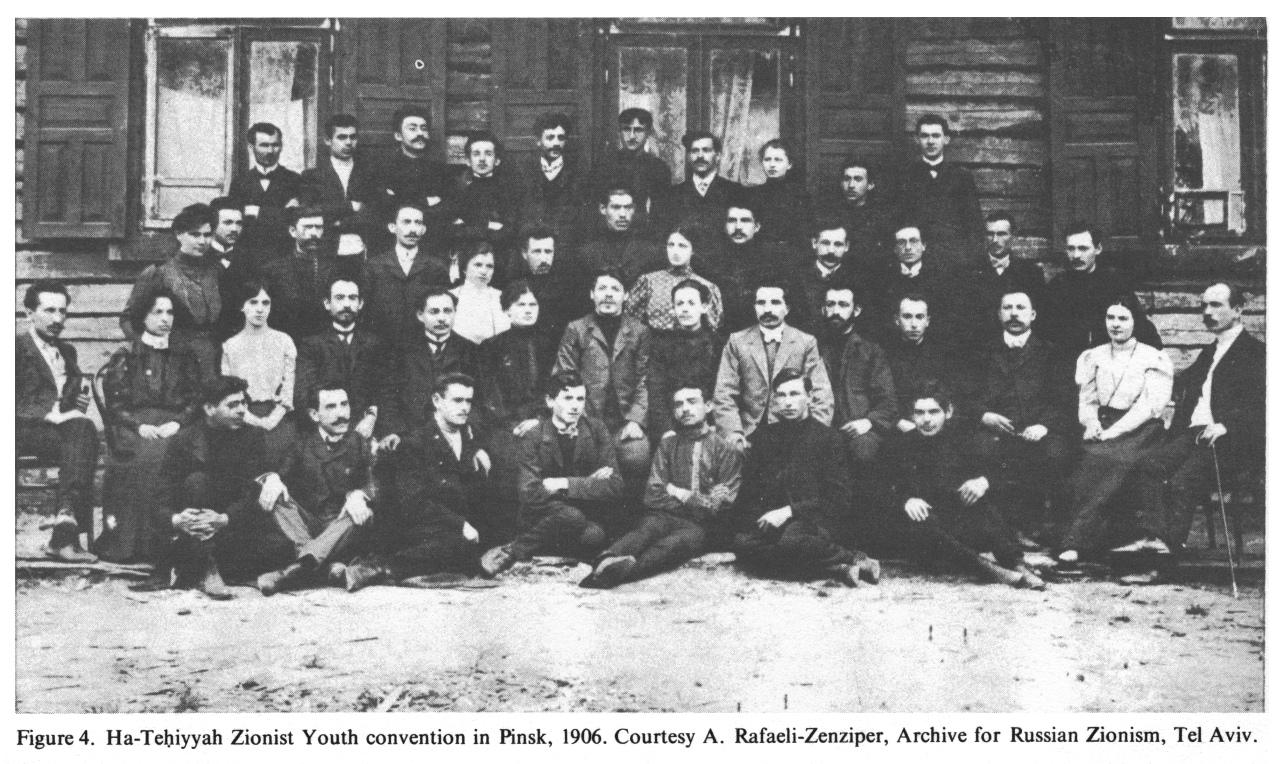
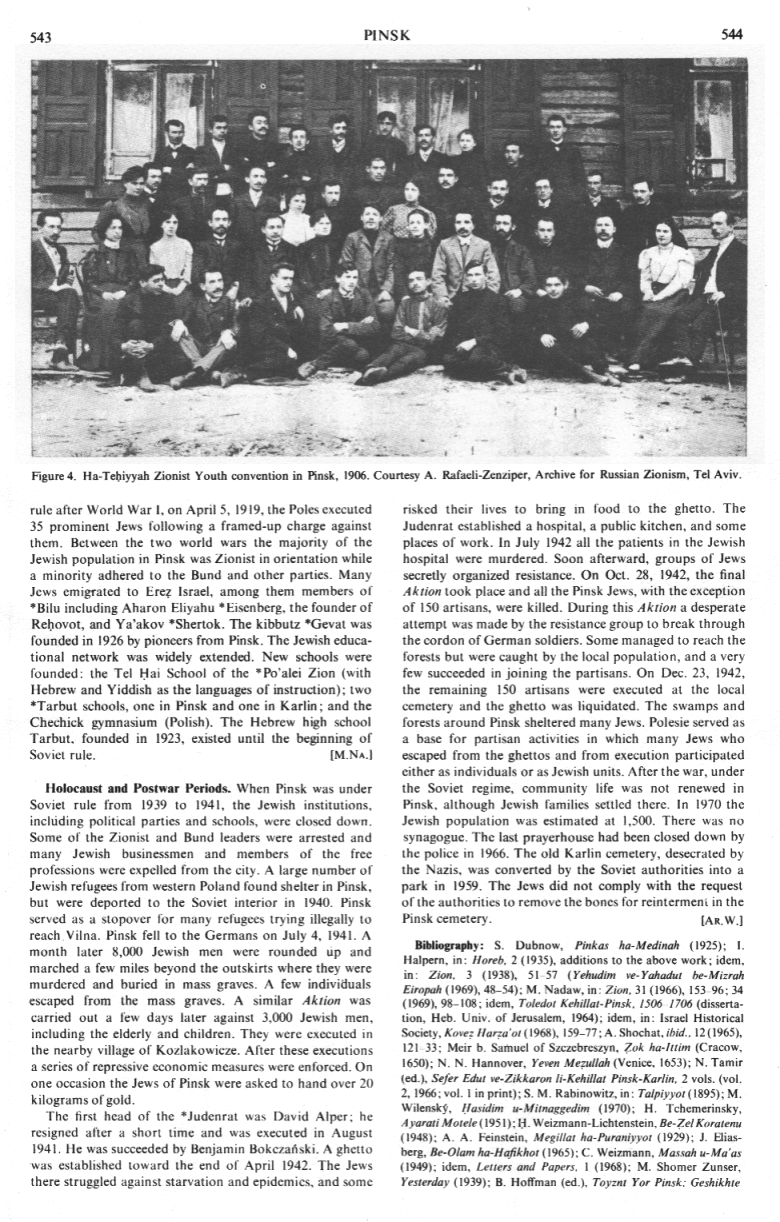
Encyclopaedia Judaica (1971): Pinsk, vol. 13, col. 543-544. Ha-Tehiyyah [[racist]] Zionist
Youth convention in Pinsk, 1906. A. Rafaeli-Zenziper, Archive for Russian Zionism, Tel Aviv.
[[The period of World War I and the subsequent wars until 1921 with its severe expulsions, pogroms, flight movements, destructions, hunger and epidemics is missing in this article. Only one massacre is mentioned, and this seems to be too little for this time]].
In Independent Poland.
[Polish massacre of 1919 - racist Zionists dominating the community - emigration to Palestine and "pioneers" - Shertok and kibbutz Gevat]
During the initial period of Polish (col. 542)
rule after World War I, on April 5, 1919, the Poles executed 35 prominent Jews following a framed-up charge against them.
Between the two world wars the majority of the Jewish population in Pinsk was Zionist in orientation while a minority adhered to the Bund and other parties. Many Jews emigrated to Erez Israel (Ereẓ Israel), among them members of *Bilu including Aharon Eliyahu *Eisenberg, the founder of Rehovot (Reḥovot), and Ya'akov *Shertok. The kibbutz *Gevat was founded in 1926 by pioneers from Pinsk.
The Jewish educational network was widely extended. New schools were founded: the Tel Hai (Ḥai) School of the *Po'alei Zion (with Hebrew and Yiddish as the languages of instruction); two *Tarbut schools, one in Pinsk and one in Karlin; and the Chechick gymnasium (Polish). The Hebrew high school Tarbut, founded in 1923, existed until the beginning of Soviet rule.
[M.NA.] (col. 543) [[...]]
[Numbers]
Subsequently the Jewish population numbered 13,681 in 1871 (77.7%); 21,819 in 1896 (77.3%); 28,063 in 1914 (72.5%); 17,513 in 1921 (74.6%); and 20,200 in 1939. Pinsk thus remained a "Jewish town" until the Holocaust (col. 538)
[[and it seems there was not a big emigration wave from 1900-1939]].
[[...]]
[Sovietization 1939-1941: arrests - Jewish refugees from western Poland - Stalin deportations]
When Pinsk was under Soviet rule from 1939 to 1941, the Jewish institutions, including political parties and schools, were closed down. Some of the Zionist and Bund leaders were arrested and many Jewish businessmen and members of the free professions were expelled from the city. A large number of Jewish refugees from western Poland found shelter in Pinsk, but were deported to the Soviet interior in 1940 [[because they refused the Soviet passport, see: Holocaust, rescue from]]. Pinsk served as a stopover for many refugees trying illegally to reach Vilna.
[[Other Stalin deportations and above all the Big Flight from Barbarossa with the withdrawal of the Russian army with the administration and the industrial staff with many Jews are missing in this article]].
[Holocaust: massacres - 20 kg of gold - Judenrat - ghetto]
Pinsk fell to the Germans on July 4, 1941. A month later 8,000 Jewish men were rounded up [[probably with the help of the population with marking the Jewish hoses etc.]] and marched a few miles beyond the outskirts where they were murdered and buried in mass graves [[probably with the help of collaborators in the "Einsatzgruppen"]]. A few individuals escaped from the mass graves. A similar Aktion was carried out a few days later against 3,000 Jewish men, including the elderly and children. They were executed in the nearby village of Kozlakowicze. After these executions a series of repressive economic measures were enforced. On one occasion the Jews of Pinsk were asked to hand over 20 kilograms of gold.
The first head of the *Judenrat was David Alper; he resigned after a short time and was executed in August 1941. He was succeeded by Benjamin Bokczański. A ghetto was established toward the end of April 1942. The Jews there struggled against starvation and epidemics, and some (col. 543)
risked their lives to bring in food to the ghetto. The Judenrat established a hospital, a public kitchen, and some places of work. In July 1942 all the patients in the Jewish hospital were murdered. Soon afterward, groups of Jews secretly organized resistance. On Oct. 28, 1942, the final Aktion took place and all the Pinsk Jews, with the exception of 150 artisans, were killed. During this Aktion a desperate attempt was made by the resistance group to break through the cordon of German soldiers. Some managed to reach the forests but were caught by the local population, and a very few succeeded in joining the partisans.
On Dec. 23, 1942, the remaining 150 artisans were executed at the local cemetery and the ghetto was liquidated.
[Resistance]
The swamps and forests around Pinsk sheltered many Jews. Polesie served as a base for partisan activities in which many Jews who escaped from the ghettos and from execution participated either as individuals or as Jewish units.
[[Change of name, change of religion and hideouts are not mentioned in this article. In 1945 the partisans probably fled with racist Zionist groups to the D.P. camps in western Europe or were emigrating directly to the Black Sea and from there Palestine]].
[Post-war times: new sovietization]
After the war, under the Soviet regime, community life was not renewed in Pinsk, although Jewish families settled there [[probably coming back from central Russia]].
[[After the establishment of racist Zionist Free Mason CIA Herzl Israel in 1948 the Soviet governments started anti-Semitism waves generally against all Jews so many Jews lost the courage to be Jewish. Scandals with Jewish ambassadors and the blame of synagogues to be centers of espionage were another reason for many Jews to give up their religion]].
The old Karlin cemetery, desecrated by the Nazis [[and their collaborators]], was converted by the Soviet authorities into a park in 1959. The Jews did not comply with the request of the authorities to remove the bones for reinterment in the Pinsk cemetery. [[...]] There was no synagogue. The last prayer house had been closed down by the police in 1966. [[...]] In 1970 the Jewish population was estimated at 1,500. [[...]]
[AR.W.]> (col. 544)
Share:
The solution for life is the Book of Life with Mother Earth - www.med-etc.com
Sources
Encyclopaedia Judaica (1971): Pinsk, vol. 13, col. 538
Encyclopaedia Judaica (1971): Pinsk, vol. 13, col. 539-540
Encyclopaedia Judaica (1971): Pinsk, vol. 13, col. 541-542
Encyclopaedia Judaica (1971): Pinsk, vol. 13, col. 543-544