Encyclopaedia Judaica
Jews in Vitebsk
(Lithuania, 1569-1795 part of Poland-Lithuania, since 1795 part of Russia, 1919-1939 eastern Poland, 1939-1941 Soviet western BSSR, 1941-1944 German Nazi rule, 1944-1970 Soviet BSSR)
Lithuania - invasions - Russian rule since 1793 - Jews from Moscow - communities - Herzl Zionism - refugees 1915 - Soviet rule - Flight from Barbarossa - Holocaust - Jews coming back - Soviet rule
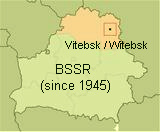
Map of BSSR with the position of Vitebsk
from: Vitebsk; In: Encyclopaedia Judaica 1971, vol. 16
presented by Michael Palomino (2008 / 2023)
Share:
The solution for life is the Book of Life with Mother Earth - www.med-etc.com
<VITEBSK, capital of Vitebsk oblast, Belorussian S.S.R.
[Charters of Lithuanian kings - invasions of Russia and Sweden]
The first Jewish settlement appears to have been established in Vitebsk at the end of the 16th century. The charter given to the residents of Vitebsk in 1597 by Sigismund III Vasa forbids Jews "in accordance with long-held practice" to dwell within the city. Still, it appears that some Jews did live there, under the protection of the local nobility, both before and after 1597. The Jewish community developed, though not without conflict with the Christian population of the city over Jewish rights and privileges. In 1627 the local ruler S. Sangushko granted permission for the construction of a synagogue in the city. A document from the 17th century takes note of "the Jew's gate".
During the war between Poland and the government of Moscow in 1654, Jews fought in the defense of the city. When it fell to the Russians, their property was confiscated and they were taken captive, not being released until peace was achieved with Poland (1687). Upon the Jews' return they had to enter into litigation with their neighbours who had appropriated their property.
In 1679 King John III Sobieski granted a charter to the Jews, restoring their former privileges and promising them freedom of religion and commercial rights. This charter was renewed and confirmed by the kings of Poland in 1729 and 1759.
In 1708, during the war with Sweden, the Jewish quarter of Vitebsk was destroyed by fire. The local residents then occupied the plot where the synagogue had been and built a church upon it. The Lithuanian supreme court ordered them to return the land to the Jews and pay damages of 13,500 gold pieces.
The Jewish community of Vitebsk was part of the *Council (col. 190)
of the Lands. It was under the jurisdiction of the *Brest-Litovsk community and through it was subject to the Lithuanian Council. The Vitebsk Jewish community kept a *pinkas (minute-book) from 1706.
[since 1772: under Russian rule - railroad - Jews from Moscow]
With the first partition of Poland in 1772 Vitebsk was annexed to Russia. At that time the community numbered 1,227 persons, or about a quarter of the town's population. Most of Vitebsk's trade in flax and tobacco was conducted with Riga by way of the Dvina River. With the completion of the Orel-Vitebsk-Dvinsk railroad during the 1860s the commerce of Vitebsk with regional towns and villages increased and the Jewish community grew accordingly. After their expulsion from Moscow in 1891 some of the Jews transferred their businesses to Vitebsk. In 1897 the city had 34,420 Jews (52.4% of the total population).
[Community life]
[Orthodox dominance - rabbis and schools]
Vitebsk was a stronghold of Orthodox Judaism, containing elements of Lithuanian Jewish scholarship, and even stronger hasidic influences. At the end of the 18th century the founders of Lithuanian Hasidism, *Menahem Mendel of Vitebsk and Shneur Zalman of Lyady, were active in the city. Strong *Habad hasidic influences were present. The rabbi of the city from 1803 to 1860 was Yizhak Isaac Behard, who was both *kazyonny ravvin (government-appointed rabbi) and the choice of the admor [[chasidic rabbi]].
Jekuthiel Zalman Landau succeeded him in the rabbinate serving also as head of the yeshivah [[religious Torah school]] of Vitebsk. After Landau moved to St. Petersburg the community did not select a new chief rabbi, as a result of a dispute between the Hasidim and *Mitnaggedim [[also: misnagdim, mitnagdim: opponents]]. During the last years of the 19th century 72% of the school-age children studied in the heder [[Jewish religious school to age of 13]] and talmud torah schools of Vitebsk.
[Jews from Moscow - Haskalah, Herzl Zionism, and Socialists - a Zionist rabbi - Zionist schools]
The settlement of Jews in Vitebsk who had been expelled from Moscow strengthened the *Haskalah elements in the city. The *Hibbat Zion movement began to develop, as did the Socialist movement at a later date. Vitebsk was one of (col. 191)
the first centers of the *Bund. In 1901 the Zionist leader Grigori (Zevi Hirsch) *Bruck was selected as kazyonny ravvin [[government-appointed rabbi]] of Vitebsk. He had great influence upon the life of the community, even after he was deposed by the authorities. This occurred as a result of his position as a delegate to the *Duma, in which he signed the Wyborg Proclamation.
The Zionist and *Po'alei Zion movements flourished, causing the talmud torah to be converted into a Hebrew school.
[[Dangerous dream Zionism
Zionism is a dangerous dream of an Israel with its center of Jerusalem on Zion hill. It's base is the book of Theodor Herzl "The Jewish State" (1896) without prescribing any borderlines and foretelling that the Arabs can be driven away as the natives in the "USA" had been driven away. Zionism refers to the dream of a "Greater Israel" with the borderlines of First Mose chapter 15 phrase 18, from the Nile to the Euphrates (look the Bible). Since 1896 the Arabs are proclaiming against criminal Zionism with Jewish invasion plans. The eternal war is foreseeable, above all since the Arabs have weapons (since 1915) and oil (since 1920s). But Zionist terrorists don't give up. War Zionism is not forbidden until now, and Herzl Israel is blocking just the main junction between Africa and Asia which had a changing foreign rule about every 300 years...]]
After 1905 several private gymnasia opened in the city, most of the students being Jewish. The artist Y. Pen opened an art school which trained hundreds of young people, including Marc *Chagall and S. Yudovin. S. *An-Ski and C. *Zhitlovsky were both from Vitebsk.
[World War I: Jewish refugees from Lithuania]
During World War I Vitebsk served as a way station for tens of thousands of Jews who had been expelled from Lithuania. Several thousand of them settled there permanently.
With the advent of Soviet rule the Vitebsk Jewish community began to decline. Thousands of residents who had come from Lithuania and Latvia used their rights of relocation and emigrated from the Soviet Union. The *Yevsektsiya [[Jewish part of the communist party]] established one of its centers in Belorussia in Vitebsk, publishing the paper Der Royter Shtern [[Yidd.]] ("The Red Star") until 1923.
[1921-1941: under Soviet rule]
In 1921 a public trial "over the heder" [[Jewish religious school to age of 13]] was conducted in Vitebsk and several synagogues in the city were confiscated [[probably because of Zionist activities with consequences against the Arabs]]. The Vitebsk *He-Halutz movement was harassed and came to an end during the middle of the 1920s. Vitebsk had a semi-legal Habad yeshivah [[religious Torah school of the Chabad Chasidim]] until 1930.
In 1923 there were 39,714 Jews (43.7% of the total population). In 1926 there were 37,013 (37.5%).
[[Supplement: Soviet regime in Vitebsk 1921-1941
With the Soviet Army in Vitebsk were connected:
-- sovietization with oppression of all religious and Herzl Zionist activities
-- degradation of class enemies (Lishentsy, middle class), ban and labour camps
-- degradation of members of families of class enemies, ban and labour camps
-- Big Flight from Barbarossa 1941: organized removal of industries to Russian interior since April 1941 with many Jewish workers, and organized withdrawal and organized flight of many Jews to Inner Russia with the Red Army since 18 June 1941, partly in connection with a scorched earth policy
-- arbitrary flight of Jews who are blocked at the Soviet border, they have to survive in cellars or forests or die
-- eventually: pogroms against the Jews of the staying "Christian" population against the Jews between the withdrawal of the Red Army and the arrival of the NS Wehrmacht]].
[The Big Flight from Barbarossa - scorched earth policy - Jews coming back from Inner Russia]
With the Nazi conquest [[operation "Barbarossa"]] of the city in July 1941 part of the Jewish population fled into the interior of Russia. The city was destroyed in a fire started by the retreating Red Army.
The 16,000 Jews who remained behind were imprisoned in a ghetto. On October 8, 1941, their systematic liquidation began.
After the liberation of the city from the (col. 192)
Germans Jews began to return.
[Soviet rule since 1944]
[[Many Jews who were surviving in the forests were drawn into the Red Army and by this died at the front 1944-1945. There were many Hezl Zionist organizations organizing false passports and flight over Rumania to Palestine. Since 1948 Stalin and his successors implemented a harsh anti-Semitic policy suppressing religion and Herzl Zionism because of Herzl Free Mason CIA Israel which functioned as a puppet state of the "USA" to encircle the Soviet Union. So the numbers of Jews who openly stated to be Jewish declined in the Soviet sphere of influence, and the institutions were closed step by step]].
In the later 1960s the Jewish population was estimated at about 20,000 but there was no synagogue.
Bibliography
-- Vitebsk Amol (Yid. 1956)
-- Sefer Vitebsk (Heb. 1957)
[Y.S.]> (col. 193)
Share:
The solution for life is the Book of Life with Mother Earth - www.med-etc.com
Encyclopaedia Judaica 1971: Vitebsk, sources
Encyclopaedia Judaica 1971: Vitebsk, vol. 16, col. 190
Encyclopaedia Judaica 1971: Vitebsk, vol. 16, col. 191-192
Encyclopaedia Judaica 1971: Vitebsk, vol. 16, col. 193