[[Other names for Volozhin are: Vishnevo, Valozhin, Wolozin, Woloschin]]

Encyclopaedia Judaica
Jews in Volozhin
(Lithuania, 1569-1795 part of Poland-Lithuania, since 1795 part of Russia, 1919-1939 eastern Poland, 1939-1941 Soviet western BSSR, 1941-1944 German Nazi rule, 1944-1970 Soviet BSSR)
Jews since 16th century - Volozhin yeshivah history - Soviet rule - Holocaust - Soviet rule
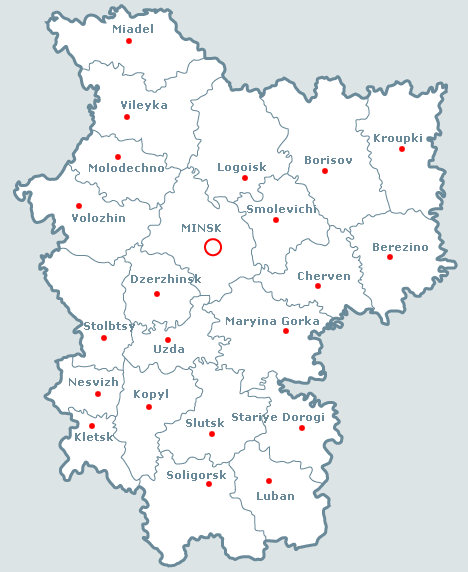
Map with the positions of Minsk and Volizhin / Vishnevo / Valozhin / Wolozin / Woloschin
from: Volozhin; In: Encyclopaedia Judaica 1971, vol. 16
presented by Michael Palomino (2008 / 2023)
Share:
The solution for life is the Book of Life with Mother Earth - www.med-etc.com
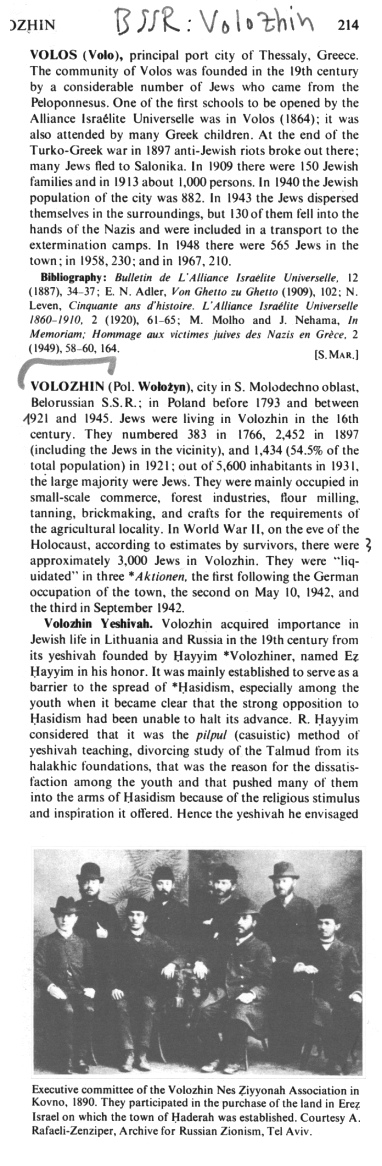
<VOLOZHIN, (Pol. Wolozyn), city in S. Molodechno oblast, Belorussian S.S.R. [[between Minsk and western border]]; in Poland before 1793 and between 1921 and 1945.
Jews were living in Volozhin in the 16th century. They numbered 383 in 1766, 2,452 in 1897 (including the Jews in the vicinity), and 1,434 (54.5% of the total population) in 1921; out of 5,600 inhabitants in 1931, the large majority were Jews. They were mainly occupied in small-scale commerce, forest industries, flour milling, tanning, brickmaking, and crafts for the requirements of the agricultural locality.> (col. 214)
[[...]]
Volozhin Yeshivah. [[The work of R. Hayyim headed against East European Orthodox Hasidism]]
Volozhin acquired importance in Jewish life in Lithuania and Russia in the 19th century from its yeshivah [[religious Torah school]] founded by Hayyim *Volozhiner, named Ez Hayyim in his honor. It was mainly established to serve as a barrier to the spread of *Hasidism [[East European Orthodox movement]], especially among the youth when it became clear that the strong opposition to Hasidism had been unable to halt its advance.
R. Hayyim considered that it was the pilpul (casuistic) method [[leading case method]] of yeshivah teaching, divorcing study of the Talmud from its halakhic [[Jewish law]] foundations, that was the reason for the dissatisfaction among the youth and that pushed many of them into the arms of Hasidism because of the religious stimulus and inspiration it offered.
Hence the yeshivah [[religious Torah school]] he envisaged (col. 214)
was to educate its pupils in the methods taught by *Elijah b. Solomon Zalman the Gaon of Vilna: analysis of the text and understanding of its plain meaning. According to one tradition the yeshivah was founded on the instructions of the Gaon, although it was established in 1803, several years after he died.
Two yeshivot already existed in Vilna when R. Hayyim decided to establish the yeshivah in Volozhin for reasons unknown - possibly to remove it from the influence of the *Vilna community administration, then rent by severe internal discord, and so that he could guide it in accordance with his own views. His opposition to the students boarding out and the responsibility for their gaining a means of livelihood which he took upon himself (about the time the yeshivah was founded he called on the Jewish communities to support it), despite the heavy burden which this would devolve on him evinced his concern to prevent the students from coming under external influence.
R. Hayyim's endeavours prevented the yeshivah from becoming a merely local institution, and made it into a foundation supported by the whole of Jewry; it thus became a prototype for the Lithuanian yeshivot founded subsequently.
[Volozhin yeshivah is protected by Napoleon]
Teaching in the yeshivah began with only ten students, but it rapidly acquired a name among the Jewish public. It became so highly esteemed that the military governor of Lithuania in 1813, during the Napoleonic wars, issued a document of protection to R. Hayyim instructing all military units
"to safeguard the chief rabbi of Volozhin, Hayyim ben Isaac, his schools and educational institutions ... and to extend to the above-mentioned chief rabbi every assistance and protection ..."
The number of students had already risen to 100. In the meantime a special building for the yeshivah had been erected (of wood). The main lectures were given by R. Hayyim himself, his son-in-law R. Hillel, rabbi of Horodono (Grodno), and his son R. Isaac.
[R. Hayyim's death in 1821 - son R. Isaac Hayyim - officially closed by the Russians in 1824 - but working on - education discussion meeting in 1843 - and discussion about casuistic methods - successors]
After R. Hayyim's death in 1821 his son R. Isaac served as principal of the yeshivah. Around this time (1824) the Russian authorities decided to close the yeshivah for reasons that are not clear. However, despite the official order prohibiting its existence, the yeshivah continued to function and expand. The number of students rose to 200 and its buildings were enlarged.
The head of Volozhin yeshivah was considered at the time to be among the leaders of Russian Jewry, even by the authorities, and when in 1843 the government decided, in line with the recommendations of its "Jewish Committee", to convene a conference of rabbis to discuss problems of Jewish education, R. Isaac was invited to attend. He took this opportunity to obtain official recognition of the yeshivah through the "record" at the ministry of education of the letter of protection which had been issued at the time to his father.
Since R. Isaac was then occupied with public matters and the administrative and financial affairs of the yeshivah, the task of teaching was principally delegated to his two sons-in-law, R. Eliezer Isaac Fried and Naphtali Zevi Judah *Berlin (Ha-Neziv). By then a controversy had already begun in the yeshivah, because, in contradiction to the tradition laid down by its founder, R. Eliezer Isaac inclined to favour pilpul [[casuistic leading case methods]] and had a following among the students.
After the death of R. Isaac in 1849, R. Eliezer Isaac Fried was appointed principal of the yeshivah and R. Naphtali Zevi Judah Berlin the vice-principal. R. Eliezer Isaac did not live much longer, and after his death in 1854, when both R. Berlin and R. Hayyim's grandson, R. Joseph Baer *Soloveichik, were both appointed principals, a severe disagreement broke out over the method of instruction, in which R. Joseph Baer favoured the pilpul method, and had many supporters among the yeshivah students.
When the (col. 215)
controversy threatened to endanger the existence of the yeshivah, a delegation of prominent Lithuanian rabbis, including David Tevele of Minsk, Joseph of Slutsk, Isaac Elhanan *Spektor of Kovno, and Ze'ev the maggid [[Jewish priecher]] of Vilna, went to Volozhin in order to settle the controversy. The committee ruled that R. Berlin should be the principal of the yeshivah while R. Joseph Baer should serve as his deputy. From then on the yeshivah was headed by two persons - the principal of the yeshivah and his vice-principal.
In 1865 R. Joseph Baer left the yeshivah to serve as rabbi of Brest-Litovsk (Brisk). R. Raphael Shapira, son-in-law of R. Berlin, was appointed in his place, serving in this position until 1881. His successor was R. Hayyim *Soloveichik, son of Joseph Baer and grandson of R. Berlin.
[Campaign against Jewish extremism in yeshivot - yeshivah of Volozhin closed down in 1858 - protests - clandestine yeshivah]
At the end of the 1850s the government renewed the campaign against the hadarim [[sg. heder, Jewish schools]] and yeshivot [[religious Torah schools]]. It was helped by a number of the maskilim [[followers of the Haskalah, enlightenment Jews, secularists]] who sent memoranda to the state-appointed "Jewish Committee" requesting that the yeshivot should be closed down as "nurseries of fanatical rabbis". The government evidently considered that so long as the yeshivot continued, the graduates of the state rabbinical seminaries would not be accepted to rabbinical offices, and that the Volozhin yeshivah was the chief rival of these seminaries. Thus in April 1858 the yeshivah was closed down by order of the authorities on the ground that its syllabus had not been submitted for approval to the ministry of education. Prominent Jews in Vilna and Minsk sent a request to the authorities to permit the yeshivah to reopen since
"the Volozhin yeshivah, because of the esteem in which its founder was held, had acquired a high reputation from its foundation. By faithfulness to its mission it had made a noteworthy contribution to the spiritual education of our people. We owe a debt of gratitude to the large number of rabbis in various towns, many of whom have become prominent as authors of important works in rabbinical literature."
Despite all the efforts on the part of the Jews, the authorities did not rescind their decision. However, like the order of closure of 1824, it did not have noticeable pracitical effects.
[New building for the yeshivah - daily learning terror program for the students]
R. Berlin proved a most able administrator, and he was assisted in this by his wife Batya Miriam. The number of pupils continued to grow, reaching 300 at the end of the 1820s and 400 at the end of the 1880s, by then also attracting students from outside Russia - from England, Germany, Austria, and even America. Berlin also considerably expanded the budget of the yeshivah, which in 1885 reached 16,675 silver rubles, of which some 6,000 were expended on support of the students (the juniors received two to four rubles monthly, and the seniors four to ten), and 3,618 rubles on teachers' salaries. At the end of the 1860s R. Berlin went to collect funds for a new building and library, and sent emissaries to all parts of the Diaspora. The appeal succeeded, and a stone building of three stories was built with the funds.
A daily program was established for the students. Prayers were held at 89 a.m., and they then took breakfast. Afterward the weekly protion was read and explained by the principal of the yeshivah. Study proceeded from 10 a.m. to 1 p.m., during which the supervisor ensured that none of the students missed study. A lecture followed (delivered in the 1880s by R. Hayyim Soloveichik, son of R. Joseph Baer, in the first part of the week, and by R. Berlin in the second) and then came the midday meal. The students returned to the yeshivah at 4 p.m., held Minhah [[afternoon prayer]], and studied until 10 p.m. Ma'ariv [[night prayer]] was then held, preceding supper. Many would return to the yeshivah and study unteil midnight. They would sleep until 3 a.m. and return to study unteil morning.
the atmosphere of the yeshivah was created by the study circle (col. 216)
of young students devoted in their enthusiasm for Torah study. At certain periods the principal of the yeshivah would examine the students once in each term (zeman).
In the 1860s opposition began to be voiced in the Jewish press to the yeshivot. Only the extreme maskilim [[followers of the Haskalah, enlightenment Jews, secularists]] demanded that they should be closed down; others criticized their system of study and its contents and wished to introduce general subjects, as had been instituted in the rabbinical seminaries in Germany and in Western countries. R. Berlin adamantly opposed any changes of this nature. However, when the *Pahlen Commission was sitting in St. Petersburg and discussing the Jewish question, a number of Jewish communal leaders regarded it necessary to demonstrate to the authorities that the Jews were ready to make changes.
On pressure from them in 1887 a number of prominent rabbis, including Isaac Elhanan Spektor, Joseph Baer Soloveichik, and R. Berlin, convened in St. Petersburg, and at this meeting it was decided on the appointment of a special teacher to instruct the yeshivah students in Russian and arithmetic, provided that these studies would not be conducted within the yeshivah, but outside it. Volozhin yeshivah refrained from translating this decision into practice.
Despite the vigilance of the supervisors and the severe discipline in the yeshivah, external influences began to infiltrate there. At first the influence of the *Musar movement had begun to be felt. Study of ethical works like Hovot ha-Levavot and Mesillat Yesharim won acceptance by many. This opened the doorway to a religious awakening in the musar spirit [[literature of medieval Jewish moralistic and ethical teachings]] despite the reservations of the heads of the yeshivah.
On the other hand the ideas of *Haskalah [[enlightenment]] were lincreasingly disseminated in the yeshivah and in the 1880s the Hovevei Zion also attracted many students. R. Berlin's sympathy with the latter helped to propagate its ideas in the yeshivah. However, the spiritual excitement raised by these influences did not end there. A growing number of students read Haskalah literature in Hebrew and other languages despite the energetic opposition of the principal.
[1891: changes by Haskalah and Russian intervention - resistance - yeshivah closed down in 1892 - students and rabbi expelled - reopening in 1895]
The maskalim [[followers of the Haskalah, enlightenment Jews, secularists]] began to demand changes in the yeshivah's regime, which finally brought intervention by the Russian educational authorities. On Dec. 22, 1891, the Russian minister of education published the "Regulations concerning Volozhin Yeshivah", which defined the yeshivah as a private open educational institution, and its pupils were required to study general subjects to elementary school standard. The regulations stated that any digression from them would lead to the closing down of the institution. R. Berlin did not agree to the regulations, and on Jan. 22, 1892, the authorities announced the closure of the yeshivah. R. Berlin and the students were expelled from Volozhin.
However, a few years later the yeshivah was reopened. In 1895 the government permitted use of the yeshivah building as a place of prayer. The students reassembled and laid the foundation for reviving the yeshivah. It continued to expand and devleop until World War I (from 1899 under R. Raphael Shapira as principal).
[1914-1918: flight to Minsk with other Jewish refugees - reopening in 1921]
When the battle zone reached the vicinity of Vilna, the heads of the yeshivah left Volozhin with the rest of the Jewish refugees for the Russian interior (Minsk).
[[There followed the Russian revolution of 1917, and the Polish-Russian war 1919-1921, with lots of Jewish refugees without anyting, helped by American Joint Distribution Committee and other committees]].
The yeshivah did not resume activity until 1921. It existed, though with reduced numbers and influence, until the liquidation of the last 64 students in the Holocaust. The last to head the yeshivah were R. Jacob Shapira (d. [[died]] 1936) and his son-in-law Hayyim Wulkin, who perished in the Holocaust. many of the students of Volozhin yeshivah distinguished themselves in Hebrew literature and public leadership, including H. N. *Bialik, who left an enduring monument to the yeshivah in his poem "Ha-Matmid", and M.J. *Berdyczewski.> (col. 217).
[[Supplement: Soviet regime in Volozhin 1939-1941
With the Soviet Army were connected:
-- sovietization with oppression of all religious and Herzl Zionist activities, probably the Soviets closed the yeshivah and not the Germans
-- deportation of class enemies (middle class) to Siberia (villages and concentration camps, gulag)
-- deportation of Jewish refugees of western Poland to Siberia (villages and concentration camps, gulag) because of the passport question
-- deportation of members of families of class enemies to Siberia (villages and concentration camps, gulag)
-- Big Flight from Barbarossa: organized removal of industries to Russian interior since April 1941 with many Jewish workers, and organized withdrawal and organized flight of many Jews to Inner Russia with the Red Army since 18 June 1941, partly in connection with a scorched earth policy
-- arbitrary flight of Jews who are blocked at the Soviet border, they have to survive in cellars or forests or die
-- eventually: pogroms against the Jews of the staying "Christian" population against the Jews between the withdrawal of the Red Army and the arrival of the NS Wehrmacht]].
[1941-1944: NS Nazi occupation and liquidation actions]
<In World War II, on the eve of the Holocaust, according to estimates by survivors, there were approximately 3,000 Jews in Volozhin. They were "liquidated" in three "Aktionen [["Actions"]], the first following the German occupation [[and their collaborators]] of the town, the second on May 10, 1942, and the third in September 1942.> (col. 214)
[[There is the big question who all counted as a "Jew" after the Soviet withdrawal after June 1941. Many Poles were willing collaborators of the German Nazi forces and indicated "Jewish" houses to them. A false oral indication was enough to be damned as a "Jew" under the NS regime because every indication at the NS police was rewarded. Other Jews changed passports or names or indicated a false religion, or were hidden by Christian families etc. All this provoked a strong Herzl Zionism with a false hope for a "home" in Palestine, where the Arabs lived and prepared a big defense against a Jewish invasion]].
[1944-1970: Soviet rule]
[[Many Jews who were surviving in the forests were drawn into the Red Army and by this died at the front 1944-1945. There were many Hezl Zionist organizations organizing false passports and flight over Rumania to Palestine. Since 1948 Stalin and his successors implemented a harsh anti-Semitic policy suppressing religion and Herzl Zionism because of Herzl Free Mason CIA Israel which functioned as a puppet state of the "USA" to encircle the Soviet Union. So the numbers of Jews who openly stated to be Jewish declined in the Soviet sphere of influence, and the institutions were closed step by step]].
Share:
The solution for life is the Book of Life with Mother Earth - www.med-etc.com
Bibliography
-- A.A. Sh-n (Sirotkin), in: Ha-Shahar, 8 (1877), 112-9, 161-9
-- Ha-Meliz, 15 (1879) nos. 28, 32, 35; 16 (1880), no. 36; 25 (1885) no. 9; 32 (1892) nos. 46, 47, 50
-- M. Berdyczewski, in: Ha-Asif, 3 (1887), 231-42
-- idem, in: Ha-Kerem (1887), 63-77
-- M.M. Horowitz: Derekh Ez Hayyim (1895)
-- Z. Epstein: Kitvei ... , 1 (1904), 117-26
-- M. Shmukler: Toledot Rabbenu Hayyim mi-Volozhin (1909)
-- S.L. Citron, in: Reshummot, 1 (1925), 123-5
-- B. Epstein: Mekor Barukh, 4 (1928), 1766-74, 1813-22, 2019-28
-- I. Nissenbaum: Alei Heldi (1929), 40-46
-- I.I. Rivkind, in: Sefer Turov (1935), 232-9
-- M. Berlin: Mi-Volozhin ad Yerushalayim, 1 (1939), 1-119
-- M. Rabinowitz, in: Kovez al Yad, 15 (1951), 221-33
-- I. Schapiro: Ge'on Ya'akov (1953)
-- S.K. Mirsky (ed.): Mosedot Torah be-Eiropah be-Vinyanam u-ve-Hurbanam (1956)
-- Sefer ha-Partizanim ha-Yehudiyyim, 1 (1958), 478-98
-- Yahadut Lita, 1 (1960), 206-13
-- J. Katzenelson, in: Voskhod, 13 (1893) no. 6
-- M. Ryvkin, ibid., 15 (1895) now. 1,3,5,
-- Yu. Hessen, in: Perezhitoye, 1 (1908), 19-22; ibid., 2 (1910), 281-5
-- I. Tenenbaum, in: Yevreyskaya Letopis, 12 (1924).
[S.ETT.]> (col. 218)
Encyclopaedia Judaica 1971: Vitebsk, sources
Encyclopaedia Judaica 1971: Volozhin, vol. 16, col. 214
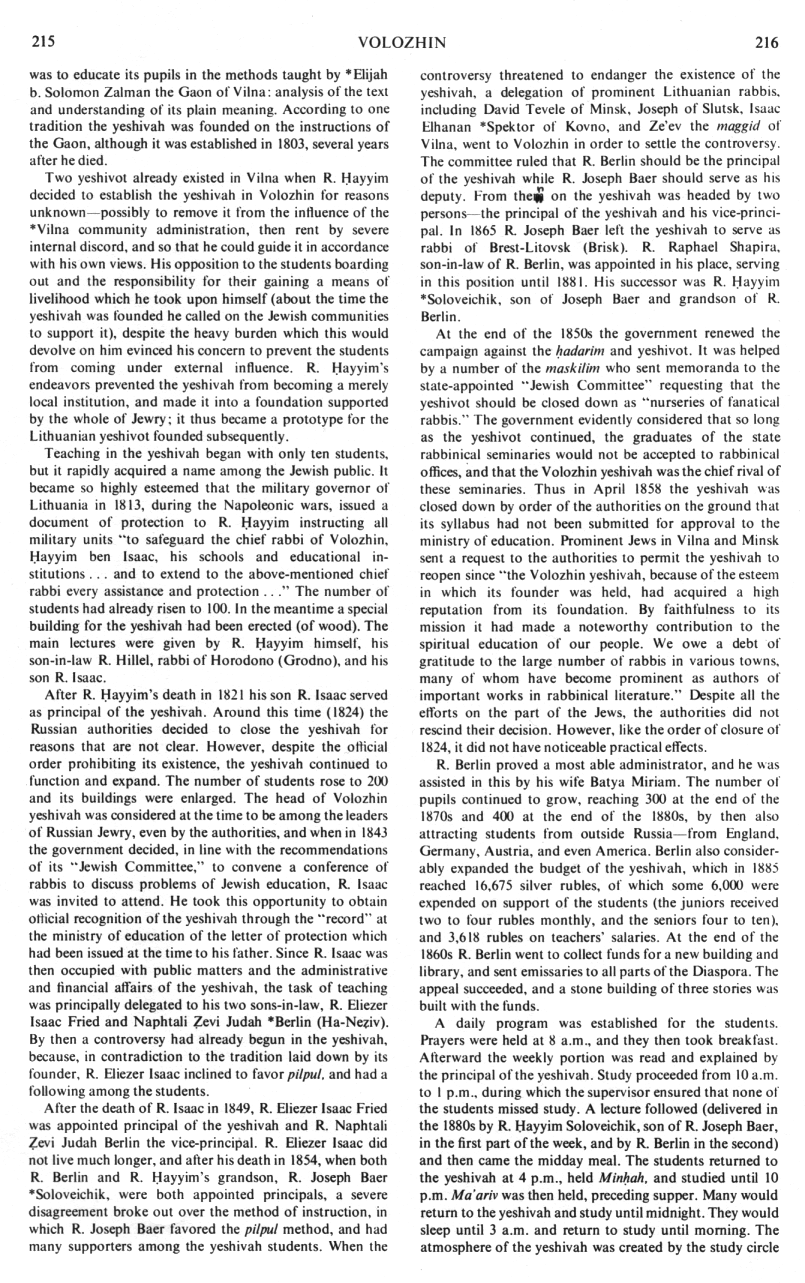
Encyclopaedia Judaica 1971: Volozhin, vol. 16, col. 215-216
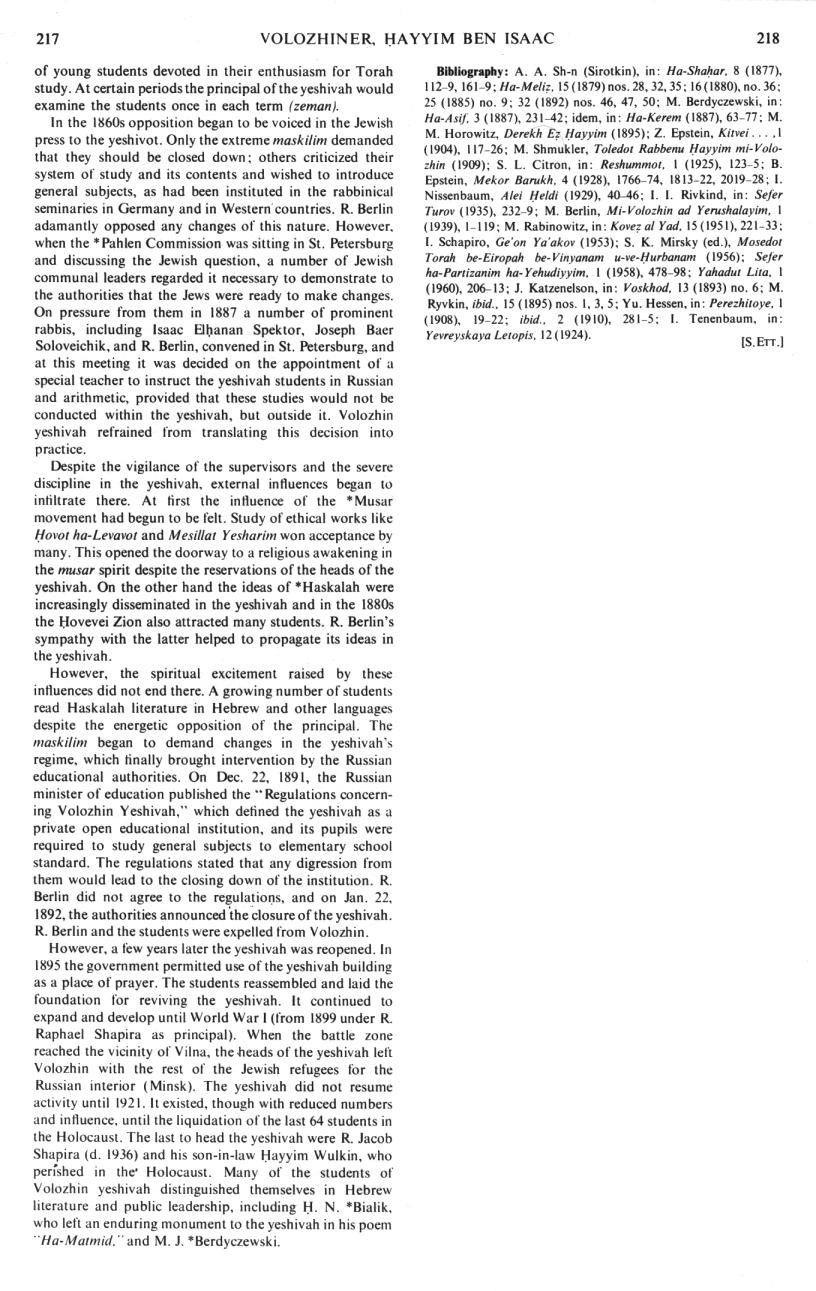
Encyclopaedia Judaica 1971: Volozhin, vol. 16, col. 217-218