Encyclopaedia Judaica
Jews in little towns of BSSR
Borisov - Braslav - Dokshitsy - Dolginovo - Novy Dvor - Vysokoye - Zelva
from: Encyclopaedia Judaica 1971
presented by Michael Palomino (2008 / 2023)
Share:
The solution for life is the Book of Life with Mother Earth - www.med-etc.com
Jews in Borisov
from: Borisov; In: Encyclopaedia Judaica 1971, vol. 4
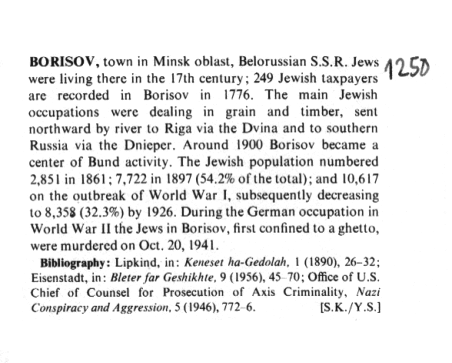
<BORISOV, town in Minsk oblast, Belorussian S.S.R.
Jews were living there in the 17th century; 249 Jewish taxpayers are recored in Borisov in 1776. The main Jewish occupations were dealing in grain and timber, sent northward by river to Riga via the Dvina and to southern Russia via the Dnieper.
Around 1900 Borisov became a center of [[Socialist party]] Bund activity.
The Jewish population numbered 2,851 in 1861; 7,722 in 1897 (54.2% of the total); and 10,617 on the outbreak of World War I, subsequently decreasing to 8,358 (32.3%) by 1926.
[[Jewish refugees from West and Central Poland are not mentioned. Stalin deportations 1940-1941 and the Big Flight from Barbarossa in June 1941 with the withdrawal of the Russian army with the administration and the industrial staff with many Jews are not mentioned either]].
During the German occupation in World War II the Jews in Borisov, first confined to a ghetto, were murdered on Oct. 20, 1941.
[[Emigration and D.P. camps are not mentioned. Jews coming back from central Russia are missing in the article]].
Bibliography
-- Lipkind, in: Keneset ha-Gedolah, I (1890), 26-32
-- Eisenstadt, in: Bleter far Geshikhte [[Leaves for History]], 9 (1956), 45-70
-- Office of U.S. Chief of Counsel for Prosecution of Axis Criminality: Nazi Conspiracy and Aggression, 5 (1946), 772-6
[S.K. / Y.S.]> (col. 1280)
Sources
Encyclopaedia Judaica (1971): Borisov, vol. 4
-----
Jews in Braslav
from: Braslav; In: Encyclopaedia Judaica 1971, vol. 4
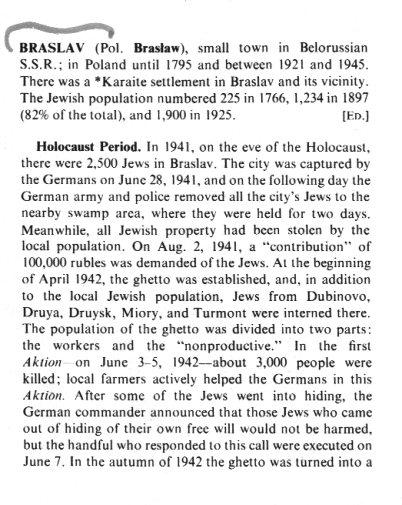
<BRASLAV (pol. Braslaw), small town in Belorussian S.S.R.; in Poland until 1795 and between 1921 and 1945.
[Jews under Polish and Russian law - Stalinization 1939-1941]
There was a *Karaite settlement in Braslav and its vicinity. The Jewish population numbered 225 in 1766, 1,234 in 1897 (82% of the total), and 1,900 in 1925.
[[Stalinization 1939-1941 is not mentioned. Jewish refugees from West and Central Poland are not mentioned. Stalin deportations 1940-1941 and the Big Flight from Barbarossa in June 1941 with the withdrawal of the Russian army with the administration and the industrial staff with many Jews are not mentioned either]].
Holocaust period.
[Swamp area - deprivation - ghetto - massacres with collaboration of the local population - resistance]
In 1941, on the eve of the Holocaust, there were 2,500 Jews in Braslav. The city was captured by the Germans on June 28, 1941, and on the following day the German army and police [[probably with the help of the German friendly population]] removed all the city's Jews to the nearby swamp area, where they were held for two days.
Meanwhile, all Jewish property had been stolen by the local population.
On Aug. 2, 1941, a "contribution" of 100,000 rubles was demanded of the Jews. At the beginning of April 1942, the ghetto was established, and, in addition to the local Jewish population, Jews from Dubinovo, Druya, Druysk, Miory, and Turmont were interned there.
The population of the ghetto was divided into two parts: the workers and the "nonproductive". In the first Aktion - on June 3-5, 1942 - about 3,000 people were killed; local farmers actively helped the Germans in this Aktion.
After some of the Jews went into hiding, the German commander announced that those Jew who came out of hiding of their own free will would not be harmed, but the handful who responded to this call were executed on June 7.
In the autumn of 1942 the ghetto was turned into a (col. 1308)
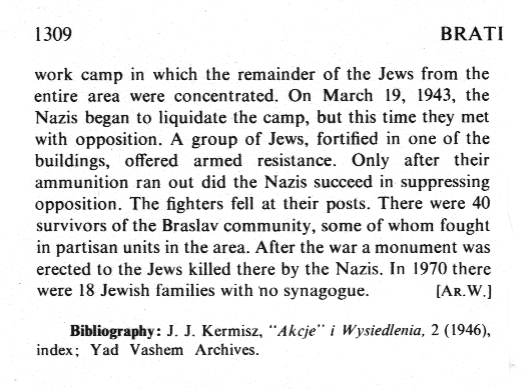
work camp in which the remainder of the Jews from the entire area were concentrated. On March 19, 1943, the Nazis [[and their collaborators]] began to liquidate the camp, but this time they met with opposition. A group of Jews, fortified in one of the buildings, offered armed resistance. Only after their ammunition ran out did the Nazis succeed in suppressing opposition. The fighters fell at their posts.
[Post-war times]
There were 40 survivors of the Braslav community, some of whom fought in partisan units in the area. [[Emigration and D.P. camps are not mentioned. Jews coming back from central Russia are missing in the article]].
After the war a monument was erected to the Jews killed there by the Nazis [[and their collaborators]]. In 1970 there were 18 Jewish families with no synagogue.
[AR.W.]
Bibliography
-- J.J. Kermisz: "Akcje" i Wysiedlenia, 2 (1946), index
-- Yad Vashem Archives.
Sources
Encyclopaedia Judaica (1971): Braslav, vol. 4, col. 1308
Encyclopaedia Judaica (1971): Braslav, vol. 4, col. 1309
-----
Jews in Dokshitsy
from: Encyclopaedia Judaica (1971): Dokshitsy, vol. 6
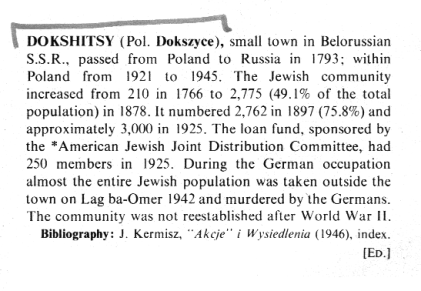
<DOKSHITSY (Pol. Dokszyce), small town in Belorussian S.S.R., passed from Poland to Russia in 1793; within Poland from 1921 to 1945. [[Partition of Poland and Sovietization of the Belorussian part are not mentioned]].
The Jewish community increased from 210 in 1766 to 2,775 (49.1% of the total population) in 1878. It numbered 2,762 in 1897 (75.8%) and approximately 3,000 in 1925. The loan fund, sponsored by the *American Jewish Joint Distribution Committee, had 250 members in 1925.
[[Partition of Poland and Sovietization of the Belorussian part are not mentioned. Stalin deportations are missing in the article. The Big Flight from Barbarossa in June 1941 with the withdrawal of the Russian army with the administration and the industrial staff with many Jews is also missing in the article]].
During the German occupation almost the entire Jewish population was taken outside the town on Lag ba-Omer 1942 and murdered by the Germans [[and their collaborators]].
[[Resistance, changing of name and of religion are not mentioned in the article. Emigration and emigration to D.P. camps are not mentioned. Jews coming back from central Russia are missing in the article]].
The community was not reestablished after World War II.
Bibliography
-- J. Kermisz: "Akcje" i Wysiedlenia (1946), index.
[ED.]> (col. 154)
Sources
Encyclopaedia Judaica (1971): Dokshitsy, vol. 6, col. 154
-----
Jews in Dolginovo
from: Encyclopaedia Judaica (1971): Dolginovo, vol. 6
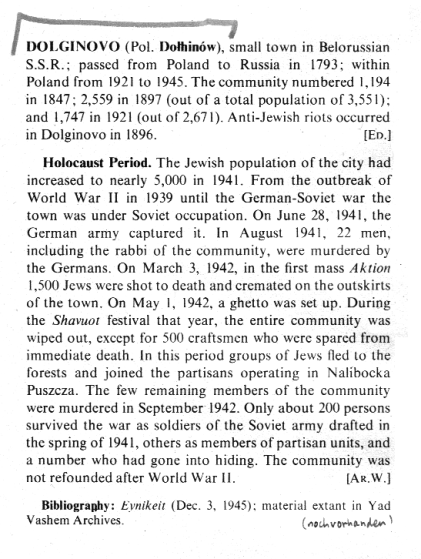
<DOLGINOVO (Pol. Dołhinów), small town in Belorussian S.S.R.;
passed from Poland to Russia in 1793; within Poland from 1921 to 1945 [[Partition of Poland and Sovietization of the Belorussian part are later mentioned]]. The community numbered 1,194 in 1847; 2,559 in 1897 (out of a total population of 3,551); and 1,747 in 1921 (out of 2,671).
Anti-Jewish riots occurred in Dolginovo in 1896.
[ED.]
[Sovietization 1939-1941]
From the outbreak of World War II in 1939 until the German-Soviet wart the town was under Soviet occupation. [[...]]
The Jewish population of the city had increased to nearly 5,000 in 1941. [[Probably there were Jewish refugees from West and Central Poland. Stalin deportations are missing in the article. The Big Flight from Barbarossa in June 1941 with the withdrawal of the Russian army with the administration and the industrial staff with many Jews is also missing in the article]].
Holocaust Period.
[Massacres - ghetto - massacres - flight - partisans]
On June 28, 1941, the German army captured it [[the town of Dolginovo]]. In August 1941, 22 men, including the rabbi of the community, were murdered by the Germans. On March 3, 1942, in the first mass Aktion 1,500 Jews were shot to death and cremated on the outskirts of the town. On May 1, 1942, a ghetto was set up. During the Shavuot festival that year [[holiday on sixth of Sivan commemorating the Ten Commandments given from God to Moses on Sinai according to 1st Mose]], the entire community was wiped out, except for 500 craftsmen who were spared from immediate death.
In this period groups of Jews fled to the forests and joined the partisans operating in Nalibocka Puszcza. The few remaining members of the community were murdered in September 1942.
Only about 200 persons survived the war as soldiers of the Soviet army drafted in the spring of 1941, others as members of partisan units, and a number who had gone into hiding.
The community was not refounded after World War II.
[[Resistance, changing of name and of religion are not mentioned in the article. Emigration and emigration to D.P. camps are not mentioned. Jews coming back from central Russia are missing in the article]].
[AR.W.]
Bibliography
-- Eynikeit [[Unity]] (Dec. 3, 1945)
-- material extant in Yad Vashem Archives.> (col. 154)
Sources
Encyclopaedia Judaica (1971): Dolginovo, vol. 6, col. 154
-----
Jews in Mogilev
Flight from Barbarossa - mass shootings of the remaining Jews - Jews in 1959
from: Mogilev; In: Encyclopaedia Judaica 1971, vol. 12
<By 1926 only 17,105 (34.1% of the population) remained. [[...]]
When Mogilev was occupied by the Germans during World War II (1941), those Jews who did not escape were massacred. It was estimated that there were about 7,000 to 10.000 Jews in Mogilev in 1959.> (col. 216)
-----
Jews in Novy Dvor
from: Novy Dvor; In: Encyclopaedia Judaica 1971, vol. 12
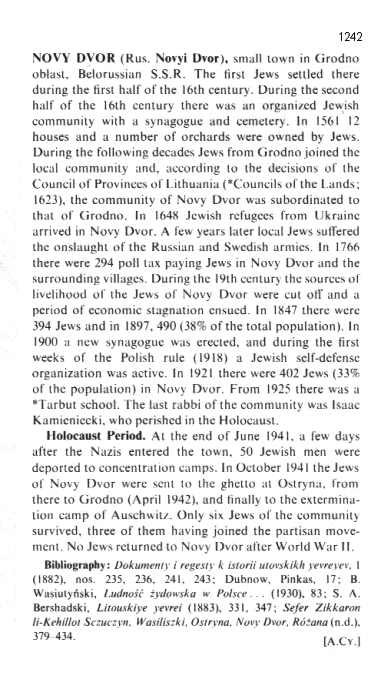
<NOVY DVOR (Rus. Novyi Dvor), small town in Grodno oblast, Belorussian S.S.R.
The first Jews settles there during the first half of the 16th century. During the second half of the 16th century there was an organized Jewish community with a synagogue and cemetery. In 1561 12 houses and a number of orchards were owned by Jews. During the following decades Jews from Grodno joined the local community and, according to the decisions of the Council of Provinces of Lithuania (*Councils of the Lands; 1923), the community of Novy Dvor was subordinated to that of Grodno.
In 1648 Jewish refugees from Ukraine arrived in Novy Dvor [[probably from Chmielnicky pogroms]]. A few years later local Jews suffered the onslaught of the Russian and Swedish armies.
In 1766 there were 294 poll tax paying Jews in Novy Dvor and the surrounding villages.
During the 19th century the sources of livelihood of the Jews of Novy Dvor were cut off and a period of economic stagnation ensued. In 1847 there were 394 Jews and in 1897, 490 (38% of the total population).
In 1900 a new synagogue was erected, and during the first weeks of the Polish rule (1918) a Jewish self-defense organization was active.
In 1921 there were 402 Jews (33% of the population) in Novy Dvor. From 1925 there was a *Tarbut school. the last rabbi of the community was Isaac Kamieniecki, who perished in the Holocaust.
[[Sovietization and the Big Flight from Barbarossa in June 1941 with the withdrawal of the Russian army with the administration and industrial staff with many Jews are not mentioned in the article]].
Holocaust Period.
At the end of June 1941, a few days after the Nazis entered the town, 50 Jewish men were deported to concentration camps [[with the help of the collaborators]]. In October 1941 the Jews of Novy Dvor were sent to the ghetto at Ostryna, from there to Grodno (April 1942), and finally to the extermination camp of Auschwitz [[resp. from there probably to the tunnel systems with a high death rate]].
[Post-war period]
Only six Jews of the community survived, three of them having joined the partisan movement. No Jews returned to Novy Dvor after World War II.
[[Resistance, changing of name and of religion are not mentioned in the article. Emigration and emigration to D.P. camps are not mentioned. Jews coming back from central Russia are missing in the article]].
Bibliography
-- Dokumenty i regesty k istorii utovskikh yevreyev, 1 (1882), nos. 235, 236, 241, 243
-- Dubnow, Pinkas, 17
-- B. Wasiutyński: Ludność zydowska w Polsce... (1930), 83
-- S. A. Bershadski: Litouskiye yevrei (1883), 331, 347
-- Sefer Zikkaron li-Kehillot Sczuczyn, Wasiliszki, Ostryna, Novy Dvor, Różana (n.d.), 379-434.
[A.CY.]> (col. 1242)
Sources
Encyclopaedia Judaica (1971): Dolginovo, vol. 12, col. 1242
-----
Jews in Vysokoye
from: Vysokoye; in: Encyclopaedia Judaica (1971), vol. 16
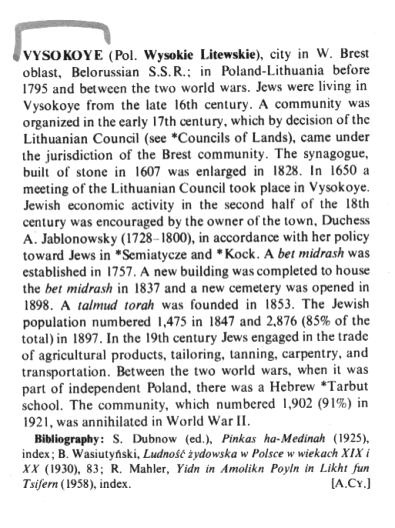
<VYSOKOYE (Pol. Wysokie Litewskie), city in W. Brest oblast, Belorussian S.S.R.; in Poland-Lithuania before 1795 and between the two world wars.
Jews were living in Vysokoye from the late 16th century. A community was organized in the early 17th century, which by decision of the Lithuanian Council (see *Councils of Lands), came under the jurisdiction of the Brest community. The synagogue, built of stone in 1607 was enlarged in 1828. In 1650 a meeting of the Lithuanian Council took place in Vysokoye.
Jewish economic activity in the second half of the 18th century was encouraged by the owner of the town, Duchess A. Jablonowsky (1728-1800), in accordance with her policy toward Jews in *Semiatycze and *Kock. A bet midrash [[House of Learning]] was established in 1757. A new building was completed to house the bet midrash in 1837 and a new cemetery was opened in 1898. A talmud torah was founded in 1853.
The Jewish population numbered 1,475 in 1847 and 2,876 (85% of the total) in 1897. In the 19th century Jews engaged in the trade of agricultural products, tailoring, tanning, carpentry, and transportation. Between the two world Wars, when it was part of independent Poland, there was a Hebrew *Tarbut [[cultural]] school. The community, which numbered 1,902 (91%) in 1921, was annihilated in World War II.
[[Flight movement to eastern Poland 1939-1940 is not mentioned in the article. Stalin deportations of the Jewish refugees are not mentioned in the article. The Big Flight from Barbarossa in June 1941 with the withdrawal of the Russian army with the administration and industrial staff with many Jews are not mentioned in the article. Resistance and changing names and changing religion are not mentioned in the article. Emigration since 1944 and D.P. camps are not mentioned. Jews coming back from central Russia since 1946 are missing in the article]].
Bibliography
-- S. Dubnow (ed.): Pinkas ha-Medinah (1925), index
-- B. Wasiutyński: Ludność zydowska w Polsce w wiekach XIX i XX (1930), 83
-- R. Mahler: Yidn in Amolikn Poyln in Likht fun Tsifern (1958), index.> (col. 234)
Sources
Encyclopaedia Judaica (1971): Dolginovo, vol. 16, col. 234
-----
Zelva
from: Zelva; in: Encyclopaedia Judaica (1971), vol. 16
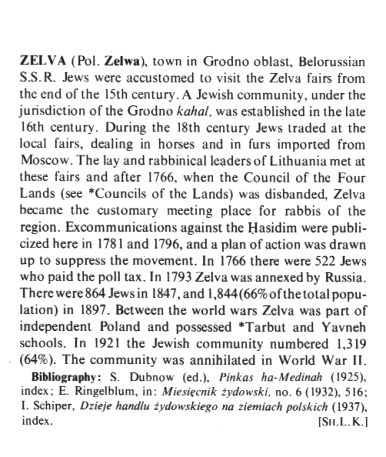
<ZELVA (Pol. Zelwa), town in Grodno oblast, Belorussian S.S.R.
Jews were accustomed to visit the Zelva fairs from the end of the 15th century.A Jewish community, under the jurisdiction of the Grodno kahal, was established in the late 16th century. During the 18th century Jews traded at the local fairs, dealing in horsed and in furs imported from Moscow.
The lay and rabbinical leaders of Lithuania met at these fairs and after 1766, when the Council of the Four Lands (see *Councils of the Lands) was disbanded, Zelva became the customary meeting place for rabbis of the region. Excommunications against the Hasidim (Ḥasidim) were publicized here in 1781 and 1796, and a plan of action was drawn up to suppress the movement.
In 1766 there were 522 Jews who paid the poll tax. In 1793 Zelva was annexed by Russia. There were 864 Jews in 1847, and 1,844 (66% of the total population) in 1897. Between the world wars Zelva was part of independent Poland and possessed *Tarbut [[cultural]] and Yavneh schools [[schools for Judaic studies]].
In 1921 the Jewish community numbered 1,319 (64%). The community was annihilated in World War II.
[[The Big Flight from Barbarossa in June 1941 with the withdrawal of the Russian army with the administration and industrial staff with many Jews are not mentioned in the article. Resistance and changing names and changing religion are not mentioned in the article. Emigration since 1944 and D.P. camps are not mentioned. Jews coming back from central Russia since 1946 are missing in the article]].
Bibliography
-- S. Dubnow (ed.): Pinkas ha-Medinah (1925), index
-- E. Ringelblum, in: Miesiẹcnik żydowski, no. 6 (1932), 516
-- I. Schiper: Dzieje handlu żydowskiego na ziemiach polskich (1937), index.
[SH. L. K.]> (col. 981)
Share:
The solution for life is the Book of Life with Mother Earth - www.med-etc.com
Sources
Encyclopaedia Judaica (1971): Dolginovo, vol. 16, col. 981