

Encyclopaedia Judaica
Jews in Berlin 02: 1812-1933
Tolerance and Jewish development - split Jewry between reformists and orthodox Jews - split Jewry between racist Zionists and anti-Zionists - revolution 1919 and Nazism since 1919 - Hebrew printing
from: Berlin; In: Encyclopaedia Judaica (1971), vol. 4
presented by Michael Palomino (2008)

| Teilen
/ share: |
Facebook |
|
Twitter
|
From the Edict of Equality to the Accession of the Nazis.
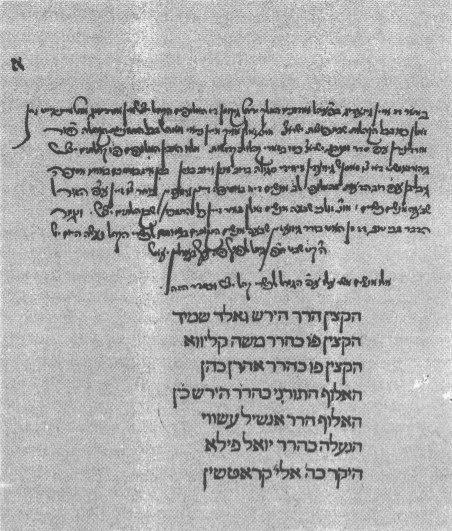
Encyclopaedia Judaica (1971): Berlin, vol. 4, col. 644. First page of the minute book
of the Berlin community, 1723. Jerusalem, C.A.H.J.P.
[Tolerance - Jewish press and successes in culture provokes anti-Semitism]
The political history of the Jews of Berlin after 1812 becomes increasingly merged with that of the Jews of *Prussia and *Germany as a whole. In the 1848 Revolution the Jews played an active role as fighters on the barricades and members of the civic guard, as orators and journalists, and the like. Despite the edict of 1812 Jews continued to be hampered by a number of restrictions, and formal civic equality was not attained until July 1860. Subsequently, Jews began to enter Berlin's political and social life in increasing numbers, and the Berlin municipality was for a long time a stronghold of liberalism and tolerance.
About one-fifth of Berlin's newspapers were owned by Jews.
[[It seems problematic that such a little group like the Jews possess one-fifth of Berlin's newspapers]].
The Berliner Tageblatt and the Vossische Zeitung, whose publishers and editors were Jewish, were read abroad with particular attention, although it was known that they did not express the opinions of circles close to the government. Berlin Jews played a prominent part in literature, the theater, music, and art. Their successes aroused fierce reaction among the more conservative elements and Berlin became a center of anti-Semitism.
[[There was also a leading Jewish role in the stock exchange. When such a little group like the Jews are dominating a big part of the press, the stock exchange, and the cultural scenery there will be some reaction, but anti-Semitism was the wrong reaction. Both groups did not find a balance]].
The "Berlin Movement" (col. 643)
founded by Adolf *Stoecker incited the masses against the Jews by alleging that they were the standard-bearers of capitalism and controlled the press (see *Anti-Semitic Political Parties and Organizations).
[Figures]
The Jewish population of Berlin numbered 3,292 in 1812; 11,840 in 1852; 108,044 in 1890; and 172,672 in 1925. Thus within a century it had increased more than fifty fold. The Jews comprised about 2% of the total population in 1840, 5.05% in 1890, and 4.29% in 1925. The Jews in Berlin comprised 1.4% of German Jewry in 1811-28, 7.03% in 1871, and 30.6% in 1925.
[[So when are about 5% Jewish population it seems problematic that the Jews possess 20% of the press, are dominating the stock exchange and the cultural scenery. There is missing a balance]].
The Jews in Berlin comprised 1.4% of German Jewry in 1811-28, 7.03% in 1871, and 30.6% in 1925.
[Jewish influx from eastern Europe - Jewish economy in Berlin]
Despite the increasing instances of intermarriage, renunciation of Judaism, and conversion to Christianity, and the decline in the Jewish birthrate, the Jewish population of Berlin continued to grow through the arrival of Jews from provincial centers, especially from the province of Posen (Poznan) and from eastern Europe.
As Berlin grew in importance as a commercial and industrial center, Jews played an increasingly important role in the city's economic life, especially as bankers (*Mendelssohn, *Bleichroeder, and others), owners of department stores (*Ertheim, *Tietz, Jandorf), and in the grain and metal trades, the textile and clothing industries, building construction, the manufacture of railway engines and cars, the brewing of beer, and other branches of the economy.
Ludwig *Loewe headed a large armaments factory in Berlin. The General Electric Company (A.E.G.) was founded by the Jewish engineer Emil *Rathenau, and both his son Walter *Rathenau and Felix Deutsch were active in it. In 1861 53.17% of the Jews in Berlin engaged in commerce, and 17.3% in industry and the manual trades; by 1910 the percentage of those occupied in commerce had decreased to 41.61%, while 35.16% earned their livelihood in industry and the manual trades.
[[When 5% of the population (the Jewish part of the population) are so strong in the Berlin economy, this will provoke some reaction. There is missing a balance]].
Internal Life of the Berlin Community (1812-1933)
[Influx of Polish Jews since 1772 - new regulations of the community since 1812 - statue of 1837 - leadership by committees]
Following the partitions of Poland-Lithuania, 1772-95, the Berlin community became increasingly influenced by the steady stream of eastern European Jews (Ostjuden) who first arrived from the Posen district. This influx made up for the losses to the Jewish communities through assimilation and apostasy. Later there was growing immigration from (col. 644)
the *Pale of Settlement. From the second half of the 19th century the increasing colony of Russian, mainly Jewish, students exerted a powerful cultural influence in Berlin. The organizational structure of the Jewish community was undermined after the emancipation of the Jews in 1812. The old regulations were abolished by the 1812 edict and no new regulations were instituted. For some time the community was not allowed to collect dues and faced disintegration.
A statue issued in July 1837 permitted the renewal of normal communal life, and from then on the Berlin community was administered by a committee of seven members and three alternates and a council of 21 members and ten alternates. The first elections to the council took place in February 1854, and the community's first constitution was ratified in August 1860. During this period, the community was thrown into a ferment as a result of the aspiration of David Friedlaender and others for extreme liturgical reforms. The *Reform program was temporarily restrained by a decree of Dec. 9, 1823, which laid down that all divine worship was to take place in the local synagogue and according to accepted custom without any innovations in the language, ritual, prayers, and liturgy.
[Schooling and teachers' seminaries]
In 1819, the *Verein fuer Kultur and Wissenschaft der Juden ("Society for Jewish Culture and Learning"), was founded in Berlin by Leopold *Zunz, I.M. *Jost, and Eduard *Gans, with Heinrich *Heine among its members (see *Germany). In the meanwhile, far-reaching changes had been introduced in education. The Hinnukh Ne'arim school was closed at the end of 1825 for lack of funds, and was replaced in 1826 by a new school for boys, founded by the community; Zunz was principal of this school until 1830. In 1835 the community founded a school for girls. There were also several Jewish private schools in Berlin, such as that of H.M. Bock (founded in 1807), whose principals were Jost (1816-35) and Sigismund *Stern (1835-45). R. Meir b. Simhah (Simḥah) Weyl, who charted a conservative course in education, opened a teachers' seminary in 1825. From 1840 to 1850 a teachers' seminary functioned under the direction of Zunz. A teachers' training institute was established in 1859 under the rectorship of Aaron *Horowitz.
[Synagogue life: reforms since 1845 and split because of an organ in 1869 - High school of Jewish science 1872 - rabbinical seminary for Orthodox Judaism 1873 - more synagogues 1880-1930]
In 1844 Michael Jehiel *Sachs was invited to be the third dayyan [[judge]] and preacher of the community. Although a Conservative, he was not opposed to moderate reform. In the wake of the foundation of the second Kulturverein ("cultural association"; 1840), Aaron *Bernstein founded the Reform Society in 1845, and later the Reform Congregation, which introduced far-flung liturgical reforms, especially during the rabbinate of Samuel *Hodlheim (1847-60).
At first, divine worship was held both on Saturdays and Sundays and later only on Sundays. The Reform Congregation was unsuccessful in its attempt to secede from the official community, but the latter was obliged to give very substantial financial support to the Reform Congregation since many of its members were among the largest taxpayers.
The Berlin community was again violently shaken when many of its members pressed for the introduction of an organ and modification of the liturgy in the New Synagogue. The appointment of Abraham *Geiger as rabbi of the Berlin community (officiated 1870-74) met with strong opposition from Orthodox circles, and in 1869 Azriel (Israel) *Hildesheimer and his adherents left the main community and established the Adass Yisroel congregation, which received official recognition in 1885. Abraham Geiger had stipulated as a condition of his appointment that an institute for Jewish research be established in Berlin, and in 1872 the *Hochschule fuer die Wissenschaft des Judentums [[High school of Jewish science]] was opened there.
A year later, Hildesheimer opened a (col. 645)
rabbinical seminary for Orthodox Judaism (*Rabbinerseminar fuer das orthodoxe Judentum). Between 1880 and 1930, eight large synagogues were erected by the Berlin community, among them that in the Fasanenstrasse which was one of the most magnificent synagogues in the world. In all, the community owned 16 synagogues, seven of them Orthodox and the remainder Liberal and Reformist. Thirty rabbis served in Berlin after Abraham Geiger (12 Orthodox and the remainder liberal). In addition, most religious groups which were supported by the community had their own rabbis.
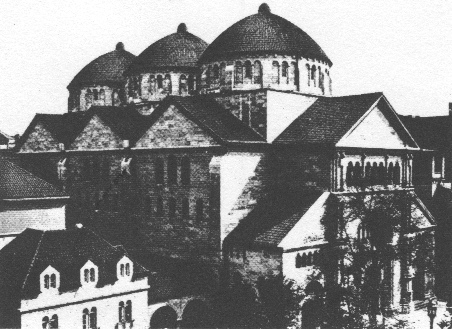
Encyclopaedia Judaica (1971): Berlin, vol. 4, col. 647. The famous Fasanenstrasse Synagogue in Charlottenburg,
Berlin, designed by E. Hessel, 1912. Berlin Municipalit. Photo State Picture Office, Berlin
[Jewish organizations in Berlin - Jewish newspapers in Berlin]
Berlin was the center of the national German-Jewish organizations, such as
-- the *Deutsch-Israelitischer Gemeindebund [[German Israelite Community Association]] (founded in 1869)
-- Verband der deutschen Juden [[Association of the German Jews]] (1904)
-- the *B'nai B'rith (1883)
-- *Central-Verein deutscher Staatsbuerger juedischen Glaubens [[CV, Principal Association of German civilians of Jewish belief]] (1893)
-- *Hilfsverein der deutschen Juden [[welfare organization of German Jews]] (1901)
-- Zentralwohlfahrtsstelle der deutschen Juden [[Central Welfare Office of the German Jews]] (1917)
and others.
Likewise, Jewish newspapers and periodicals were published in Berlin, including the communal organ, whose circulation reached 60,000 copies. The Berlin communal institutions and their activities in every field served as a model for Jewish communities throughout the world. The annual communal budget in the 1930s was about 10,000,000 marks (as against 5,000,000 marks in 1914). About 70,000 Jews in Berlin paid dues to the community.
[Racist Zionism in Berlin and Jewish opposition against racist Zionism: the anti-Zionists]
For about 80 years the Liberals were predominant in the Berlin community. But Liberals and Orthodox worked together in full harmony in the central organizations in which, at least for a certain period, the [[racist]] Zionists also participated. The *Hibbat (Ḥibbat) Zion movement met with but a lukewarm reception in Berlin, especially among the Orthodox, and the opposition to political [[racist]] Zionism was particularly keen. The Berlin rabbi S. *Maybaum was among the leaders of the "*Protest Rabbis", and the Central-Verein and the *Vereinigung fuer das liberale Judentum [[Association for liberal Jewry]] launched a concerted effort against the [[racist]] Zionistische Vereinigung fuer Deutschland [[Zionist Association for Germany]] and its organ, the *Juedische Rundschau [[Jewish News]].
When the procedure for communal elections was changed after World War I, four representatives of the *Juedische Volkspartei [[Jewish Popular Party]] (a coalition of Zionists, *Mizrachi, and the Verband der ostjuedischen Organizationen [[Association of the Eastern Jewish Organizations]]) and one of the *Po'alei Zion were elected in 1920 to the representative council (Repraesentantenversammlung), which consisted of 21 members; two [[racist]] Zionists sat on the communal committee (Gemeindevorstand).
In the 1926 election, a coalition of the Juedische Volkspartei, the Conservatives, and the Mittelpartei [[Central Party]] won a majority. For three years, the [[racist]] Zionist Georg Kareski headed the communal committee. However, in the elections of November 1930, 24 Liberals were elected to the representative council, 14 from the Juedische Volkspartei, and three from among the small parties; seven Liberals, three [[racist]] Zionists, and one Conservative sat on the communal committee. Max Naumann and his faction were the spearhead of the extremist anti-Zionist faction which rejected all cooperation with non-German Jews and demanded that the [[racist]] Zionists be deprived of their German citizenship and permitted to reside in Germany only as aliens.
[[The ideological base of racist Zionism was the nationalist booklet of racist Theodor Herzl "The Jewish State" (1896) saying that the Arabs could be driven away as the natives in "America" had been driven away, and the Arabs would be the slaves of the Jews, and in Palestine could be found gold mines as in South Africa etc. Add to this the racist Zionist project was to establish a "Greater Israel" from the Nile to the Euphrates according to 1st Mose, chapter 15, phrase 18. One has to consider that racist Theodor Herzl did not mention any borderline in his booklet "The Jewish State". This declaration of war against the Arabs was answered in the Arab world with newspapers and agitation against Jews since 1896, and the anti-Zionists saw the big danger of the racist Zionist fantasy of a new "Israel" which would be fought by the whole Arab world. These racist Zionist war mongers were to be excluded, thought the anti-Zionists. But the main problem of nationalism that Jewishness is a religion and not a nation was not discussed. The balance and the peaceful solution was not found]].
[Prussian Association of Jewish communities - inflation 1923 - murders and attacks]
In 1922, at the initiative of the Berlin community, the Preussischer Landesverband juedischer Gemeinden [[Prussian Association of Jewish communities]] was founded, comprising 655 communities, not including the Orthodox communities which formed their own association. A great boon to the Berlin community was the government support which was granted for the first time during the inflation of late 1923, without which it could not have survived. In later years, the government subsidy to the community was insufficient.
After the murder of Karl Liebknecht and Rosa (col. 646)
*Luxemburg in January 1919, anti-Semitic propaganda in Berlin increased. The Kapp putsch (March 1920) had blatant anti-Jewish undertones. Walter Rathenau, the German foreign minister, was assassinated by anti-Semitic nationalists on June 24, 1922. On Nov. 5, 1923, anti-Semites attacked the Jews living in Grenadierstrasse and Dragonerstrasse, which were centers of Jewish residence. In 1926, after the appointment of Joseph *Goebbels as Gauleiter in Berlin, anti-Jewish rabble-rousing increased. On the eve of the Jewish New Year (Sept. 12, 1931), Jews returning from synagogue in Kurfuerstendam were assaulted by gangs of Nazis, organized by Count Wolff Heinrich von Halldorf (later chief of police in the Third Reich).
[J.MEL. / ED.] (col. 647)
[[There was a big frustration in big parts of the German population after 1919 because Communists had performed an ammunition strike so on the front was ammunition missing and Germany gave up the war on the basis of 14 points. Add to this the Emperor system was abolished. Further the 14 points were not fulfilled in the Treaty of Versailles and Germany lost all colonies. So there were enough national reasons for a big frustration and some groups blamed the Jews for it. And the more the Communists were agitating in Germany, the more the Nazis had a chance for successful fights against them, and big parts of the populations believed the Nazi propaganda which was financed mostly from abroad]].
Hebrew Printing in Berlin.
The first Hebrew printer in Berlin was the court preacher and professor D.E. Jablonsky, as Jews could not obtain the necessary license; nevertheless, the manager J.L. Neumark, and most of the setters and proofreaders were Jews. The first book published by them was the Book of Psalms (1697), followed by the complete Bible (1699), and other scholarly and liturgical works. An application by Rabbi Mirels for permission to print the Talmud in Berlin was refused by Frederick I, king of Prussia; the permission to publish Maimonides' Code was not taken up, as this was just being printed in Amsterdam by J. *Athias. But a Talmud edition was issued by Gottschalk and Jablonski, in partnership with a Frankfort on the Oder printer, 1715-22.
Among other printers to be mentioned are Baruch Buchbinder (Radoner) of Vilna (1708-17), who printed a number of important works such as the Tzena Urena and works by the Shabbatean Nehemiah *Hayon (1713), a Mishnah with Rashi and Jacob Hagiz's (Ḥagiz's) commentary (1716-17), and a Hoshen Mishpat (1717). Nathan, son of the aforementioned J.L. Neumark, was active 1719-27, while his son-in-law Aaron b. Moses Rofe of Lissa built up an important press, 1733-62, publishing a series of well-known rabbinic works, above all the second Berlin Talmud edition 1734-39. Aaron's press was continued for a while by his grandson Moses b. Mordecai.
An annual Lu'ah (Lu'aḥ) began to appear probably from 1725 but not later than 1738. Of some importance was the press of Isaac b. Jacob Speyer (1764-70), a son-in-law of the Berlin rabbi David Fraenkel, who printed notable rabbinic works - Steinschneider calls it "the highlight of Hebrew printing in Berlin"; and that of Mordecai Landsberg, also from 1764. The prolific writer and editor Isaac *Satanow took over Landsberg's press in 1772 and issued a considerable number of books, particularly his own (until 1804).
In 1784 David Friedlaender and his friends founded the Verlag der juedischen Freischule [[Jewish Free School Printing House]], managed by A. *Wolfsohn-Halle who bought the Landsberg press and obtained a license to print and sell books. Pupils of the society were taught the craft of printing and a number of books were published from 1796 with the imprint "Orientalische Druckerei" [[Oriental Printing House]]. During these years Berlin became the center for the printing of Enlightenment literature, notably the writings of M. Mendelssohn, N.H. Wessely, D. Friedlaender, etc. Mendelssohn's edition of the Pentateuch appeared here in 1783.
In 1830 the Landsberg press was bought by Isaac Levent. In that (col. 653)
year the printer Trevitsch and son moved to Berlin from Frankfort on the Oder. In 1834, the year of his death, David Friedlaender founded his own press and published a number of important books; the scholar D. *Cassel worked there as a proofreader. In 1836 the apostate Julius Sittenfeld set up a printing house which published the complete Talmud (1862-68), Maimonides' Code (1862), and other works. In the late 19th and early 20th century H. Itzkowski, Siegfried, Arthur and Erich Scholem were active as general, Jewish, and also Hebrew publishers and printers in Berlin. In 1930 a Pentateuch was printed for the *Soncino-Gesellschaft [[Soncino Association]] by the "Officina Serpentis" with a new Hebrew type cut for this occasion.
[A.M.H.]> (col. 654)
| Teilen
/ share: |
Facebook |
|
Twitter |
| Sources |
|||
 Encyclopaedia Judaica (1971): Berlin, vol. 4, col. 643-644 |
 Encyclopaedia Judaica (1971): Berlin, vol. 4, col. 645-646 |
 Encyclopaedia Judaica (1971): Berlin, vol. 4, col. 653-654 |
 Encyclopaedia Judaica (1971): Berlin, vol. 4, col. 647-648 |
Č Ḥ Š Ṭ Ẓ
ā ć č ḥ ī š ū ž ẓ
ā ć č ḥ ī š ū ž ẓ
^