

Encyclopaedia Judaica
Jews in Berlin 03: Third Reich and WW II
Boycott - discriminations - Jewish schooling - racist Zionists, Bannmeile (ban mile), emigration - forced labor - deportations - survivors
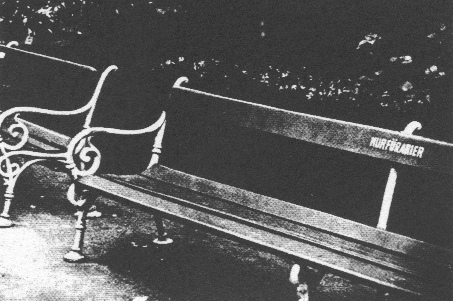
Encyclopaedia Judaica (1971): Berlin, vol. 4, col. 654. A bench in a Berlin park,
"For Aryans Only" [["Nur fuer Arier"]], 1938. Jerusalem, Yad Vashem Museum
from: Berlin; In: Encyclopaedia Judaica (1971), vol. 4
presented by Michael Palomino (2008)


| Teilen
/ share: |
Facebook |
|
Twitter
|
1933-39.
[Numbers - boycott day - dismissals and aryanization - murders and suicides - Jewish schooling - discriminations - Jewish Cultural Society]
At the time the Nazis seized power, Berlin's organized Jewish community numbered about 172,000 persons. In 1933 the Nazi boycott (April 1)
[[there was a boycott day]]
affected Jewish shop owners;
[[but many Germans were going shopping to the Jewish shops the day after the boycott day and bought more than normally; see also: *Boycott, anti-Jewish]].
[[To the contrary the worldwide Jewish organizations organized a big counter boycott against Germany all the time from 1933-1945; see also: *Boycott, anti-Nazi]].
legislation against non-Aryans led to dismissal of Jewish professionals; while "aryanization" of Jewish firms
[[the Hitler regime gave the enterprises to his political "friends" in Germany and abroad, also in "neutral" Switzerland]]
and the dismissal of their Jewish employees was carried out by the exertion of steady economic pressure. The Jewish officials not affected by these measures were eventually ousted under the provisions of the *Nuremberg Laws (1935).
During this early period, such incidents as the murder of a Jewish physician, Dr. Philippsthal (spring 1933), and the suicide of Rudolf S. Mosse after mistreatment in prison (fall 1933), the first such incidents of their kind, caused great consternation among the Jews.
In these initial years, when the members of the Jewish community were being methodically deprived of their economic standing and civil rights, Jewish religious and cultural life in Berlin underwent a tremendous upsurge. Jewish children, most of them excluded from the public schools, attended schools set up and maintained by the Jewish community or private schools. Eight elementary Jewish schools were maintained at one period to meet the community needs, as well as the famous college for Jewish studies, the *Hochschule fuer die Wissenschaft des Judentums [[High School for Jewish Science]].
Jews were later forbidden to attend theaters and public places of entertainment. The Juedischer Kulturbund ("Jewish Cultural Society") was established.
[Yellow benches - raids and arrests - Jewish books - racist Zionism - status of the community deprived]
In the summer of 1935 [[with the Nuremberg laws]] yellow benches for the segregation of Jews were set up in parks and inscribed nur fuer Juden ("only for Jews"). Signs inscribed Juden unerwuenscht ("Jews not wanted") were displayed in public places. These were removed for the duration of the Olympic Games then being held in Berlin (summer 1936). [[The same system with "Jews not wanted" existed in other racist states, e.g. in the criminal United States. The Olympic Games were a big Hitler show with the first application of direct TV broadcasting]].
Throughout this (col. 647)
period, raids and arrests became frequent occurrences and were accelerated in 1938. Until November 1938 Jewish newspapers and books were published on an unprecedented [[never been so much]] scale. Notable among the newspapers was the Berliner juedisches Gemeindeblatt (Berlin Jewish Local]], a voluminous weekly published by the community.
[[Racist]] Zionist work was in full swing, especially that of He-Halutz (He-Ḥalutz), and in February 1936, a German [[racist]] Zionist convention was held in Berlin (the last to meet there), still reflecting in its composition the vigorous party life of German [[racist]] Zionists.
[[There was a big emigration wave to Palestine. The emigration was well organized by the Jewish organizations in collaboration with the Nazis. The Jews could bring German goods to Palestine, see *Haavara. But at the end Palestine was projected to be occupied by the Nazi troops and the Jews would have been victims again...]]
From March 28, 1938, the Jewish community was deprived of its status as a recognized public corporate body. The Berlin community was made a "private" organization, denied the right to collect dues from the community, and renamed the Juedische Kultusvereinigung Berlin ("Jewish Religious Society").
[Mass arrests - Kristallnacht - Bannmeile [[ban mile]] - reduction of newspapers and religious services - rabbis left - Central Bureau for Jewish Emigration]
In June 1938, mass arrests of Jews took place on the charge that they were "asocial", e.g., had a criminal record, including traffic violations, and they were imprisoned in *Sachsenhausen concentration camp. On November 9-10, *Kristallnacht marked a turning point in the affairs of Berlin Jewry: synagogues were burned down, Jewish shops destroyed, and 10,000 Jews from Berlin and other places were arrested and imprisoned in Sachsenhausen. The "Bannmeile" was decreed, which restricted Jews to an area within a certain radius from their place of residence; banished them from most of the main thoroughfares [[main streets]], and the area in which government offices were located; and evicted Jews from their apartments, a step which had begun earlier, but was now accelerated.
Jewish newspapers had to cease publication. The only paper was the new Das juedische Nachrichtenblatt [[Jewish News]] which was required to publish Gestapo directives to the Jews. Meeting of bodies of the Jewish community were no longer permitted, and the Jewish community's executive council had to conduct its affairs from then on without consulting any representative group. Religious services, when resumed, were now restricted to three synagogues (on Levetzow, Luetzow, and Kaiser Streets) and a few small halls.
Most of Berlin's rabbis left Berlin before Kristallnacht: the last three rabbis to stay were
-- Leo *Baeck (who was later sent to Theresienstadt camp)
-- Felix Singerman (died in Riga in 1942), and
-- Martin Salomonski (died in Auschwitz [[resp. probably in tunnel systems]] in 1944).
At the end of January 1939, the Gestapo established a Zentralstelle fuer juedische Auswandeurng ("Central Bureau for Jewish Emigration") in Berlin.
The Berlin community, presided over by Heinrich *Stahl, was the largest and most dynamic German-Jewish community, and was incorporated along with the Reichsvertretung der deutschen Juden [[Reich's representation of the German Jews]] into the Nazi-imposed Reichsvereinigung der Juden in Deutschland [[RVE, Reich's Federation of the Jews in Germany)]], established on July 4, 1939. After its incorporation into the Reichsvereinigung , the Berlin community maintained its autonomous function for some time.
[[The Berlin Nazi government planned a war against Russia. This "Barbarossa" project was supported by many great personalities from abroad. It was hoped that Hitler would destroy Communism. Banks of the criminal United States supported both sides, Communism and Nazism...]]
1939-45.
[Forced labor - yellow badge - "evacuation" preparations - legal emigrations stops]
After the outbreak of the war, the living conditions and situation of the Jews worsened. Emigration was still permitted and even encouraged, and existing organizations and institutions (Kulturbund [["Jewish Cultural Society"]], Jewish schools) were able to continue functioning. However, Jews were drafted for forced labor at wages far below the prevailing rate and with no social benefits, but this at least provided them with a minimum income and delayed their deportation.
On Jan. 31, 1940, a special Arbeitsamt fuer Judenarbeiter ("Labor Exchange for Jew-Workers") was set up. In the spring of 1940 Stahl was removed from his post in the Reichsvereinigung [[Reich's Federation]] by the Nazi authorities and replaced by Moritz Henschel, a former attorney.
In September 1941, a drastic turn for the worse came about [[because the fast victory against Russia did not come]]. First the Judenstern ("Jewish star", i.e., yellow *badge) was introduced. Two weeks later, on the Day of Atonement, in the middle of a (col. 648)
sermon by Rabbi Leo Baeck, the president of the community was summoned to the Gestapo and told that the community would have to prepare for a partial evacuation from the city, that large apartments still occupied by Jews would have to be cleared, that many additional parts of the city would now be out of bounds to Jews, and that the Levetzowstrasse synagogue would be turned into a Sammellager ("assembly camp") for 1,000 persons. In due course more such assembly camps were added.
Legal emigration was prohibited on October 23. The last transport of emigrants left Berlin on October 18 for Lisbon. In the preceding months (May-October), 1,342 emigrants had been permitted to leave. Between October 23 and the end of the year only 62 persons managed to leave, and in 1942 only nine Jews were permitted to go abroad.
[[Many Jews could hide in Christian families]].
[Deportation: 5 deportation waves - Osttransporte [[transports to the East]] and Alterstransporte [transports for elders]] - Alois Brunner in November and December 1942 - Jews "safe from deportation" - "Fabrikaktion" and women's demonstration for their husbands]
There were five major phases in the process of deportation:
(a) Between fall 1941 and January 1942 the deportees were sent to Riga, Minsk, Kovno, and Lodz
(b) Those deported in spring 1942 were sent to Lublin (Trawniki)
(c) Between summer 1942 and February 1943 their destination was Theresienstadt, Auschwitz, Riga, and Tallin (Rasiku)
(d) Auschwitz was the destination of the deportees of March-April 1943 [[and then probably to the tunnel systems with high death rate]]
(e) Those deported from spring 1943 until the end of the war were sent to Bergen-Belsen, Ravensbrueck, Sachsenhausen, and Auschwitz [[and then probably to the tunnel systems with high death rate]].
Altogether there were 63 Osttransporte [[transportations to the East]] carrying some 35,000 victims to death camps in the east, and 117 Alterstransporte [[transportations of the elders]], transporting some 15,000 (mainly older) persons to Theresienstadt. It is believed that about 95% of the first and 90% of the second group perished. (For lists of transport numbers, dates, numbers of deportees and destinations, see bibliography, Sellenthin, 84-85).
All through 1942 the deportations were kept up, although community employees and persons employed on forced labor were still excluded. In November and December 1942, the infamous commissar Alois Brunner (see Adolf *Eichmann) from Vienna was employed in Berlin and was responsible for organizing the picking up of the candidates for deportation in their homes, "distinguishing" himself by his extraordinary cruelty. Eventually, the deportations came to include groups of community employees, and from the fall of 1942, only those Jewish laborers who were employed in vital war production were still safe from deportation.
At the beginning of 1943, the Gestapo persuaded the military administration to relinquish these workers, which resulted on February 27-28 in the so-called "Fabrikaktion" [["Production plant action"]] - marked by exceptional cruelty - in which all the workers were taken straight from the factories and deported from Berlin. Those Jews arrested in this "action" who had gentile wives were taken to a special camp for onward deportation, but when their wives carried out violent street demonstrations, the Gestapo yielded and set their husbands free.
[Anti-Jewish exhibition "Soviet Paradise" - Jewish attack and murdered German group - revenge and 50 Jews shot for 1 German victim]
On May 13, 1942, an anti-Jewish exhibition, "Soviet Paradise", was opened in Berlin, and was attacked by a group of Jewish communists, led by Herbert *Braun. The group was caught and hardly any of them survived. Two hundred and fifty Jews - 50 for each German who had been killed in the attack - were shot, and another 250 were sent to Sachsenhausen and perished there.
[Office closed and deportation to Theresienstadt 1943]
The community offices were closed down on June 10, 1943, and six days later the "full" Jews among the members of its executive council were deported to Theresienstadt. The remaining Jews were looked after by the Neue Reichsvereinigung [[Reichsvereinigung der Juden in Deutschland (RVE), Reich's Federation of the Jews in Germany)]], which took up its seat in the Berlin Jewish Hospital.
[Flight and hideout - surviving Jews in mixed marriages]
While the deportations went on, many Jews tried to stay on illegally, a very difficult undertaking, owing to the need for frequent change of hideouts, and the lack of ration cards; many were caught and deported. The "illegals" were given temporary help on an organized basis, by groups of people (col. 649)
who were of mixed parentage (Mischlinge) and as such were not liable for deportation themselves; there were also some Germans who at the risk of their lives put their apartments at the disposal of the Jews who were hiding out. One group of Jewish youngsters and their instructor managed to hide in Grunewald for an extended period, spending their time in the study of [[racist]] Zionist subjects. No exact figure is available for the number of "illegal" Jews who survived in Berlin, and estimates vary from 2,000 to 4,000.
Berlin became officially "judenrein" ("clean of Jews") on June 16, 1943. On June 30, 1943, there were in fact 6,700 and on March 31, 1945, 5,990 Jews, comprising 4,790 Jews who had non-Jewish spouses, 992 "Geltungsjuden" (persons of mixed parentage, professing Jewish religion), 46 Jews from non-enemy countries, and 162 "full" Jews, most of whom were employed in the Jewish Hospital. The Jewish cemetery had remained in use - several Torah Scrolls were hidden there, to be restituted after the war.
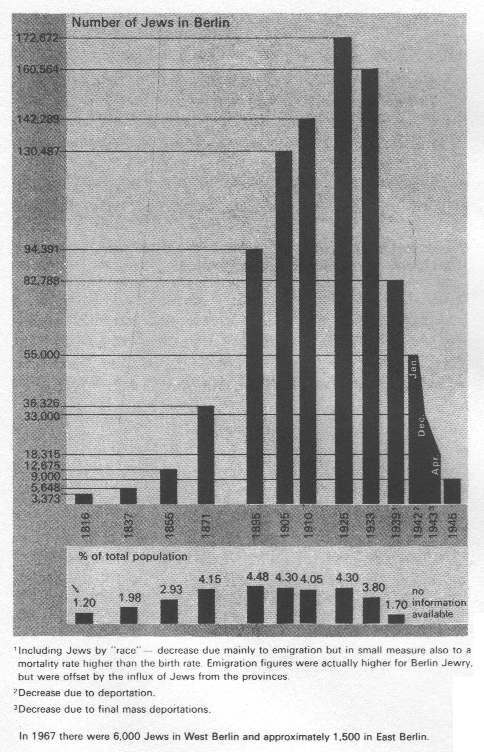
Size of the Jewish Population. The diagram shows the decrease in the Jewish population of Berlin between 1925 and 1945. The statistics before 1933 refer to persons designated as members of the Jewish faith, whereas the later figures for the most part also include Jews "by race" (as defined by the Nuremberg Laws).
Encyclopaedia Judaica (1971): Berlin, vol. 4, col. 650. The Jewish population of Berlin 1816-1945
1 Including Jews by "race" - decrease due mainly to emigration but in small measure also to a mortality rate higher than the birth rate. Emigration figures were actually higher for Berlin Jewry, but were offset by the influx of Jews from the provinces.
2 Decrease due to deportation
3 Decrease due to final mass deportations.
The Jewish population of Berlin 1816-1945.
[K.Y.B.-K./ED.]> (col. 650)
| Teilen
/ share: |
Facebook |
|
Twitter |
| Sources |
|
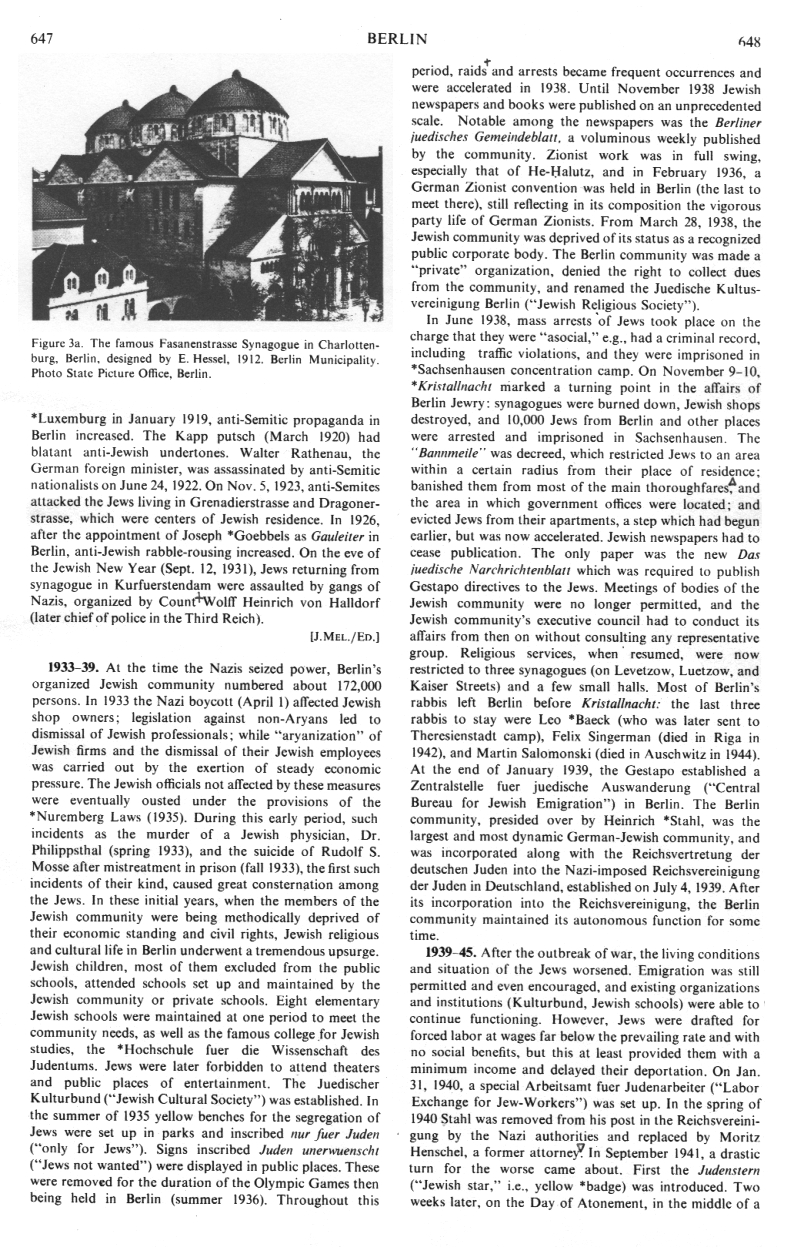 Encyclopaedia Judaica (1971): Berlin, vol. 4, col. 647-648 |
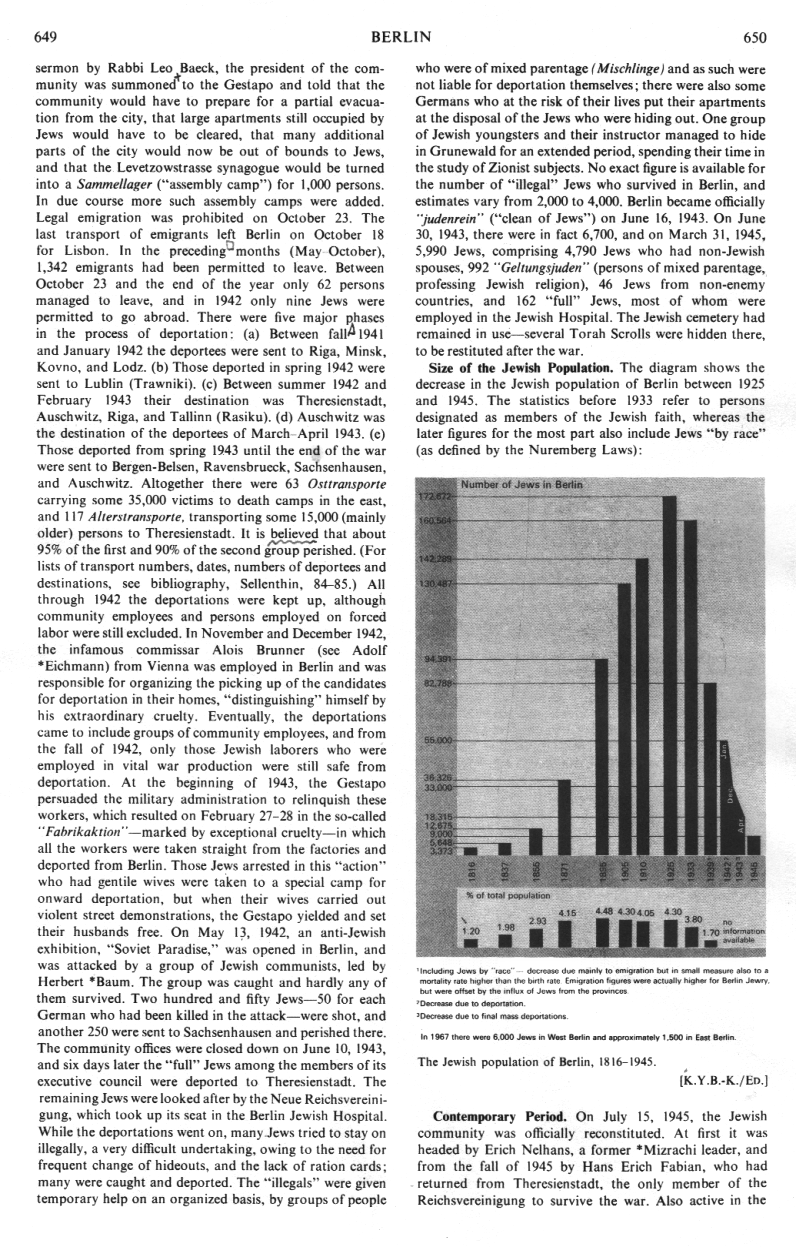 Encyclopaedia Judaica (1971): Berlin, vol. 4, col. 649-650 |
 previous
Č Ḥ Š Ṭ Ẓ
ā ć č ḥ ī š ū ž ẓ
ā ć č ḥ ī š ū ž ẓ
^