Encyclopaedia Judaica
Jews in Berlin 04: 1945-1970
Community starting again - DPs and DP camps - split 1952 - organizations and activities
from: Berlin; In: Encyclopaedia Judaica (1971), vol. 4
presented by Michael Palomino (2008)

| Teilen / share: |
Facebook |
|
Twitter
|
Contemporary Period.
[1946: Jewish community of Berlin with 7,070 members - liquidation is expected]
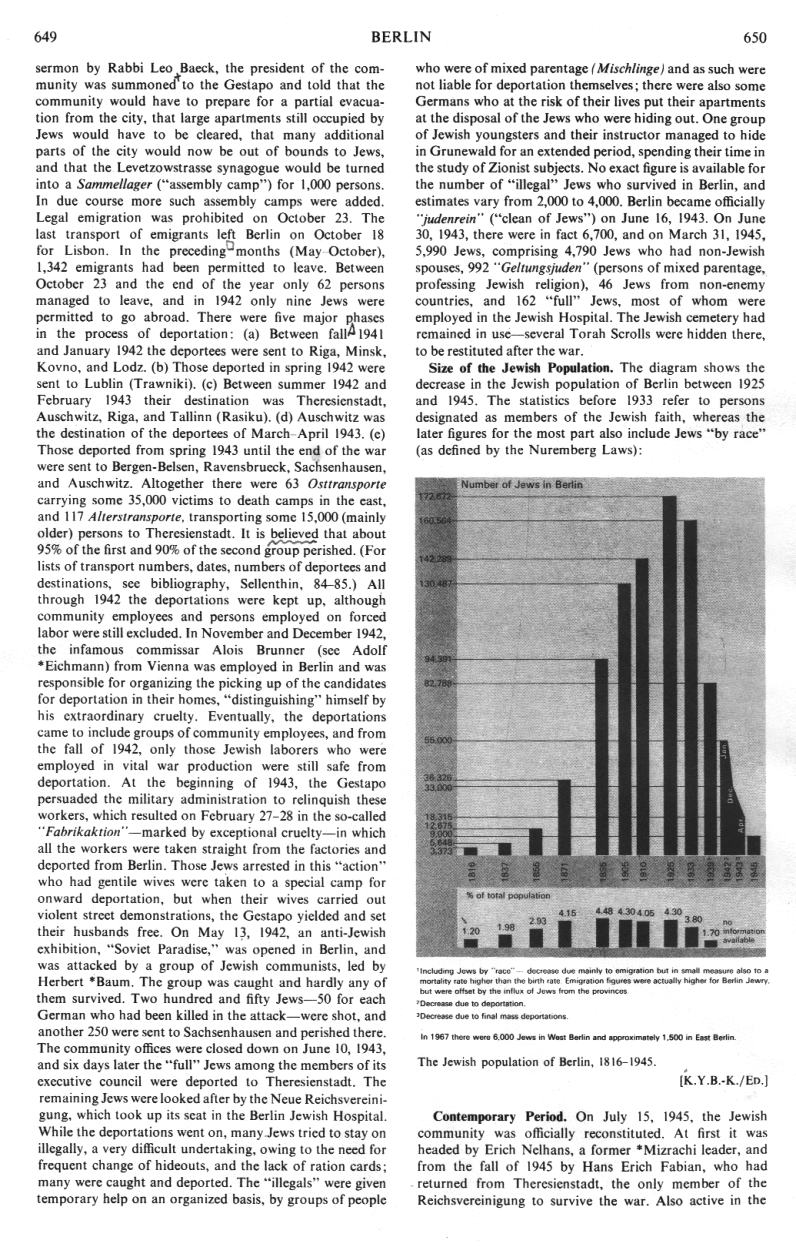
On July 15, 1945, the Jewish community was officially reconstituted. At first it was headed by Erich Nelhans, a former *Mizrachi leader, and from the fall of 1945 by Hans Erich Fabian, who had returned from Theresienstadt, the only member of the Reichsvereinigung [[Reich's Federation]] to survive the war. Also active in the (col. 650)
leadership of the community were Alfred Schoyer, a member of the Berlin Jewish Community Council before his deportation; Heinz Galinski, who had returned from Bergen-Belsen; and Julius Meyer, a survivor of Auschwitz.
At the beginning of 1946, the community had a registered membership of 7,070 people, of whom 4,121 (over 90% of all married members) had non-Jewish spouses, 1,321 had survived the war by hiding, and 1,628 had returned from concentration camps. The Jews were dispersed throughout Berlin, a third of them living in the Soviet sector. The community was assisted by the military government, as well as by the *American Jewish Joint Distribution Committee (JDC), which initiated its activities in Berlin in the autumn of 1945.
Several synagogues were opened, the Jewish Hospital resumed its work (although most of its patients and staff were not Jews), and three homes for the aged and a children's home were established. There was no local rabbi or religious teachers, but American Jewish army chaplains volunteered their services. The general assumption at this time was that the Jews would not be able to reestablish themselves in Berlin (or anywhere els in Germany) and that the community's principal task was to help them to emigrate from the country. The community was thus defined as a "liquidation community" (Liquidationsgemeinde).
[Displaced Persons (DPs) from Poland in Berlin - three DP camps (Wittenau, Schlachtensee, Tempelhof) - emigration by Berihah - transport to the American Zone in West Germany]
In addition to the organized Jewish community, Berlin also became a center for Jewish *Displaced Persons (DPs). Toward the end of 1945 and during the first half of 1946, the main *Berihah (Beriḥah) route from Poland led through Stettin and the Soviet Zone to Berlin, from where it continued through the remaining part of the Soviet Zone and the (col. 651)
British Zone to the American Zone. It was a very arduous route, especially during the harsh winter months, and temporary shelter had to be provided in Berlin. A small camp was established in the Wittenau district of the French sector of the city in the autumn of 1945 with a capacity of 200; at the beginning of 1946 a large camp was established at Schlachtensee in the American sector, which could hold 4,000 refugees, and a third camp was established in the summer of 1946 in the Tempelhof district of the American sector.
In July 1946, however, the Berihah (Beriḥah) from Poland took on a quasi-legal character and was rerouted through Czechoslovakia and Vienna to the American Zone in Germany and Austria. As a result the refugee population of Berlin became fairly stabilized. By the end of 1946, there were 6,785 DPs in the three Berlin camps.
When the Soviet blockade of Berlin was lifted, the Occupation authorities decided to evacuate the DPs, and between July 23 and Aug. 1, 1948, 5,456 Jewish refugees were airlifted from Berlin to various camps in the American Zone.
[Influx of Jews to Berlin from abroad]
By this time the Jewish community had reached a measure of consolidation, in spite of the difficult economic and political conditions in the city. Although a few hundred members had emigrated overseas and mortality exceeded the birthrate, the total number of Jews had increased as a result of the influx of Jews returning from abroad. Prominent among the returnees was a group of 500 refugees who had spent the war years in *Shanghai.
The welfare services extended by the community were greatly improved; the return of confiscated property, a process which was initiated at this time, also helped raise the standing of the community. In 1946, upon the initiative of Fabian, the community established its own weekly, Der Weg [[The Path]], later to be merged with the Jewish weekly appearing in Duesseldorf. Jewish organizations in the United States arranged for American rabbis to undertake several years' service in Berlin. In 1949 Galinski was elected as chairman of the community council.
[Jews in the conflict between Capitalists and Communists - split of the community in 1952 - growth of the West Berlin community]
The growing tension between the Western and Soviet Occupation authorities
[[Both sides were financed by the banks of the criminal United States!]]
also had its effect upon Berlin Jewry. In 1947 Nelhans was arrested by the Soviets on the charge of aiding Soviet military personnel to desert; he was sentenced to 15 years imprisonment and was not heard of subsequently. Although the city administration was split in two, the Jewish community remained unified until the end of 1952, when its own split became inevitable. In the following years, the situation of the Jews and the community in West Berlin was greatly improved as a result of the rising economic prosperity in West Germany (which also affected West Berlin) and the return of confiscated (c. 652)
property and the indemnification of victims of Nazi persecution. The Berlin City Senate showed great concern for the rehabilitation of the community and its individual members; Joachim Lipschitz, the senator for internal affairs (who was the son of a Jewish father and a Christian mother), in particular did his utmost to help the development of the community.
There are four synagogues in Berlin. In 1959 the City of Berlin erected a large Jewish community center on Fasanenstrasse at the site on which one of Berlin's most magnificent synagogues had stood until 1938.
[Jewish organizations and cultural activities in Berlin since 1945]
In 1954 the [[racist]] Zionist Organization and the Israel Appeal renewed their activities in Berlin. There exists an active Jewish women's organization, a B'nai B'rith lodge, a Jewish students' organization, and a youth organization. There are also several organizations dedicated to the fostering of interfaith relations. The Juedischer Verlag [[Jewish Printing House]] Publishing Company has been reestablished.
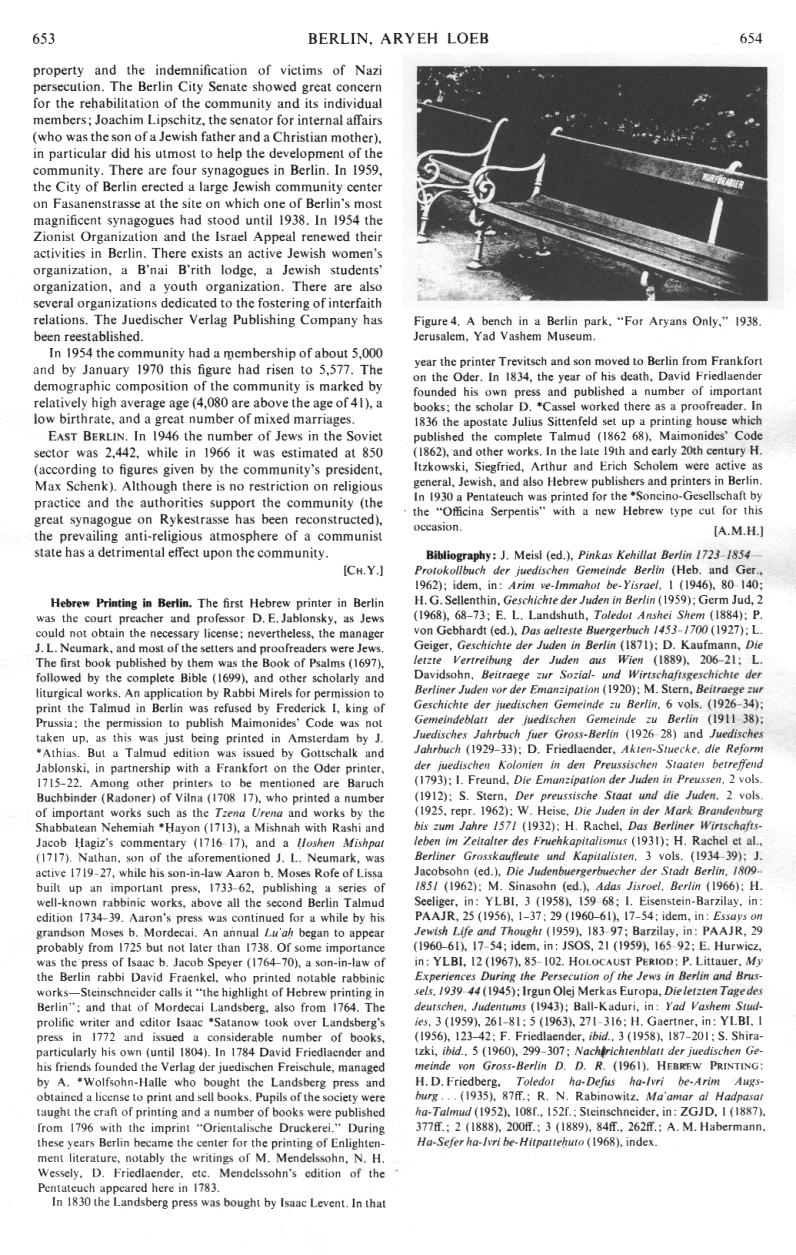
In 1954 the community had a membership of about 5,000 and by January 1970 this figure had risen to 5,577. The demographic composition of the community is marked by relatively high average age (4,080 are above the age of 41), a low birthrate, and a great number of mixed marriages.
EAST BERLIN.
In 1946 the number of Jews in the Soviet sector was 2,442, while in 1966 it was estimated at 850 (according to figures given by the community's president, Max Schenk). Although there is no restriction on religious practice and the authorities support the community (the great synagogue on Rykestrasse has been reconstructed), the prevailing anti-religious atmosphere of a communist state has a detrimental effect upon the community.
[CH.Y.]> (col. 653)
| Teilen / share: |
Facebook |
|
Twitter
|
Bibliography
-- J. Meisl (ed.): Pinkas Kehillat Berlin 1723-1854 - Protokollbuch der juedischen Gemeinde Berlin (Heb. and Ger., 1962)
-- idem, in: Arim ve-Immahot be-Yisrael, 1 (1946), 80-140
-- H.G. Sellenthin: Geschichte der Juden in Berlin (1959)
-- Germ Jud, 2 (1968), 68-73
-- E.L. Landshuth: Toledot Anshei Sehm (1884)
-- P. von Gebhardt (ed.): Das aelteste Buergerbuch 1453-1700 (1927)
-- L. Geiger: Geschichte der Juden in Berlin (1871)
-- D. Kaufmann: Die letzte Vertreibung der Juden aus Wien (1889), 206-21
-- L. Davidsohn: Beitraege zur Sozial- und Wirtschaftsgeschichte der Berliner Juden vor der Emanzipation (1920)
-- M. Stern: Beitraege zur Geschichte der juedischen Gemeinde zu Berlin; 6 vols. (1926-34)
-- Gemeindeblatt der juedischen Gemeinde zu Berlin (1911-38)
-- Juedisches Jahrbuch fuer Gross-Berlin (1926-28)
-- Juedisches Jahrbuch (1929-33)
-- D. Friedlaender: Akten-Stuecke, die Reform der juedischen Kolonien in den Preussischen Staaten betreffend (1793)
-- I. Freund: Die Emanzipation der Juden in Preussen; 2 vols. (1912)
-- S. Stern: Der preussische Staat und die Juden; 2 vols. (1925, repr. 1962)
-- W. Heise: Die Juden in der Mark Brandenburg bis zum Jahre 1571 (1932)
-- H. Rachel: Das Berliner Wirtschaftsleben im Zeitalter des Fruehkapitalismus (1931)
-- H. Rachel et. al.: Berliner Grosskaufleute und Kapitalisten; 3 vols. (1934-39)
-- J. Jacobsohn (ed.): Die Judenbuergerbuecher der Stadt Berlin (1966)
-- H. Seeliger, in: YLBI, 3 (1958), 159-68
-- I. Eisenstein-Barzilay, in: PAAJR, 25 (1956), 1-37; 29 (1960-61), 17-54
-- idem, in: Essays on Jewish Life and Thought (1959), 183-97
-- Barzhilay, in: PAAJR, 29 (1960-61), 17-54
-- idem, in: JSOS, 21 (1959), 165-92
-- E. Hurwicz, in: YLBI, 12 (1967), 85-102
HOLOCAUST PERIOD
-- P. Littauer: My Experiences During the Persecution of the Jews in Berlin and Brussels, 1939-44 (1945)
-- Irgun Olej Merkas Europa: Die letzten Tages des deutschen Judentums (1943)
-- Ball-Kaduri, in: Yad Vashem Studies, 3 (1959), 261-81; 5 (1963), 271-316
-- H. Gaertner, in: YLBI, 1 (1956), 123-42
-- F. Friedlaender, ibid. 3 (1958), 187-201
-- S. Shiratzki, ibid., 5 (1960), 299-307
-- Nachrichtenblatt der juedischen Gemeinde von Gross-Berlin D.D.R. (1961)
HEBREW PRINTING
-- H.D. Fiedberg: Toledot ha-Defus ha-Ivri be-Arim Augsburg... (1935), 87ff.
-- R.N. Rabinowitz: Ma'amar al Hadpasat ha-Talmud (1952), 108-109, 152-153
-- Steinschneider, in: ZGJD, 1 (1887), 377 ff.; 2 (1888), 200 ff.; 3 (1889), 84 ff., 262 ff.
-- A.M. Habermann: Ha-Sefer ha-Ivri be-Hitpattehuto (Hitpatteḥuto) (1968), index.> (col. 654)
Sources
Encyclopaedia Judaica (1971): Berlin, vol. 4, col. 649-650
Encyclopaedia Judaica (1971): Berlin, vol. 4, col. 651-652
Encyclopaedia Judaica (1971): Berlin, vol. 4, col. 653-654
ā ć č ḥ ī š ū ž ẓ
^