<< >>

Encyclopaedia Judaica
Jews in Germany 03: from 1815 to emancipation
The "Christian state" after Napoleon - conversions - reform movement and anti-reformists - scientific wave - professions and shifting movements - emancipation and the "new type of Jew" in Germany - cultural life - racist Herzl Zionism
from: Germany; In: Encyclopaedia Judaica (1971), vol. 7
presented by Michael Palomino (2008)

| Teilen
/ share: |
Facebook |
|
Twitter
|
<POST-NAPOLEONIC REACTION.
[Re-introduction of harsh anti-Jewish traditions - the concept of the "Christian state"]
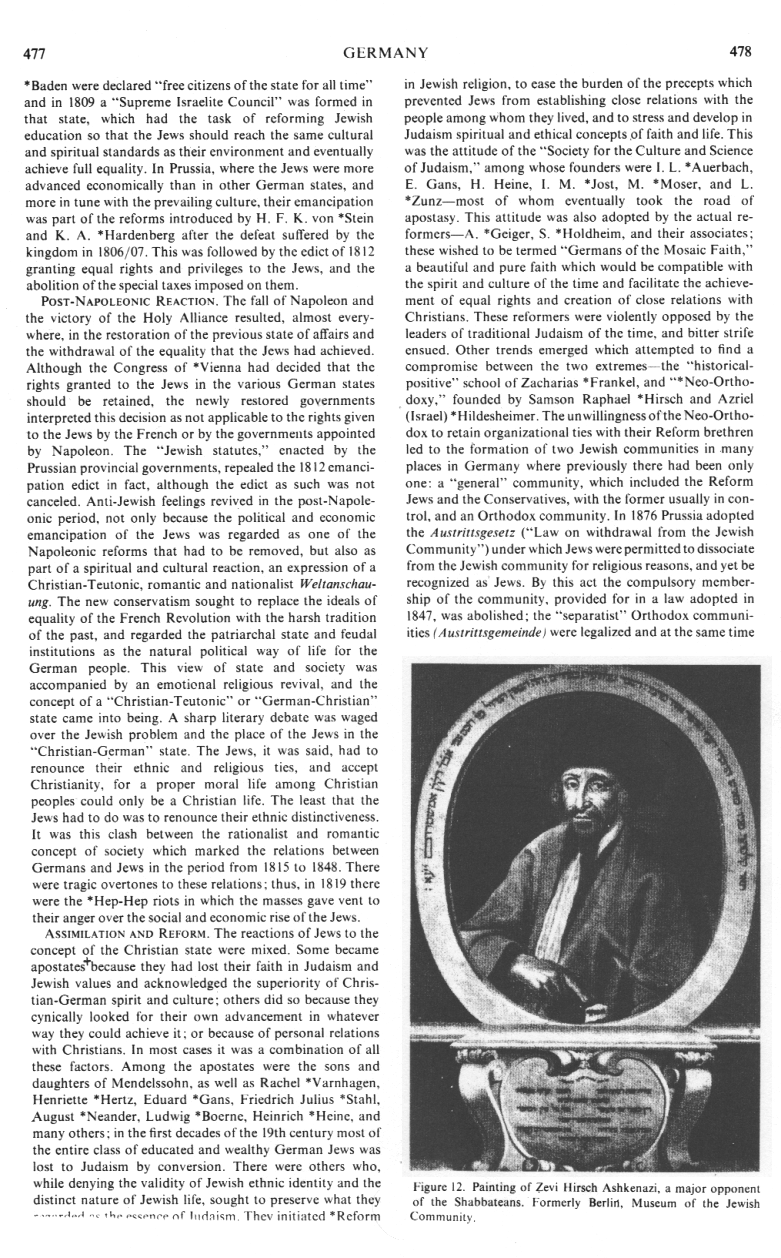
The fall of Napoleon and the victory of the Holy Alliance resulted, almost everywhere, in the restoration of the previous state of affairs and the withdrawal of the equality that the Jews had achieved. Although the Congress of *Vienna had decided that the rights granted to the Jews in the various German states should be retained, the newly restored governments interpreted this decision as not applicable to the rights given to the Jews by the French or be the governments appointed by Napoleon. The "Jewish statutes", enacted by the Prussian provincial governments, repealed the 1812 emancipation edict in fact, although the edict as such was not canceled. Anti-Jewish feelings revived in the post-Napoleonic period, not only because the political and economic emancipation of the Jews was regarded as one of the Napoleonic reforms that hat to be removed, but also as part of a spiritual and cultural reaction, an expression of a Christian-Teutonic, romantic and nationalist Weltanschauung [[vision of the world]].
The new conservatism sought to replace the ideals of equality of the French Revolution with the harsh tradition of the past, and regarded the patriarchal state and feudal institutions as the natural political way of life for the German people. This view of state and society was accompanied by an emotional religious revival, and the concept of a "Christian-Teutonic" or "German-Christian" state came into being. A sharp literary debate was waged over the Jewish problem and the place of the Jews in the "Christian-German" state. The Jews, it was said, hat to renounce their ethnic and religious ties, and accept Christianity, for a proper moral life among Christian peoples could only be a Christian life.
The least that the Jews had to do was to renounce their ethnic distinctiveness. It was this clash between the rationalist and romantic concept of society which marked the relations between Germans and Jews in the period from 1815 to 1848. There were tragic overtones to these relation; thus, in 1819 there were the *Hep-Hep riots in which the masses gave vent to their anger over the social and economic rise of the Jews.
[[There were always some rich Jews, and a lot of poor Jews, as there were always some rich "Christians", and a lot of poor "Christians", but the poor Jews are not mentioned here]].
ASSIMILATION AND REFORM
[Conversions to "Christianity" and the reasons]
The reactions of Jews to the concept of the Christian state were mixed. Some became apostates [[converted to "Christianity"]] because they had lost their faith in Judaism and Jewish values and acknowledged the superiority of Christian-German spirit and culture;
[[within this German "spirit" were people like Grimm and Goethe, like Robert Schumann or Beethoven etc.]]
others did so because they cynically looked for their own advancement in whatever way they could achieve it; or because of personal relations with Christians. In most cases it was a combination of all these factors. Among the apostates [[converted Jews]] were the sons and daughters of Mendelssohn, as well as Rachel *Varnhagen, Henriette *Hertz, Eduard *Gans, Friedrich Julius *Stahl, August *Neander, Ludwig *Boerne, Heinrich *Heine, and many others; in the first decades of the 19th century most of the entire class of educated and wealthy German Jews was lost to Judaism by conversion.
[Jewish reform movement "Society for the Culture and Science of Judaism" - and anti-reformists - split]
There were others who, while denying the validity of Jewish ethnic identity and the distinct nature of Jewish life, sought to preserve what they regarded as the essence of Judaism. They initiated *Reform (col. 477)
in Jewish religion, to ease the burden of the precepts which prevented Jews from establishing close relations with the people among whom they lived, and to stress and develop in Judaism spiritual and ethical concepts of faith and life. This was the attitude of the "Society for the Culture and Science of Judaism", among whose founders were I.L. *Auerbach, E. Gans, H. Heine, I.M. *Jost, M. *Moser, and L. *Zunz - most of whom eventually took the road of apostasy [[conversion]].
This attitude was also adopted by the actual reformers - A. *Geiger, S. *Holdheim, and their associates; these wished to be termed "Germans of the Mosaic Faith", a beautiful and pure faith which would be compatible with the spirit and culture of the time and facilitate the achievement of equal rights and creation of close relations with Christians.
These reformers were violently opposed by the leaders of traditional Judaism of the time, and bitter strife ensued.
Other trends emerged which attempted to find a compromise between the two extremes - the "historical-positive" school of Zacharias *Frankel, and "*NeoOrthodoxy", founded by Samson Raphael *Hirsch and Azriel (Israel) *Hildesheimer. The unwillingness of the Neo-Orthodox to retain organizational ties with their Reform brethren led to the formation of two Jewish communities in many places in Germany where previously there had been only one: a "general" community, which included the Reform Jews and the Conservatives, with the former usually in control, and an Orthodox community.
[Jews without membership in the community since 1876 in Prussia - scientific wave in German Jewry]
In 1876 Prussia adopted the Austrittsgesetz ("Law on withdrawal from the Jewish Community") under which Jews were permitted to dissociate from the Jewish community for religious reasons, and yet be recognized as Jews. By this act the compulsory membership of the community, provided for in a law adopted in 1847, was abolished; the "separatist" Orthodox communities (Austrittsgemeinde [["Withdrawal Community"]]) were legalized and at the same time (col. 478)
individual Jews were enabled to leave the organized Jewish community without having to go through formal conversion. These various trends in German Jewry gave rise to the *Wissenschaft des Judentums [[Science of Jewry]] which, at the end of the 19th and beginning of the 20th centuries, made Germany the center of scientific study of Jewish history and culture. In the initial stage, the men associated with the Wissenschaft des Judentums were nearly all leaders of the Reform movement, but later on scholars of all the trends in German Jewry took part.
ECONOMIC AND SOCIAL LIFE.
[Jews in more and more professions and in politics - Jews shifting from the countryside to the towns - influx from eastern Europe]
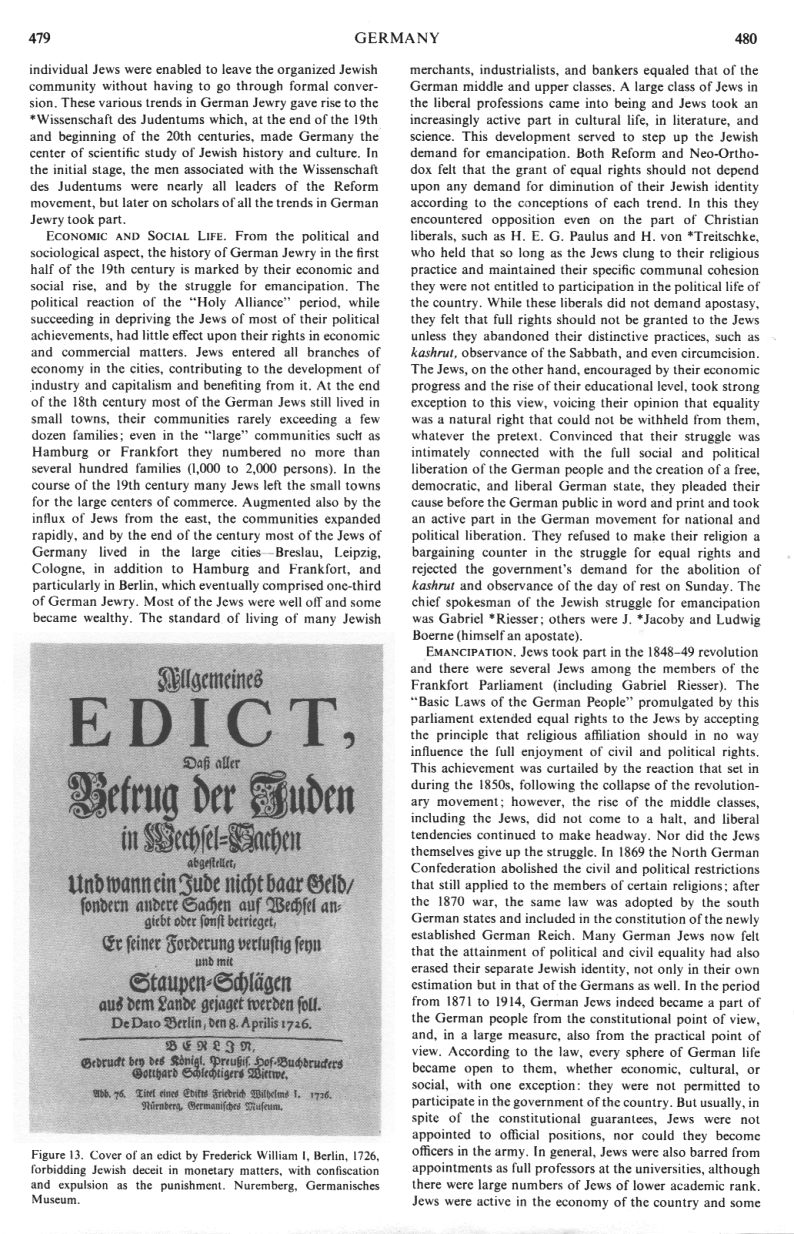
From the political and sociological aspect, the history of German Jewry in the first half of the 19th century is marked by their economic and social rise, and by the struggle for emancipation. The political reaction of the "Holy Alliance" period, while succeeding in depriving the Jews of most of their political achievements, had little effect upon their rights in economic and commercial matters.
Jews entered all branches of economy in the cities, contributing to the development of industry and capitalism and benefiting from it. At the end of the 18th century most of the German Jews still lived in small towns, their communities rarely exceeding a few dozen families; even in the "large" communities such as Hamburg or Frankfort they numbered no more than several hundred families (1,000 to 2,000 persons).
In the course of the 19th century many Jews left the small towns for the large centers of commerce. Augmented also by the influx of Jews from the east, the communities expanded rapidly, and by the end of the century most of the Jews of Germany lived in the large cities - Breslau, Leipzig, Cologne, in addition to Hamburg and Frankfort, and particularly in Berlin, which eventually comprised one-third of German Jewry.
[Jewish upper class in Germany - the discussion about emancipation and the conditions]
Most of the Jews were well off and some became wealthy. The standard of living of many Jewish (col. 479)
merchants, industrialists, and bankers equaled that of the German middle and upper classes. A large class of Jews in the liberal professions came into being and Jews took an increasingly active part in cultural life, in literature, and science. This development served to step up the Jewish demand for emancipation. Both Reform and Neo-Orthodox felt that the grant of equal rights should not depend upon any demand for diminution of their Jewish identity according to the conceptions of each trend. In this they encountered opposition even on the part of Christian liberals, such as H.E.G. Paulus and H. von *Treitschke, who held that so long as the Jews clung to their religious practice and maintained their specific communal cohesion they were not entitled to participation in the political life of the country.
While these liberals did not demand apostasy [[conversion]], they felt that full rights should not be granted to the Jews unless they abandoned their distinctive practices, such as kashrut [[Jewish nutrition rules]] observance of the Sabbath, and even circumcision. The Jews, on the other hand, encouraged by their economic progress and the rise of their educational level, took strong exception to this view, voicing their opinion that equality was a natural right that could not be withheld from them, whatever the pretext. Convinced that their struggle was intimately connected with the full social and political liberation of the German people and the creation of a free, democratic, and liberal German state, they pleaded their cause before the German public in word and print and took an active part in the German movement for national and political liberation. They refused to make their religion a bargaining counter in the struggle for equal rights and rejected the government's demand for the abolition of kashrut [[Jewish nutrition rules]] and observance of the day of rest on Sunday. The chief spokesman of the Jewish struggle for emancipation was Gabriel *Riesser; others were J. *Jacoby and Ludwig Boerne (himself an apostate).
EMANCIPATION.
[Revolution 1848-49 - full equal rights in northern Germany in 1869, in southern Germany 1870 - German Reich with emancipation of the Jews since 1871 - professions, and some restrictions]
Jews took part in the 1848-49 revolution and there were several Jews among the members of the Frankfort Parliament (including Gabriel Riesser). The "Basic Laws of the German People" promulgated by this parliament extended equal rights to the Jews by accepting the principle that religious affiliation should in no way influence the full enjoyment of civil and political rights. This achievement was curtailed by the reaction that set in during the 1850s, following the collapse of the revolutionary movement; however, the rise of the middle classes including the Jews, did not come to a halt, and liberal tendencies continued to make headway. Nor did the Jews themselves give up the struggle.
In 1869 the North German Confederation abolished the civil and political restrictions that still applied to the members of certain religions; after the 1870 war, the same law was adopted by the south German states and included in the constitution of the newly established German Reich.
Many German Jews now felt that the attainment of political and civil equality had also erased their separate Jewish identity, not only in their own estimation but in that of the Germans as well. In the period from 1871 to 1914, German Jews indeed became a part of the German people from the constitutional point of view, and, in a large measure, also from the practical point of view. According to the law, every sphere of German life became open to them, whether economic, cultural, or social, with one exception: they were not permitted to participate in the government of the country. But usually, in spite of the constitutional guarantees, Jews were not appointed to official positions, nor could they become officers in the army. In general, Jews were also barred from appointments as full professors at the universities, although there were large numbers of Jews of lower academic rank.
Jews were active in the economy of the country and some (col. 480)
became leading bankers, industrialists, and businessmen; there was also a large number of Jews in the liberal professions: Jews were among the founders and leaders of the political parties; the Liberal and Social-Democrat parties usually had a number of Jewish members in the Reichstag. In the sciences and technology, in Literature, the press, the theater and the arts the share of Jews was disproportionately high. Almost all were radically assimilated, and for Jewish history they are significant only as the target of German *anti-Semitism, and, in some instances, for actions they undertook on behalf of the Jewish people.
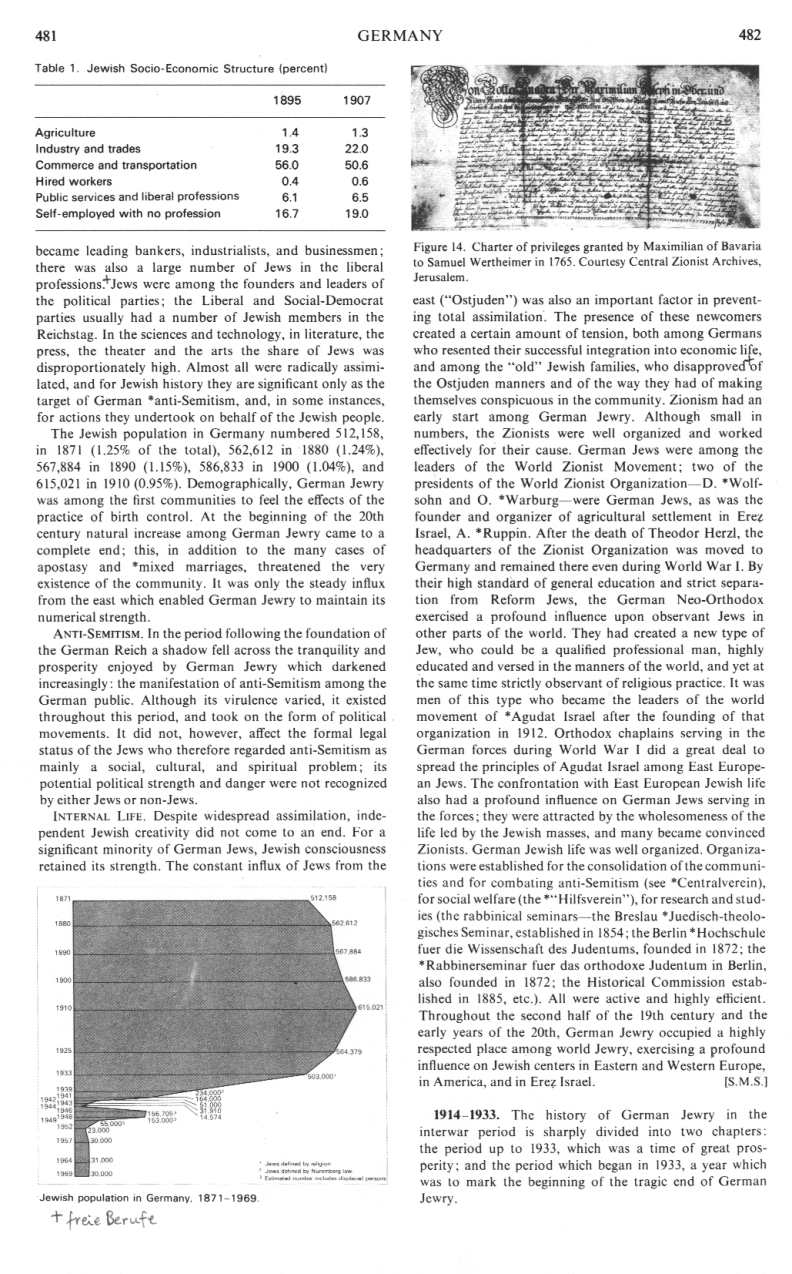
Jewish Socio-Economic Structure (percent)
1895
1907
Agriculturexxxxxxxxxxxxxxxxxxxxxxxxxxxxxxxxxxxxxxxxxxxxxxxxxx 1.4%xxx
1.3%xxx Industry and trades
19.3%xxx 22.0%xxx Commerce and transportation
56.0%xxx 50.6%xxx Hired workers
0.4%xxx 0.6%xxx Public services and liberal professions
6.1%xxx 6.5%xxx Self-employed with no profession
16.7%xxx 19.0%xxx from: Germany; In: Encyclopaedia Judaica (1971), vol. 7, col. 481
[Numbers]
The Jewish population in Germany numbered 512,158, in 1871 (1.25% of the total), 562,612 in 1880 (1.24%), 567,884 in 18990 (1.15%), 586,833 in 1900 (1.04%), and 615,021 in 1910 (0.95%).
Demographically, German Jewry was among the first communities to feel the effects of the practice of birth control. At the beginning of the 20th century natural increase among German Jewry came to a complete end; this, in addition to the many cases of apostasy [[conversion]] and *mixed marriages [[only children of Jewish mothers are Jewish]], threatened the very existence of the community. It was only the steady influx from the east which enabled German Jewry to maintain its numerical strength.
ANTI-SEMITISM.
[[Anti-Semitism was a world wide movement and had it's spiritual base in England with Darwinism and the science of "election". Then some propagandists converted it into an ideology against the Jews. Destructive Darwinism which is a philosophy of war was never prohibited in any country on the world. Add to this the Jewish Talmud also has absolutely racist paragraphs. Peaceful philosophies are missing, so]].
In the period following the foundation of the German Reich a shadow fell across the tranquility and prosperity enjoyed by German Jewry which darkened increasingly: the manifestation of anti-Semitism among the German public.
[[This anti-Semitism also came up in France, in Austria, in Hungary, and in many other countries, also in the criminal "USA"]].
Although its virulence varied, it existed throughout this period, and took on the form of political movements. It did not, however, affect the formal legal status of the Jews who therefore regarded anti-Semitism as mainly a social, cultural, and spiritual problem; its potential political strength and danger were not recognized by either Jews or non-Jews.
[[Above all since 1919 when Jewish cliques came to power with Communist ideology anti-Semitism got stronger and said any Jew would be a Communist, an absolute nonsense, but big parts of the population followed this propaganda...]]
INTERNAL LIFE.
[German Jews - East European Jews - racist Herzl Zionists - the "new type of Jew" in Germany]
Despite widespread assimilation, independent Jewish creativity did not come to an end. For a significant minority of German Jews, Jewish consciousness retained its strength. The constant influx of Jews from the (col. 481)
east ("Ostjuden") was also an important factor in preventing total assimilation. The presence of these newcomers created a certain amount of tension, both among Germans who resented their successful integration int economic life, and among the "old" Jewish families, who disapproved of the Ostjuden manners and of the way they had of making themselves conspicuous in the community.
[[Racist]] Zionism had an early start among German Jewry. Although small in numbers, the [[racist]] Zionists were well organized and worked effectively for their cause.
[[This cause resp. the aim of the racist Zionists was the creation of a "Greater Israel" within the borderlines from the Nile to the Euphrates according to 1st Mose, chapter 15, phrase 18. Add to this the base was the booklet from racist Theodor Herzl "The Jewish State" stating that all Arabs could be driven away as the natives in the criminal "USA" had been driven away. The Arabs would be the slaves of the Jews, and eventually there could be found gold mines in Palestine as in South Africa. "Greater Israel" should be a second racist "United States". So, racist Zionism was a total war declaration against the Arab world and the Arab reaction was counter propaganda from the beginning with a new Arab anti-Semitism which is never subject in the censored European press. See: Zionism]].
German Jews were among the leaders of the [[racist]] World Zionist Movement; two of the presidents of the World Zionist Organization - D. *Wolfsohn and O. *Warburg - were German Jews, as was the founder and organizer of agricultural settlement in Erez Israel (Ereẓ Israel), A. *Ruppin. After the death of Theodor Herzl, the headquarters of the [[racist]] Zionist Organization was moved to Germany and remained there even during World War I.
By their high standard of general education and strict separation from Reform Jews, the German Neo-Orthodox exercised a profound influence upon observant Jews in other parts of the world. They had created a new type of Jew, who could be a qualified professional man, highly educated and versed in the manners of the world, and yet at the same time strictly observant of religious practice. It was men of this type who became the leaders of the world movement of *Agudat Israel after the founding of that organization in 1912.
Orthodox chaplains serving in the German forces during world War I did a great deal to spread the principles of Agudat Israel among East European Jews. The confrontation with East European Jewish life also had a profound influence on German Jews serving in the forces; they were attracted by the wholesomeness of the life led by the Jewish masses, and may became convinced [[racist]] Zionists.
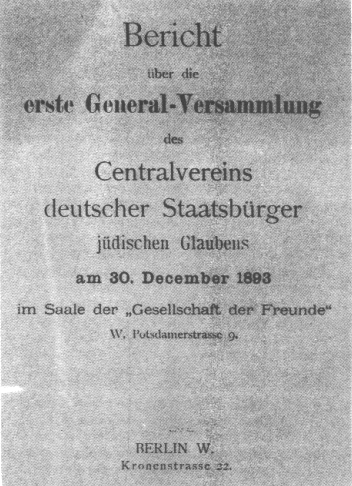
Encyclopaedia Judaica (1971): Germany, vol.7, col. 486. Title page of the first report of the Centralverein, the general organization of German Jews. Berlin, December 30, 1893. Jerusalem, C.A.H.J.Pl, T.D. 809
German Jewish life was well organized. Organizations were established for the consolidation of the communities and for combating anti-Semitism (see *Centralverein), for social welfare (the *"Hilfsverein"), for research and studies (the rabbinical seminars - the Breslau *Juedisch-theologisches Seminar [[Jewish Theologic Seminar]], established in 1854; the Berlin *Hochschule fuer die Wissenschaft des Judentums [[Jewish Science High School]], founded in 1872; the *Rabbinerseminar fuer das orthodoxe Judentum in Berlin [[Rabbi Seminary for Berlin Orthodox Jewry]], also founded in 1872; the Historical Commission established in 1885, etc.). All were active and highly efficient. Throughout the second half of the 19th century and the early years of the 20th, German Jewry occupied a highly respected place among world Jewry, exercising a profound influence on Jewish centers in Eastern and Western Europe, in America, and in Erez Israel (Ereẓ Israel).
[S.M.S.]> (col. 482)
| Teilen
/ share: |
Facebook |
|
Twitter |
| Sources |
||
 Encyclopaedia Judaica (1971): Germany, vol. 7, col. 477-478 |
 Encyclopaedia Judaica (1971): Germany, vol. 7, col. 479-480 |
 Encyclopaedia Judaica (1971): Germany, vol. 7, col. 481-482 |
Č Ḥ Š Ṭ Ẓ
ā ć č ḥ ī š ū ž ẓ
ā ć č ḥ ī š ū ž ẓ
^