Encyclopaedia Judaica
Jews in Germany 06: WW II and Holocaust
Mass killing in eastern Europe - Jewish star - "transferred" Jews - closed Jewish institutions - confiscated Jewish assets - privileged camp Theresienstadt - emigration - the Reich never was "judenrein"
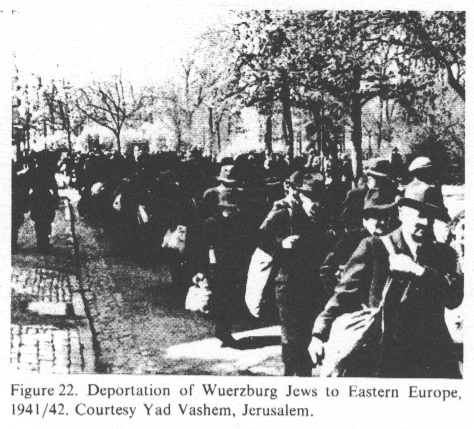
Encyclopaedia Judaica (1971): Germany, vol. 7, col. 495. Deportation of Wuerzburg Jews
to eastern Europe, 1941 / 42. Courtesy Yad Vashem, Jerusalem
from: Germany; In: Encyclopaedia Judaica (1971), vol. 7
presented by Michael Palomino (2008)


| Teilen
/ share: |
Facebook |
|
Twitter
|
<World War II.
[Jews in camps - mass murder of Jews in eastern Europe - more Jewish emigration from Greater Germany]
In the course of the war, when German rule was extended over large areas [[which partly was wanted by the local authorities abroad]], Jews were sent to or transferred from Germany and other European countries. Many German Jews were put to death in Germany itself, along with foreign Jews interned there.
[[...]]
The outbreak of the war (Sept. 1, 1939) did not bring about any change in the legal status of the Jews. Until November 1941, i.e., at a time when the mass killing of Jews in eastern Europe had been in process for several months
[[by "Aktionen", i.e. "actions", i.e. mass shootings on fields or in forests of the local East European Jews who had not fled]]
some still succeeded in leaving Germany [[now: "Greater Germany"]]. German Jews were admitted so some neutral countries, others were able to escape across the Atlantic. In fact they reached every corner of the globe, including *Shanghai. Until June 20, 1940, Jews who had some means at their disposal were able to reach Palestine by way of the Italian ports, and until Nov. 11, 1942, they could go to *Lisbon and *Casablanca by way of unoccupied France.
On May 1, 1941, there were 169,000 Jews in Germany, and by Oct. 1, 1941, 164,000.
In the period that had elapsed since May 1939 their number had therefore been reduced by some 50,000 to 70,000. A substantial number of these had succeeded in leaving Germany, although some of them only moved to countries which soon came under German occupation. (col. 494)
[Deportations and mass death in the camps - Jewish star - "transferred" German Jews - the suitcase]
About 8,000 Jews were deported by the Nazis, to make room for Germans who were repatriated after the outbreak of war. (col. 494)
These Jews were sent in the first shipment to *Lublin district, and later to unoccupied France. Many Jews were put into the existing concentration camps, or into newly established ones. The mortality rate among the Jews also rose to unprecedented heights [[by cold, by hunger, by epidemics, by exhaustion]].
Some time in March 1941, Hitler issued his verbal order for the "Final Solution of the Jewish Question" by a physical extermination program. On Sept. 1, 1941, the Jews were ordered to wear the yellow badge (Judenstern = "Jewish star"). (col. 495)
(A front-page article of the Rundschau, published under the title, Tragt ihn mit Stolz, den gelben Fleck ("Wear it proudly, the yellow badge"), electrified the Jews with its call for courage in the face of adversity). (col. 493)
In mid-October 1941, their mass "transfer" ("Evakuierungen" or "Abwanderungen") to ghettos in eastern Europe (*Lodz, *Minsk, *Riga, *Kovno) and to concentration and forced labor camps [[e.g. in the Baltic states with heavy losses by cold]] was begun, under Adolf *Eichmann's supervision.
[[The Jews of eastern Europe were killed in masses and the West European Jews were deported into their homes or into empty quarters]].
By the end of the year, 30,000 Jews had been thus "transferred". [[One suitcase was allowed]]. In the period from October 1942 to March 1943, Jews from Germany were "transferred" to *Auschwitz and other extermination centers [[e.g. tunnel systems with high death rates]], at first by way of concentration camps and, later, directly. (col. 495)
Encyclopaedia Judaica (1971): Germany, vol. 7, col. 495. Deportation of Wuerzburg Jews
to eastern Europe, 1941 / 42. Courtesy Yad Vashem, Jerusalem
[[This photo is problematic because it can be from anywhere, and the people also can be from anywhere. There is not one single special local indication]].
[[The Jewish suitcase and the role of Switzerland for the Nazi S.S.
The Jewish suitcase was in a deposit of the camp. The authorities of the camps - normally the S.S. - were interested in that the Jews died because the suitcase could be robbed and the things of high value were sold on the black market in "neutral" countries like Switzerland and others. There was also an exhibition "Entartete Kunst" of Jewish artists, and the pictures were sold officially in "neutral" Switzerland in Lucerne. The German Nazi authorities had a credit purchase agreement with Switzerland. At the same time alternative movements in Switzerland could save many Jews leading them over the borderline. Some helpers of the Jews were even punished by the racist Swiss military government under General Guisan for helping the Jews. The rehabilitation followed only 50 years after...]].
[Robbery of Jewish possession in the Reich - closed Reichsvereinigung in July 1943 - privileged camp Theresienstadt]
Many synagogues [[which were not destroyed by the Kristallnacht]] were turned into collection point for those about to be deported. It was in this period that the rate of suicide among the Jews took a sudden rise. The property of the "transferred" Jews, or of those who had committed suicide, was taken over by the state, as property of "enemies of the people and the country".
German Jewry's public activities were carried on within the framework of the Reichsvereinigung, which in accordance with the law had absorbed all the 1,500 organizations and institutions and the 1,600 religious communal bodies which had existed in Germany in 1939. The last to be absorbed, in January 1943, was the Berlin Community.
When emigration ceased, the work of the Reichsvereinigung was restricted to education and social welfare. It supported elementary schools, several high schools and colleges, vocational and agricultural training courses, and language courses, as well as the famous Hochschule fuer die Wissenschaft des Judentums [[High school for Jewish science]].
In July 1942 all Jewish educational institutions were closed down. The Reichsvereinigung also supported Jewish hospitals, children's homes, and homes for the aged. It was forced to assist the Nazis in gathering the Jews who had been earmarked for "transfer". The Reichsvereinigung derived its income from contributions, membership dues, and special taxes imposed on emigrants. In July 1943 the activities of the Reichsvereinigung came to an end. By then, most of its officials, as well as most of those whom it had cared for, had been "transferred" to their deaths, or put into prison [[to the "privileged camp" Theresienstadt]]. The assets of the Reichsvereinigung (about 170 million marks) were confiscated by the Nazis. A new national body was created, headed by Walter Lustig, at the Jewish hospital in Berlin (col. 495)
In the "privileged camp" which was known as the *Theresienstadt Ghetto, of the 139,606 Jews interned, 42,103 were from Germany. In January 1943, Leo Baeck was interned there. This ghetto allowed the continuation of Jewish life in some measure. But by the end of the war, only 5,639 German survivors were left in the ghetto.
By the end of 1942 the number of Jews in Germany had been reduced to 51,000, and by the beginning of April the following year to 32,000.
[[Probably many Jews could also emigrate under other nations' quota. The data are secret until now (2008)]].
On May 19, 1943, Germany was declared judenrein.
[[The lie of Goebbels propaganda of 1943 that Germany would be "judenrein"
The word "judenrein" for the Reich was a big lie of the propaganda ministry because many Jews who had been deported to eastern Europe and had survived until this date were transported back now to the Reich to working the tunnel systems. So: The Reich got the survivors from eastern Europe back, and the tunnel systems were built for the future underground weapon production: rockets, air fighters, tanks, petrol distillation, or there were tunnel systems for Hitler's government etc., with high death rates. In some cases the Jewish workers were murdered alive at the end of the war by blasting the entrances of the tunnel systems during the works to prevent that the Jewish workers would get into Communist hands]].
On Sept. 1, 1944, there were still 14,574 Jews in Germany [[officially]] who were not imprisoned. These were for the most part (97.8%), the spouses of non-Jews, or "half-Jews", who had been defined as Jews by the Nuremberg Laws. On the other hand, in January 1945, there were in concentration and forced labor camps in Germany hundreds of thousands of Jews from various European countries [[with high death rates because the few lasting camps were absolutely overcrowded at the end of the war and the delivery channels broke down]].
The number of Jews who remained free in Germany - openly or underground [[e.g. in hiding places with German families]] - has been estimated at 19,000, and those who returned from the concentration camps after the war (including Theresienstadt) at 1,000.
Late (January 1942) and doubtful figures provided by the Nazis state that from the beginning of Nazi rule 360,000 Jews had emigrated from Germany. 160,000 to 180,000 German Jews are estimated to have been murdered by the Nazis in Germany, or to have died as a result of persecution.
See also *Holocaust.
[J.LEV.]> (col. 496)
[[At the end the German towns were in ruins and many houses of Jews also had been bombed into ruins. By the useless bombardments many houses were in ruins which could have been rendered after the war]].
| Teilen
/ share: |
Facebook |
|
Twitter |
| Sources |
|
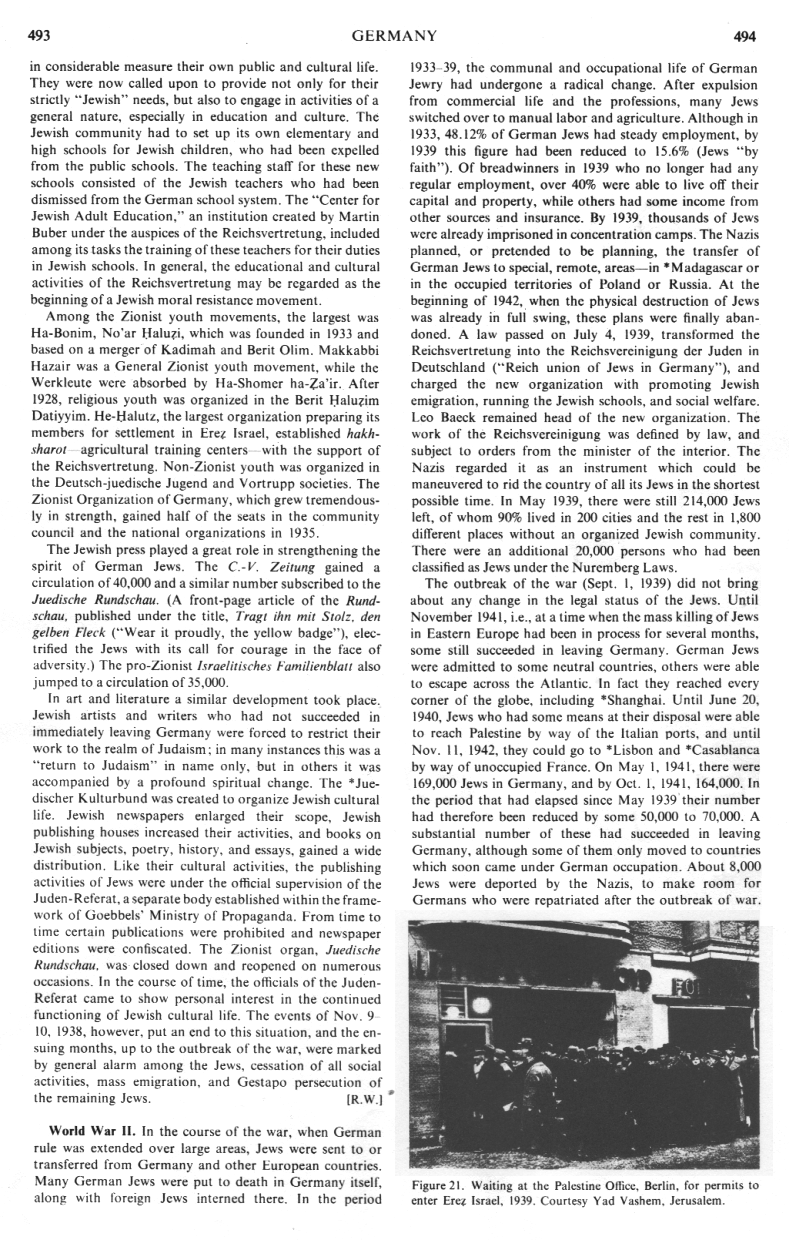 Encyclopaedia Judaica (1971): Germany, vol. 7, col. 493-494 |
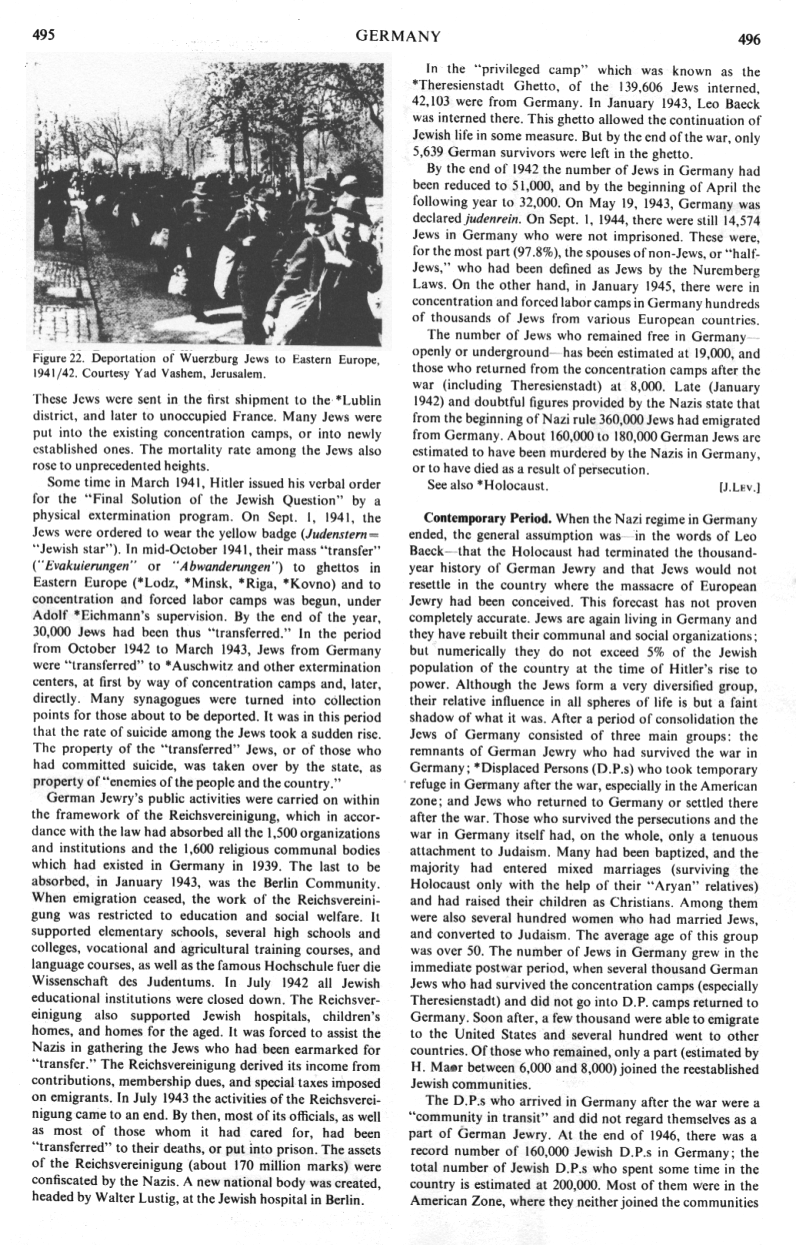 Encyclopaedia Judaica (1971): Germany, vol. 7, col. 495-496 |
Č Ḥ Š Ṭ Ẓ
ā ć č ḥ ī š ū ž ẓ
ā ć č ḥ ī š ū ž ẓ
^