<Contemporary Period.
[Surviving Jews - Jews in
communities and without community]
Encyclopaedia Judaica
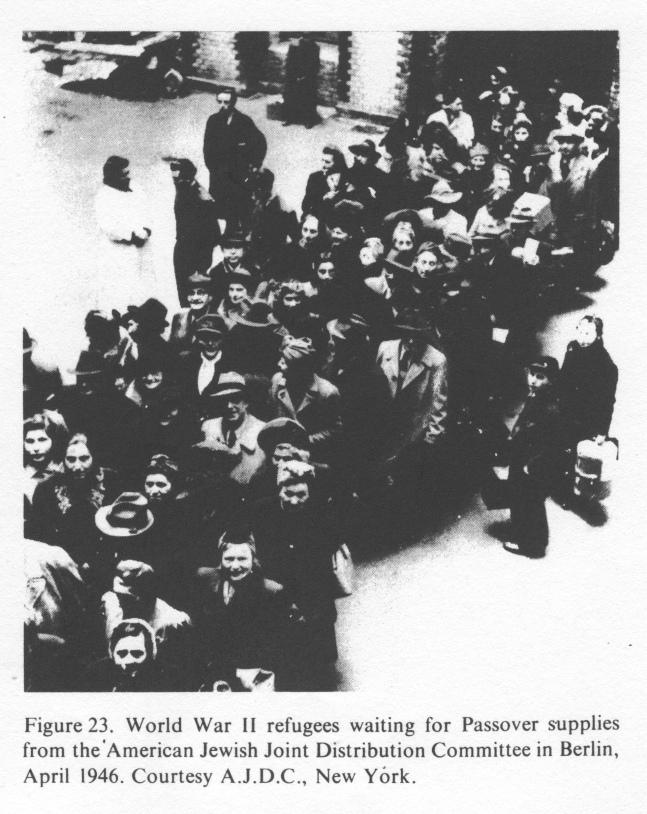
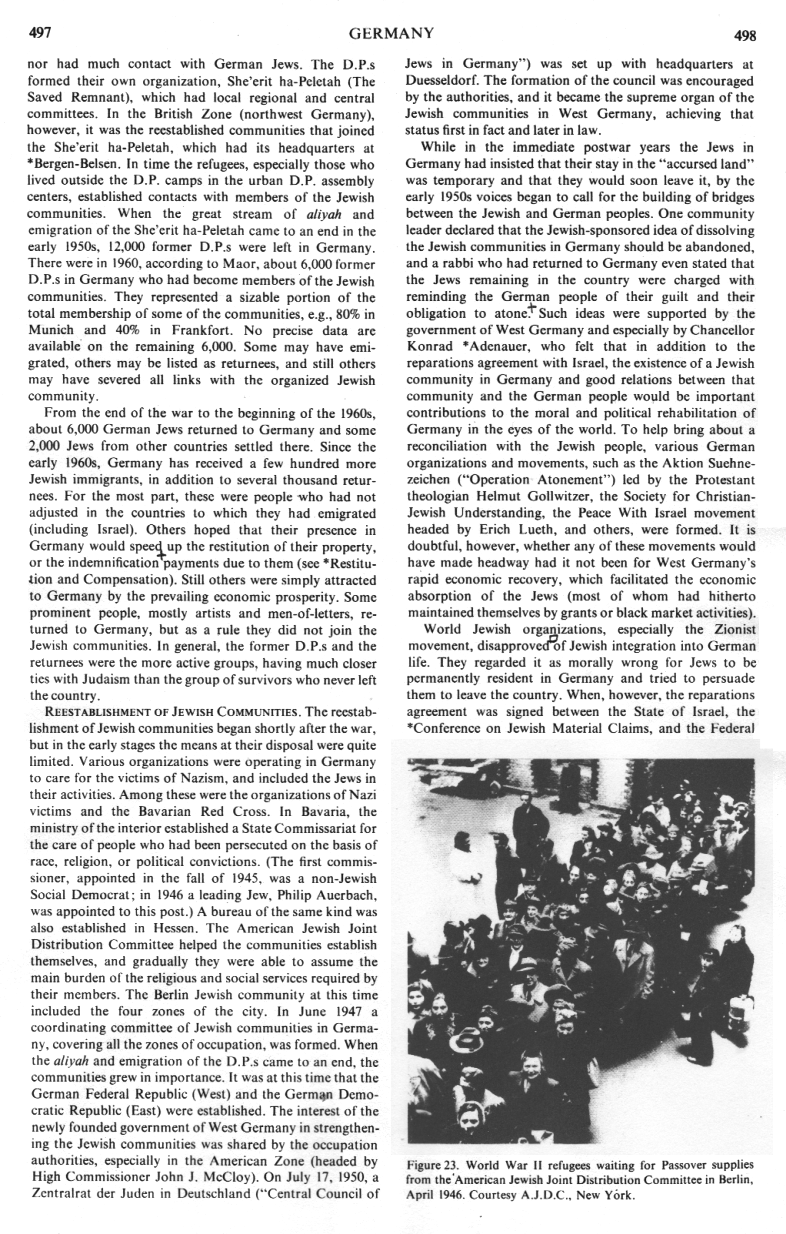
(1971): Germany, vol. 7, col. 498: World War II refugees
waiting for
Passover supplies from the American Jewish Joint
Distribution Committee in Berlin,
April 1946. Courtesy A.J.D.C., New York
When the Nazi regime in Germany ended, the general
assumption was - in the words of Leo Baeck - that the
Holocaust had terminated the thousand-year history of German
Jewry and that Jews would not resettle in the country where
the massacre of European Jewry had been conceived.
This forecast has not proven completely accurate. Jews are
again living in Germany and they have rebuilt their communal
and social organizations; but numerically they do not exceed
5% of the Jewish population of the country at the time of
Hitler's rise to power. Although the Jews form a very
diversified group, their relative influence in all spheres
of life is but a faint shadow of what it was.
After a period of consolidation the Jews of Germany
consisted of three main groups:
-- the remnants of German Jewry who had survived the war in
Germany;
-- *Displaced Persons (D.P.s) who took temporary refuge in
Germany after the war, especially in the American zone;
-- and Jews who returned to Germany or settled there after
the war.
[[Many Jews also had survived with wrong names or by change
of religion and did not re-convert again. They are not
counted as survivors but they are mentioned only in
estimates]].
Those who survived the persecutions and the war in Germany
itself had, on the whole, only a tenuous attachment to
Judaism. Many had been baptized, and the majority had
entered mixed marriages (surviving the Holocaust only with
the help of their "Aryan" relatives) and had raised their
children as Christians. Among them were also several hundred
women who had married Jews, and converted to Judaism. The
average age of this group was over 50. The number of Jews in
Germany grew in the immediate postwar period, when several
thousand German Jews who had survived the concentration
camps (especially Theresienstadt) and did not go into D.P.
camps returned to Germany. Soon after, a few thousand were
able to emigrate to the United States and several hundred
went to other countries. Of those who remained, only a part
(estimated by H. Maor between 6,000 and 8,000) joined the
reestablished Jewish communities.
[The Displaced Persons
(D.P.s) in Germany - D.P. organization She'erit ha-Peletah
with headquarters in Bergen-Belsen]
The D.P.s who arrived in Germany after the war
[[transported by the Jewish organizations after the war
within the flight from Communist occupation in eastern
Europe]]
were a "community in transit" and did not regard themselves
as a part of German Jewry. At the end of 1946, there was a
record number of 160,000 Jewish D.P.s in Germany; the total
number of Jewish D.P.s who spent some time in the country is
estimated at 200,000.
[[In May in the camps of whole Europe were alive "perhaps a
million Jewish refugees", see: *Zionism.
Many of the surviving Jews came from eastern Europe to the
D.P. camps in western Germany, driven by criminal Gulag
Communism and lead by racist Zionist facilities. Not all
surviving Jews went to the D.P. camps but found private
shelter. There were further D.P. camps in Austria, see: *D.P.s,
and *Vienna]].
Most of them were in the American Zone, where they neither
joined the communities (col. 496)
nor had much contact with German Jews. The D.P.s formed
their own organization, She'erit ha-Peletah (The Saved
Remnant), which had local regional and central committees.
In the British Zone (northwest Germany), however, it was the
reestablished communities that joined the She'erit
ha-Peletah, which had its headquarters at *Bergen-Belsen. In
time the refugees, especially those who lived outside the
D.P. camps in the urban D.P. assembly centers, established
contacts with members of the Jewish communities. When the
great stream of aliyah
and emigration of the She'erit ha-Peletah came to an end in
the early 1950s, 12,000 former D.P.s were left in Germany.
There were in 1960, according to Maor, about 6,000 former
D.P.s in Germany who had become members of the [[local]]
Jewish communities. They represented a sizable portion of
the total membership of some of the communities, e.g., 80%
in Munich and 40% in Frankfort. NO precise data are
available on the remaining 6,000. Some may have emigrated,
other may be listed as returnees, and still other may have
severed all links with the organized Jewish community.
[1945-1960: About 6,000
Jews coming back to Germany - the reasons]
From the end of the war to the beginning of the 1960s, about
6,000 German Jews returned to Germany and some 2,000 Jews
from other countries settled there. Since the early 1960s,
Germany has received a few hundred more Jewish immigrants,
in addition to several thousand returnees. For the most
part, these were people who had not adjusted in the
countries to which they had emigrated (including Israel).
Others hoped that their presence in Germany would speed up
the restitution of their property, or the indemnification
[[compensation]] payments due to them (see *Restitution and
Compensation). Still others were simply attracted to Germany
by the prevailing economic prosperity. Some prominent
people, mostly artists and men-of-letters, returned to
Germany, but as a rule they did not join the Jewish
communities. In general, the former D.P.s and the returnees
were the more active groups, having much closer ties with
Judaism than the group of survivors who never left the
country. (col. 497)
When the aliyah
and emigration of the D.P.s came to an end, the communities
grew in importance. (col. 497)
REESTABLISHMENT OF JEWISH COMMUNITIES.
[New organizations
established for the victims of Nazism - State Commissariat
in Bavaria and in Hessen - Philip Auerbach - help by the
Joint - Berlin in 4 zones]
The reestablishment of Jewish communities began shortly
after the war, but in the early stages the means at their
disposal were quite limited. Various organizations were
operating in Germany to care for the victims of Nazism, and
included the Jews in their activities. Among these were the
organizations of Nazi victims and the Bavarian Red Cross. In
Bavaria, the ministry of the interior established a State
Commissariat for the care of people who had been persecuted
on the basis of race, religion, or political convictions.
(The first commissioner, appointed in the fall of 1945, was
a non-Jewish Social Democrat; in 1946 a leading Jew, Philip
Auerbach, was appointed to this post). A bureau of the same
kind was also establishes in Hessen.
[[Auerbach was a criminal and abused German money which was
foreseen for Jews into his own pockets. The justice punished
him and the case fed anti-Jewish prejudices]].
The American Jewish Joint Distribution Committee helped the
communities establish themselves, and gradually they were
able to assume the main burden of the religious and social
services required by their members.
The Berlin Jewish community at this time included the four
zones of the city. In June 1947 a coordinating committee of
Jewish communities in Germany, covering all the zones of
occupation, was formed. (col. 497)
It was at this time that the German Federal Republic (West)
and the German Democratic Republic (East) were established.
The interest of the newly founded government of West Germany
in strengthening the Jewish communities was shared by the
occupation authorities, especially in the American Zone
(headed by High Commissioner John J. McCloy).
On July 17, 1950, a Zentralrat der Juden in Deutschland
("Central Council of (col. 497)
Jews in Germany") was set up with headquarters at
Duesseldorf. The formation of the council was encouraged by
the authorities, and it became the supreme organ of the
Jewish communities in West Germany, achieving that status
first in fact and later in law.
[Official reconciliation
work]
While in the immediate postwar years the Jews in Germany had
insisted that their stay in the "accursed land" was
temporary and that they would soon leave it, by the early
1950s voices began to call for the building of bridges
between the Jewish and German peoples. One community leader
declared that the Jewish-sponsored idea of dissolving the
Jewish communities in Germany should be abandoned, and a
rabbi who had returned to Germany even stated that the Jews
remaining in the country were charged with reminding the
German people of their guilt and their obligation to atone
[[compensate]]. Such ideas were supported by the government
of West Germany and especially by Chancellor Konrad
*Adenauer, who felt that in addition to the reparations
agreement with [[racist Zionist Free Mason CIA Herzl]]
Israel, the existence of a Jewish community in Germany and
good relations between that community and the German people
would be important contributions to the moral and political
rehabilitation of Germany in the eyes of the world. To help
bring about a reconciliation with the Jewish people, various
German organizations and movements, such as the Aktion
Suehnezeichen ("Operation Atonement") led by the Protestant
theologian Helmut Gollwitzer, the Society for
Christian-Jewish Understanding, the Peace With Israel
movement headed by Erich Lueth, and others, were formed.
It is doubtful, however, whether any of these movements
would have made headway had it not been for West Germany's
rapid economic recovery, which facilitated the economic
absorption of the Jews (most of whom had hitherto maintained
themselves by grants or black market activities).
[Racist Zionists claim that
no Jew will stay in Germany - moderate policy after the
creation of the Central Council (Zentralrat) -
compensation and restitution]
World Jewish organizations, especially the [[racist]]
Zionist movement, disapproved [[[condemned]] of Jewish
integration into German life. They regarded it as morally
wrong for Jews to be permanently resident in Germany and
tried to persuade them to leave the country. When, however,
the reparations agreement was signed between the State of
[[racist Zionist Free Mason CIA Herzl]] Israel, the
*Conference on Jewish Material Claims, and the Federal (col.
498)
Republic in September 1952, the psychological and political
basis for ostracizing the Jews of Germany no longer existed.
The Zentralrat became a member of the Claims Conference, and
in 1954 the [[racist]] Zionist Executive approved the
reestablishment of the [[racist]] Zionist Organization of
Germany. (This is not to be confused with the [[racist]]
Zionist Organization of the She'erit ha-Peletah, which was
disbanded in 1951 as were all other institutions of the
She'erit Ha-Peletah).
The Zentralrat also became affiliated with the *World Jewish
Congress. Following the reparations agreement and the
legislation for indemnification and the restitution of
property, he federal government of West Germany and
governments of the Laender
[[provinces]] adopted a liberal policy toward the
restitution of property to the communities and provided them
with regular subsidies for their needs. As a result, the
Jewish communities of Germany became among the wealthiest in
the world.
This process of consolidation was not without its upheavals,
struggles, and public scandals, which came before the German
courts. Among those sentenced to imprisonment were Aaron
Ohrenstein, the rabbi of Munich, and Philip Auerbach, who
committed suicide in prison. There were also court
proceedings contesting the legality of several community
councils.
[Anti-Semitism after 1945 -
pro-Jewish actions]
Anti-Semitism continued to exist in the country, perhaps
exacerbated by the problem of bringing Nazi criminals to
justice and the demand for the exclusion of Nazis from
public office and government service. In fact, Neo-Nazi
movements sprang up, Jewish cemeteries were desecrated,
swastikas were daubed on walls, and anti-Semitic propaganda
was disseminated.
On the other hand, there were signs of a genuine change of
heart: German youth was educated toward democracy, Jewish
literature and literature on Jews appeared on the
bookstands, there were exhibitions on Jewish themes, etc.
The authorities assisted the communities in the construction
of new synagogues and undertook the reconstruction of
synagogues of historical value in places where there was no
Jewish community (such as the Rashi Synagogue in Worms).
[[This generalization that German youth was educated toward
democracy is not so sure because many teachers were former
Nazis and gave Nazism the right of existence against the
stock market manipulations and against Communism. These
teachers did not know that criminal "USA" had financed
Communism and the Third Reich at the same time...]]
[Numbers of Jews in Germany
in the 1960s - mixed marriages]
In October 1967, the number of Jews registered with the
Jewish communities in West Germany, including West Berlin,
was 26,226 (this includes 1,300 Jews living in Frankfort who
were not members of the community but registered as Jews in
the census). It is estimated that there are 5,000 to 10,000
additional Jews in the country who are not listed with the
communities.
According to the figures for Oct. 1, 1966, the largest
communities were in West Berlin (5,991 members), Frankfort
(4,168), Munich (3,345), Duesseldorf (1,579), Hamburg
(1,500), and Cologne (1,304).
Because of the high average age, the demographic composition
of German Jewry is highly abnormal. [[The racist Zionist
organizations had transported the whole German Jewish youth
to Palestine between 1933 and 1941]].
The (col. 499)
death rate greatly exceeds the birth rate, e.g. in 1963-64
there were 482 deaths and only 69 births. In spite of the
wide gulf between Jews and Germans, the rate of
intermarriage is among the highest in the world. In the
period 1955-58, there were 679 marriages in which both
partners were Jewish, as against 2,009 mixed marriages;
72.5% of the Jewish men and 23.6% of the Jewish women who
married chose non-Jewish partners. (For the period 1901-30
the respective figures were 19.6% for men and 12.2% for
women).
[Jewish cultural life after
1945]
Several aged rabbis returned to Germany, and a few came
there from other countries, e.g., the United States,
[[racist Zionist Free Mason CIA Herzl]] Israel, and Britain,
to serve for a limited period. There was a serious scarcity
of teachers, religious articles, and community workers. The
work of the communities was generally in the hands of a
salaried staff. Jewish schools were established in Frankfort
and Munich, while elsewhere the community provided religious
instruction during after-school hours. There were social
welfare departments in the communities and a central welfare
office (Zentralwohlfahrtsstelle) in Frankfort.
Many communities maintained homes for the aged and summer
camps for children. German-language Jewish weeklies were
published in Duesseldorf and Munich. The Juedischer Verlag
(Jewish Publishing Co.) in Berlin was reestablished, and
another publishing house, Ner Tamid, was opened. The
[[racist]] Zionist organization had branches in most of the
communities, as did Jewish women's organizations and youth
movements.
In most places there were local committees of the *Keren
Hayesod and the *Jewish National Fund, and in Berlin,
Frankfort, and Munich there were B'nai B'rith Lodges.
An outstanding contribution to the postwar rehabilitation of
Jews in Germany was made by Karl Marx (1897-1966), who
returned to Germany in 1945, joined the [[racist]] Zionist
movement, and founded the Allgemeine Wochenzeitung des
Judentums ("General Jewish Weekly") in Duesseldorf. He
regarded as his task the "building of a bridge" between the
Jewish people and [[racist Zionist Free Mason CIA Herzl]]
Israel, on the one hand, and Germany, on the other. He had
close connections with the first president of the Federal
Republic, Theodor Heuss, with Chancellor Adenauer, and with
Social Democratic leaders and tried to serve as a link
between them and the leaders of [[racist Zionist Free Mason
CIA Herzl]] Israel and world Jewry.
A number of Jews assumed important public offices. Among
them were
-- Paul Hertz, a Social Democratic senator in Berlin
-- Herbert A. *Weichmann, President of the Bundesrat and
mayor of Hamburg
-- Joseph Neuberger, the minister of justice in North
Rhine-Westphalia (who returned to Germany from [[racist
Zionist Free Mason CIA Herzl]] Israel)
-- and Ludwig Rosenberg, chairman of the Federation of Trade
Unions.
Several scholars and prominent artists, including the actors
Ernst *Deutsch and Fritz *Kortner, also returned to Germany.
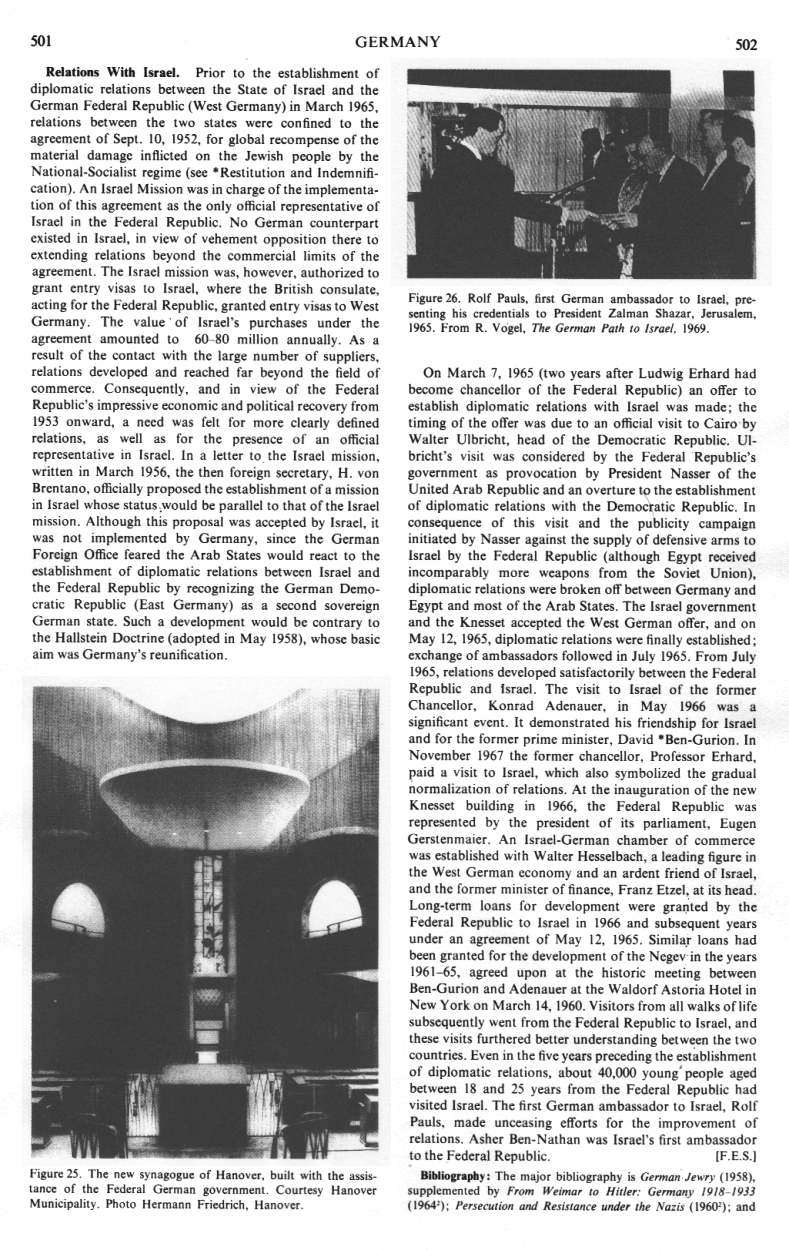
Encyclopaedia Judaica
(1971): Germany, vol. 7, col. 501: The new synagogue of
Hanover, built with the
assistance of the Federal German government. Courtesy
Hanover Municipality.
Photo Hermann Friedrich, Hanover.
Despite their manifold activities, the Jewish communities in
Germany rest on weak foundations because of their abnormal
demographic structure, the inadequacy of Jewish education,
and the abyss that continues to exist between the Jews and
German society. The replacement of the expression Deutsche Juden ("German
Jews") by the term Juden
in Deutschland ("Jews in Germany") may be taken as
an indication of the strangeness that Jews feel in Germany
and their anxiety about the future.
[[Generally the anti-Zionist line was weakened because of
the wars of racist Zionist Free Mason CIA Herzl Israel.
Generally there are Jewish leaders in West German TV
stations and radio stations controlling and censoring the
news hiding the racist and anti-Arab nature of the "Jewish
state of Israel". Since the fall of the wall many Jews from
eastern Europe have arrived in re-united Germany]].
[Jews in East Germany
(GDR)]
There is only a tiny remnant of Jews in the German
Democratic Republic. Their number is estimated at 1,500, of
whom 900 live in East Berlin. Although there is no ban on
religious practice, the communist regime makes an effort to
obscure the identity of Jews. Only a few of the public
figures who are of Jewish origin have retained any
connection with organized Judaism. One of these was the
author Arnold *Zweig who was president of the Academy of
Arts.
[CH.Y.]
[Table]:
Jewish population in Germany, 1871-1969
|
xxxxxxxxx1871xxxxxxxxx
|
xxxxxxxxx512,158xxxxxxxxx |
[[with
Pommern,
Silesia, Prussia]]
|
1880
|
562,612xxxxxxxxx |
"
|
1890
|
567,884xxxxxxxxx |
"
|
1900
|
586,833xxxxxxxxx |
"
|
1910
|
615,021xxxxxxxxx |
"
|
1925
|
564,379xxxxxxxxx |
[[without Eastern
Prussia, without Polish corridor]]
|
1933
|
503,0001xxxxxxxx |
Jews defined by
religion
|
1939
|
234,0002xxxxxxxx |
Jews defined by
Nuremberg law [[with Austria and Sudeten]]
|
1941
|
164,000xxxxxxxxx |
[[with Austria,
Sudeten, and Polish corridor]] |
1942
|
51,000xxxxxxxxx |
[[with Austria,
Sudeten, and Polish corridor]] |
1943
|
31,910xxxxxxxxx |
[[with Austria,
Sudeten, and Polish corridor]] |
1944
|
14,574xxxxxxxxx |
[[with Austria,
Sudeten, and Polish corridor]] |
1946
|
156,7053xxxxxxxx |
Estimated number
includes displaced persons
[[without Austria, Sudeten, Pommern, Silesia,
Prussia]]
|
1948
|
153,0003xxxxxxxx |
Estimated number
includes displaced persons
[[without Austria, Sudeten, Pommern, Silesia,
Prussia]] |
1949
|
55,0003xxxxxxxx |
Estimated number
includes displaced persons
[[without Austria, Sudeten, Pommern, Silesia,
Prussia]] |
1952
|
23,000xxxxxxxxx |
|
1957
|
30,000xxxxxxxxx |
|
1964
|
31,000xxxxxxxxx |
|
1969
|
30,000xxxxxxxxx |
|
from: Germany; In: Encyclopaedia Judaica
(1971), vol. 7, col. 481
|
Relations With [racist
Zionist Free Mason CIA Herzl] Israel.
Prior to the establishment of diplomatic relations between
the State of Israel and the German Federal Republic (West
Germany) in March 1965, relations between the two states
were confined to the agreement of Sept. 10, 1952, for global
recompense of the material damage inflicted on the Jewish
people by the National-Socialist regime (see *Restitution
and Indemnification).
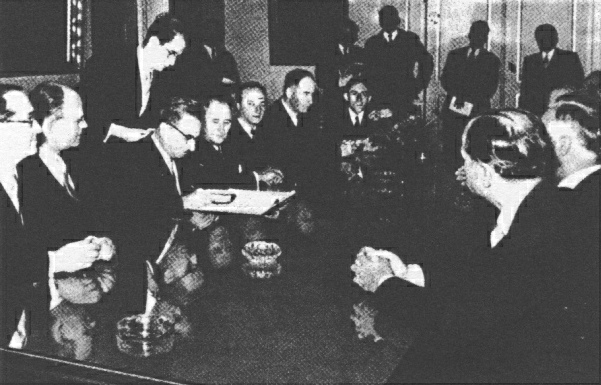
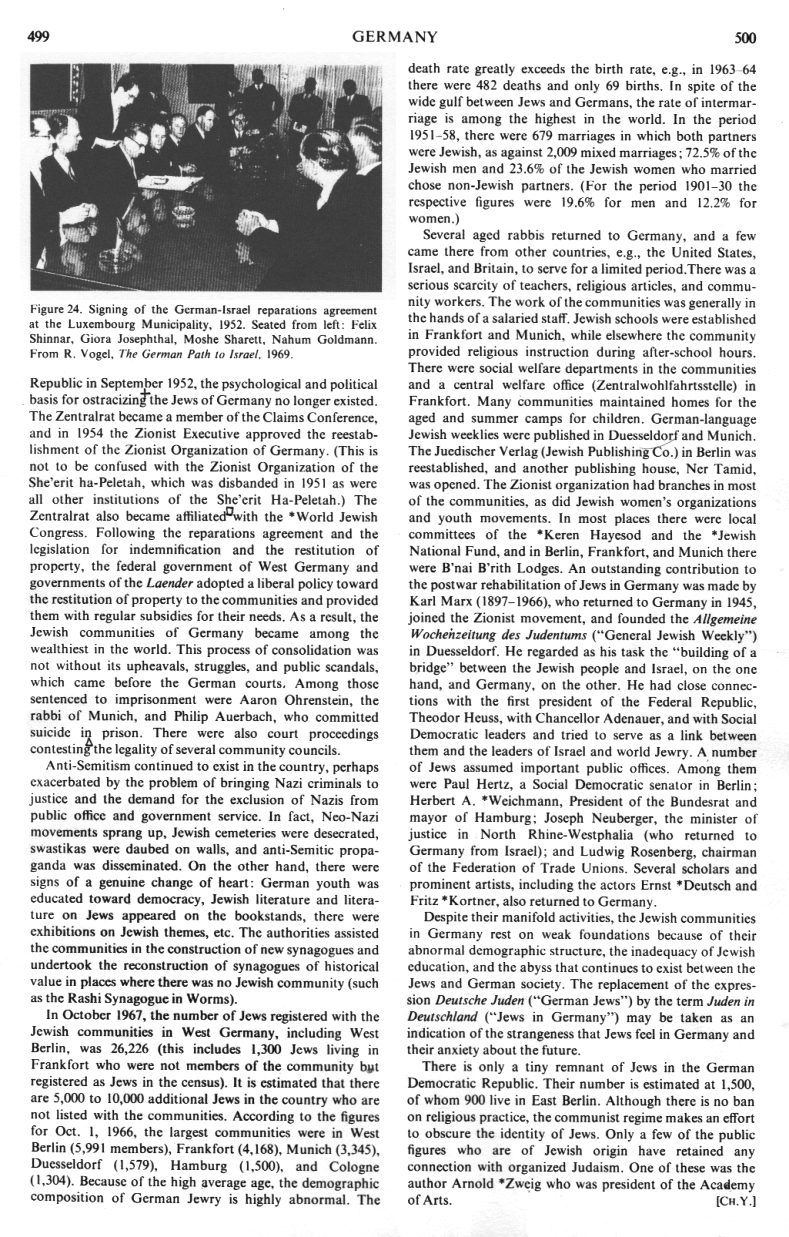
Encyclopaedia Judaica
(1971): Germany, vol. 7, col. 499: Signing of the
German-Israel reparations
agreement at the Luxembourg Municipality, 1952. Seated
from left: Felix Shinnar, Giora Josephthal,
Moshe Sharett, Nahum Goldmann. From: R. Volge: The German
Path to Israel, 1969
An Israel Mission was in charge of the implementation of
this agreement as the only official representative of Israel
in the Federal Republic. No German counterpart existed in
[[racist Zionist Free Mason CIA Herzl]] Israel, in view of
vehement opposition there to extending relations beyond the
commercial limits of the agreement.
The Israel mission was, however, authorized to grant entry
visas to [[racist Zionist Free Mason CIA Herzl]] Israel,
where the British consulate, acting for the Federal
Republic, granted entry visas to West Germany.
[[Racist Zionist Free Mason CIA Herzl]] Israel was boycotted
by the Arab states so trade with Western Europe was
existentially important, also with West Germany]].
The value of Israel's purchases under the the agreement
amounted to 60-80 million annually. As a result of the
contact with the large number of suppliers, relations
developed and reached far beyond the field of commerce.
[[The perverse situation was that democratic Germany was
supporting a racist Zionist state with it's aim of a
"Greater Israel" from the Nile to the Euphrates according to
1st Mose, chapter 15, phrase 18, which was never mentioned
in the press and in TV and in the radio. At the same time
Germany kept relations with the Arab states which are
agitating against this racist Zionist state with
anti-Semitism which was officially banned in Germany. East
Germany (German Democratic Republic, GDR) was in line with
the "Soviet Union" which supported the Arab states against
racist Zionist Free Mason CIA Herzl Israel. Principally the
"Soviet Union" wanted Israel to be a Communist satellite. By
this, the tensions - and the propaganda - were enormous on
both sides and German-Jewish relations with racist Zionist
Free Mason CIA Herzl Israel were blocked by this]].
[Embassy questions - GDR
and tactics with the Arab states - West German embassy
since 12 May 1965]
Consequently, and in view of the Federal Republic's
impressive economic and political recovery from 1953 onward,
a need was felt for more clearly defined relations, as well
as for the presence of an official representative in
[[racist Zionist Free Mason CIA Herzl]] Israel. In a letter
to the Israel mission, written in March 1956, the then
foreign secretary, H. von Brentano, officially proposed the
establishment of a mission in [[racist Zionist Free Mason
CIA Herzl]] Israel whose status would be parallel to that of
the Israel mission.
Although this proposal was accepted by [[racist Zionist Free
Mason CIA Herzl]] Israel, it was not implemented by Germany,
since the German Foreign Office feared the Arab States would
react to the establishment of diplomatic relations between
[[racist Zionist Free Mason CIA Herzl]] Israel and the
Federal Republic by recognizing the German Democratic
Republic (East Germany) as a second sovereign German state.
Such a development would be contrary to the Hallstein
Doctrine (adopted in May 1958), whose basic aim was
Germany's reunification. (col. 501)
On March 7, 1965 (two years after Ludwig Erhard had become
chancellor of the Federal Republic) an offer to establish
diplomatic relations with [[racist Zionist Free Mason CIA
Herzl]] Israel was made; the timing of the offer was due to
an official visit to Cairo by Walter Ulbricht, head of the
Democratic Republic. Ulbricht's visit was considered by the
Federal Republic's government as provocation by President
Nasser of the United Arab Republic and an overture to the
establishment of diplomatic relations with the Democratic
Republic.
In consequence of this visit and the publicity campaign
initiated by Nasser against the supply of defensive arms to
Israel by the Federal Republic (although Egypt received
incomparably more weapons from the Soviet Union), diplomatic
relations were broken off between Germany and Egypt and most
of the Arab States. The Israel government and the Knesset
accepted the West German offer, and on May 12, 1965,
diplomatic relations were finally established; exchange of
ambassadors followed in July 1965.
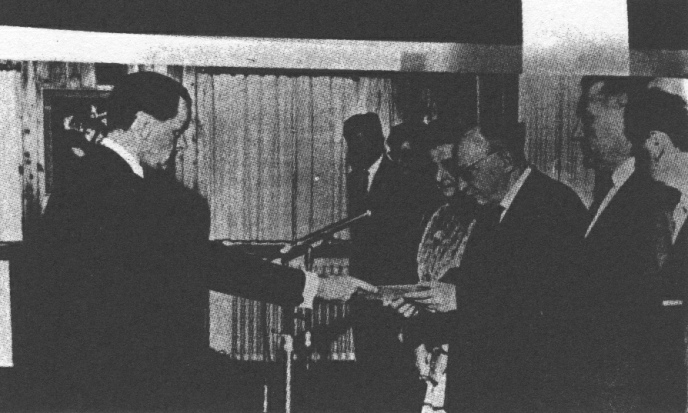
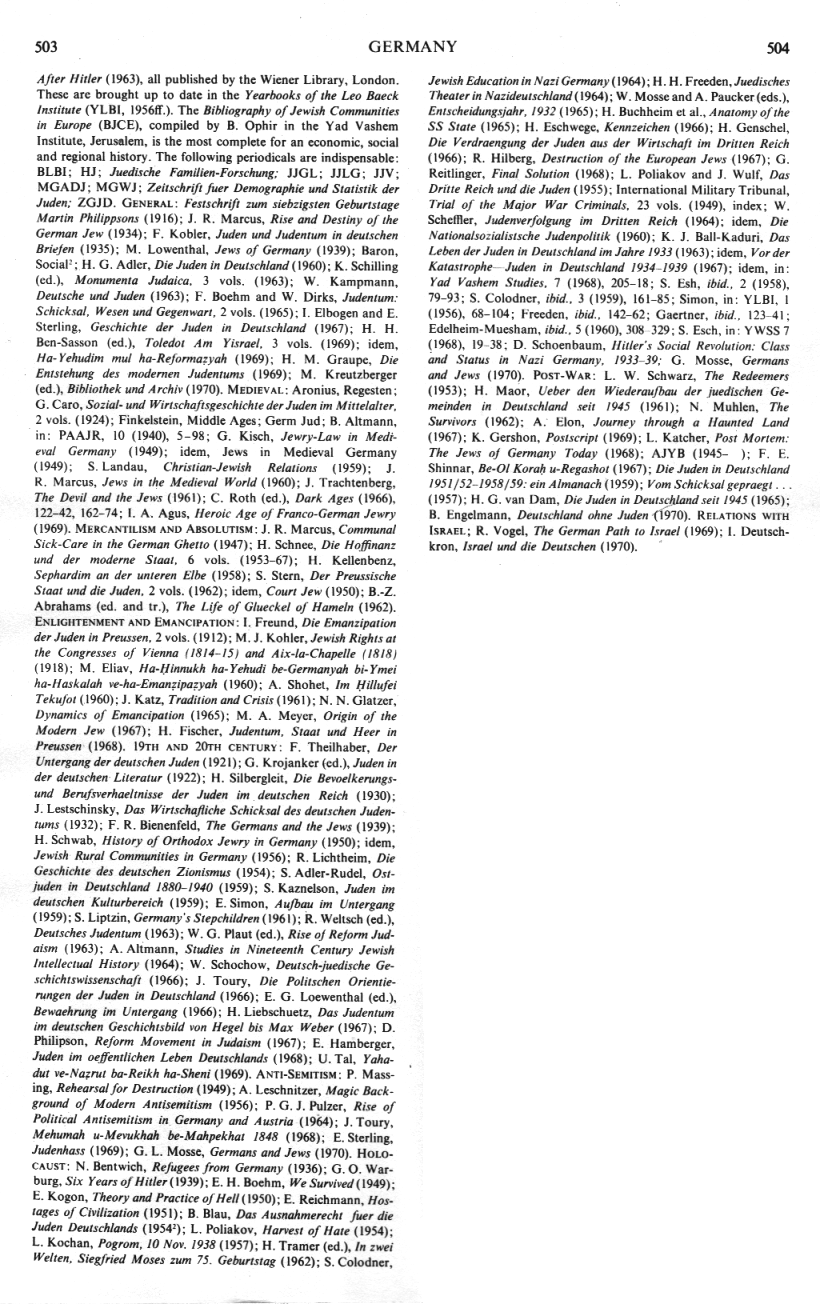
Encyclopaedia Judaica
(1971): Germany, vol. 7, col. 502: Rolf Pauls, first
German ambassador to Israel, presenting
his credentials to President Zalman Shazar, Jerusalem,
1965. From: R. Vogel: The German Path to Israel, 1969.
From July 1965, relations developed satisfactorily between
the Federal Republic and [[racist Zionist Free Mason CIA
Herzl]] Israel. The visit to Israel of the former
Chancellor, Konrad Adenauer, in May 1966 was a significant
event. It demonstrated his friendship for Israel and for the
former prime minister, David *Ben-Gurion. In November 1967
the former chancellor, Professor Erhard, paid a visit to
Israel, which also symbolized the gradual normalization of
relations. At the inauguration of the new Knesset building
in 1966, the Federal Republic was represented by the
president of its parliament, Eugen Gerstenmaier. An
Israel-German chamber of commerce was established with
Walter Hesselbach, a leading figure in the West German
economy and an ardent friend of Israel, and the former
minister of finance, Franz Etzel, at its head.
Long-term loans for development were granted by the Federal
Republic to [[racist Zionist Free Mason CIA Herzl]] Israel
in 1966 and subsequent years under an agreement of May 12,
1965. Similar loans had been granted for the development of
the Negev in the years 1961-65, agreed upon at the historic
meeting between [[racist]] Ben-Gurion and Adenauer at the
Waldorf Astoria Hotel in New York on March 14, 1960.
Visitors from all walks of life subsequently went from the
Federal Republic to [[racist Zionist Free Mason CIA Herzl]]
Israel, and these visits furthered bitter understanding
between the two countries. Even in the five years preceding
the establishment of diplomatic relations, about 40,000
young people aged between 18 and 25 years from the Federal
Republic had visited [[racist Zionist Free Mason CIA Herzl]]
Israel. The first German ambassador to [[racist Zionist Free
Mason CIA Herzl]] Israel, Rolf Pauls, made unceasing efforts
for the improvement of relations. Asher Ben-Nathan was
Israel's first ambassador to the Federal Republic.
[[Since 1948 the non-Zionists were banned to be silent by
the racist Zionists with their racist Zionist Free Mason CIA
Herzl Israel and their rich "Jewish organizations" which
dominated and discriminated all non-Zionists and the
non-Zionist groups]].
[F.E.S.]