Encyclopaedia Judaica

Jews in Dortmund
Crusades - Jewish community - Black Death - expulsions - Napoleon and equality - Prussian law and industrialization - Nazi times and Holocaust - post-war times
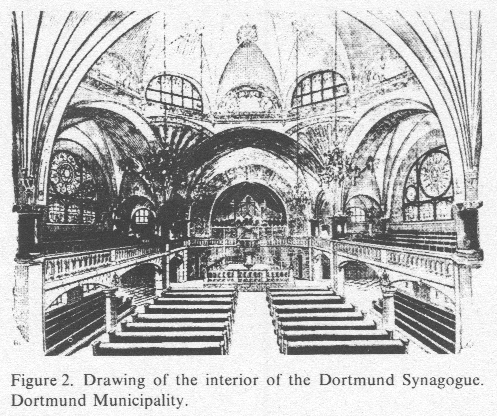
Encyclopaedia Judaica (1971): Dortmund, vol. 6, col. 176, synagogue in Dortmund, Germany,
built in 1900, and destroyed by the Nazis in 1938 [[Kristallnacht, S.A. riot]]
from: Dortmund; In: Encyclopaedia Judaica (1971), vol. 6
presented by Michael Palomino (2008)

![Encyclopaedia Judaica (1971): Dortmund, vol. 6,
col. 176, synagogue in Dortmund, Germany, built in
1900, and destroyed by the Nazis in 1938
[[Kristallnacht, S.A. riot]]](EncJud_juden-in-Dortmund-d/EncJud_Dortmund-band6-kolonne176-synagoge1900-1938-55pr.jpg "Encyclopaedia
Judaica (1971): Dortmund, vol. 6, col. 176,
synagogue in Dortmund, Germany, built in 1900, and
destroyed by the Nazis in 1938 [[Kristallnacht, S.A.
riot]]")
| Teilen
/ share: |
Facebook |
|
Twitter
|
<DORTMUND, city in W. Germany.
[Crusade attacks in 1096]
A privilege issued by Emperor Henry IV to the city of *Worms in 1074 granted the Jews there trading rights in Dortmund market. In 1096 Mar Shemaryah, fleeing from the crusading mob, killed himself and his whole family in Dortmund.
[Cultural life and Jewish rights in 13th century]
Records pointing to the existence of an organized Jewish settlement there date from the 13th century. The Jews paid a contribution of 15 marks to the (col. 176)
imperial treasury from 1241 to 1250. They had their own quarter or street. While in 1250 it was the archbishop of Cologne who granted a privilege to the Jews of Dortmund and was responsible for their protection, these rights and duties had passed to the emperor by 1257, and from 1300 devolved on Count Eberhard of the Mark.
By 1257 the community had a Magistratus Judaeorum, a rabbi (clericus or papen), a cantor, shohet (shoḥet) [[ritual slaughterer]], and a Schulklopfer [[beating teacher]], and possessed a synagogue, a communal center, a cemetery, and a mikveh [[ritual bath]], for which ground rent had to be paid. Jews participated in the guarding of the city walls.
[Black Death: expulsion of 1350 and readmittance in 1372 - further expulsions about 1498 - and in 1596 - Napoleon and equal rights]
In the *Black Death period the Jews were expelled from Dortmund (1350); the Judenturm ("Jews' Tower") was built with the spoils seized from them. They were readmitted in 1372 (for six-to ten-year periods) after making a payment to the count. Subsequently taxes were levied from individuals and not from the community; moneylenders were allowed to charge an interest rate of 36.1% on loans made within the city but twice as much outside. Jews could acquire property only with the permission of the municipality. There were no more than ten Jewish families living in Dortmund in 1380.
Another expulsion seems to have taken place around the end of the 15th century as in 1543 the Jews were readmitted for an initial period of ten years, only to be expelled once more in 1596.
A privilege granted in 1750 indicates the existence of a new community in Dortmund with elders elected every three years. Under French rule (1806-15) [[under Napoleon]] the Jews in Dortmund as elsewhere gained equal rights.
[Prussian law since 1815 - industrialization and growth of the Jewish community - institutions and cultural life - Jews from eastern Europe since 1919]
After its incorporation into Prussia in 1815, Dortmund expanded considerably as the result of the industrial revolution. The Jewish population also increased, from 120 in 1840 to 1,000 (1.5% of the total) in 1880, and 4,108 in 1933 (0.8%). The community built a modest synagogue around 1850 and a magnificent building in 1900. Benno *Jacob, the Bible scholar, became rabbi in Dortmund (1906-29); K. *Wilhelm, served as rabbi from 1929 to 1933. The community had its own elementary school, apart from a religious school, and a variety of political, charitable, and social institutions, including a communal magazine.
As the main congregation was *Reform, a small Orthodox congregation (*Adass Jisroel) was established, supported also by immigrants from eastern Europe who arrived after World War I.
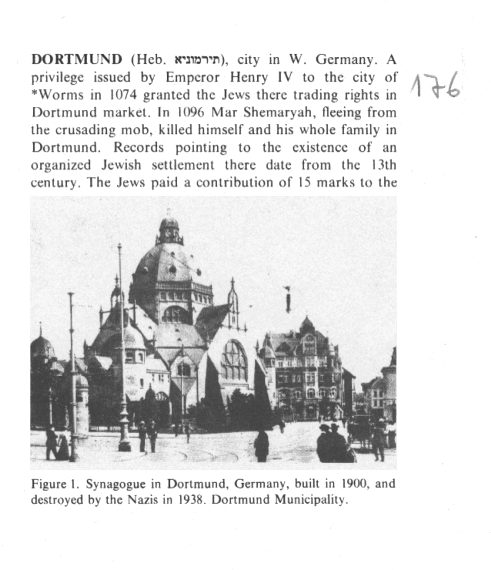
Encyclopaedia Judaica (1971): Dortmund, vol. 6, col. 177, drawing of the interior
of the Dortmund Synagogue. Dortmund Municipality
[Nazi times: Holocaust with deprivations, discriminations and deportations]
The community was forced to sell its synagogue by the Nazis and it had already been dismantled by *Kristallnacht. In October 1938 Jews of Polish nationality were deported, as elsewhere, to the no-man's-land on the Polish border. By about May 1939, 1,500 souls, i.e., about one-third of the 1933 population, were left in Dortmund. Most of them perished in the concentration and extermination camps in eastern Europe [[and probably many in the tunnel systems]]. By July 1944 only (col. 177)
334 were left, mainly partners of mixed marriages, but of those too the majority eventually suffered the same fate.
[1945-1970]
The small post-war community, formed in 1945, numbered 351 in 1970, with a synagogue, communal center and old-age home (opened in 1956). The rabbi of the Union of Jewish Congregations in Westphalia had his seat in Dortmund from 1951.
Bibliography
-- Germ. Jud, 1 (1934, repr. 1963), 88-90; 2, pt. 1 (1968), 170-4
-- Monumenta Judaica; 3 vols. (1963), index
-- H.C. Meyer (ed.): Aus Geschichte und Leben der Juden in Westfalen [[From History and Life of the Jews in Westfalen]] (1962) includes bibliiography
-- Kaiserling, in: MGWJ, 9 (1860), 81-91
-- B.N. Brilling: Zur Geschichte der Juden in Dortmund [[About History of the Jews in Dortmund]] (1958).
[A.C.]> (col. 178)
| Teilen
/ share: |
Facebook |
|
Twitter |
| Sources |
|
 Encyclopaedia Judaica (1971): Dortmund, vol. 6, col. 176 |
 Encyclopaedia Judaica (1971): Dortmund, vol. 6, col. 177-178 |
Č Ḥ Š Ṭ Ẓ
ā ć č ḥ ī š ū ž ẓ
ā ć č ḥ ī š ū ž ẓ
^