Encyclopaedia Judaica

Jews in Erfurt
Middle ages - riots and readmittance - Black Death expulsion and readmittance - expulsion 1458 - Nazi times with emigration wave 1933-1939 - deportations - post-war times
Encyclopaedia Judaica (1971): Erfurt, vol. 6, col. 839-840, the synagogue in Erfurt, East Germany, built 1840,
destroyed during Kristallnacht, Nov. 9-10, 1938 [[a S.A. riot]]. Erfurt Municipal Archives
from: Erfurt; In: Encyclopaedia Judaica (1971), vol. 6
presented by Michael Palomino (2008)

![Encyclopaedia Judaica (1971): Erfurt, vol. 6,
col. 839-840, the synagogue in Erfurt, East Germany,
built 1840, destroyed during Kristallnacht, Nov.
9-10, 1938 [[a S.A. riot]]. ERfurt Municipal
Archives](EncJud_juden-in-Erfurt-d/EncJud_Erfurt-band6-kolonne-839-840-synagoge1840-1938.jpg "Encyclopaedia Judaica (1971):
Erfurt, vol. 6, col. 839-840, the synagogue in
Erfurt, East Germany, built 1840, destroyed during
Kristallnacht, Nov. 9-10, 1938 [[a S.A. riot]].
ERfurt Municipal Archives")
| Teilen
/ share: |
Facebook |
|
Twitter
|
<ERFURT, city in Thuringia, E. Germany.
[Jews mentioned since 12th century - riots and synagogue burnt down in 1221 - new synagogue]
Jews are first mentioned there in the 12th century. At first under the protecting of the king, by the second half of the 12th century they had passed to the jurisdiction of the archbishop of Mainz, who composed an *oath formula for them in German. In 1209 the king also relinquished his right to collect taxes from the Jews, which in 1212 was explicitly (col. 837)
granted to the archbishop.
In 1221 anti-Jewish riots broke out in Erfurt: the synagogue was burned down, and a number of Jews were murdered while some threw themselves into the flames. Among the martyrs was the paytan [[cantor]] and cantor Samuel b. Kalonymus. Nevertheless, the Jewish community of Erfurt continued to exist and even to expand.
After some time a new synagogue was built and well-known rabbis chose Erfurt as their seat. Between 1286 and 1293 *Asher b. Jehiel probably lived there, and at about the same time Kalonymus b. Eliezer ha-Nakdan composed his Masorah Ketannah, still preserved in manuscript in Erfurt.
During the Middle Ages the Jews of Erfurt followed the Saxony prayer rite. The community's Book of Ritual is preserved at Jew's College, London (Ms. 104-4).
[Black Death massacres - readmittance and new synagogue in 1357 - important community - new expulsion in 1458]
At the beginning of the 14th century protection over the Jews passed to the municipality; this however, was unable to save them from massacre during the *black Death: at the beginning of March 1349 over 100 Jews were murdered by the populace, and many set fire to their homes and perished in the flames. Those who survived were driven from the city. Among the martyrs was Alexander Suslin ha-Kohen, author of Sefer ha-Aguddah. *Israel b. Joel Susslin mentions the Erfurt martyrs in an elegy (Sefer ha-Dema'ot, 2, 126-7).
The city council again permitted Jews to settle within the city walls and build a new synagogue in 1357. During the following century the Erfurt community became one of the largest and most important in Germany, some of the most celebrated rabbis officiating there. *Meir b. Baruch ha-Levi served there for some time; a disciple of his was *Hillel of Erfurt. In the middle of the 15th century Jacob b. Judah *Weil taught there.
During this period, Erfurt Jews played an important role in banking in Thuringia. In 1391 the king canceled all the debts owed by Christians to the Erfurt Jews and handed them over to the municipality for 2,000 gulden; the municipality claimed this sum from the Jews but promised them to return part of the debts. Subsequently the Jews had to pay a special tax to the king's treasury. In 1418 they were compelled to declare the amount of their property on oath, in the synagogue, and the king collected new taxes from them on this basis. In 1458 they were again expelled from Erfurt.
[Prussian law: Jewish tombstones in the town wall - new Jewish settlement]
Around 1820 the Prussian authorities used the tombstones in the Jewish cemetery for the fortification of the city. At that time Jews again began to settle in Erfurt, numbering some 144 in 1840 when a new synagogue was dedicated. The communal archives from 1855 to 1936 have been transferred to the Central Archives for the History of the Jewish People in Jerusalem.
[Nazi times: over 60% emigrating 1933-1939 - synagogue destroyed in 1938 - deportations]
The community numbered 546 in 1880 (1.03% of the total population); 795 in 1910 (0.72%); and 831 in 1933 (0.6%).
After the advent of the (col. 838)
Nazis the majority left Erfurt, 263 remaining in 1939. The synagogue was burned down on Nov. 9, 1938. The community was compelled to pay for the benzine used for igniting the synagogue and for clearing the ruins. The men were detained in the local school, where they were mistreated, and subsequently deported to *Buchenwald.
The 173 Jews remaining in Erfurt were deported in February 1945 to *Theresienstadt.
[Post-war times]
A few Jews returned to Erfurt after the war, and there were 40 in 1951. A new synagogue was opened in 1952, and the community numbered 120 in 1961. One of the famous manuscripts of the Tosefta was found in Erfurt after which it is named (S. Leibman, intr. Tosefta bi-Feshuto).
Bibliography
-- A. Jaraczewsky: Geschichte der Juden in Erfurt (1868)
-- Wiener, in: MGWJ, 17 (1868), 313-17, 352-59, 385-95
-- Th. Kronner: Festschrift zur Einweihung der neuen Synagoge in Erfurt (1884)
-- Suessmann, in: MGADJ, 5 (1914), 1-126
-- Germ Jud, 1 (1963), 97-102; 2 (1968), 215-25
-- PKG
-- Baron, Social 9 (1965), 223-26
[Z.AV.]> (col. 839)
| Teilen
/ share: |
Facebook |
|
Twitter |
| Sources |
|
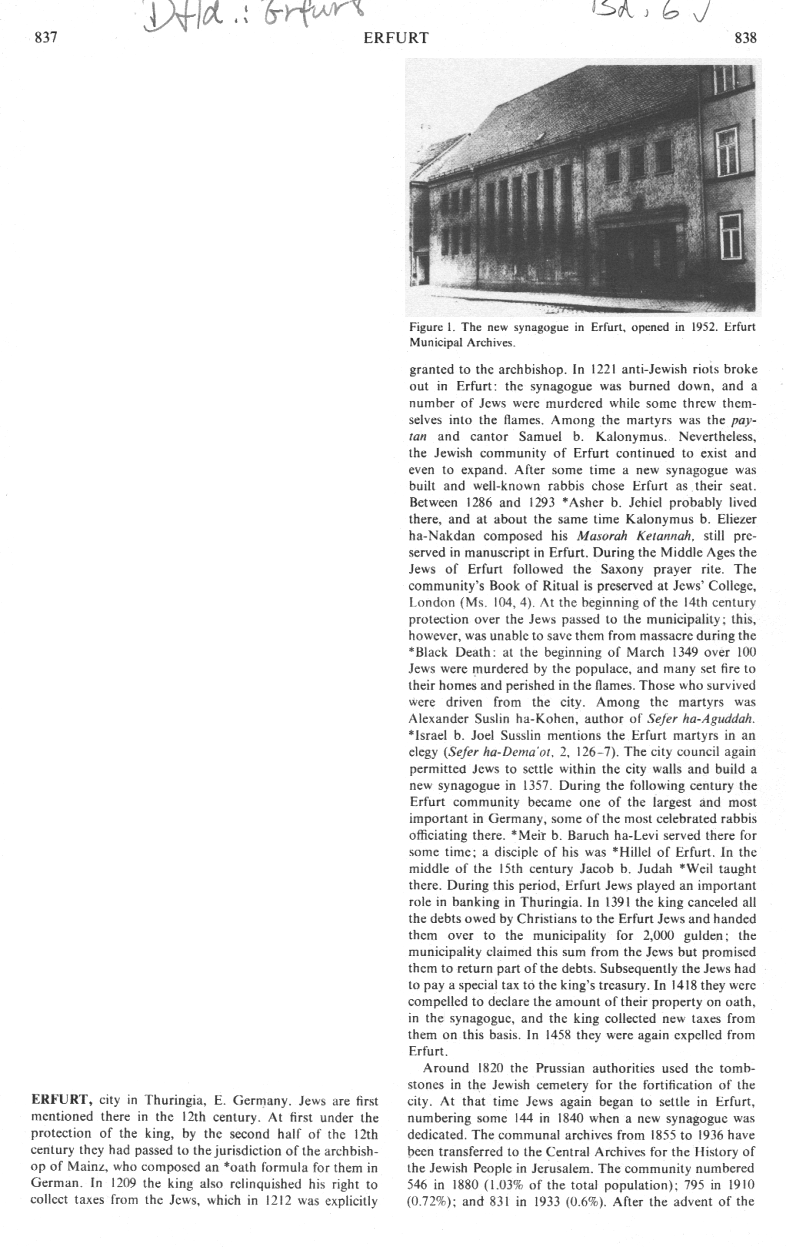 Encyclopaedia Judaica (1971): Erfurt, vol. 6, col. 837-838 |
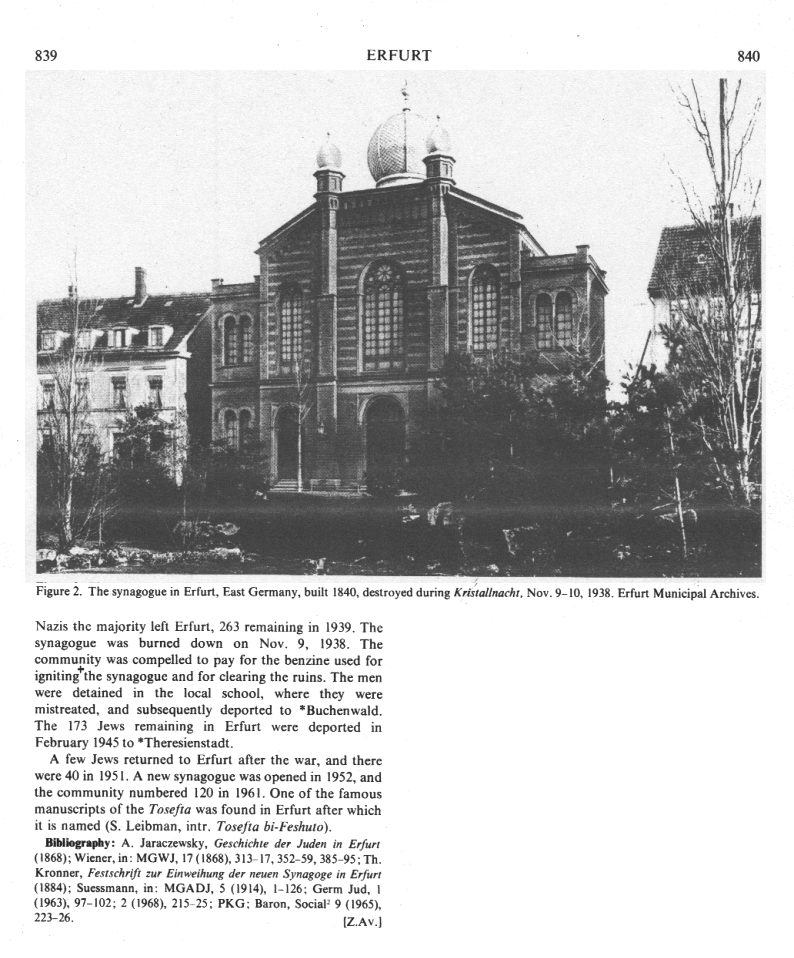 Encyclopaedia Judaica (1971): Erfurt, vol. 6, col. 839-840 |
Č Ḥ Š Ṭ Ẓ
ā ć č ḥ ī š ū ž ẓ
ā ć č ḥ ī š ū ž ẓ
^