Encyclopaedia Judaica

Jews in Cologne
Roman times - First Crusade massacre in 1096 - reconstruction - fortress Wolkenburg - privileges and tax - Black Death massacres of 1349 - expulsion in 1429 - Napoleon - Prussian rule - equality since 1856 - emigration wave 1933-1939 - "Kulturbund" - Holocaust - post-war times
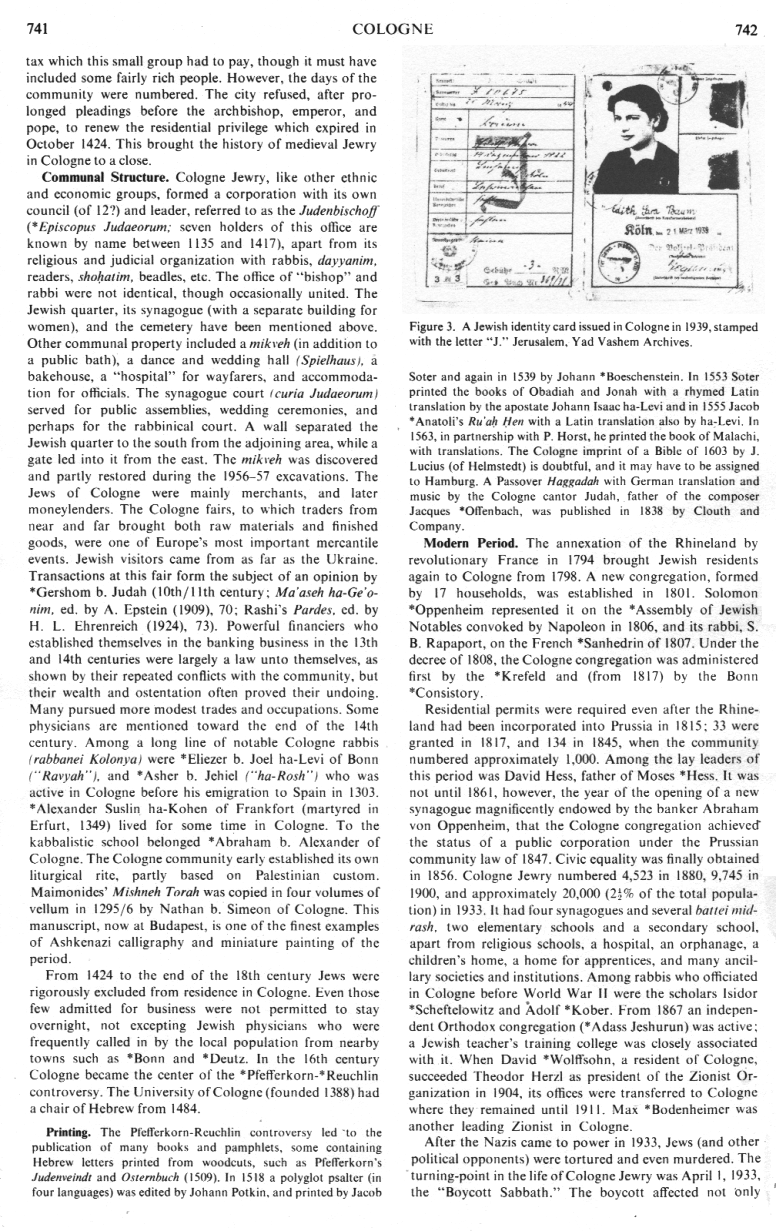
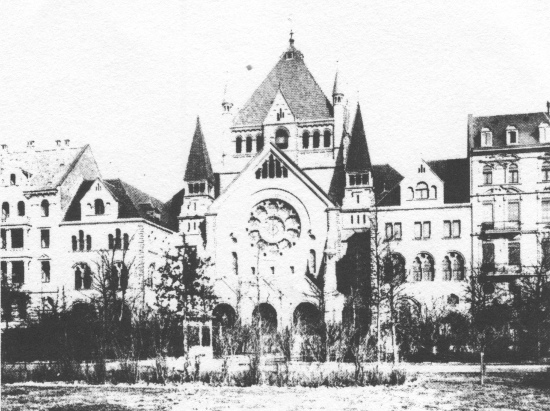
Encyclopaedia Judaica (1971): Cologne, vol. 5, col. 740. Roonstrasse Synagogue, Cologne,
before its destruction in World War II. Cologne Municipality, Rhine Picture Archive
from: Cologne; In: Encyclopaedia Judaica (1971), vol. 5
presented by Michael Palomino (2008)

| Teilen / share: |
Facebook |
|
Twitter
|
<COLOGNE, (Ger. Köln), city in W. Germany.
[Roman times - Middle Ages and synagogue detected]
Founded in 50 C.E. as the Roman Colonia Agrippinensis, seat of the provincial and military administration, it is likely to have attracted a Jewish population at an early date. A Jewish cemetery, assumed to have existed from Roman times, is attested there from the 11th century. It was in use to the end of the 17th century and came to light in the 1930s. Two edicts of Constantine (Cod. Theod. 16:8, 3-4) of 321 and 331 respectively imposed the onerous Curia duties on the Jews of Cologne and exempted the officials of their community from the obligations incumbent on the lower class of citizens. No further information on Jews in Cologne is available until the 11th century.
[[Generally the first Jews came to the Rhine valley as slaves and then developed their communities]].
In 1012 (or 1040) a synagogue was erected which, though destroyed, was three times rebuilt on the same site, until after the expulsion of 1424, it was turned into a chapel, though it served various purposes in the course of the time.
Allied bombing during World War II laid bare the foundations of the ancient building where unique examples of a genizah cellar [[store-room / depository in a synagogue for worn-out / used religious books and texts]] under the bimah [[platform with Torah stands]] and a cistern (in the forecourt?) have been discovered.
During the 12th century rabbinical opinion was divided over the religious propriety of its stained glass windows depicting lions and serpents. A chronicler of the first half of the 12th century describes the Cologne community at the end of the 11th century as "a distinguished city ... from where life, livelihood, and settled law issued for all our brethren scattered far and wide" (Solomon b. Samson in Sefer Gezerot Ashenaz ve-Zarefat (Ẓarefat), ed. by A.M. Habermann (1945), 43).
The (col. 738)
central importance of the Cologne fair and the community there for Jewry throughout the Rhine valley is further attested by the description of the *synods held in the city: "all the communities came to Cologne to the fairs three times a year and deliberated at its synagogue" (ibid., 47).
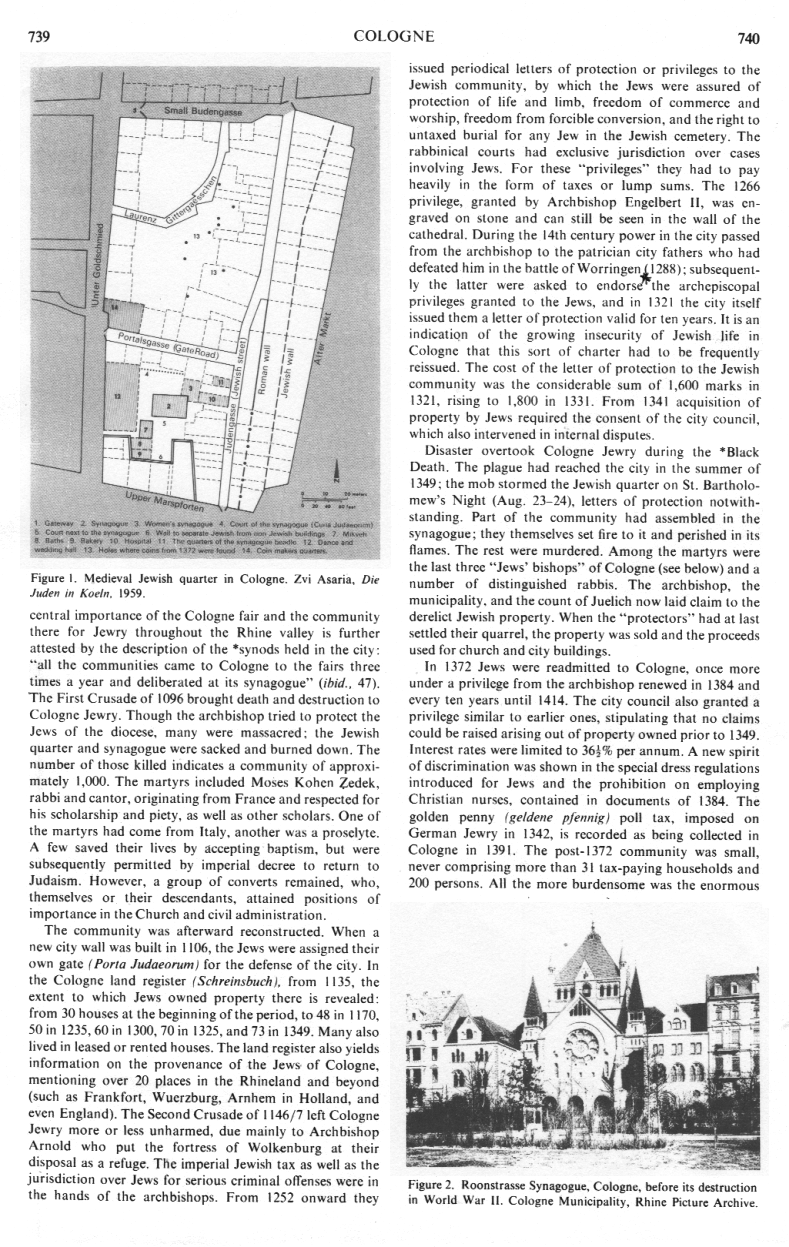
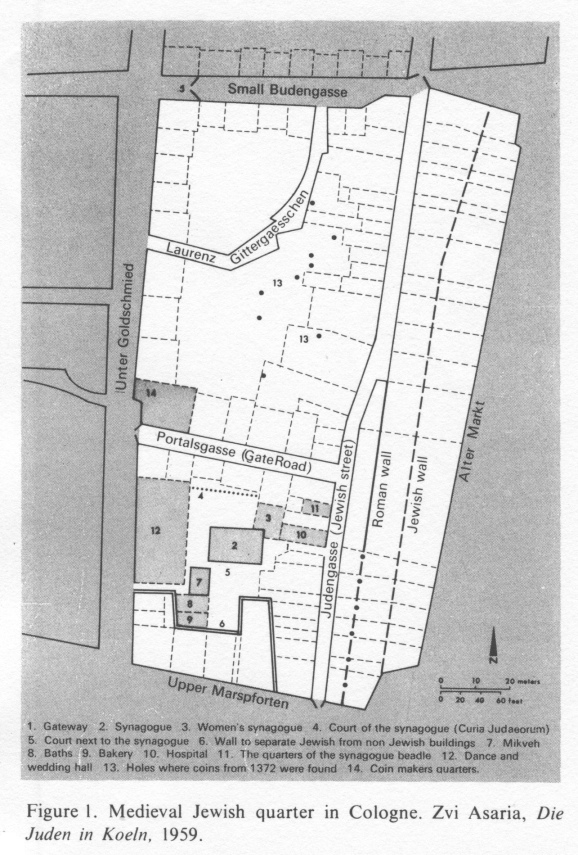
Encyclopaedia Judaica (1971): Cologne, vol. 5, col. 739. Map showing the Medieval
Jewish quarter in Cologne. Zvi Asaria: "Die Juden in Koeln", 1959
[First crusade with massacre]
The First Crusade of 1096 brought death and destruction to Cologne Jewry. Though the archbishop tried to protect the Jews of the diocese, many were massacred; the Jewish quarter and synagogue were sacked and burned down. The number of those killed indicates a community of approximately 1,000.The martyrs included Moses Kohen Zedek (Ẓedek), rabbi and cantor, originating from France and respected for his scholarship and piety, as well as other scholars. One of the martyrs had come from Italy, another was a proselyte. A few saved their lives by accepting baptism, but were subsequently permitted by imperial decree to return to Judaism. However, a group of converts remained, who, themselves or their descendants, attained positions of importance in the Church and civil administration.
[Reconstruction]
The community was afterward reconstructed. When a new city wall was built in 1106, the Jews were assigned their own gate (Porta Judaeorum [[Gate of the Jews]]) for the defense of the city. In the Cologne land register (Schreinsbuch [[Register Book]]), from 1135, the extent to which Jews owned property there is revealed: from 30 houses at the beginning of the period, to 48 in 1170, 50 in 1235, 60 in 1300, 70 in 1325, and 73 in 1349. Many also lived in leased or rented houses. The land register also yields information on the provenance of the Jews of Cologne, mentioning over 20 places in the Rhineland and beyond (such as Frankfort, Wuerzburg, Arnhem in Holland, and even England).
[Second crusade in 1146/7 - fortress of Wolkenburg]
The Second Crusade of 1146/7 left Cologne Jewry more or less unharmed, due mainly to Archbishop Arnold who put the fortress of Wolkenburg at their disposal as a refuge.
[[If the Jewish houses were destroyed is not mentioned in the article]].
The imperial Jewish tax as well as the jurisdiction over Jews for serious criminal offenses were in the hands of the archbishops.
[Privileges for heavy taxes since 1252 - the government of the patrician city fathers since 1288]
From 1252 onward they (col. 739)
issued periodical letters of protection or privileges to the Jewish community, buy which the Jews were assured of protection of life and limb, freedom of commerce and worship, freedom from forcible conversion, and the right to untaxed burial for any Jews in the Jewish cemetery. The rabbinical courts had exclusive jurisdiction over cases involving Jews. For these "privileges" they had to pay heavily in the form of taxes or lump sums.
The 1266 privilege, granted by Archbishop Engelbert II, was engraved on stone and can still be seen in the wall of the cathedral. During the 14th century power in the city passed from the archbishop to the patrician city fathers who had defeated him in the battle of Worringen (1288); subsequently the latter were asked to endorse the archiepiscopal privileges granted to the Jews, and in 1321 the city itself issued them a letter of protection valid for ten years.
It is an indication of the growing insecurity of Jewish life in Cologne that this sort of charter had to be frequently reissued. The cost of the letter of protection to the Jewish community was the considerable sum of 1,600 marks in 1321, rising to 1,800 in 1331. From 1341 acquisition of property by Jews required the consent of the city council, which also intervened in internal disputes.
[Black Death persecutions of 1349 - burning of Jews and synagogues - massacre]
Disaster overtook Cologne Jewry during the *Black Death. The plague had reached the city in the summer of 1349; the mob stormed the Jewish quarter on St. Bartholomew's Night (Aug. 23-24), letters of protection notwithstanding. Part of the community had assembled in the synagogue; they themselves set fire to it and perished in its flames. The rest were murdered. Among the martyrs were the last three "Jews' bishops" of Cologne (see below) and a number of distinguished rabbis.
The archbishop, the municipality, and the count of Juelich now laid claim to the derelict Jewish property. When the "protectors" had at last settled their quarrel, the property was sold and the proceeds used for church and city buildings.
[Readmittance of the Jews in 1372 - professions - discrimination clothing - employment discrimination - tax - expulsion of 1424]
In 1372 Jews were readmitted to Cologne, once more under a privilege from the archbishop renewed in 1384 and every ten years until 1414. The city council also granted a privilege similar to earlier ones, stipulating that no claims could be raised arising out of property owned prior to 1349.
Interest rates were limited to 36 1/2 % per annum. A new spirit of discrimination was shown in the special dress regulations introduced for Jews and the prohibition on employing Christian nurses, contained in documents of 1384. The golden penny (geldene pfennig) poll tax, imposed on German Jewry in 1342, is recorded as being collected in Cologne in 1391. The post-1372 community was small, never comprising more than 31 tax-paying households and 200 persons.
All the more burdensome was the enormous (col. 740)
tax which this small group had to pay, though it must have included some fairly rich people. However, the days of the community were numbered. The city refused, after prolonged pleadings before the archbishop, emperor, and pope, to renew the residential privilege which expired in October 1424. This brought the history of medieval Jewry in Cologne to a close.
Communal Structure.
Cologne Jewry, like other ethnic and economic groups, formed a corporation with its own council (of 12?) and leader, referred to as the Judenbischoff [[Jewish bishop]] (*Episcopus Judaeorum; seven holders of this office are known by name between 1135 and 1417), apart from its religious and judicial organization with rabbis, dayyanim [[judges]], readers, shohatim (shoḥatim) [[ritual slaughterers]], beadles, etc. The office of "bishop" and rabbi were not identical, though occasionally united. The Jewish quarter, its synagogue (with a separate building for women), and the cemetery have been mentioned above.
Other communal property included a mikveh [[ritual bath]] (in addition to a public bath), a dance and wedding hall (Spielhaus), a bakehouse, a "hospital" for wayfarers, and accommodation for officials. The synagogue court (curia Judaeorum) served for public assemblies, wedding ceremonies, and perhaps for the rabbinical court.
A wall separated the Jewish quarter to the south from the adjoining area, while a gate led into it from the east. The mikveh [[ritual bath]] was discovered and partly restored during the 1956-57 excavations. The Jews of Cologne were mainly merchants, and later moneylenders. The Cologne fairs, to which traders from near and far brought both raw materials and finished goods, were one of Europe's most important mercantile events. Jewish visitors came from as far as the Ukraine. Transactions at this fair form the subject of an opinion by *Gershom b. Judah (10th / 11th century; Ma'aseh ha-Ge'onim, ec. by A. Epstein (1909), 70; Rashi's Pardes, ed. by H.L. Ehrenreich (1924), 73).
Powerful financiers who established themselves in the banking business in the 13th and 14th centuries were largely a law unto themselves, as shown by their repeated conflicts with the community, but their wealth and ostentation often proved their undoing. Many pursued more modest trades and occupations. Some physicians are mentioned toward the end of the 14th century. Among a long line of notable Cologne rabbis (rabbanei Kolonya) were *Eliezer b. Joel ha-Levi of Bonn ("Ravyah"), and *Asher b. Jehiel ("ha-Rosh") who was active in Cologne before his emigration to Spain in 1303. *Alexander Suslin ha-Kohen of Frankfort (martyred in Erfurt, 1349) lived for some time in Cologne. To the kabbalistic school belonged *Abraham b. Alexander of Cologne.
The Cologne community early established its own liturgical rite, partly based on Palestinian custom. Maimonides' Mishneh Torah was copied in four volumes of vellum in 1295 / 6 by Nathan b. Simeon of Cologne. This manuscript, now at Budapest, is one of the finest examples of Ashkenazi calligraphy and miniature painting of the period.
[Radical anti-Jewish Cologne 1429-18th century - Jews cannot stay over night]
From 1424 to the end of the 18th century Jews were rigorously excluded from residence in Cologne. Even those few admitted for business were not permitted to stay overnight, not excepting Jewish physicians who were frequently called in by the local population from nearby towns such as *Bonn and *Deutz.
[The Pfefferkorn-Reuchlin controversy at Cologne]
In the 16th century Cologne became the center of the *Pfefferkorn-*Reuchlin controversy. The University of Cologne (founded 1388) had a chair of Hebrew from 1484.
Printing.
The Pfefferkorn-Reuchlin controversy led to the publication of many books and pamphlets, some containing Hebrew letters printed from woodcuts, such as Pfefferkorn's Judenveindt [[Jewish Ennemy]] and Osternbuch [[Eastern Book]] (1509).In 1518 a polyglot psalter (in four languages) was edited by Johann Potkin, and printed by Jacob (col. 741)
Soter and again in 1539 by Johann *Boeschenstein. In 1553 Soter printed the books of Obadiah and Jonah with a rhymed Latin translation by the apostate Johann Isaac ha-Levi and in 1555 Jacob *Anatoli's Ru'ah Hen (Ru'aḥ Ḥen) with a Latin translation also by ha-Levi. In 1563, in partnership with P. Horst, he printed the book of Malachi, with translations. The Cologne imprint of a Bible of 1603 by J. Lucius (of Helmstedt) is doubtful, and it may have to be assigned to Hamburg. A Passover Haggadah with German translation and music by the Cologne cantor Judah, father of the composer Jacques *Offenbach, was published in 1838 by Clouth and Company. (col. 742)
Modern Period.
[Napoleon times with new Jewish community]
The annexation of the Rhineland by revolutionary France in 1794 brought Jewish residents against to Cologne from 1798. A new congregation, formed by 17 households, was established in 1801. Solomon *Oppenheim represented it on the *Assembly of Jewish Notables convoked by Napoleon in 1806, and its rabbi, S. B. Rapaport, on the French *Sanhedrin of 1807. Under the decree of 1808, the Cologne congregation was administered first by the *Krefeld and (from 1817) by the Bonn *Consistory.
[Prussian Cologne - civic equality since 1856]
Residential permits were required even after the Rhineland had been incorporated into Prussia in 1815; 33 were granted in 1817, and 134 in 1945, when the community numbered approximately 1,000. Among the lay leaders of this period was David Hess, father of Moses *Hess. It was not until 1861, however, the year of the opening of a new synagogue magnificently endowed by the banker Abraham von Oppenheim, that the Cologne congregation achieved the status of a public corporation under the Prussian community law of 1847. Civic equality was finally obtained in 1856.
[Numbers]
Cologne Jewry numbered 4,523 in 1880, 9,745 in 1900, and approximately 20,000 (2 1/2 % of the total population) in 1933.
[Institutions - split of the community since 1867 - racist Zionists]
It had four synagogues and several battei midrash [["Houses of Learning"]], two elementary schools and a secondary school, apart from religious schools, a hospital, an orphanage, a children's home, a home for apprentices, and many ancillary societies and institutions. Among rabbis who officiated in Cologne before World War II were the scholars Isidor *Scheftelowitz and Adolf *Kober.
From 1867 an independent Orthodox congregation (*Adass Jeshurun) was active; a Jewish teacher's training college was closely associated with it. When David *Wolffsohn, a resident of Cologne, succeeded [[the racist]] Theodor Herzl as president of the [[racist]] Zionist Organization in 1904, its offices were transferred to Cologne where they remained until 1911. Max *Bodenheimer was another leading [[racist]] Zionist in Cologne.
[[About World War I and the inflation times of 1923 and 1929-1933 is not indication in the article]].
[Third Reich: boycott day - books burned - protests - emigration movement - refuge in the city - "Kulturbund" (Cultural Congregation) - Jewish schools]
After the Nazis came to power in 1933, Jews (and other political opponents) were tortured and even murdered. The turning-point in the life of Cologne Jewry was April 1, 1933, the "Boycott Sabbath".
[[The international Jewish organizations began with the boycott of the Third Reich before. This boycott lasted until 1945; see: *Boycott, anti-Nazi. The German boycott on 1 April 1933 was one day (see: *Boycott, anti-Jewish) and many Germans made their purchases at the Jewish shops the day after]].
The boycott affected not only (col. 742)
shops and businesses but doctors, lawyers, and other professionals as well. It was a two-way boycott, many Christian shops refusing to serve Jews.
[[The international boycott of Germany since February 1933 under the leadership of the Jewish organizations is not mentioned in this article. Also the restrictions of professions are not mentioned in this article]].
On May 5, 1933, "Jewish" books were burned on the University plaza. The Jewish community reacted to all this by carefully worded protests and declarations of loyalty to Germany, but also by assisting emigration, by increased welfare efforts, and by organizing professional re-training courses and trade schools. More than 40% of the Jewish population had emigrated before September 1939, while all the time Jews from the small towns and villages of the Rhineland sought refuge in Cologne. The community organized its own cultural life through the local "Kulturbund" (Cultural Congregation); religious life revived, and Jewish schools could hardly accommodate the number of pupils seeking admission.
In March 1938 the two Cologne congregations were deprived of their status of public law corporations. [[...]]
The first deportation was that of Polish Jews in September 1938. [[...]]
The *Kristallnacht [[Chrystal Night]] of November 9, 1938, led to the destruction by fire or vandalism of all synagogues. Jewish shops and offices were plundered and great numbers of Jews thrown into prison or concentration camps.
[Holocaust: September 1939 discriminations - deportations]
When war came in September 1939, the remainder of Cologne Jewry became subject to an all-night curfew, their special food rations were far below that of the general population, they were officially forbidden to use public transport and, when allied bombing began, to use public air raid shelters. Jews had to move out of houses owned by non-Jews; later they were restricted to certain parts of the town, and finally to Jewish -owned houses or institutions, and living conditions grew steadily more desperate. [[...]]
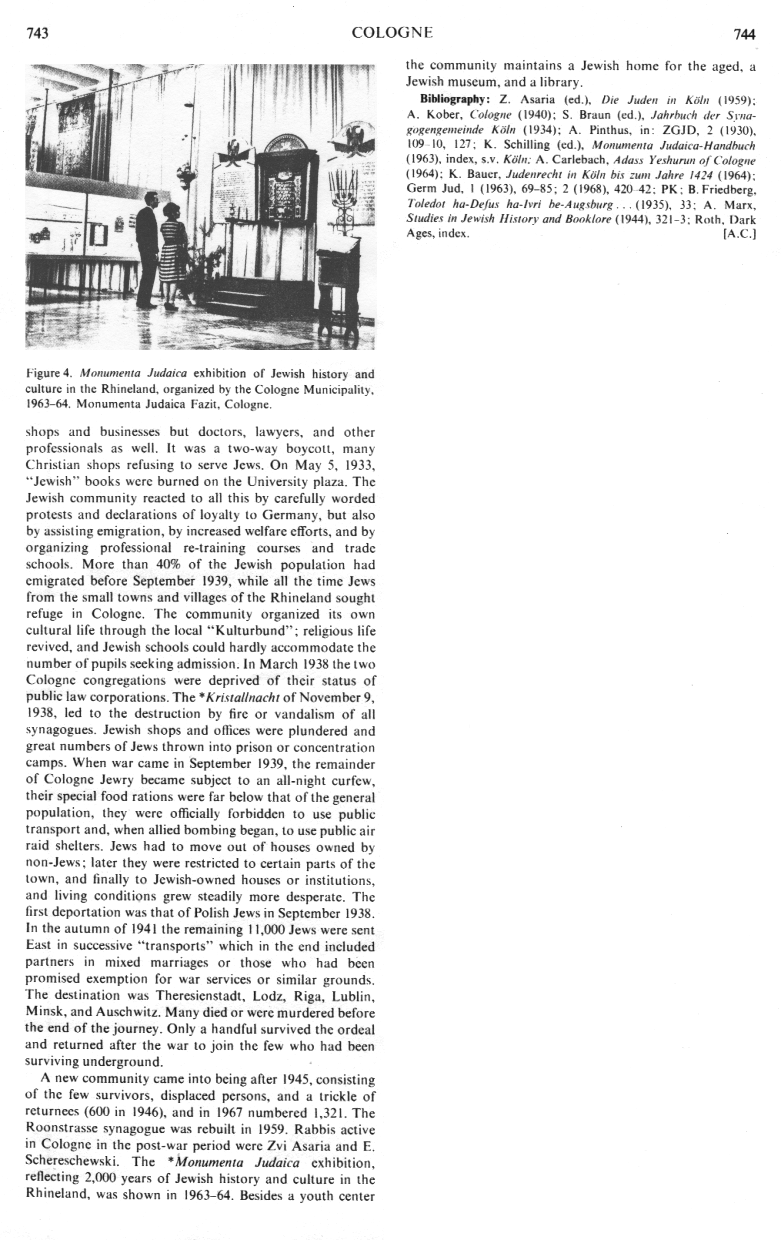
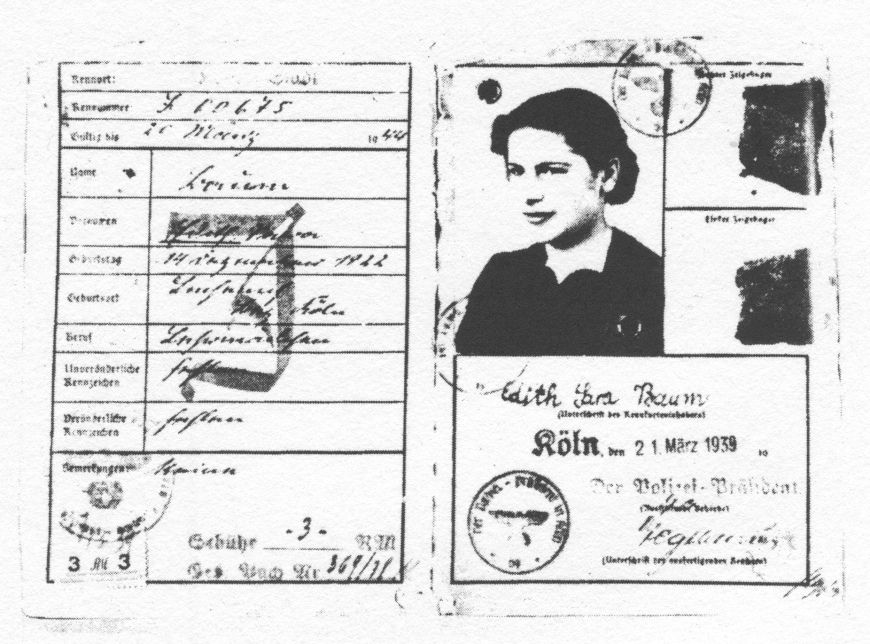
Encyclopaedia Judaica (1971): Cologne, vol. 5, col. 742. A Jewish identity card issued
in Cologne in 1939, stamped with the letter "J". Jerusalem, Yad Vashem Archives
In the autumn of 1941 the remaining 11,000 Jews [[1933 there were about 20,000]] were sent East in successive "transports" which in the end included partners in mixed marriages or those who had been promised exemption for war services or similar grounds. The destination was Theresienstadt, Lodz, Riga, Lublin, Minsk, and Auschwitz. [[Since 1943 many of the surviving Jews were brought back to the Reich and then had to suffer in the tunnel systems with high death rates]].
Many died or were murdered before the end of the journey. Only a handful survived the ordeal and returned after the war to join the few who had been surviving underground.
[[Hideouts, changing name, changing religion and resistance are not mentioned in the article]].
[Post-war times]
A new community came into being after 1945, consisting of the few survivors, displaced persons, and a trickle of returnees (600 in 1946), and in 1967 numbered 1,321. The Roonstrasse synagogue was rebuilt in 1959. Rabbis active in Cologne in the post-war period were Zvi Asaria and E. Schereschewski. The *Monumenta Judaica exhibition, reflecting 2,000 years of Jewish history and culture in the Rhineland, was shown in 1963-64. Besides a youth center (col. 743)
the community maintains a Jewish home for the aged, a Jewish museum, and a library.
Encyclopaedia Judaica (1971): Cologne, vol. 5, col. 743. "Monumenta Judaica" exhibition of Jewish history and culture in the Rhineland, organizedby the Cologne Municipality, 1963-64. Monumenta Judaica Fazit, Cologne

| Teilen / share: |
Facebook |
|
Twitter
|
Bibliography
-- Z. Asaria (ed.): Die Juden in Köln [[The Jews in Cologne]] (1959)
-- A. Kober:Cologne (1940)
-- S. Braun (ed.): Jahrbuch der Synagogengemeinde Köln [[Year Book of the Synagogue Community of Cologne]] (1934)
-- A. Pinthus, in: ZGJD, 2 (1930), 109-10, 127
-- K. Schilling (ed.): Monumenta Judaica-Handbuch (1963), index, s.v. Köln
-- A. Carlebach: Adass Yeshurun of Cologne (1964)
-- K. Bauer: Judenrecht in Köln bis zum Jahre 1424 [[Jewish Law in Cologne until 1424]] (1964)
-- Germ Jud, 1 (1963), 69-85; 2 (1968), 420-42
-- PK
-- B. Friedberg: Toledot ha-Defus ha-Ivri be-Augsburg ... (1935), 33
-- A. Marx: Studies in Jewish History and Booklore (1944), 321-3
-- Roth: Dark Ages, index.
[A.C.]> (col. 744)
Sources
Encyclopaedia Judaica (1971): Cologne, vol. 5, col. 738
Encyclopaedia Judaica (1971): Cologne, vol. 5, col. 739-740
Encyclopaedia Judaica (1971): Cologne, vol. 5, col. 741-742
Encyclopaedia Judaica (1971): Cologne, vol. 5, col. 743-744
Č Ḥ Š Ṭ Ẓ
ā ć č ḥ ī š ū ž ẓ
^