Encyclopaedia Judaica

Jews in Lueneburg
Jews in the Middle Ages - synagogue and ritual bath - massacre in 1350 because of Black Death rumor - selling of Jewish houses - three expulsions in 16th century - protected Jews since 1680 - Jewish population figures 1811-1945
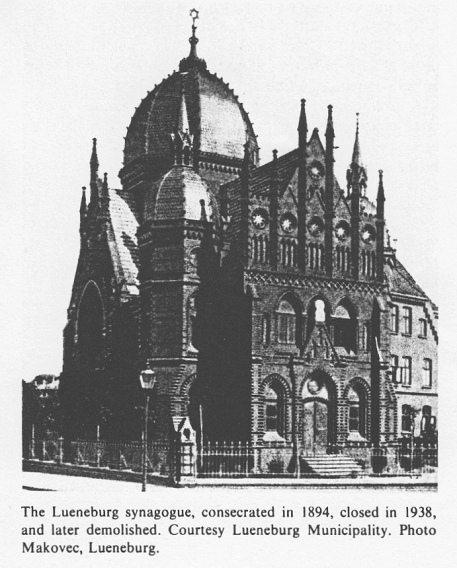
Encyclopaedia Judaica (1971): Jews in Lueneburg, vol. 11, col. 557: The Lueneburg synagogue, consecrated in 1894,
closed in 1938, and later demolished. Courtesy Lueneburg Municipality. Photo: Makovec, Lueneburg
from: Lueneburg; In: Encyclopaedia Judaica (1971), vol. 11
presented by Michael Palomino (2008)

| Teilen
/ share: |
Facebook |
|
Twitter
|
<LUENEBURG, city in W. Germany.
The mention of a Judenstrasse [[Jewish Street]] in 1288 indicates that Jews were living there earlier. They maintained a synagogue and mikveh [[ritual bath]] in the 14th century. The Jews dealt in money lending and were under the protection of the dukes of Lueneburg. In 1350, (col. 227)
during the *Black Death, the Jews were massacred, only a few managing to escape despite the feeble attempt of the duke to protect them.
[[Generally Jews were blamed having poisoned the wells. Medicine did not know what is a virus or a bacillus during these times]].
The houses of the Jews were subsequently sold by the duke to the very burghers who had participated in the massacre. By the late 14th century, Jews were again living in Lueneburg.
Community life was repeatedly interrupted by expulsions in the 16th century (1510, 1553, and 1591). Jacob, son of Leffmann Behrends the Hanover *Court Jew, was allowed to settle there in 1680; a number of *Schutzjuden [[protected Jews]] were subsequently permitted to reside there.
The Jewish population increased slowly from 27 in 1811 to 145 in 1910. Between 1927 and 1930 the large synagogue, consecrated in 1894, was repeatedly desecrated and bombed by local anti-Semites and Nazis.
By Oct. 1, 1936, only 36 Jews remained and on Oct. 30, 1938, final services were conducted in the synagogue which was then closed down.
During World War II, 11 Jews were deported and lost their lives.
Bibliography
-- Germ Jud, 2 (1968), 498-501.
[ED.]>
Let's analysis:
The Jewish population increased slowly from 27 in 1811 to 145 in 1910
[[This is because of the emancipation after 1848 and because of the good economic situation]].
Between 1927 and 1930 the large synagogue, consecrated in 1894, was repeatedly desecrated and bombed by local anti-Semites and Nazis.
[[This seems to be a local phenomenon that the synagogue was attacked before Hitler's regime. Considering the photo of the synagogue it can be that the Jewish synagogue was higher than the church and because of this was attacked by "Christians". For the NS times is nothing mentioned about any attack, so it can be that the experience with the attacks of 1927 to 1930 lead to a more peaceful conduct of the "Christians"]].
By Oct. 1, 1936, only 36 Jews remained
[[So there was an emigration movement, and it can be admitted that some of them also were in concentration camps, went to bigger towns or were shifted to bigger towns. From the emigrated normally not all succeeded with it's emigration to overseas and a certain percentage was captured in Western Europe, above all in France]].
and on Oct. 30, 1938, final services were conducted in the synagogue which was then closed down.
[[This final services is when the number of Jewish men is under 10]].
During World War II, 11 Jews were deported and lost their lives.
[[Probably these were the elder ones, and the younger ones had emigrated or were in bigger towns and also were deported, but did not perish. It seems strange that there is not one single indication about Jewish life after 1945 because Lueneburg was an important stop over for refugees from East Germany and as it seemed was not bombed [web01]. This seems to be mysterious that there is no indication about the times after 1945]].
| Teilen
/ share: |
Facebook |
|
Twitter |
| Source |
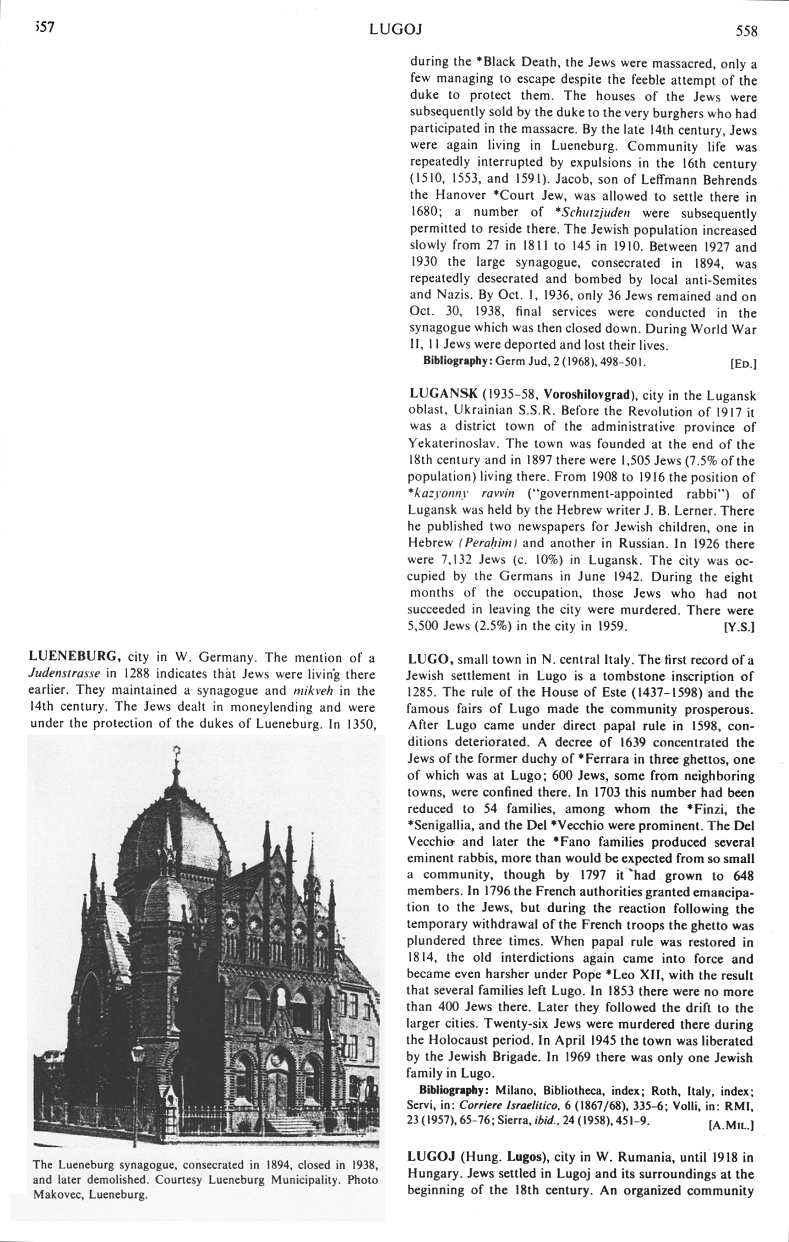 Encyclopaedia Judaica (1971): Jews in Lueneburg, vol. 11, col. 557-558 |
Sources
[web01] http://de.wikipedia.org/wiki/Lüneburg
^