Encyclopaedia Judaica

Jews in Nuremberg
Cultural life - WW I and after - Streicher with Nazi terror, synagogues burnt, and emigration wave - post-war times
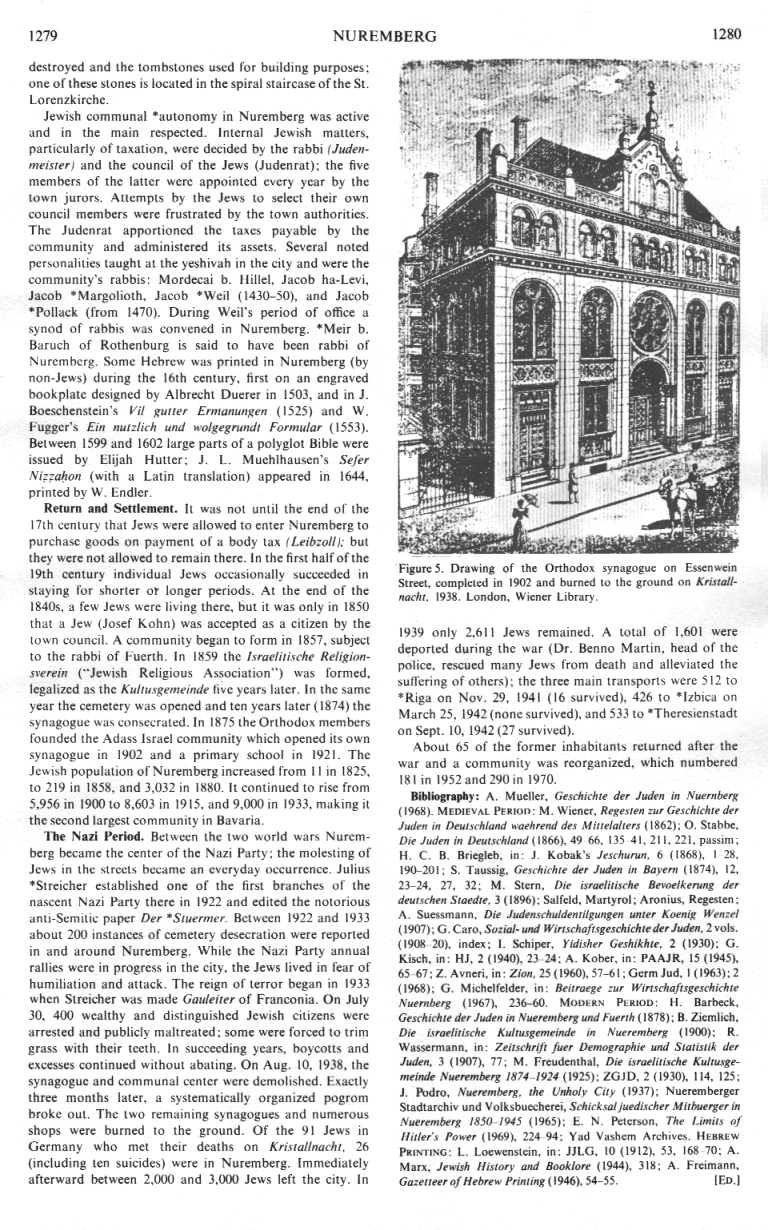
Encyclopaedia Judaica (1971): Nuremberg, vol. 12, col. 1280. Drawing of the Orthodox synagogue on Essenwein Street,
completed in 1902 and burned to the ground on Kristallnacht [[Chrystal Night]], 1938 London, Wiener Library
from: Nuremberg; In: Encyclopaedia Judaica (1971), vol. 12
presented by Michael Palomino (2008)

![Encyclopaedia Judaica (1971): Nuremberg, vol. 12,
col. 1280. Drawing of the Orthodox synagogue on
Essenwein Street, completed in 1902 and burned to the
ground on Kristallnacht [[Chrystal Night]], 1938 London,
Wiener Library](EncJud_juden-in-Nuernberg-d/EncJud_Nuremberg-band12-kolonne1280-orth-syn-Essenweinstrasse1902-1938.jpg "Encyclopaedia Judaica (1971):
Nuremberg, vol. 12, col. 1280. Drawing of the Orthodox
synagogue on Essenwein Street, completed in 1902 and
burned to the ground on Kristallnacht [[Chrystal
Night]], 1938 London, Wiener Library")
| Teilen / share: |
Facebook |
|
Twitter
|
<[[...]]
[Tombstones - Jewish cultural life with a Judenrat and rabbis]
[[cemetery]] destroyed and the tombstones used for building purposes; one of these stones is located in the spiral staircase of the St. Lorenzkirche [[Lorenz church]].
Jewish communal *autonomy in Nuremberg was active and in the main respected. Internal Jewish matters, particularly of taxation, were decided by the rabbi (Judenmeister) [[Jew Master]] and the council of the Jews (Judenrat); the five members of the latter were appointed every year by the town jurors. Attempts by the Jews to select their own council members were frustrated by the town authorities. The Judenrat apportioned the taxes payable by the community and administered its assets. Several noted personalities taught at the yeshivah [[religious Torah school]] in the city and were the community's rabbis: Mordecai b. Hillel, Jacob ha-Levi, Jacob *Margolioth, Jacob *Weil (1430-50), and Jacob *Pollack (from 1470).
During Weil's period of office a synod of rabbis was convened in Nuremberg. *Meir b. Baruch of Rothenburg is said to have been rabbi of Nuremberg. Some Hebrew was printed in Nuremberg (by non-Jews) during the 16th century, first on an engraved bookplate designed by Albrecht Duerer in 1503, and in J. Boeschenstein's Vil gutter Ermanungen [[Rule Booklet]] (1525)and W. Fugger's Ein nutzlich und wolgegrundt Formular [[Booklet for a useful and good Life]] (1553). Between 1599 and 1602 large parts of a polyglot Bible were issued by Elijah Hutter; J.L. Muehlhausen's Sefer Nizzahon (Niẓẓaḥon) (with a Latin translation) appeared in 1644, printed by W. Endler.
Return and Settlement.
It was not until the end of the 17th century that Jews were allowed to enter Nuremberg to purchase goods on payment of a body tax (Leibzoll); but they were not allowed to remain there. In the first half of the 19th century individual Jews occasionally succeeded in staying for shorter or longer periods. At the end of the 1840s, a few Jews were living there, but it was only in 1850 that a Jew (Josef Kohn) was accepted as a citizen by the town council.
[[The emancipation and emancipation laws are not mentioned]].
A community began to form in 1857, subject to the rabbi of Fuerth. In 1859 the Israelitische Religionsverein ("Jewish Religious Association") was formed, legalized as the Kultusgemeinde [[Cultural Association]] five years later. In the same year the cemetery was opened and ten years later (1874) the synagogue was consecrated. In 1875 the Orthodox members founded the Adass Israel community which opened its own synagogue in 1902 and a primary school in 1921.
[Numbers 1825-1933]
The Jewish population of Nuremberg increased from 11 in 1825, to 219 in 1858, and 3,032 in 1880. It continued to rise from 5,956 in 1900 to 8,603 in 1915, and 9,000 in 1933, making it the second largest community in Bavaria.
[[WW I and after
Happenings of World War I are not mentioned in this article, but they are very important: After WW I there was a big propaganda instigated by France to split Germany into Prussia and Bavaria and more little states which provoked strong nationalism in Bavaria and Prussia. Add to this Austria was forbidden to be member of Germany which provoked even more fury in Bavaria. Add to this in 1919 there was a Jewish Communist government in Bavaria, in which Kurt *Eisner, Eugene *Levine, and Gustav *Landauer were prominent. For the national German propaganda it was now easy to claim that every Jew would be a "Communist", but many Jews had also to suffer under Communism, and this was never said. The Communists had whole districts and whole towns in their hands, and the nationalists began to fight against the Communist spider which was also financed by the criminal "USA" by it's lodge connections.
Until the stock exchange crash of 1929 the Nazi party was not more than a splinter of under 5% in Germany, in Bavaria maybe 10%. Anti-Semitic outbursts always were on the base that there had been a Jewish Communist government in 1919. Since the stock exchange crash of 1929 and the high unemployment the NSDAP got more and more popular because the Germans without work said that racism was not so important, but work was important. NSDAP gangs were murdering around and the German police was not capable to stop this violence, and was not capable to put Hitler into prison as a criminal foreigner, because Hitler got much money also from abroad. One has to consider that the NSDAP never got a majority in Germany but was given the power in 1933 because the Catholic Center party was in coalition with the racist NSDAP - because a coalition with the Communists was not at all possible. With all this bad mental energy the Nazis came to power and Nuremberg was their center of their rallies]]:
[[...]] Between the two world wars Nuremberg became the center of the Nazi Party; the molesting of Jews in the streets became an everyday occurrence. Julius *Streicher established one of the first branches of the nascent Nazi Party there in 1922 and edited the notorious anti-Semitic paper Der *Stuermer. Between 1922 and 1933 about 200 instances of cemetery desecration were reported in and around Nuremberg. While the Nazi Party annual rallies were in progress in the city, the Jews lived in fear of humiliation and attack.
The Nazi Period. [Terror under Streicher - synagogues burnt down - emigration wave - deportations]
[[...]] The reign of terror began in 1933 when Streicher was made Gauleiter [[Prince of a District]] of Franconia. On July 30, 400 wealthy and distinguished Jewish citizens were arrested and publicly maltreated; some were forced to trim grass with their teeth. In succeeding years, boycotts and excesses continued without abating.
[[The emigration movement is not mentioned]].
On Aug. 10, 1938, the synagogue and communal center were demolished. Exactly three months later, a systematically organized pogrom broke out. The two remaining synagogues and numerous shops were burned to the ground. Of the 91 Jews in Germany who met their deaths on Kristallnacht, 26 (including ten suicides) were in Nuremberg. Immediately afterward between 2,000 and 3,000 Jews left the city. [[emigration?]]
In (col. 1279)
1939 only 2,611 Jews remained [[from 9,000 in 1933. So there had been a big emigration wave]]. A total of 1,601 were deported during the war (Dr. Benno Martin, head of the police, rescued many Jews from death and alleviated the suffering of others); the three main transports were 512 to *Riga on Nov. 29, 1941 (16 survived), 426 to *Izbica on March 25, 1942 (none survived), and 533 to *Theresienstadt on Sept. 10, 1942 (27 survived).
[[Jews who had been brought to eastern Europe were brought back to the Reich for the tunnel systems with high death rates]].
[Post-war period: Nuremberg 1945-1970]
About 65 of the former inhabitants returned after the war and a community was reorganized, which numbered 181 in 1952 and 290 in 1970.
[[Survivors by hiding, by changing name or religion by forging documents are not mentioned. Also D.P.s are not mentioned in the article]].
| Teilen / share: |
Facebook |
|
Twitter
|
Bibliography
-- A. Mueller: Geschichte der Juden in Nuernberg [[History of the Jews in Nuremberg]] (1968)
MEDIEVAL PERIOD
-- M. Wiener: Regesten zur Geschichte der Juden in Deutschland waehrend des Mittelalters [[Records about Jewish History in Germany during the Middle Ages]] (1862)
-- O. Stabbe: Die Juden in Deutschland [[The Jews in Germany]] (1866), 49-66, 135-41, 211, 221, passim
-- H.C.B. Briegleb, in: J. Kobak's Jeschurun, 6 (1868), 1-28, 190-201
-- S. Taussig: Geschichte der Juden in Bayern [[The History of the Jews in Bavaria]] (1874), 12, 23-24, 27, 32
-- M. Stern: Die israelitische Bevoelkerung der deutschen Staedte [[the Israelite Population of the German Towns]], 3 (1869)
-- Salfeld: Martyrol
-- Aronius: Regesten [[Records]]
-- A. Suessmann: Die Judenschuldentilgungen unter Koenig Wenzel [[The Depts Arrangement of the Jews under King Wenzel]] (1907)
-- G. Caro: Sozial- und Wirtschaftsgeschichte der Juden [[Social and Economic History of the Jews]], 2 vols. (1908-20), index
-- I. Schiper: Yidisher Geshikhte [[Yiddish History]], 2 (1930)
-- G. Kisch, in: JH, 2 (1940), 23-24
-- A. Kober, in: PAAJR, 15 (1945), 65-67
-- Z. Avneri, in: Zion, 25 (1960), 57-61
-- Germ Jud, 1 (1963); 2 (1968)
-- G. Michelfelder, in: Beitraege zur Wirtschaftsgeschichte Nuernberg [[Records about Economic History of Nuremberg]] (1967), 236-60
MODERN PERIOD
-- H. Barbeck: Geschichte der Juden in Nueremberg und Fuerth [[History of the Jews in Nuremberg and Fuerth]] (1878)
-- B. Ziemlich: Die israelitische Kultusgemeinde in Nueremberg [[The Israeli Cultural Community in Nuremberg]] (1900)
-- R. Wassermann, in: Zeitschrift fuer Demographie und Statistik der Juden [[Review for Demography and Statistics of the Jews]], 3 (1907), 77
-- M. Freudenthal: Die israelitische Kultusgemeinde Nueremberg 1874-1924 [[the Israelite Cultural Community of Nuremberg 1874-1924]] (1925)
-- ZGJD, 2 (1930), 114, 125
-- J. Podro: Nueremberg, the Unholy City (1937)
-- Nueremberger Stadtarchiv und Volksbuecherei: Schicksal juedischer Mitbuerger in Nueremberg 1850-1945 [[Nuremberg Town's Archives and Popular Library: Faith of Jewish Co-Civilians in Nuremberg 1850-1945]] (1965)
-- E.N. Peterson: The Limits of Hitler's Power (1969), 224-94
-- Yad Vashem Archives
HEBREW PRINTING
-- L. Loewenstein, in: JJLG, 10 (1912), 53, 168-70
-- A. Marx: Jewish History and Booklore (1944), 318
-- A. Freimann: Gazetteer of Hebrew Printing (1946), 54-55.> (col. 1280)
Sources
Encyclopaedia Judaica (1971): Nuremberg, vol. 12, col. 1279-1280
^