Encyclopaedia Judaica

Jews in Offenbach
Judenstrasse ("street of Jews") - numbers - NS times with expelled Polish Jews, burnt synagogue emigrations and deportations - Hebrew printing
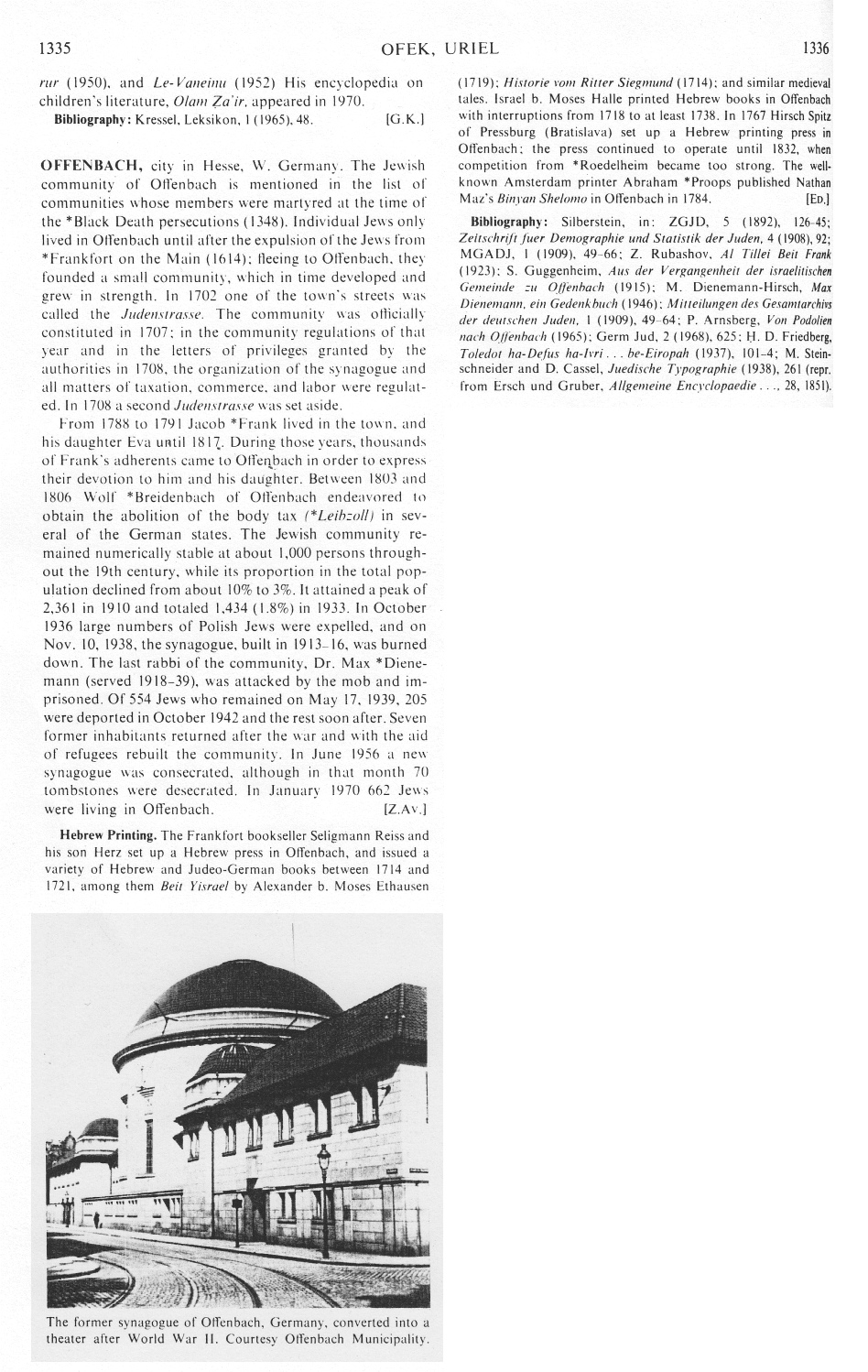
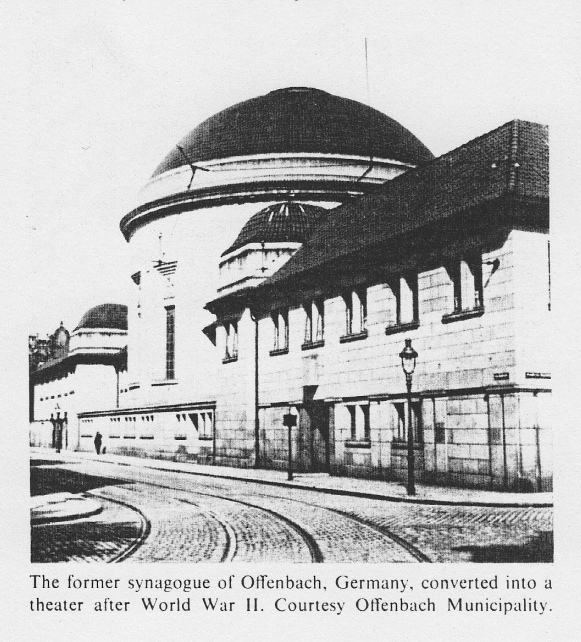
Encyclopaedia Judaica: Offenbach: The synagogue was burnt in 1938 and was converted into a theater after World War II.
from: Offenbach; In: Encyclopaedia Judaica (1971)
presented by Michael Palomino (2010)

| Teilen
/ share: |
Facebook |
|
Twitter
|
<OFFENBACH, city in Hesse, W. Germany.
The Jewish community of Offenbach is mentioned in the list of communities whose members were martyred at the time of the *Black Death persecutions (1348). Individual Jews only lived in Offenbach until after the expulsion of the Jews from *Frankfort on the Main (1614); fleeing to Offenbach, they founded a small community, which in time developed and grew in strength.
In 1702 one of the town's streets was called the Judenstrasse. The community was officially constituted in 1707; in the community regulations of that year and in the letters of privileges granted by the authorities in 1708, the organization of the synagogue and all matters of taxation, commerce, and labor were regulated. In 1708 a second Judenstrasse was set aside.
From 1788 to 1791 Jacob *Frank lived in the town, and his daughter Eva until 1817. During those years, thousands of Frank's adherents came to Offenbach in order to express their devotion to him and his daughter. Between 1803 and 1806 Wolf *Breidenbach of Offenbach endeavored to obtain the abolition of the body tax (*Leibzoll) in several of the German states.
[Numbers]
The Jewish community remained numerically stable at about 1,000 persons throughout the 19th century, while its proportion in the total population declined from about 10% to 3%. It attained a peak of of 2,361 in 1910 and totaled 1,434 (1.8%) in 1933.
[Polish Jews expelled in 1936 - synagogue burnt in 1938 - 554 Jews on 17 May 1939 - deportations until 1942]
In October 1936 large numbers of Polish Jews were expelled, and on Nov. 10, 1938, the synagogue, built in 1913-16, was burned down. The last rabbi of the community, Dr. Max *Dienemann (served 1918-39), was attacked by the mob and imprisoned. Of 554 Jews who remained on May 17, 1939, 205 were deported in October 1942 and the rest soon after.
[[So it can be admitted that 880 Jews succeeded with emigration from Offenbach before May 17, 1939. But a little part of it did not leave Europe but only left Germany and perhaps was caught again after 1940]].
Seven former inhabitants returned after the war and with the aid of refugees rebuilt the community. In June 1956 a new synagogue was consecrated, although in that month 70 tombstones were desecrated. In January 1970 662 Jews were living in Offenbach. [Z.Av.]
The former synagogue of Offenbach, Germany, converted into a theater after World War II.
Hebrew Printing
The Frankfort bookseller Seligmann Reiss and his son Herz set up a Hebrew press in Offenbach, and issued a variety of Hebrew and Judeo-German books between 1714 and 1721, among them Beit Yisrael by Alexander b. Moses Ethausen [col. 1335]
(1719); Historie vom Ritter Siegmund (1714); and similar medieval tales. Israel b. Moses Halle printed Hebrew books in Offenbach with interruptions from 1718 to at least 1738. In 1767 Hirsch Spitz of Pressburg (Bratislava) set up a Hebrew printing press in Offenbach; the press continued to operate until 1832, when competition from *Roedelheim became too strong. The well-known Amsterdam printer Abraham *Proops published Nathan Maz's Binyan Shelomo in Offenbach in 1784. [ED.]
Bibliography
-- Silberstein, in: ZGJD, 5 (1892), 126-45
-- Review for demography and statistics of the Jews (orig.: "Zeitschrift fuer Demographie und Statistik der Juden"), 4 (1908), 92
-- MGADJ, I (1909), 49-66
-- Z. Rubashov: Al Tillei Beit Frank (1923)
- S. Guggenheim: From the past of Israeli community of Offenbach ("Aus der Vergangenheit der israelitischen Gemeinde zu Offenbach") (1915)
-- M. Dienemann-Hirsch: Max Dienemann, a memorial book (orig.: "Max Dienemann, ein Gedenkbuch") (1946)
-- News of complete archive of German Jews (orig.: "Mitteilungen des Gesamtarchivs der deutschen Juden"), I (1909), 49-64
-- P. Arnsberg: From Podolia to Offenbach (orig.: "Von Podolien nach Offenbach") (1965)
-- Germ Jud, 2 (1968), 625
-- H.D. Friedberg: Toledot ha-Defus ha-Ivri ... be-Eiropah (1937), 101-4
-- M. Steinschneider and D. Cassel: Jewish typography (orig.: "Juedische Typographie") (1939), 261 (repr. from Ersch and Gruber: General Encyclopedia (orig.: "Allgemeine Encyclopaedie") ..., 28, 1851).>
| Teilen
/ share: |
Facebook |
|
Twitter |