Encyclopaedia Judaica

Jews in Worms
Crusades - money lending - Jewish taxes - Black Death massacres of 1349 and resettlement - expulsion of 1615 and resettlement - emancipation - Holocaust and emigration wave - post-war times
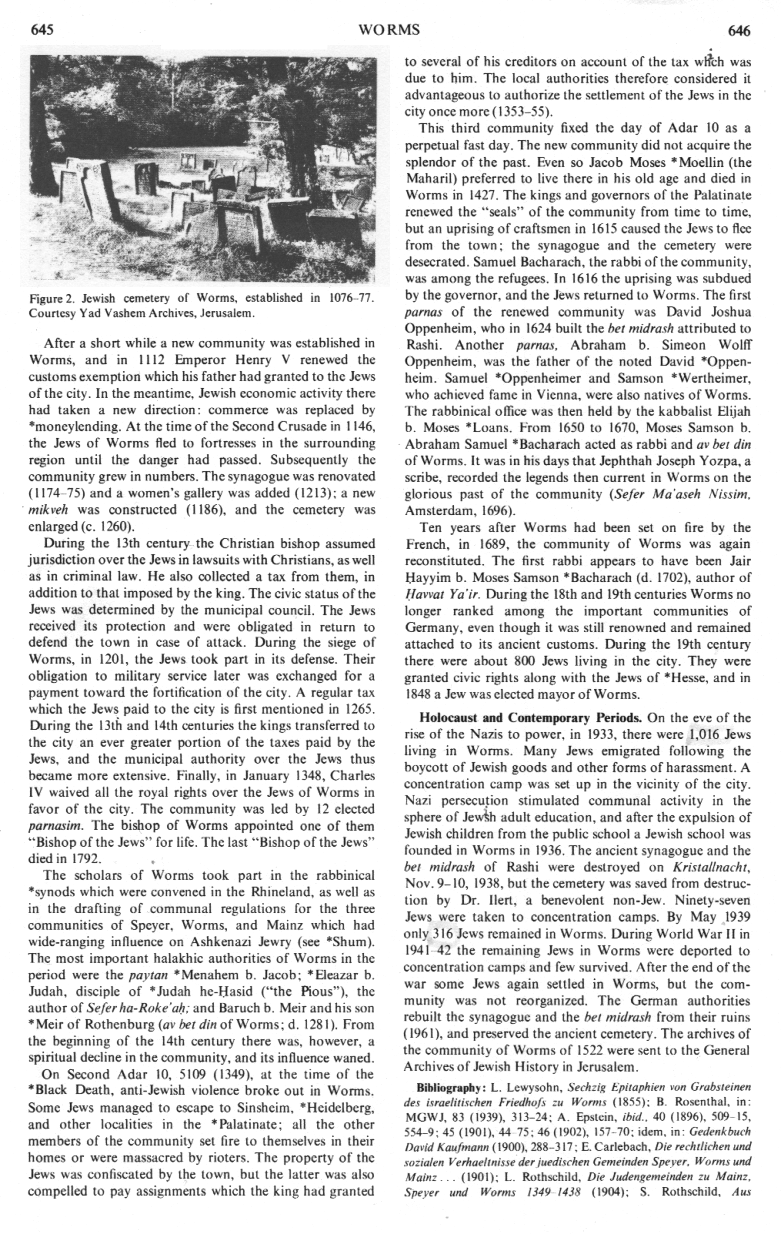
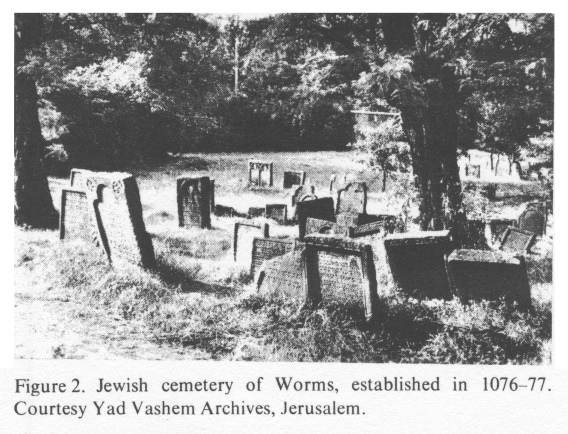
Encyclopaedia Judaica (1971): Worms, vol. 16, col.645. Jewish cemetery of Worms,
established in 1076-77. Courtesy Yad Vashem Archives, Jerusalem
from: Worms; In: Encyclopaedia Judaica (1971), vol. 16
presented by Michael Palomino (2008)

| Teilen
/ share: |
Facebook |
|
Twitter
|
[First Crusade 1096 - money lending - Second Crusade in 1146 with refuge in fortresses - growing Jewish community - Jewish taxes - siege of Worms in 1201 with Jews in the defense]
<[[...]]
After a short while [[after the First Crusade of 1096]] a new community was established in Worms, and in 1112 Emperor Henry V renewed the customs exemption which his father had granted to the Jews of the city. In the meantime, Jewish economic activity there had taken a new direction: commerce was replaced by *money lending.
At the time of the Second Crusade in 1146, the Jews of Worms fled to fortresses in the surrounding region until the danger had passed. Subsequently the community grew in numbers. The synagogue was renovated (1174-75) and a women's gallery was added (1213); a new mikveh [[ritual bath]] was constructed (1186), and the cemetery was enlarged (c. 1260).
During the 13th century the Christian bishop assumed jurisdiction over the Jews in lawsuits with Christians, as well as in criminal law. He also collected a tax from them, in addition to that imposed by the king. The civic status of the Jews was determined by the municipal council. The Jews received its protection and were obligated in return to defend the town in case of attack.
During the siege of Worms, in 1201, the Jews took part in its defense. Their obligation to military service later was exchanged for a payment toward the fortification of the city.
A regular tax which the Jews paid to the city is first mentioned in 1265. During the 13th and 14th centuries the kings transferred to the city an ever greater portion of the taxes paid by the Jews, and the municipal authority over the Jews thus became more extensive. Finally, in January 1348, Charles IV waived all the royal rights over the Jews of Worms in favor of the city. The community was led by 12 elected parnasim [[presidents, communal leaders]]. The bishop of Worms appointed one of them "Bishop of the Jews" for life. The last "Bishop of the Jews" died in 1792.
[Cultural life in Worms during the central Middle Ages]
The scholars of Worms took part in the rabbinical *synods which were convened in the Rhineland, as well as in the drafting of communal regulations for the three communities of Speyer, Worms, and Mainz which had wide-ranging influence on Ashkenazi Jewry (see *Shum). The most important halakhic authorities [[Jewish judges and court]] of Worms in the period were the paytan [[cantor]] *Menahem b. Jacob; *Eleazar b. Judah, disciple of *Judah he-Hasid (Ḥasid) ("the Pious"), the author of Sefer ha-Roke'ah (Sefer ha-Roke'aḥ); and Baruch b. Meir and his son *Meir of Rothenburg (av bet din [[eldest court chairman]] of Worms; d. 1281).
[[Worms was one of the first spiritual Jewish centers together with the towns Mainz and Speyer, see: *Germany]].
From the beginning of the 14th century there was, however, a spiritual decline in the community, and its influence waned.
[Black Death persecutions, massacres and confiscations in 1349 - and resettlement]
On Second Adar 10, 5109 (1349), at the time of the *Black Death, anti-Jewish violence broke out in Worms. Some Jews managed to escape to Sinsheim, *Heidelberg, and other localities in the *Palatinate [[Pfalz]]; all the other members of the community set fire to themselves in their homes or were massacred by rioters. The property of the Jews was confiscated by the town, but the latter was also compelled to pay assignments which the king had granted (col. 645)
to several of his creditors on account of the tax which was due to him. The local authorities therefore considered it advantageous to authorize the settlement of the Jews in the city once more (1353-55).
This third community fixed the day of Adar 10 as a perpetual fast day. The new community did not acquire the splendor of the past. Even so Jacob Moses *Moellin (the Maharil) preferred to live there in his old age and died in Worms in 1427.
[Expulsion of 1615 - and return in 1616 - reconstruction of the community - cultural life]
The kings and governors of the Palatinate [[Pfalz]] renewed the "seals" of the community from time to time, but an uprising of craftsmen in 1615 caused the Jews to flee from the town; the synagogue and the cemetery were desecrated. Samel Bacharach, the rabbi of the community, was among the refugees.
In 1616 the uprising was subdued by the governor, and the Jews returned to Worms. The first parnas [[communal leader]] of the renewed community was David Joshua Oppenheim, who in 1624 built the bet midrash [[house of learning]] attributed to Rashi. Another parnas, Abraham b. Simeon Wolff Oppenheim, was the father of the noted David *Oppenheim. Samuel *Oppenheimer and Samson *Wertheimer, who achieved fame in Vienna, were also natives of Worms. The rabbinical office was then held by the kabbalist Elijah b. Moses *Loans.
From 1650 to 1670, Moses Samson b. Abraham Samuel *Bacharach acted as rabbi and av bet din [[eldest court chairman]] of Worms. It was in his days that Jephthah Joseph Yozpa, a scribe, recorded the legends then current in Worms on the glorious past of the community (Sefer Ma'aseh Nissim, Amsterdam, 1696).
[Fire in Worms of 1689]
Ten years after Worms had been set on fire by the French, in 1689, the community of Worms was again reconstituted. The first rabbi appears to have been Jair Hayyim (Ḥayyim) b. Moses Samson *Bacharach (d. 1702), author of Havvat Ya'ir (Ḥavvat Ya'ir).
[Industrialization times 18th and 19th century - emancipation]
During the 18th and 19th centuries Worms no longer ranked among the important communities of Germany, even though it was still renowned and remained attached to its ancient customs. During the 19th century there were about 800 Jews living in the city. They were granted civic rights along with the Jews of *Hesse [[Hessen]], and in 1848 a Jew was elected mayor of Worms.
[[WW I and after
Happenings of World War I are not mentioned in this article, but they are very important: The French dream to split Germany could not be reached, but at least the Treaty of Versailles deprived Germany from all colonies. Add to this came the fight between Communists and Nationalists. Until the stock exchange crash of 1929 the Nazi party was not more than a splinter of under 5% in Germany. Since the stock exchange crash of 1929 and the high unemployment the NSDAP got more and more popular because the Germans without work said that racism was not so important, but work was important. NSDAP gangs were murdering around and the German police was not capable to stop this violence, and was not capable to put Hitler into prison as a criminal foreigner, because Hitler got much money also from abroad. One has to consider that the NSDAP never got a majority in Germany but was given the power in 1933 because the Catholic Center party was in coalition with the racist NSDAP - because a coalition with the Communists was not at all possible. With all this bad mental energy the Nazis came to power]].
Holocaust and Contemporary Periods.
[Emigration wave - boycotts - concentration camp - Jewish education - deportations]
On the eve of the rise of the Nazis to power, in 1933, there were 1,016 Jews living in Worms. Many Jews emigrated following the boycott of Jewish goods and other forms of harassment.
[[There was a boycott day, but many Germans were going shopping to the Jewish shops the day after the boycott day and bought more than normally. To the contrary the worldwide Jewish organizations organized a big counter boycott against Germany all the time from 1933-1945. See: *Boycott, anti-Jewish, *Boycott, anti-Nazi]]
[[The anti-Jewish Nazi laws 1933-1939 are prescribed in *Germany, and the discriminations since 1939 in *Cologne]].
A concentration camp was set up in the vicinity of the city. Nazi persecution stimulated communal activity in the sphere of Jewish adult education, and after the expulsion of Jewish children from the public school a Jewish school was founded in Worms in 1936. [[For further information about Jewish learning and emigration 1933-1939, see: *Germany]].
The ancient synagogue and the bet midrash [[House of Learning]] of Rashi were destroyed on Kristallnacht [[Chrystal Night]], Nov. 9-10, 1938, but the cemetery was saved from destruction by Dr. Ilert, a benevolent non-Jews. Ninety-seven Jews were taken to concentration camps.
By May 1939 only 316 Jews remained in Worms.
[[As it seems with 316 Jews staying in 1939 the emigration wave comprised over 50% of the 1,016 Jews of 1933]].
During World War II in 1941-42 the remaining Jews in Worms were deported to concentration camps and few survived.
[[There is no indication in the article about hideouts, changing name or changing religion by forged documents, about resistance in Worms etc.]]
[Post-war times]
After the end of the war some Jews again settled in Worms, but the community was not reorganized. The German authorities rebuilt the synagogue and the bet midrash [[House of Learning]] from their ruins (1961), and preserved the ancient cemetery. The archives of the community of Worms of 1522 were sent to the General Archives of Jewish History in Jerusalem.> (col. 646)
| Teilen
/ share: |
Facebook |
|
Twitter |