Encyclopaedia Judaica

Jews in Wuerzburg
Second Crusade attacks - Jewish community - Rindfleisch pogrom - taxes and financial aid for the fortified city - Black Death pogroms - Heidingsfeld - 19th century - Holocaust - post-war times
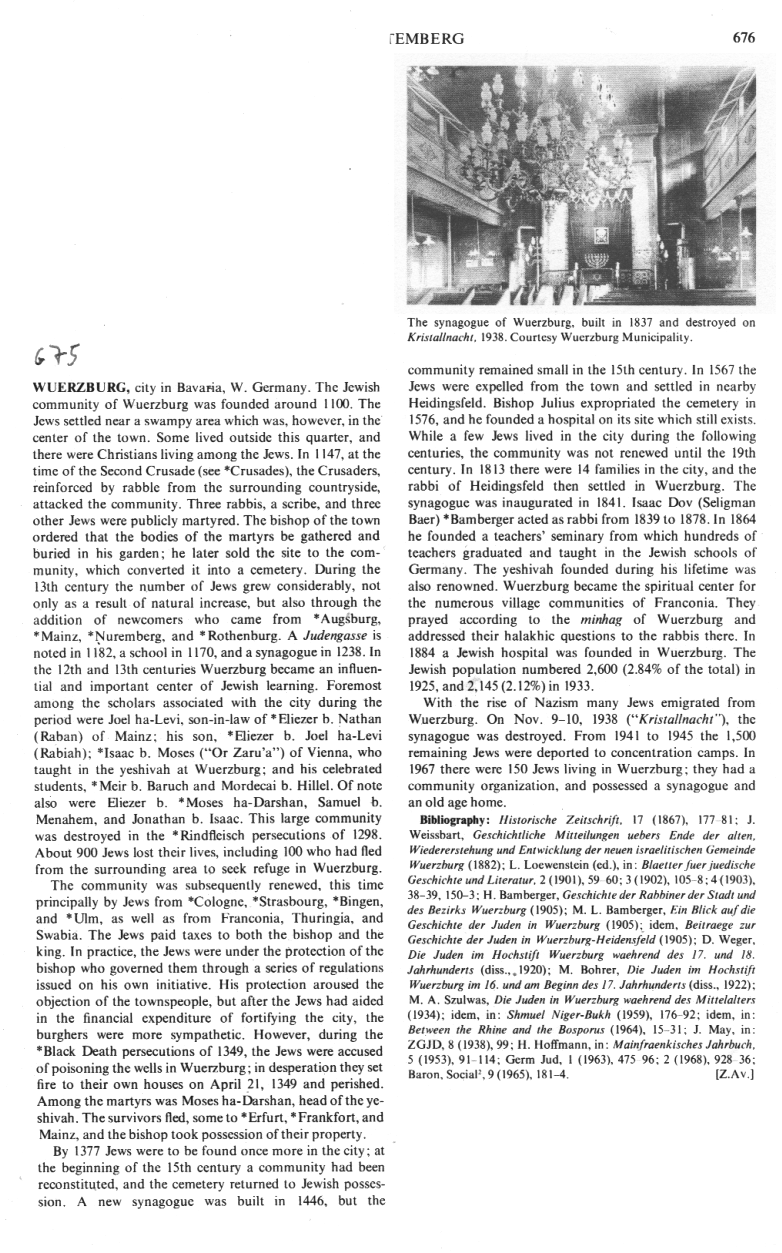
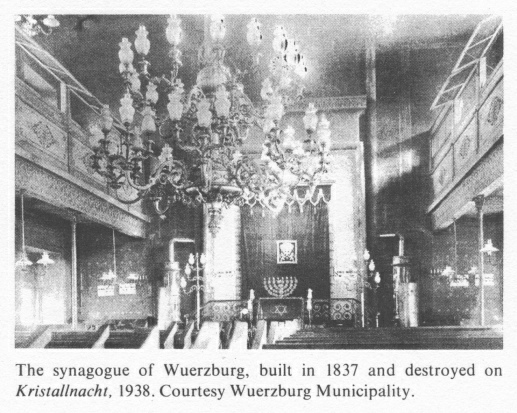
Encyclopaedia Judaica (1971): Wuerzburg, vol. 16, col. 676. The synagogue of Wuerzburg,
built in 1837 and destroyed on Kristallnacht, 1938. Courtesy Wuerzburg Municipality.
from: Wuerzburg; In: Encyclopaedia Judaica (1971), vol. 16
presented by Michael Palomino (2008)

| Teilen
/ share: |
Facebook |
|
Twitter
|
<WUERZBURG, city in Bavaria, W. Germany.
[Jewish settlement - Second Crusade attacks - Jewish community - Rindfleisch pogrom]
The Jewish community of Wuerzburg was founded around 1100. The Jews settled near a swampy area which was, however, in the center of the town. Some lived outside this quarter, and there were Christians living among the Jews.
In 1147, at the time of the Second Crusade (see *Crusades), the Crusaders reinforced by rabble from the surrounding countryside, attacked the community. Three rabbis, a scribe, and three other Jews were publicly martyred. The bishop of the town ordered that the bodies of the martyrs be gathered and buried in his garden; he later sold the site of the community, which converted it into a cemetery. [[...]]
A Judengasse is noted in 1182, a school in 1170, and a synagogue in 1238. [[...]]
During the 13th century the number of Jews grew considerably, not only as a result of natural increase, but also through the addition of newcomers who came from *Augsburg, *Mainz, *Nuremberg, and *Rothenburg. [[...]]
In the 12th and 13th centuries Wuerzburg became an influential and important center of Jewish learning. Foremost among the scholars associated with the city during the period were Joel ha-Levi, son-in-law of *Eliezer b. Nathan (Raban) of Mainz; his son, *Eliezer b. Joel ha-Levi (Rabiah); *Isaac b. Moses ("Or Zaru'a") of Vienna, who taught in the yeshivah [[religious Torah school]] at Wuerzburg; and his celebrated students, *Meir b. Baruch and Mordecai b. Hillel. Of note also were Eliezer b. *Moses ha-Darshan, Samuel b. Menahem, and Jonathan b. Isaac.
This large community was destroyed in the *Rindfleisch persecutions of 1298. About 900 Jews lost their lives, including 100 who had fled from the surrounding area to seek refuge in Wuerzburg.
[Taxes and financial aid for the fortified city - Black Death pogroms - murders, flight and deprivation]
The community was subsequently renewed, this time principally by Jews from *Cologne, *Strasbourg, *Bingen, and *Ulm, as well as from Franconia, Thuringia, and Swabia. The Jews paid taxes to both the bishop and the king. IN practice, the Jews were under the protection of the bishop who governed them through a series of regulations issued on his own initiative. His protection aroused the objection of the townspeople, but after the Jews had aided in the financial expenditure of fortifying the city, the burghers were more sympathetic.
However, during the *Black Death persecutions of 1349, the Jews were accused of poisoning the wells in Wuerzburg; in desperation they set fire to their own houses on April 21, 1349 and perished. Among the martyrs was Moses ha-Darshan, head of the yeshivah [[religious Torah school]]. The survivors fled, some to *Erfurt, *Frankfort,and Mainz, and the bishop took possession of their property.
[[The criminal Church never gave compensation and is not liquidated until now...]]
[Jews in Wuerzburg after 1349 - Jewish community - expulsion in 1567 to Heidingsfeld]
By 1377 Jews were to be found once more in the city; at the beginning of the 15th century a community had been reconstituted, and the cemetery returned to Jewish possession. A new synagogue was built in 1446, but the (col. 675)
community remained small in the 15th century. In 1567 the Jews were expelled from the town and settled in nearby Heidingsfeld. Bishop Julius expropriated the cemetery in 1576, and he founded a hospital on its site which still exists.
[Jewish resettlement in Wuerzburg since 19th century - Jewish community]
While a few Jews lived in the city during the following centuries, the community was not renewed until the 19th century. In 1813 there were 14 families in the city, and the rabbi of Heidingsfeld then settled in Wuerzburg. The synagogue was inaugurated in 1841. Isaac Dov (Seligman Baer) *Bamberger acted as rabbi from 1839 to 1878. In 1864 he founded a teachers' seminary from which hundreds of teachers graduated and taught in the Jewish schools of Germany. The yeshivah founded during his lifetime was also renowned.
Wuerzburg became the spiritual center for the numerous village communities of Franconia. They prayed according to the minhag [[afternoon prayer]] of Wuerzburg and addressed their halakhic questions [[question according to Jewish law]] to the rabbis there. In 1884 a Jewish hospital was founded in Wuerzburg.
[Numbers]
The Jewish population numbered 2,600 (2.84% of the total) in 1925, and 2,145 (2.12%) in 1933.
[Holocaust]
With the rise of Nazism many Jews emigrated from Wuerzburg. On Nov. 9-10, 1938 ("Kristallnacht"), the synagogue was destroyed. From 1941 to 1945 the 1,500 remaining Jews were deported to concentration camps.
[Post-war times]
In 1967 there were 150 Jews living in Wuerzburg; they had a community organization, and possessed a synagogue and an old age home.
Bibliography
-- Historische Zeitschrift [[Historical review]], 17 (1867), 177-81
-- J. Weissbart: Geschichtliche Mitteilungen uebers Ende der alten Wiedererstehung und Entwicklung der neuen israelitischen Gemeinde Wuerzburg [[Historical news about the end of the old resurrection and development of the new israelite community of Wuerzburg]] (1882)
-- L. Loewenstein (ed.), in: Blaetter fuer juedische Geschichte und Literatur [[Leaflets for Jewish History and Literature]], 2 (1901), 59-60; 3 (1902), 105-8; 4 (1903), 38-39, 150-3
-- H. Bamberger: Geschichte der Rabbiner der Stadt und des Bezirks Wuerzburg [[History of the rabbis of the Wuerzburg town and province]] (1905)
-- M.L. Bamberger: Ein Blick auf die Geschichte der Juden in Wuerzburg [[Blink on the History of the Jews in Wuerzburg]] (1905)
-- idem: Beitraege zur Geschichte der Juden in Wuerzburg-Heidensfeld [[History of the Jeww in Wuerzburg-Heidensfeld]] (1905)
-- D. Weger: Die Juden im Hochstift Wuerzburg waehrend des 17. und 18. Jahrhunderts [[The Jews in Hochstift Wuerzburg during 17th and 18th century]] (diss., 1920)
-- M. Bohrer: Die Juden im Hochstift Wuerzburg im 16. und am Beginn des 17. Jahrhunderts [[The Jews in Hochstift Wuerzburg in 16th and on the beginning of 17th century]] (diss., 1922)
-- M.A. Szulwas: Die Juden in Wuerzburg waehrend des Mittelalters [[The Jews in Wuerzburg during the Middle Ages]] (1934)
-- idem, in: Shmuel Niger-Bukh (1959), 176-92
-- idem, in: Between the Rhine and the Bosporus (1964), 15-31
-- J. May, in: ZGJD, 8 (1938), 99
-- H. Hoffmann, in: Mainfraenkisches Jahrbuch [[Year book of Franconia on the Main]], 5 (1953), 91-114
-- Germ Jud, 1 (1963), 475-96; 2 (1968), 928-36
-- Baron, Social, 9 (1965), 181-4
[Z.AV.]> (col. 676)
| Teilen
/ share: |
Facebook |
|
Twitter |
|
|
|