Encyclopaedia Judaica

Jews in little towns of Germany L-Z
Great reduction of Jews from 1933 to 1939 - the remaining Jews mostly deported
presented by Michael Palomino (2008)

| Teilen / share: |
Facebook |
|
Twitter
|
Stupid criminal judges in Switzerland and in Germany have to LEARN that many Jews managed their emigration from Germany and Austria during NS time 1933-1939. The indications are here in JEWISH lexicon Encyclopaedia Judaica. But some judges never will learn to read because after their diploma they only read what is useful for them - and not for the truth.When will the criminal judges be torn to justice?
Jews in Lindau
Questions about taxes and rights - expulsion in 1430 because of a rumor of a murdered boy - Jews excluded by law since 1547 - only short stays allowed in 18th and 19th century - 4 Jews in 1939
from: Lindau; In: Encyclopaedia Judaica (1971), vol. 11, col. 258
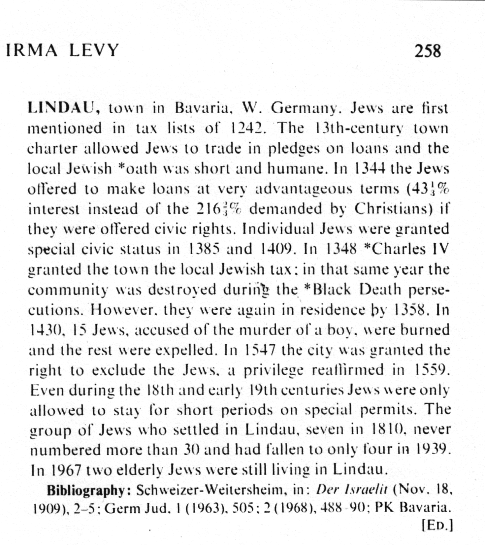
<LINDAU, town in Bavaria, W. Germany.
Jews are first mentioned in tax lists of 1242. The 13th-century town charter allowed Jews to trade in pledges on loans and the local Jewish *oath was short and humane. In 1344 the Jews offered to make loans at very advantageous terms (43 1/3% interest instead of the 216 2/3% demanded by Christians) if they were offered civic rights. Individual Jews were granted special civic status in 1385 and 1409. In 1348 *Charles IV granted the town the local Jewish tax; in that same year the community was destroyed during the *Black Death persecution. However, they were again in residence by 1358.
In 1430, 15 Jews, accused of the murder of a boy, were burned and the rest were expelled.
In 1547 the city was granted the right to exclude the Jews, a privilege reaffirmed in 1559.
Even during the 18th and early 19th centuries Jews were only allowed to stay for short periods on special permits. The group of Jews who settled in Lindau, seven in 1810, never numbered more than 30 and had fallen to only four in 1939.
[[There must have been a strong emigration movement. Some Jews also could be in concentrations camps]].
In 1967 two elderly Jews were still living in Lindau.
Bibliography:
-- Schweizer-Weitersheim, in: Der Israelit (Nov. 18, 1909), 2-5
-- Germ Jud. I (1963), 505; 2 (1968), 488-90;
-- PK Bavaria.
[ED.]> (col. 258)
Source
Encyclopaedia Judaica (1971): Jews in Lindau, vol. 11, col. 258
-----
Jews in Minden
Reduction of the Jews from 192 in 1933 to 107 in 1939
from: Minden; In: Encyclopaedia Judaica (1971), vol. 12, col. 4
<After emancipation, when Minden reverted to Prussia, the small community grew steadily, from 65 in 1787 to 81 in 1810, 193 in 1840, and 267 in 1880. Their numbers later decreased to 192 in 1933 and 107 in 1939, when there were 228 Jews in the district of Minden. During WW II, 179 Jews were deported from the town and district. The Menorbuch of the synagogue from the 17th and 18th centuries has been preserved. The synagogue built in 1867 was destroyed in 1938. After WW II a small community was reconstituted which had 44 members in 1962.> (col.4)
[[The reduction between 1933 and 1939 can be because of emigration or by shifting in bigger towns where emigration was organized. Some could also have been in a concentration camp]].
-----
Jews in Niederstetten (close to Wuerzburg)
Large-scale emigration 1933-1939 - deportations - synagogue destroyed by stupid allied bombs
from: Niederstetten; In: Encyclopaedia Judaica (1971), vol. 12, col. 1150
<The community numbered 215 in 1854, decreased to 163 in 1900, and to 81 in 1933. In the 20th century Jews were active as wholesale merchants in leather and wine, and as shopkeepers. They also engaged in textile manufacturing and banking. They were active in political and cultural life of the town, and one Jew was a member of the municipal council during Weimar Republic.
In 1933 Jewish merchants were subject to the Nazi *boycott and some leaders of the community were physically assaulted. This resulted in large-scale Jewish emigration. During the general destruction on Christallnacht [[Crystal Night]] in 1938, the synagogue itself was preserved, but eight Jewish men were sent to concentration camps.
Between 1941 and 1942, 42 Jews were deported to extermination camps, never to return [[probably died with diseases or were secretly deported to Russian Gulag in "Judentransfer" or shot in mass shootings etc.]].
In early 1945 the synagogue was destroyed as a result of the war [[probably by allied English or "American" bombs]]. the ritual objects of the community were saved, however, and turned over to a U.S. army chaplain when the war ended.
All that was left in 1970 of a once active community in Niederstetten was the Jewish cemetery.> (col. 1150)
[[Probably there were lots of survivors emigrating as Displaced Persons or privately or resettling in bigger towns in Germany. This article is one of the rare cases where Encyclopaedia Judaica mentions "emigration" with the word itself. ]].
-----
Jews in Noerdlingen
From 186 Jews in 1933 leave 145 until 1942 - deportation of 41 Jews
from: Noerdlingen; In: Encyclopaedia Judaica (1971), vol. 12, col. 1202-1203
<A community with 25 families was organized in 1870, dedicated a new synagogue in 1885, and formed a ḥevra kaddisha [[Jewish burial society]] in 1898. It numbered 489 persons in 1899, and 314 (3.8% of the total) in 1913.
By June 16, 1933, only 186 remained
[[because they had left Noerdlingen by economic crises to bigger cities or had emigrated or were preparing emigration in bigger cities getting visas for overseas]].
145 of them left before 1942
[[probably emigration to overseas or they were in bigger towns or they could find hiding places]],
when the remnants of the Jewish community were deported [[41 Jews]]. The mayor of the city prevented the destruction of the synagogue in 1938 [[and as it seems there was no bombing damage, too]],
and in 1952 it was sold to a Protestant group as a community center.> (col. 1206)
-----
Jews in Nordhausen
Big emigration wave in Nordhausen 1933-1939
from: Nordhausen; In: Encyclopaedia Judaica (1971), vol. 12, col. 1214-1215
<In 1925 the community numbered 438, in 1933 it had 394 members, five cultural and philanthropic organizations, and a religious school. In 1939, under the pressure of Nazi persecution and consequent emigration, the number of Jews declined to 128, and the community came to an end during World War II.> (col. 1215)
[[The reduction between 1933 and 1939 was because of emigration or by shifting in bigger towns where emigration was organized. This is one of the rare cases where Encyclopaedia Judaica mentions "emigration" with the word itself. Some could also have been in a concentration camp]].
-----
Jews in Oppenheim (West Germany)
Reduction of the Jews 1933-1939 by more than 66%
from: Oppenheim; In: Encyclopaedia Judaica (1971), vol. 12, col. 1418
<The community numbered 20 families in 1807, 257 in 1872, 189 in 1880, and 56 in 1933. Of the 17 Jews who remained during WW II, 16 were deported. In 1970 no Jews lived in Oppenheim.> (col. 1418)
[[The reduction between 1933 and 1939 can be because of emigration or by shifting in bigger towns where emigration was organized. Some could also have been in a concentration camp]].
-----
Jews in Osnabrueck
Big synagogue of 1906 provoking anti Judaism and attacks in 1927 - emigration 1933-1938 - 102 dead victims 1941-1945 - 400 Jewish Yugoslav officers - new synagogue in 1969
from: Osnabrueck; In: Encyclopaedia Judaica (1971), vol. 12, col. 1500-1501
<the community subsequently grew from 138 in 1871 to 379 in 1880 and 450 in 1925. A large synagogue was consecrated for the community of wealthy merchants in 1906. Anti-semitic movements flourished in Osnabrueck and in 1927 the synagogue and cemetery were desecrated.
Between 1933 and 1938 about 350 Jews emigrated; on May 17, 1939, only 119 remained. On *Kristallnacht [[Crystal Night]] the synagogue was set on fire and shops and homes were looted. During the Holocaust 102 former citizens of Osnabrueck lost their lives. During the war 400 Jewish Yugoslav officers were placed in a special P.O.W. camp in Osn.
In August 1945 services were renewed in a prayer room. In 1969 a synagogue and community center for the community of 69 persons were consecrated.> (col. 1501)
[[This article is one of the rare cases where Encyclopaedia Judaica mentions "Jews emigrated" with the words itself]].
| Teilen / share: |
Facebook |
|
Twitter
|
^