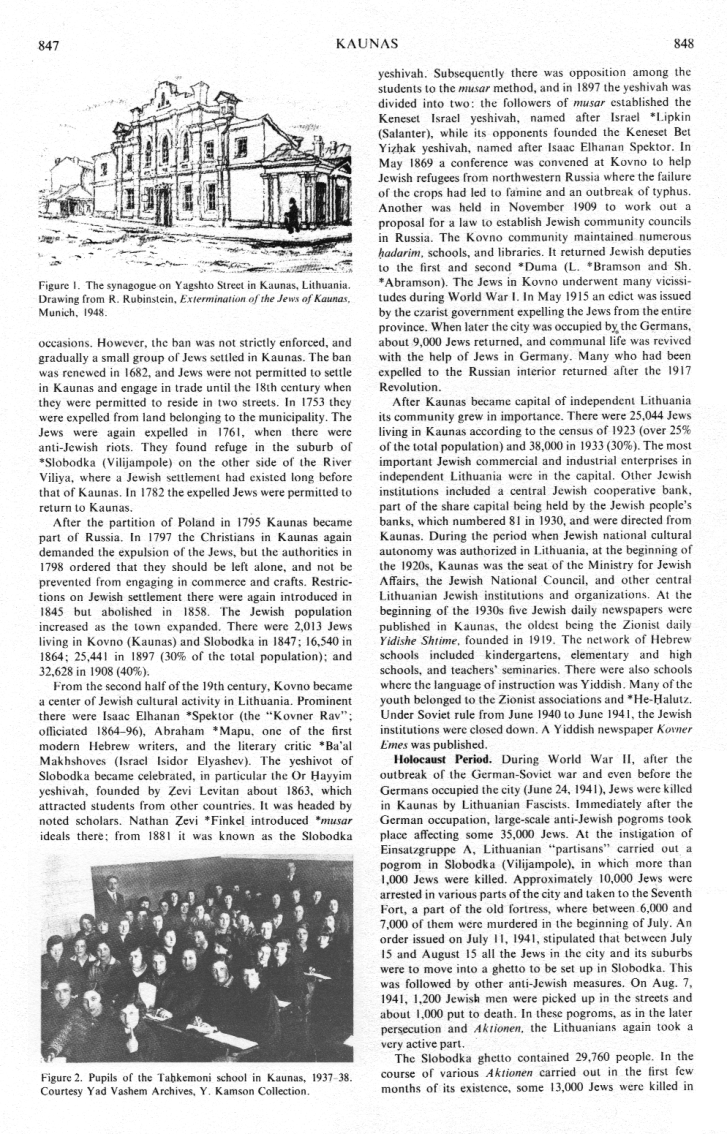
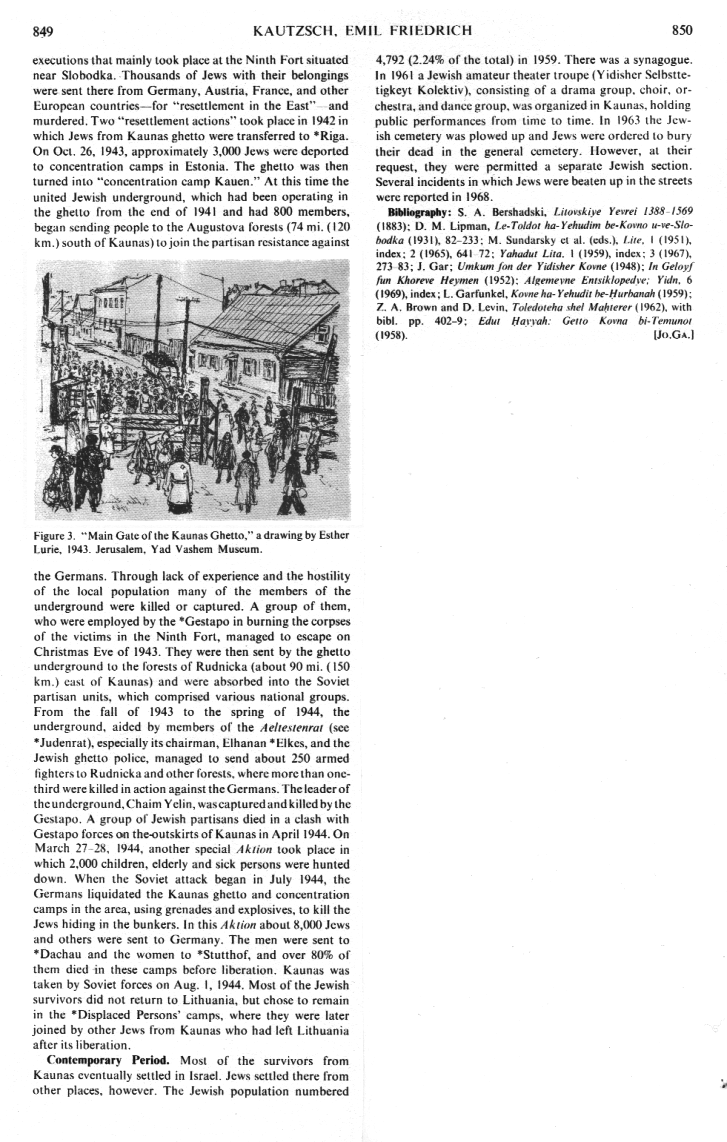
[Kaunas under different
rule]
<KAUNAS (Pol. Kowno; Rus. Kovno; Germ. under Nazi
occupation Kauen), city in Lithuanian S.S.R. situated at the
confluence of the rivers Viliya and Neman. Formerly in
Poland-Lithuania, it passed to Russia in 1795, was occupied
by Germany in World War I (1915-18), and became capital of
the independent Lithuanian Republic from 1920 to 1939.
In World War II it was under Soviet rule from June 1940 to
June 1941 and subsequently under Nazi occupation to July
1944.
[Jewish merchants -
expulsions in 18th century]
Jews took part in the trade between Kaunas and Danzig in the
16th century. Their competition aroused opposition from the
Christian merchants, and through their influence Jews were
prohibited from Kaunas on numerous (col. 846)
occasions. However, the ban was not strictly enforced, and
gradually a small group of Jews settled in Kaunas. The ban
was renewed in 1682, and Jews were not permitted to settle
in Kaunas and engage in trade until the 18th century when
they were permitted to reside in two streets. In 1753 they
were expelled from land belonging to the municipality. The
Jews were again expelled in 1761, when there were
anti-Jewish riots. They found refuge in the suburb of
*Slobodka (Vilijampole) on the other side of the River
Viliya, where a Jewish settlement had existed long before
that of Kaunas. In 1782 the expelled Jews were permitted to
return to Kaunas.
After the partition of Poland in 1795 Kaunas became part of
Russia. In 1797 the Christians in Kaunas again demanded the
expulsion of the Jews, but the authorities in 1798 ordered
that they should be left alone, and not be prevented from
engaging in commerce and crafts. Restrictions on Jewish
settlement there were again introduced in 1845 but abolished
in 1858.
[Figures]
The Jewish population increased as the town expanded. There
were 2,013 Jews living in Kovno (Kaunas) and Slobodka in
1847; 16,540 in 1864; 25,441 in 1897 (30% of the total
population); and 32,628 in 1908 (40%).
[[The increase of the percentage happened because the Jews
on the countryside were driven away to the towns by the
"Christian" population]].
From the second half of the 19th century, Kovno became a
center of Jewish cultural activity in Lithuania. Prominent
there were
-- Isaac Elhanan *Spektor (the "Kovner Rav"; officiated
1864-96)
-- Abraham *Mapu, one of the first modern Hebrew writers,
-- and the literary critic *Ba'al Makhshoves (Israel Isidor
Elyashev).
[Jewish schooling in
Slobodka: Keneset Israel against Keneset Bet Yizhak
(Yiẓhak) yeshivah - conferences - more schooling
institutions]
The yeshivot [[religious Torah schools]] of Slobodka became
celebrated, in particular the Or Hayyim yeshivah, founded by
Zevi Levitan about 1863, which attracted students from other
countries. It was headed by noted scholars. Nathan Zevi
*Finkel introduced
*musar
ideals there [[literature of medieval Jewish moralistic and
ethical teachings, ethical literature]]; from 1881 it was
known as the Slobodka (col. 847)
yeshivah. Subsequently there was opposition among the
students to the
musar
method, and in 1897 the yeshivah was divided into two: the
followers of musar established the Keneset Israel yeshivah,
named after Israel *Lipkin (Salanter), while its opponents
founded the Keneset Bet Yizhak (Yiẓhak) yeshivah, named
after Isaac Elhanan Spektor.
In May 1869 a conference was convened at Kovno to help
Jewish refugees from northwestern Russia where the failure
of the crops had led to famine and an outbreak of typhus.
Another was held in November 1909 to work out a proposal for
a law to establish Jewish community councils in Russia.
The Kovno community maintained numerous hadarim (ḥadarim)
[[small Jewish schools]], schools, and libraries. It
returned Jewish deputies to the first and second *Duma (L.
*Bramson and Sh. *Abramson).
[Jews expelled from Kaunas
during WWI 1914-1917]
The Jews in Kovno underwent many vicissitudes during World
War I. In May 1915 an edict was issued by the czarist
government expelling the Jews from the entire province. When
later the city was occupied by the Germans, about 9,000 Jews
returned, and communal life was revived with the help of
Jews in Germany. Many who had been expelled to the Russian
interior returned after the 1917 Revolution.
[Jews in Kaunas 1917-1941]
After Kaunas became capital of independent Lithuania its
community grew in importance. There were 25,044 Jews living
in Kaunas according to the census of 1923 (over 25% of the
total population) and 38,000 in 1933 (30%). The most
important Jewish commercial and industrial enterprises in
independent Lithuania were in the capital. Other Jewish
institutions included a central Jewish cooperative bank,
part of the share capital being held by the Jewish people's
banks, which numbered 81 in 1930, and were directed from
Kaunas.
During the period when Jewish national cultural autonomy was
authorized in Lithuania, at the beginning of the 1920s,
Kaunas was the seat of the Ministry for Jewish Affairs, the
Jewish National Council, and other central Lithuanian Jewish
institutions and organizations. At the beginning of the
1930s five Jewish daily newspapers were published in Kaunas,
the oldest being the Zionist daily
Yidishe Shtime, founded in 1919. The
network of Hebrew schools included kindergartens, elementary
and high schools, and teachers' seminaries. There were also
schools where the language of instruction was Yiddish.
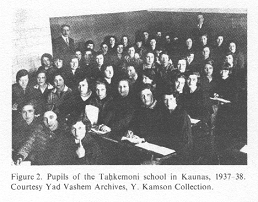
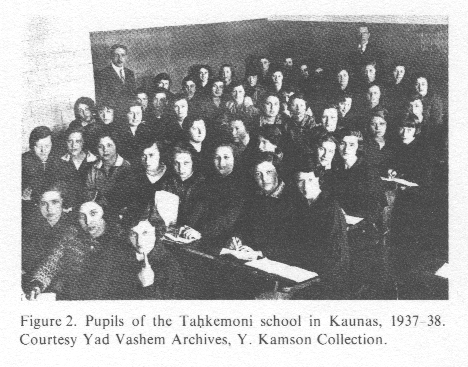
Encyclopaedia Judaica (1971): Kaunas (Kovno), vol. 10,
col. 847, photo 2: Pupils of the Tahkemoni (Taḥkemoni)
school in Kaunas, 1937-38. Courtesy Yad Vashem Archives,
Y. Kamson Collection
Many of the youth belonged to the Zionist associations and
*He-Halutz (He-Ḥalutz). Under Soviet rule from June 1940 to
June 1941, the Jewish institutions were closed down. A
Yiddish newspaper
Kovner
Emes was published.
Holocaust Period.
[[The Stalin deportations 1940-1941 and the Big Flight from
Barbarossa of the Red Army with many Jews and many
Communists are not mentioned in this article]].
[First killings of Jews
even before German NS occupation of 24 June 1941 -
Einsatzgruppe A]
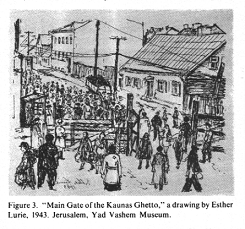
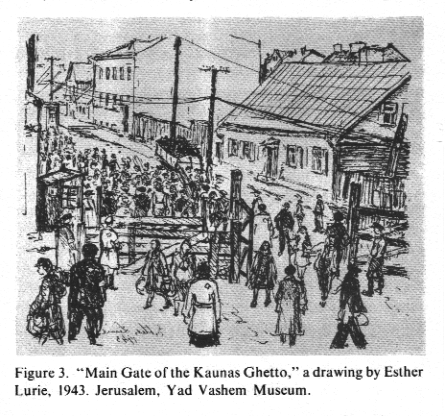
Encyclopaedia Judaica (1971): Kaunas (Kovno), vol. 10,
col. 849: "Main Gate of the Kaunas Ghetto",
a drawing by Esther Lurie, 1943. Jerusalem, Yad Vashem
Museum
During World War II, after the outbreak of the German-Soviet
war and even before the Germans occupied the city (June 24,
1941), Jews were killed in Kaunas by Lithuanian Fascists.
Immediately after the German occupation, large-scale
anti-Jewish pogroms took place affecting some 35,000 Jews.
At the instigation of Einsatzgruppe A, Lithuanian
"partisans" carried out a pogrom in Slobodka (Vilijampole),
in which more than 1,000 Jews were killed. Approximately
10,000 Jews were arrested in various parts of the city and
taken to the Seventh Fort, a part of the old fortress, where
between 6,000 and 7,000 of them were murdered in the
beginning of July.
[Jewish ghetto at Slobodka
- mass murder on some 13,000 Lithuanian Jews - Jews from
Germany, Austria, France a.o.]
An order issued on July 11, 1941, stipulated that between
July 15 and August 15 all the Jews in the city and its
suburbs were to move into a ghetto to be set up in Slobodka.
This was followed by other anti-Jewish measures. On Aug. 7,
1941, 1,200 Jewish men were picked up in the streets and
about 1,000 put to death. In these pogroms, as in the later
persecution and
Aktionen,
the Lithuanians [[Lithuanian Fascists]] again took a very
active part.
The Slobodka ghetto contained 29,760 people. In the course
of various
Aktionen
carried out in the first few months of its existence, some
13,000 Jews were killed in (col. 848)
executions that mainly took place at the Ninth Fort situated
near Slobodka. Thousands of Jews with their belongings were
sent there from Germany, Austria, France, and other European
countries - for "resettlement in the East" - and murdered.
[[According to Gorbatshev documents the Jews were
re-deported to the Reich, above all into forced labor in the
tunnel systems where a big part of the deported Jews died]].
Two "resettlement actions" took place in 1942 in which Jews
from Kaunas ghetto were transferred to *Riga. On Oct. 26,
1943, approximately 3,000 Jews were deported to
concentration camps in Estonia. The ghetto was then turned
into "concentration camp Kauen".
[Jewish underground
resistance movement]
At this time the united Jewish underground, which had been
operating in the ghetto from the end of 1941 and had 800
members, began sending people to the Augustova forests (74
mi. (10 km) south of Kaunas) to join the partisan resistance
against the Germans [[and their collaborators]]. Through
lack of experience and the hostility of the local population
[[the local population mainly did not want a communist
occupation again]] many of the members of the underground
were killed or captured. A group of them, who were employed
by the *Gestapo in burning the corpses of the victims in the
Ninth Fort, managed to escape on Christmas Eve of 1943. They
were then sent by the ghetto underground to the forests of
Rudnicka (about 90 mi. (150 km) east of Kaunas) and were
absorbed into the Soviet partisan units, which comprised
various national groups.
From the fall of 1943 to the spring of 1944, the
underground, aided by members of the
Aeltestenrat [[council
of the elders]] (see *Judenrat), especially its chairman,
Elhanan *Elkes, and the Jewish ghetto police, managed to
send about 250 armed fighters to Rudnicka and other forests,
where more than one-third were killed in action against the
Germans. The leader of the underground, Chaim Yelin, was
captured and killed by the Gestapo.
A group of Jewish partisans died in a clash with Gestapo
forces on the outskirts of Kaunas in April 1944. On March
27-28, 1944, another special
Aktion took place in which 2,000 children,
elderly and sick persons were hunted down.
[Soviet occupation of
Kaunas since 1944 - re-deportation of Jews to the Reich]
When the Soviet attack began in July 1944, the Germans [[and
their collaborators]] liquidated the Kaunas ghetto and
concentration camps in the area, using grenades and
explosives, to kill the Jews hiding in the bunkers. In this
Aktion about 8,000
Jews and others were sent to Germany. The men were sent to
*Dachau and the women to *Stutthof, and over 80% of them
died in these camps before liberation [[many died in the
tunnel systems]]. Kaunas was taken by Soviet forces on Aug.
1, 1944. Most of the Jewish survivors did not return to
Lithuania, but chose to remain in the *Displaced Persons'
camps, where they were later joined by other Jews from
Kaunas who had left Lithuania after its liberation [[which
was another Soviet occupation with sovietization and Gulag
system]].
Contemporary Period.
[Migration movements - census of 1959 - Jewish cultural
life in Kaunas]
Most of the survivors from Kaunas eventually settled in
Israel. Jews settled there from other places, however.
[[The return of many Jews from central Russia to Kaunas
1946-1947 is not mentioned in this article. Also the many
anti-Semitic propaganda waves since the founding of racist
Zionist Free Mason CIA Herzl Israel and the pressure to be
Russian for acting in professions is not mentioned in this
article]].
The Jewish population numbered (col. 849)
4,792 (2.24% of the total) in 1959. There was a synagogue.
In 1961 a Jewish amateur theater troupe (Yidisher
Selbsttetigkeyt Kolektiv), consisting of a drama group,
choir, orchestra, and dance group, was organized in Kaunas,
holding public performances from time to time. In 1963 the
Jewish cemetery was plowed up and Jews were ordered to bury
their dead in the general cemetery. However, at their
request, they were permitted a separate Jewish section.
Several incidents in which Jews were beaten up in the
streets were reported in 1968.
Bibliography
-- S.A. Bershadski: Litovskiye Yevrei 1388-1569 (1883)
-- D.M. Lipman: Le-Toldot ha-Yehudim be-Kovno u-ve-Slobodka
(1931), 82-233
-- M. Sundarsky et al. (eds.): Lite, 1 (1951), index; 2
(1965), 641-72
-- Yahadut Lita. 1 (1959), index; 3 (1967), 273-83
-- J. Gar
-- Umkum fon der Yidisher Kovne (1948)
-- In Geloyf fun Khoreve Heymen (1952)
-- Algemeyne Entsiklopedye
-- Yidn, 6 (1969), index
-- L. Garfunkel: Kovne ha-Yehudit be-Hurbanah (1959)
-- Z.A. Brown and D. Levin: Toledoteha shel Mahterer
(Maḥterer) (1962), with bibl. pp. 402-9
-- Edut Hayyah (Ḥayyah): Getto Kovna bi-Temunot (1958)
[JO. GA.]> (col. 850)