Encyclopaedia Judaica
Jews in Gdansk (Danzig)
German rule and Jewish Lane - Polish law and restrictions - Northern wars and expulsion of 1748 - Prussian "liberation decree" of 1814 - Free City 1920-1938 - discriminations and emigration waves since 1937 - pogroms and more emigration in 1938 - Holocaust deportations - some Jews since 1945 - emigration waves
from: Gdansk; In: Encyclopaedia Judaica 1971, vol. 7
presented by Michael Palomino (2008 / 2020)
Share:
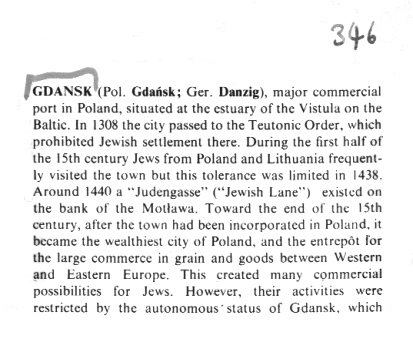
<GDANSK (Pol. Gdańsk; Ger. Danzig), major commercial port in Poland, situated at the estuary of the Vistula [[Ger.: Weichsel]] on the Baltic.
[[The main reason for anti-Semitism - the criminal catholic Church - is never mentioned in this article]].
[German law since 1308 - Jewish Lane - Polish law end of 15th century - richest town of Poland - equal trade rights since 1476 - Jewish settlement 1454-1520 - Schottland suburb since 1520]
In 1308 the city passed to the Teutonic Order, which prohibited Jewish settlement there. During the first half of the 15th century Jews from Poland and Lithuania frequently visited the town but this tolerance was limited in 1438. Around 1440 a "Judengasse" ("Jewish Lane") existed on the bank of the Motława. Toward the end of the 15th century, after the town had been incorporated in Poland, it became the wealthiest city of Poland, and the entrepôt [[deposit stores]] for the large commerce in grain and goods between western and eastern Europe. This created many commercial possibilities for Jews. However, their activities were restricted by the autonomous status of Gdansk, which (col. 346)
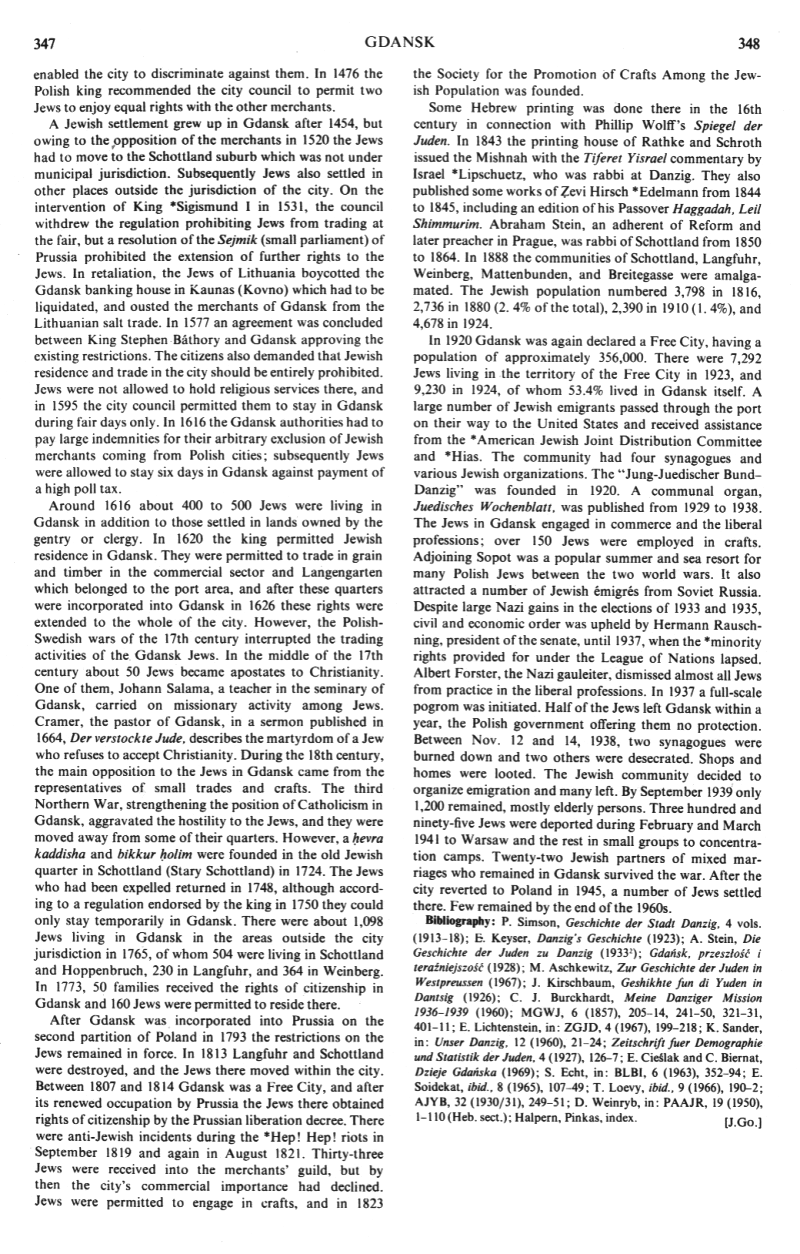
enabled the city to discriminate against them. In 1476 the Polish king recommended the city council to permit two Jews to enjoy equal rights with the other merchants. A Jewish settlement grew up in Gdansk after 1454, but owing to the opposition of the merchants in 1520 the Jews had to move to the Schottland suburb which was not under municipal jurisdiction. Subsequently Jews also settled in other places outside the jurisdiction of the city.
[Quarrel about trade rights and banks between Poland and Prussia - religious service prohibited in Gdansk - tax]
On the intervention of King *Sigismund I in 1531, the council withdrew the regulation prohibiting Jews from trading at the fair, but a resolution of the Sejmik (small parliament) of Prussia prohibited the extension of further rights to the Jews.
In retaliation, the Jews of Lithuania boycotted the Gdansk banking house in Kaunas (Kovno) which hat to be liquidated, and ousted the merchants of Gdansk from the Lithuanian salt trade.
In 1577 an agreement was concluded between King Stephen Báthory and Gdansk approving the existing restrictions. The citizens also demanded that Jewish residence and trade in the city should be entirely prohibited. Jews were not allowed to hold religious services there, and in 1595 the city council permitted them to stay in Gdansk during fair days only.
In 1616 the Gdansk authorities had to pay large indemnities for their arbitrary exclusion of Jewish merchants coming from Polish cities; subsequently Jews were allowed to stay six days in Gdansk against payment of a high poll tax.
Around 1616 about 400 to 500 Jews were living in Gdansk in addition to those settled in lands owned by the gentry or clergy. In 1620 the king permitted Jewish residence in Gdansk. They were permitted to trade in grain and timber in the commercial sector and Langengarten which belonged to the port area, and after these quarters were incorporated into Gdansk in 1626 these rights were extended to the whole of the city. However, the Polish-Swedish wars of the 17th century interrupted the trading activities of the Gdansk Jews.
[Conversions]
In the middle of the 17th century about 50 Jews became apostates to Christianity. One of them, Johann Salama, a teacher in the seminary of Gdansk, carried on missionary activity among Jews. Cramer, the pastor of Gdansk, in a sermon published in 1664, Der verstockte Jude [[The Blockhead Jews]], describes the martyrdom of a Jew who refused to accept Christianity.
[Anti-Semitism in Gdansk - Northern War and expulsions - Jewish institutions in the Schottland suburb - return of expelled Jews in 1748]
During the 18th century, the main opposition to the Jews in Gdansk came from the representatives of small trades and crafts. The third Northern War, strengthening the position of Catholicism in Gdansk, aggravated the hostility to the Jews, and they were moved away from some of their quarters. However, a hevra (ḥevra) kaddisha [[Jewish burial society]] and bikkur ḥolim [["visiting of the sick"]] were founded in the old Jewish quarter in Schottland (Stary Schottland) in 1724. The Jews who had been expelled returned in 1748, although according to a regulation endorsed by the king in 1750 they could only stay temporarily in Gdansk.
[Numbers]
There were about 1,098 Jews living in Gdansk in the areas outside the city jurisdiction in 1765, of whom 504 were living in Schottland and Hoppenbruch, 230 in Langfuhr, and 364 in Weinberg. In 1773, 50 families received the rights of citizenship in Gdansk and 160 Jews were permitted to reside there.
[Free City - Prussian law with Jewish "liberation decree" of 1814 - riots 1819 and 1821 - Jews in the guild - foundation of the Jewish Society for Crafts]
After Gdansk was incorporated into Prussia on the second partition of Poland in 1793 the restrictions on the Jews remained in force. In 1813 Langfuhr and Schottland were destroyed, and the Jews there moved within the city. Between 1807 and 1814 [[during Napoleon times]] Gdansk was a Free City, and after its renewed occupation by Prussia the Jews there obtained rights of citizenship by the Prussian liberation decree. There were anti-Jewish incidents during the *Hep! Hep! riots in September 1819 and again in August 1821.Thirty-three Jews were received into the merchants' guild, but by then the city's commercial importance had declined. Jews were permitted to engage in crafts, and in 1823 (col. 347)
the Society for the Promotion of Crafts Among the Jewish Population was founded.
[[Orthodox movement or Enlightenment movement or the revolution of 1848 are not mentioned in the article]].
[Printing - rabbis - unification of suburbs]
Some Hebrew printing was done there in the 16th century in connection with Phillip Wolff's Spiegel der Juden [[Mirror of the Jews]]. In 1843 the printing house of Rathke and Schroth issued the Mishnah with the Tiferet Yisrael commentary by by Israel *Lipschuetz, who was rabbi at Danzig. They also published some works of Zevi (Ẓevi) Hirsch *Edelmann from 1844 to 1845, including an edition of his Passover Haggadah, Leil Shimmurim.
Abraham Stein, an adherent of Reform and later preacher in Prague, was rabbi of Schottland from 1850 to 1864.
In 1888 the communities of Schottland, Langfuhr, Weinberg, Mattenbunden, and Breitegasse were amalgamated.
[Numbers]
The Jewish population numbered 3,798 in 1816, 2,736 in 1880 (2.4% of the total), 2,390 in 1910 (1.4%), and 4,678 in 1924.
[[The events of the First World War with battle fields, refugees and hardship are not mentioned in this article]].
[Territory of the Free City 1920-1938: numbers - aid organizations and emigration wave]
In 1920 Gdansk was again declared a Free City, having a population of approximately 356,000. There were 7,292 Jews living in the territory of the Free City in 1923, and 9,230 in 1924, of whom 53.4% lived in Gdansk itself. A large number of Jewish emigrants passed through the port on their way to the [[criminal racist]] United States and received assistance from the *American Jewish Joint Distribution Committee and *Hias.
[Cultural life - professions - Russian Jewish influx from "Soviet Union"]
The community had four synagogues and various Jewish organizations. The "Jung-Juedischer Bund-Danzig" was founded in 1920. A communal organ, Juedisches Wochenblatt [[Jewish Weekly]], was published from 1929 to 1938.
The Jews in Gdansk engaged in commerce and the liberal professions; over 150 Jews were employed in crafts. Adjoining Sopot was a popular summer and sea resort for many Polish Jews between the two world wars. It also attracted a number of Jewish émigrés from Soviet Russia.
[[The gulag system of Russian Communism is never mentioned in the Encyclopaedia Judaica. Under Communism all free trade was forbidden and many Jews were discriminated by other Jews of Communist leadership]].
[Discrimination since 1937 - pogrom of 1937 - 50% of the Jews emigrating within one year]
Despite large Nazi gains in the elections of 1933 and 1935, civil and economic order was upheld by Hermann Rauschning, president of the senate, until 1937, when the *minority rights provided for under the League of Nations lapsed. Albert Forster, the Nazi gauleiter, dismissed almost all Jews from practice in the liberal professions. In 1937 a full-scale pogrom was initiated. Half of the Jews left Gdansk within a year, the Polish government offering them no protection.
[[The Polish government was systematically anti-Semitic since 1919. Unfortunately there is no indication to which countries the Jewish emigrants - about 4,000? (the half of 9,230?) - have emigrated, probably mainly to Palestine (as Jews) and to the criminal racist "USA" (under other nationality quotas. Forged documents with changed names or changed religion was easy to have by Jewish aid organizations)]].
[Further emigration after pogroms of November 1938 - 1,300 Jews in September 1939]
Between Nov. 12 and 14, 1938, two synagogues were burned down and two others were desecrated. Shops and homes were looted. The Jewish community decided to organize emigration and many left. By September 1939 only 1,300 remained, mostly elderly persons.
Table. Jews in the Territory of the Free City of Gdansk
xxxxxYearxxxxx number of Jews
remark
1923xxxxx 7,292
1924xxxxx 9,230
1937xxxxx - about 50%
emigration wave after 1937 pogrom and discrimination law
1938xxxxx - ?
emigration wave after November 1938 pogrom
1939xxxxx 1,300
1941xxxxx - 395
deportations February-March 1941
xxxxx1941-1944xxxxx - about 900
deportations
xxxxxsince 1945xxxxx + ?
Jews coming back from central Russia who had deported from Poland 1940-1941
xxxxxsince 1946xxxxx - ?
emigration waves because of Polish anti-Semitism
Table by Michael Palomino; from: from: Gdansk; In: Encyclopaedia Judaica 1971, vol. 7, col. 348
[[Gdansk was the main port for all emigration from anti-Semitic Poland]].
[Holocaust with deportations]
Three hundred and ninety-five Jews were deported during February and March 1941 to Warsaw and the rest in small groups to concentration camps. Twenty-two Jewish partners of mixed marriages who remained in Gdansk survived the war.
[[Gdansk was heavily bombed by the Russian army]].
[Polish rule since 1945]
After the city reverted to Poland in 1945, a number of Jews settled there [[probably coming back from central Russia]]. Few remained by the end of the 1960s.
[[Polish anti-Semitism provoked new pogroms 1945-1946 (see *Poland) and provoked emigration waves 1948-1970 after Jewish wars of racist Zionist Free Mason CIA Herzl Israel provoked emigration waves (see *Poland). Gdansk was historically reconstructed]].
Bibliography
-- P. Simson: Geschichte der Stadt Danzig [[History of the Town of Gdansk]], 4 vols. (1913-18)
-- E. Keyser: Danzig's Geschichte [[History of Gdansk]] (1923)
-- A. Stein: Die Geschichte der Juden zu Danzig [[History of the Jews of Gdansk]] (1933)
-- Gdańsk, przeszłość i teraźnieyszość (1928)
-- M. Aschkewitz: Zur Geschichte der Juden in Westpreussen [[About History of the Jews in western Prussia]] (1967)
-- J. Kirschbaum: Geshikhte fun di Yuden in Dantsig [[History of the Jews in Gdansk]] (1926)
-- C.J. Burckhardt: Meine Danziger Mission 1936-1939 (1960)
-- MGWJ, 6 (1857), 205-14, 241-50, 321-31, 401-11
- E. Lichtenstein, in: ZGJD, 4 (1967), 199-218
-- K. Sander, in: Unser Danzig [[Our Gdansk]], 12 (1960), 21-24
-- Zeitschrift fuer Demographie und Statistik der Juden [[Review for Demography and Statistics of the Jews]], 4 (1927), 126-7
-- E. Cieslak and C. Biernat: Dzieje Gdanska (1969)
-- S. Echt, in: BLBI, 6 (1963), 352-94
-- E. Soidekat, ibid., 8 (1965), 107-49
-- T. Loevy, ibid., 9 (1966), 190-2
-- AJYB, 32 (1930/31), 249-51
-- D. Weinryb, in: PAAJR, 19 (1950), 1-110 (Heb. sect.)
-- Halpern, Pinkas, index.
[J.GO.]> (col. 348)
Sources
Encyclopaedia Judaica (1971): Gdansk, vol. 7, col. 346
Encyclopaedia Judaica (1971): Gdansk, vol. 7, col. 347-348
Č Ḥ Ł Š Ṭ Ẓ Ż
ā ć č ẹ ȩ ę ḥ ī ł ń ś š ū ž ż ẓ
^