Encyclopaedia Judaica
Jews in Cracow 03: 18th century to 1848
"Christian" pressure - professions - inner split - Polish partitions - Austrian and Polish rule - Orthodox and Enlightenment movements - tax questions - Cracow republic and reforms 1815-1846 - revolution and reforms in 1848
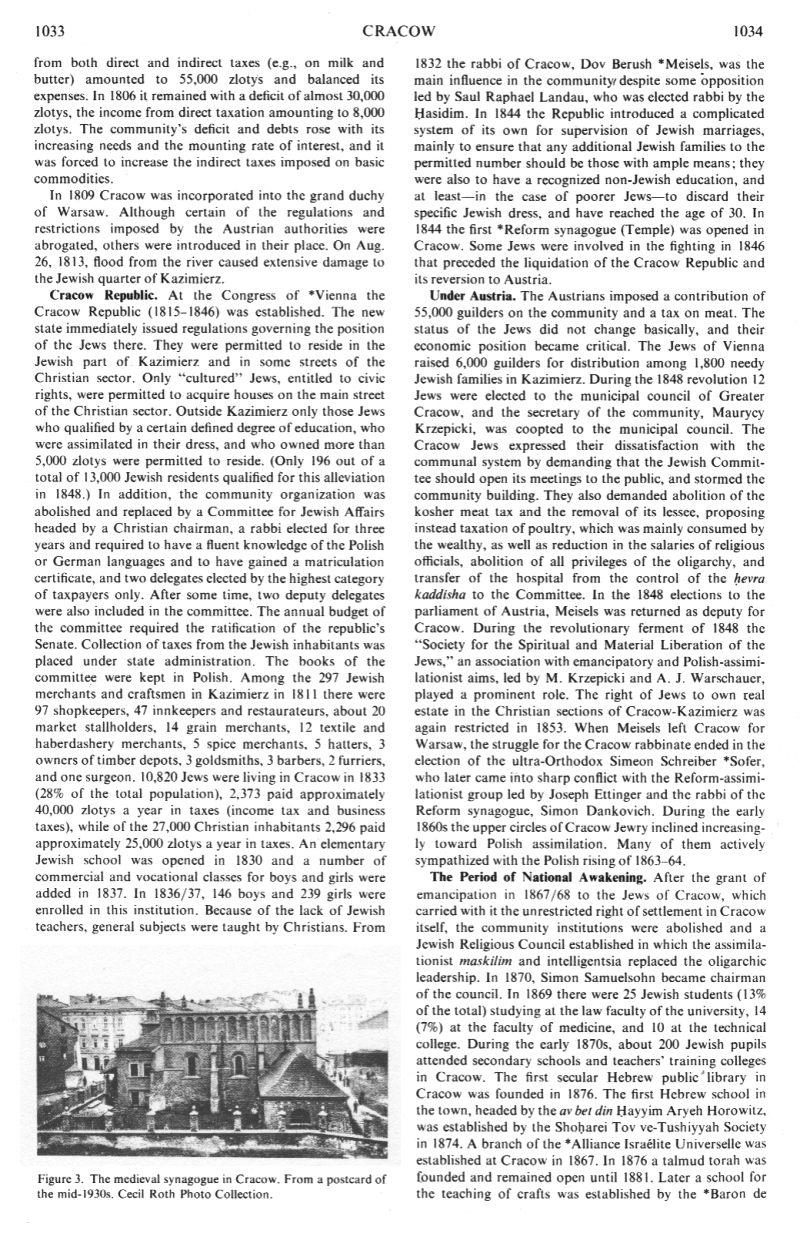
Encyclopaedia Judaica (1971): Cracow, vol. 5, col. 1039. Jewish merchants in Cracow marketplace.
A 19th-century etching by A. Hervieu. Cecil Roth Photo Collection.
from: Cracow; In: Encyclopaedia Judaica 1971, vol. 5
presented by Michael Palomino (2008 / 2020)
Share:
<18th Century.
[Pressure by the "Christian" population - protection by the court - professions - split between rich and poor Jews - costs and loans for defense against libels - anti-trade laws - war times 1768-1772]
The history of the community in the 18th century was marked by fluctuations in the struggle of the Cracow citizenry to close the city, trade, and crafts to the Kazimierz Jews. In general, the Jews were able to withstand this pressure, with the support of the magnates and the king, since it was in their interest to have Jews acting as suppliers and financiers in Cracow itself.
Anti-Jewish restrictions imposed by the city were mainly ineffectual and reflect the penetration of Jews into an increasing number of branches of trade and crafts, such as the trade in furs and hides, wax, soap, salt, tobacco, and haberdashery. Jews also traded in silver and gold, worked as goldsmiths, and engaged in large-scale import and export business, finance, and the lease and management of estates of the gentry (see *arenda).
However the economic rise of the merchant and financier circles of the community was accompanied by increasing impoverishment among the majority of Kazimierz Jewry. These factors, combined with the growth of the artisan element, sharpened social tensions within the oligarchically led community. The expenses incurred in the struggle with the Cracow citizenry for providing defense against libels and for the constantly increasing requirements of charity forced the community to take loans and it thus became indebted to wealthy Christians and the Church. In 1719 the community owed a total of approximately 600,000 zlotys, of which about 350,000 was owed to churches and monasteries and the remainder to Polish noblemen and merchants.
With the decline in status of the Kazimierz community its influence among the communities of the province also began to wane, and at the beginning of the 18th century these became largely independent of the mother community. In 1761 the Senate of Poland ratified a decree enforcing (col. 1031)
the prohibitions against Jewish commerce in Cracow. An attempt made by the municipality to confiscate the contents of the Jewish shops in the city was stopped by the authorities. During the troubled period between 1768 and 1772 the Jews in Kazimierz suffered at the hands of both the Polish and Russian armies. Many members of the community were arrested. One of its leaders, Gutman Rakowski, was tortured to death by the Poles. The Kazimierz community numbered 3,500 in 1775, and owned 212 houses; their property was valued at about 1,100,000 zlotys.
After the Polish Partitions.
[Split between Kazimierz and Cracow by borderline since 1776 - quarrel about Jewish commercial rights in Cracow - professions and new enterprises - exodus to Warsaw and other Polish towns]
In 1772-76 Kazimierz passed to *Austria, while Cracow remained within Poland. The Austrian authorities demanded that Jews should be permitted to cross to Cracow, but the municipality tried to prevent them. In 1776 Kazimierz was returned to Poland, but the Senate prohibited Jewish commerce in Cracow and imposed a heavy sum on the Kazimierz community. Tension within the community continued under the new rule, and factions were formed among the oligarchy (see also *Jekeles family). Most of the Jews left Cracow and transfered their affairs to Kazimierz. the 92 Jews who remained were engaged in banking or moneylending, or owned inns. They occupied 38 houses.
At the end of 1776 the king ratified an agreement between the community and the Kazimierz municipality extending Jewish commercial rights there. The Cracow municipal leaders then offered certain concessions to Jewish merchants in the city to prevent the complete transfer of Jewish business to Kazimierz. By the end of the 1770s, the 350 Jewish merchants and shopkeepers established in their new center at Kazimierz included 45 bankers and moneylenders, 52 textile merchants, 17 chandlers, 18 innkeepers, and several tailors, bakers, and furriers. In 1788 an explosives factory was established by a Jew in the vicinity of Cracow, and in 1790 a tannery. Many wealthy Jews left Cracow for Warsaw and other towns during this period.
[Orthodox, pietistic movement Hasidism in Cracow since 1780s - and counter movement]
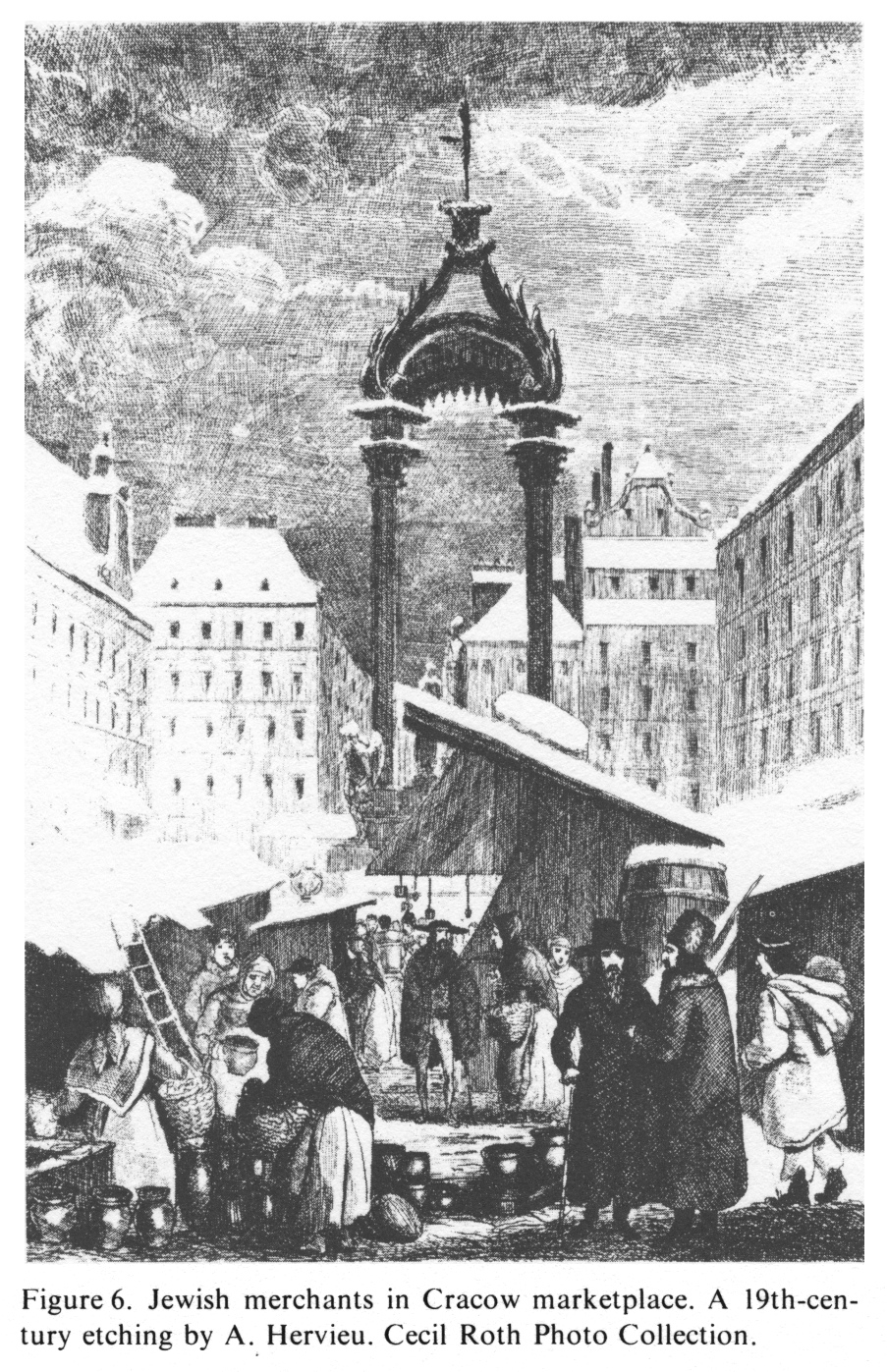
During the 1780s the influence of *Hasidism (Ḥasidism) [[Orthodox, pietistic movement]] began to penetrate to Cracow. This first circle of supporters of the movement in the city was established by Kalman *Epstein. In 1785 a herem (ḥerem) ("ban") [[excommunication]] was imposed on the Cracow Hasidim (Ḥasidim).
Encyclopaedia Judaica (1971): Cracow, vol. 5, col. 1037. Herem (ban) imposed by Cracow rabbis
on the city's Hasidim [[Orthodox movement]] in 1786. From M. Balaban, op. cit.
Hasidism (Ḥasidism) gained many adherents among the poorer classes of Jews in Kazimierz. Special houses of prayer were organized by the Hasidim (Ḥasidim), and the Mitnaggedim [[opponents]] imposed a second herem (ḥerem) on them in 1797.
[[There is no reason indicated for the ban, but there must have been heavy reasons for that]].
[Austrian Cracow since 1795 - removal of Jewish businesses - Enlightenment and Jewish taxes]
In 1795 Cracow and its environs were annexed by Austria, and in 1799 the Austrian authorities ordered the removal of all Jewish businesses from Cracow proper. Subsequently the communal leadership and nomenclature changed under the Germanizing influence and with the spread of *Enlightenment.
The Austrian government attempted to introduce the specific taxed imposed on Jews within its territories, as well as the special systems of restriction and supervision of the number of Jewish families and marriages. the authority of the five Vorstehers, as the communal leaders were henceforth termed, was restricted to the synagogues, charities, and responsibility for the collection of taxes and the conscription of the quota of army recruits demanded from the Jewish quarter of Kazimierz.
From 1800 both electoral and elective rights were determined by payment of the *candle tax, a new impost which constituted a heavy burden on the poorer sector in particular. This system required the payment of tax on at least seven candles a week in order to acquire the passive vote, and on eight candles to be eligible for election. Eligibility for the office of rabbi or Vorsteher [[communal leader]] required payment on ten candles a week. This system did not change the social structure of the communal leadership. At the elections of 1807 there were only about 40 votes.
In 1801 the income of the community (col. 1032)
from both direct and indirect taxes (e.g., on milk and butter) amounted to 55,000 zlotys and balanced its expenses. In 1806 it remained with a deficit of almost 30,000 zlotys, the income from direct taxation amounting to 8,000 zlotys. The community's deficit and debts rose with its increasing needs and the mounting rate of interest, and it was forced to increase the indirect taxes imposed on basic commodities.
[Cracow under Polish law since 1809 - restrictions abrogated - and new restrictions - flood of 1813]
In 1809 Cracow was incorporated into the grand duchy of Warsaw. Although certain of the regulations and restrictions imposed by the Austrian authorities were abrogated, others were introduced in their place. On Aug. 26, 1813, flood from the river caused extensive damage to the Jewish quarter of Kazimierz.
Cracow Republic. [1815-1846]
[Creation of Cracow Republic at the Congress of Vienna in 1815 - rights for "cultured" Jews - 5000 zlotys needed for settling outside of Kazimierz]
At the Congress of *Vienna the Cracow Republic (1815-1846) was established. The new state immediately issued regulations governing the position of the Jews there. They were permitted to reside in the Jewish part of Kazimierz and in some streets of the Christian sector. Only "cultured" Jews, entitled to civic rights, were permitted to acquire houses on the main street of the Christian sector. Outside Kazimierz only those Jews who qualified by a certain defined degree of education, who were assimilated in their dress, and who owned more than 5,000 zlotys were permitted to reside. (Only 196 out of a total of 13,000 Jewish residents qualified for this alleviation in 1848).
[New structures of the Jewish community]
In addition, the community organization was abolished and replaced by a Committee for Jewish Affairs headed by a Christian chairman, a rabbi elected for three years and required to have a fluent knowledge of the Polish or German languages and to have gained a matriculation certificate, and two delegates elected by the highest category of taxpayers only. After some time,two deputy delegates were also included in the committee. The annual budget of the committee required the ratification of the republic's Senate. Collection of taxes from the Jewish inhabitants was placed under state administration. The books of the committee were kept in Polish.
[Professions and numbers]
Among the 297 Jewish merchants and craftsmen in Kazimierz in 1811 there were 97 shopkeepers, 47 innkeepers and restaurateurs, about 20 market stallholders, 14 grain merchants, 12 textile and haberdashery merchants, 5 spice merchants, 5 hatters, 3 owners of timber depots, 3 goldsmiths, 3 barbers, 2 furriers, and one surgeon. 10,820 Jews were living in Cracow in 1833 (25% of the total population), 2,373 paid approximately 40,000 zlotys a year in taxes (income tax and business taxes), while of the 27,000 Christian inhabitants 2,296 paid approximately 25,000 zlotys a year in taxes.
[Schooling - marriage law of 1844 - reform community since 1844]
An elementary Jewish school was opened in 1830 and a number of commercial and vocational classes for boys and girls were added in 1837. In 1836/37, 146 boys and 239 girls were enrolled in this institution. Because of the lack of Jewish teachers, general subjects were taught by Christians. From (col. 1033)
1832 the rabbi of Cracow, Dvo Berush *Meisels, was the main influence in the community despite some opposition led by Saul Raphael Landau, who was elected rabbi by the Hasidim (Ḥasidim).
In 1844 the Republic introduced a complicated system of its own for supervision of Jewish marriages, mainly to ensure that any additional Jewish families to the permitted number should be those with ample means; they were also to have a recognized non-Jewish education, and at least - in the case of poorer Jews - to discard their specific Jewish dress, and have reached the age of 30.
In 1844 the first *Reform synagogue (Temple) was opened in Cracow. Some Jews were involved in the fighting in 1846 that preceded the liquidation of the Cracow Republic and its reversion to Austria.
[Austrian rule since 1846 - revolution of 1848 - Jews enter the Jewish community building]
the Austrians imposed a contribution of 55,000 guilders on the community and a tax on meat. The status of the Jews did not change basically, and their economic position became critical. The Jews of Vienna raised 6,000 guilders for distribution among 1,800 needy Jewish families in Kazimierz.
During the 1848 revolution 12 Jews were elected to the municipal council of Greater Cracow, and the secretary of the community, Maurycy Krzepicki, was coopted to the municipal council. The Cracow Jews expressed their dissatisfaction with the communal system by demanding that the Jewish Committee should open its meetings to the public, and stormed the community building.
They also demanded abolition of the kosher meat tax and the removal of its lessee, proposing instead taxation of poultry, which was mainly consumed by the wealthy, as well as reduction in the salaries of religious officials, abolition of all privileges of the oligarchy, and transfer of the hospital from the control of the hevra (ḥevra) kaddisha [[Jewish burial society]] to the Committee. In the 1848 elections to the parliament of Austria, Meisels was returned as deputy for Cracow. During the revolutionary ferment of 1848 the "Society for the Spiritual and Material Liberation of the Jews", an association with emancipatory and Polish-assimilationist aims, led by M. Krzepicki and A.J. Warschauer, played a prominent role.
[New restrictions - quarrel between Orthodox and Reform Jews]
The right of Jews to own real estate in the Christian sections of Cracow-Kazimierz was again restricted in 1853. When Meisels left Cracow for Warsaw, the struggle for the Cracow rabbinate ended in the election of the ultra-Orthodox Simeon Schreiber *Sofer, who later came into sharp conflict with the Reform-assimilationist group led by Joseph Ettinger and the rabbi of the Reform synagogue, Simon Dankovich. During the early 1860s the upper circles of Cracow Jewry inclined increasingly toward Polish assimilation. Many of them actively sympathized with the Polish rising of 1863-64. (col. 1034)
Sources
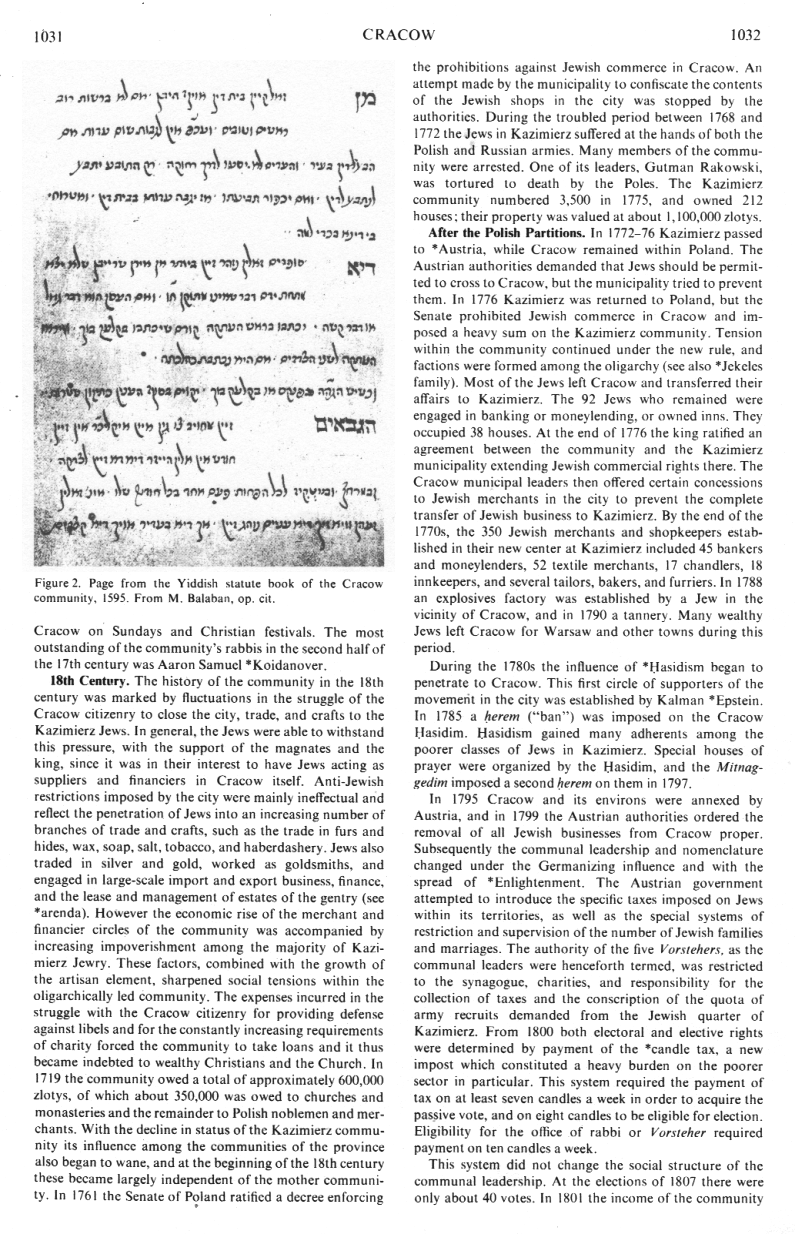
Encyclopaedia Judaica (1971): Cracow, vol. 5, col. 1031-1032
Encyclopaedia Judaica (1971): Cracow, vol. 5, col. 1033-1034
Č Ḥ Ł Š Ṭ Ẓ Ż
ā ć č ẹ ȩ ę ḥ ī ł ń ś š ū ž ż ẓ
^


![Encyclopaedia Judaica (1971): Cracow, vol. 5, col.
1037. Herem (ban) imposed by Cracow rabbis on the city's
Hasidim [[Orthodox movement]] in 1786. From M. Balaban,
op. cit.](../d/EncJud_juden-in-Krakau-d/EncJud_Cracow-band5-kolonne1037-bann-der-hasidim1786.jpg "Encyclopaedia Judaica (1971): Cracow,
vol. 5, col. 1037. Herem (ban) imposed by Cracow rabbis
on the city's Hasidim [[Orthodox movement]] in 1786.
From M. Balaban, op. cit.")