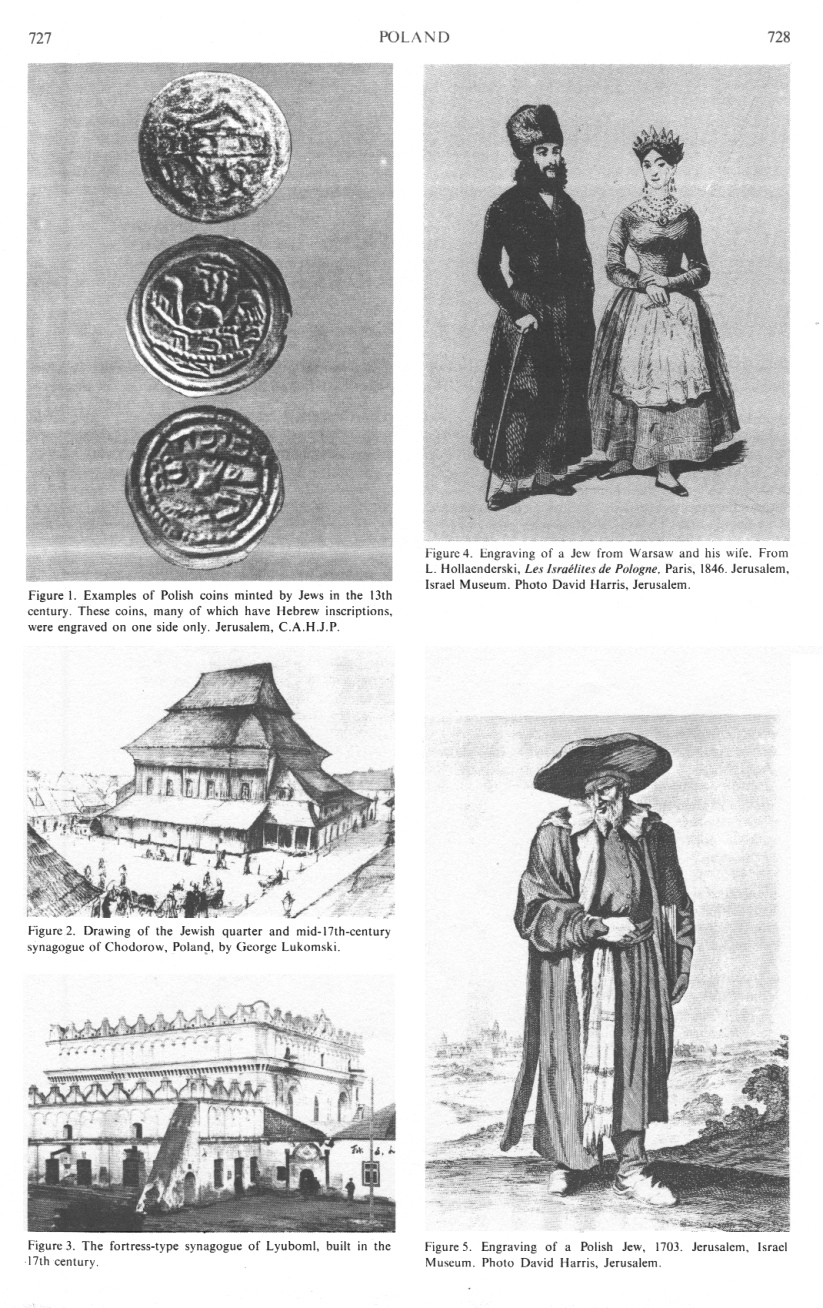
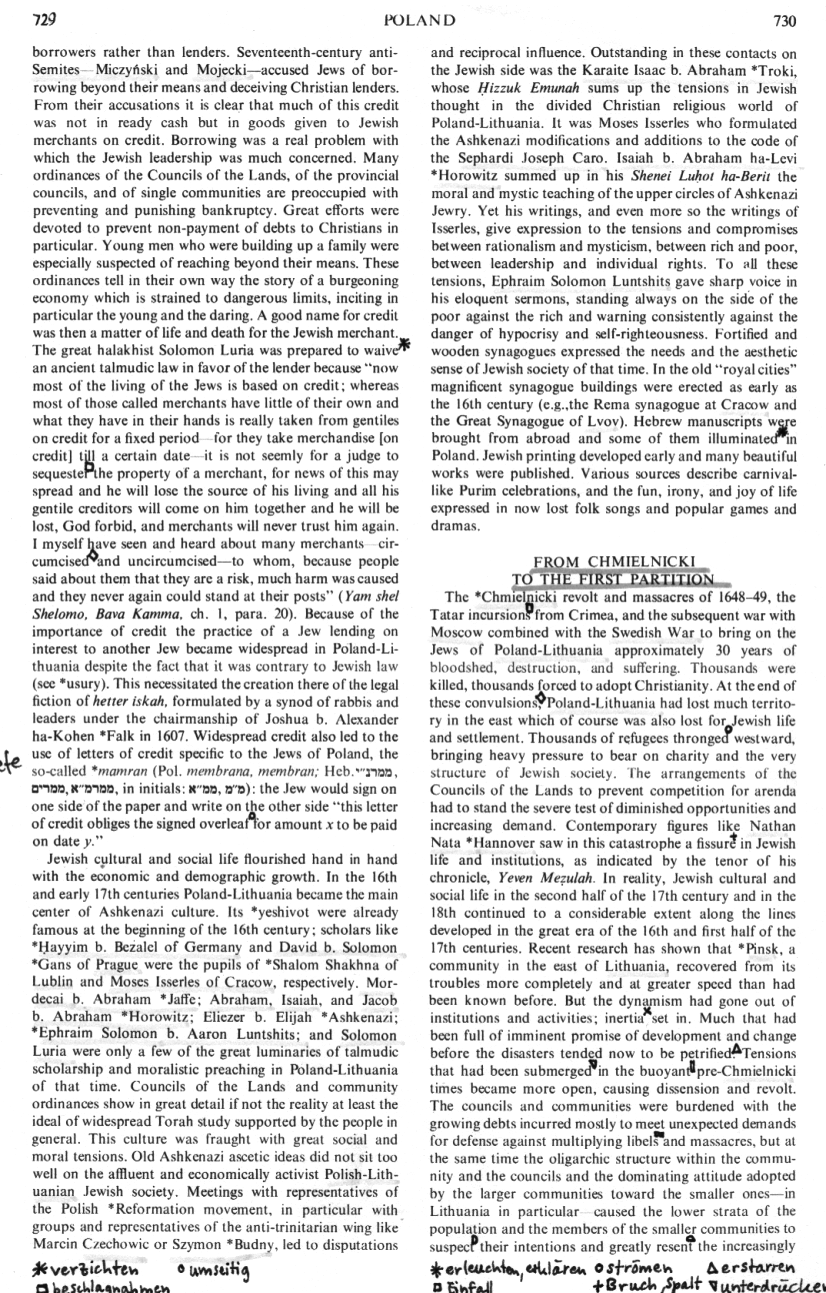
Jews in Poland 01:
colonization of Poland-Lithuania by Jews
Jewish settlers - moneylending and trade with
connections between Germany, Poland, and the Ottoman
Empire - cultural life and disputes - Christian resistance
and Jewish towns
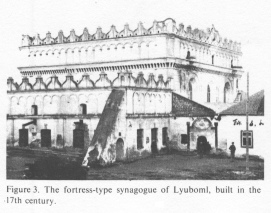

Encyclopaedia Judaica (1971):
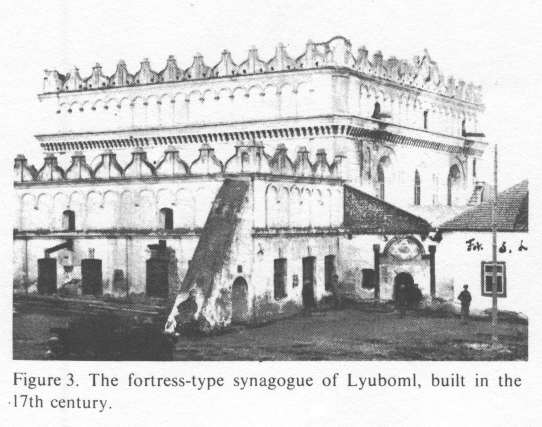
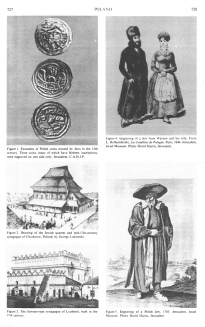
Poland, vol. 13, col. 727. The fortress-type
synagogue of Lyuboml, built in the 17th century.
from: Poland; In: Encyclopaedia Judaica 1971, vol. 13
presented by Michael Palomino (2008 / 2020)
<POLAND [[...]]
ECONOMIC ACTIVITY.
[Moneylending and agriculture
- cemetery is paid with spices in 1287 - trade in grand
duchy of Lithuania and Poland with Genoese colonies in
Crimea and with Constantinople]
From the very first the Jews of Poland developed their
economic activities through moneylending toward a greater
variety of occupations and economic structures. Thus, by the
very dynamics of its economic and social development, Polish
Jewry constitutes a flat existential denial and factual
contradiction of the anti-Semitic myth of "the Jewish spirit
of usury". On the extreme west of their settlement in Poland,
in Silesia, although they were mainly engaged in moneylending,
Jews were also employed in agriculture.
When the Kalisz community in 1287 bought a cemetery it
undertook to pay for it in pepper and other oriental wares,
indicating an old connection with the trade in spices. As
noted above, the Jewish mintmasters of the 12th century must
undoubtedly have been large-scale traders. In 1327 Jews were
an important element among the participants at the *Nowy Sacz
fair. Throughout the 14th and 15th centuries Jews were
occupied to a growing degree in almost every branch of trade
pursued at that time. Jews from both the grand duchy of
Lithuania and Poland traded in cloth, dyes, horses, and cattle
(and on a fairly large scale).
At the end of the 15th century they engaged in trade with
Venice, Italy, with Kaffa (Feodosiya), and with other (col.
717)
Genoese colonies in the Crimea, and with Constantinople.
[Jewish large-scale
land-transit trade between Europe and Ottoman Empire - trade
up to Moscow - rich Jews lend money to the government]
Lvov Jews played a central role in this trade, which in the
late 15th and early 16th centuries developed into a
large-scale land-transit trade between the Ottoman Empire and
Christian Europe. Through their participation in this trade
and their contacts with their brethren in the Ottoman Empire,
many Jewish communities became vital links in a trade chain
that was important to both the various Christian kingdoms and
the Ottoman Empire. Lithuanian Jews participated to the full
and on a considerable scale in all these activities, basing
themselves both on their above-mentioned recognized role in
Lithuanian civic society and on their particular opportunities
for trade with the grand principality of *Moscow and their
evident specialization in dyes [[colors]] and dyeing
[[coloring]]. Obviously, in all these activities, all links
with Jewish communities in central and western Europe were
beneficial.
During all this period Jews were engaged in moneylending, some
of them (e.g., *Lewko Jordanis, his son Canaan, and Volchko)
on a large scale. They made loans not only to private citizens
but also to magnates, kings, and cities, on several occasions
beyond the borders of Poland. The scope of their monetary
operations at their peak may be judged by the fact that in
1428 King Ladislaus II Jagello accused one of the Cracow city
counselors of appropriating [[using]] the fabulous sum of
500,000 zlotys which the Jews had supplied to the royal
treasury.
[Financial assistance to the
court - Jews are chosen for colonization projects - customs
rights and salt rights - Jews become a "third estate" in the
cities - complaints because of unfair trade - deprivation of
rights - expulsion from Cracow to Kazimierz in 1495]
To an increasing extent many of the Jewish moneylenders became
involved in trade. They were considered by their lords as
specialists in economic administration. In 1425 King Ladislaus
II Jagello charged Volchko - who by this time already held the
Lvov customs lease - with the colonization of a large tract of
land:
"As we have great confidence in the wisdom, carefulness, and
foresight of our Lvov customs-holder, the Jews Volchko ...
after the above-mentioned Jew Volchko has turned the
above-mentioned wilderness into a human settlement in the
village, it shall remain in his hands till his death."
King Casimir Jagello entrusted to the Jews Natko both the salt
mines of Drohbycz (*Drogobych) and the customs station of
Grejdek, stating in 1452 that he granted it to him on account
of his "industry and wisdom so that thanks to his ability and
industry we shall bring in more income to our treasury."
The same phenomenon is found in Lithuania. By the end of the
15th century, at both ends of the economic scale Jews in
Poland were becoming increasingly what they had been from the
beginning in Lithuania: a "third estate" in the cities.
The German-Polish citizenry quickly became aware of this. By
the end of the 15th century, accusations against the Jews
centered around unfair competition in trade and crafts more
than around harsh usury. Not only merchants but also Jewish
craftsmen are mentioned in Polish cities from 1460 onward. In
1485 tensions in Cracow was so high that the Jewish community
was compelled to renounce [[give up]] formally its rights to
most trades and crafts. Though this was done "voluntarily",
Jews continued to pursue their living in every decent [[living
properly]] way possible. This was one of the reasons for their
expulsion from Cracow to Kazimierz in 1495. However, the end
of Jewish settlement in Cracow was far from the end of Jewish
trade there; it continued to flourish and aggravate [[be
harder]] the Christian townspeople, as was the case with many
cities (like *Lublin and *Warsaw) which had exercised their
right de non tolerandis
Judaeis and yet had to see Jewish economic activity
flourishing at their fairs and in their streets.
CULTURAL AND SOCIAL LIFE.
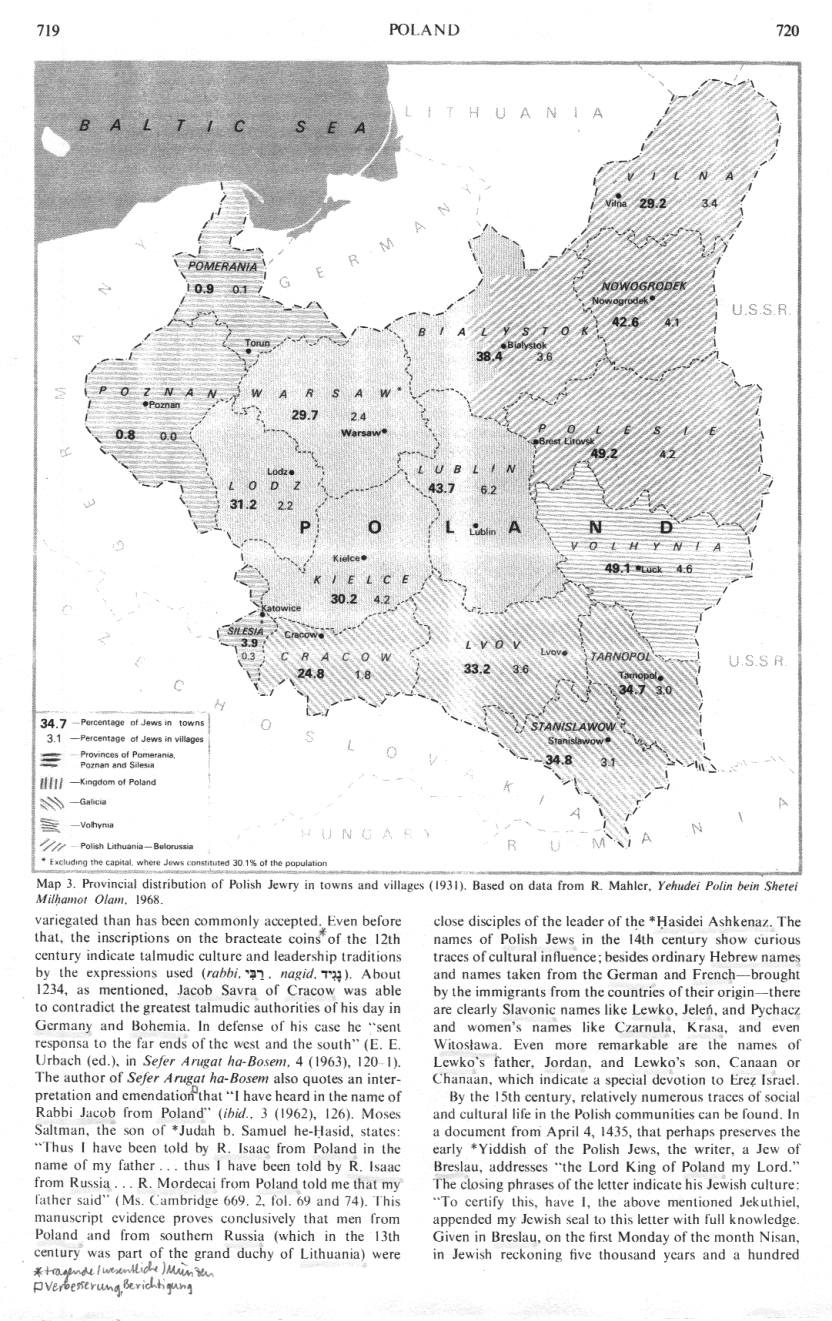
In Poland and Lithuania from the 13th century onward Jewish
culture and society was much richer and more (col. 718)
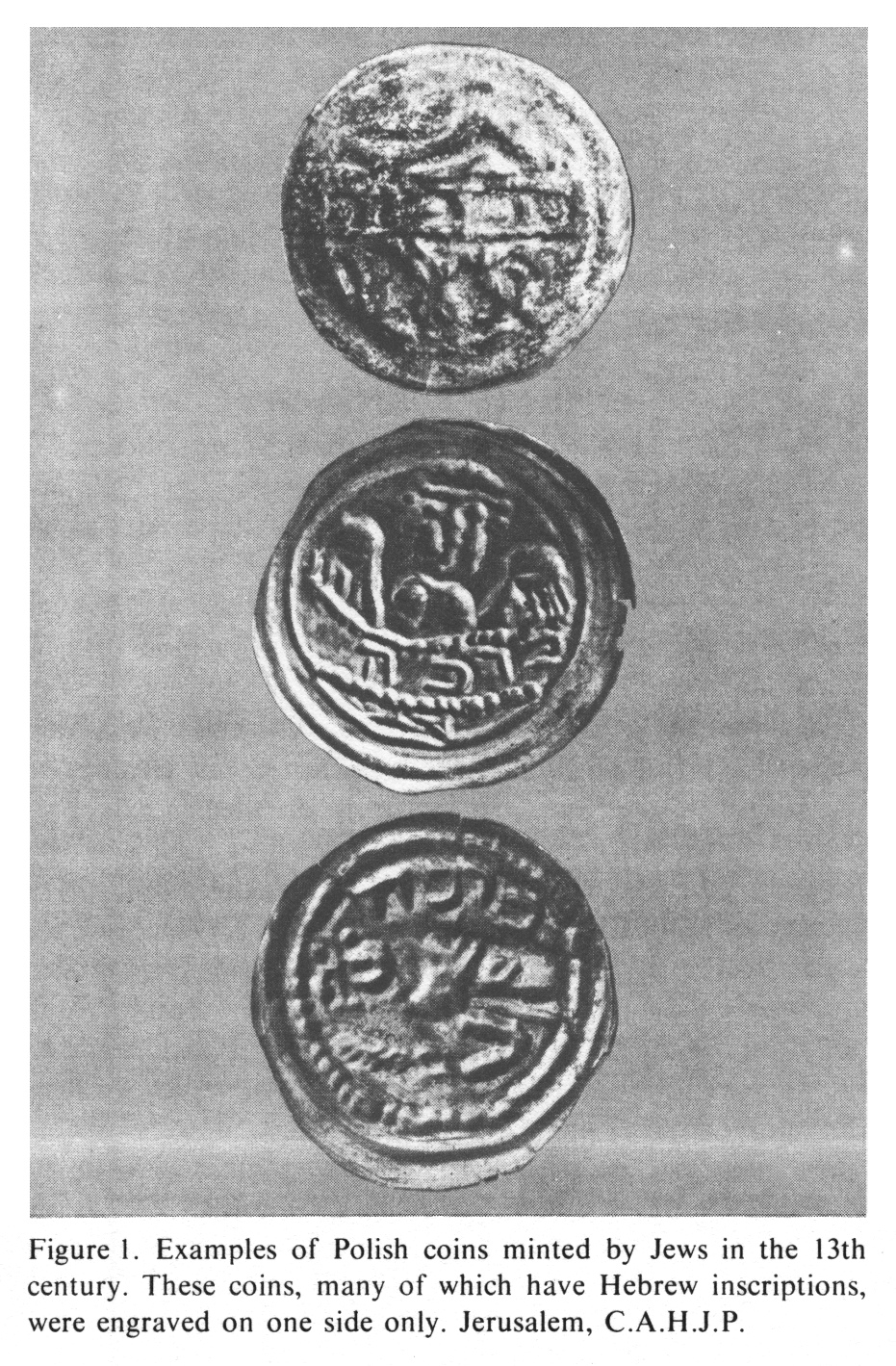
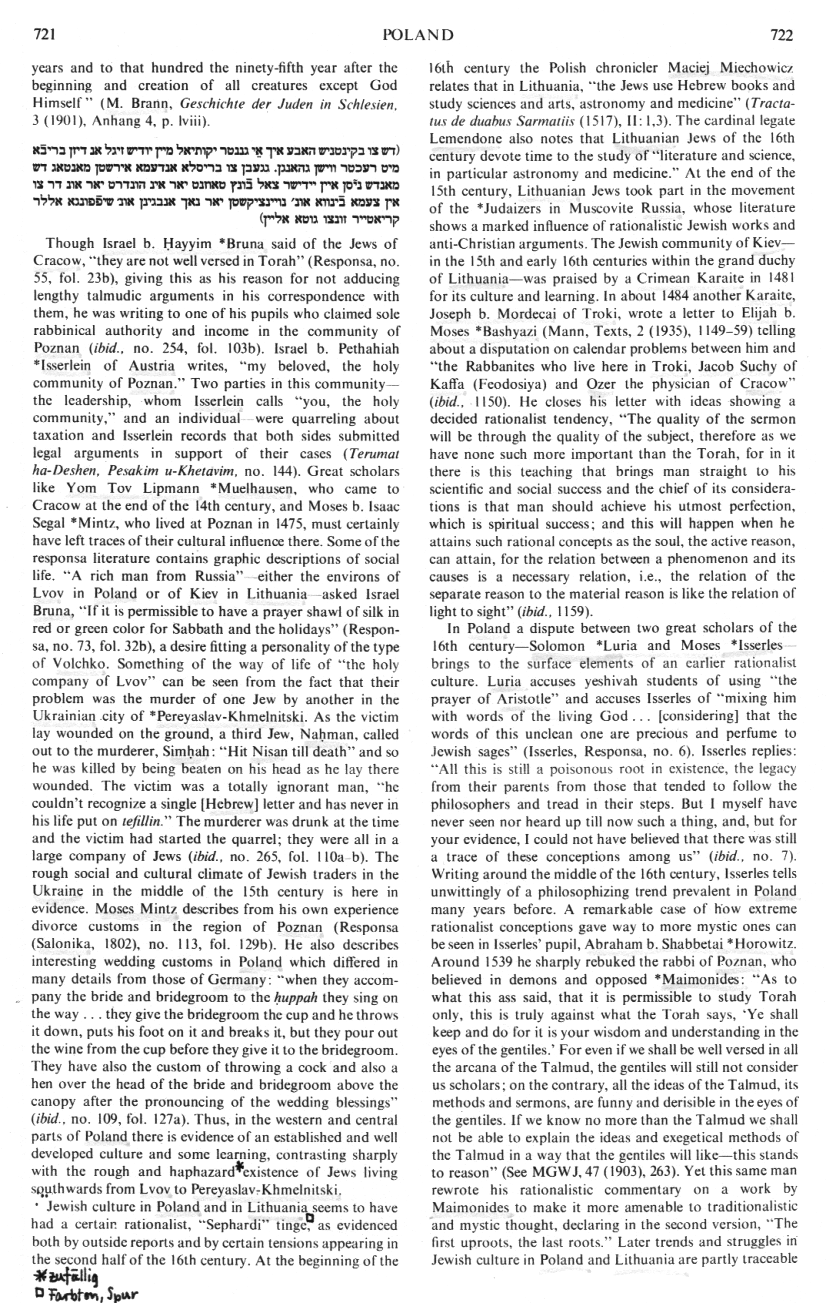
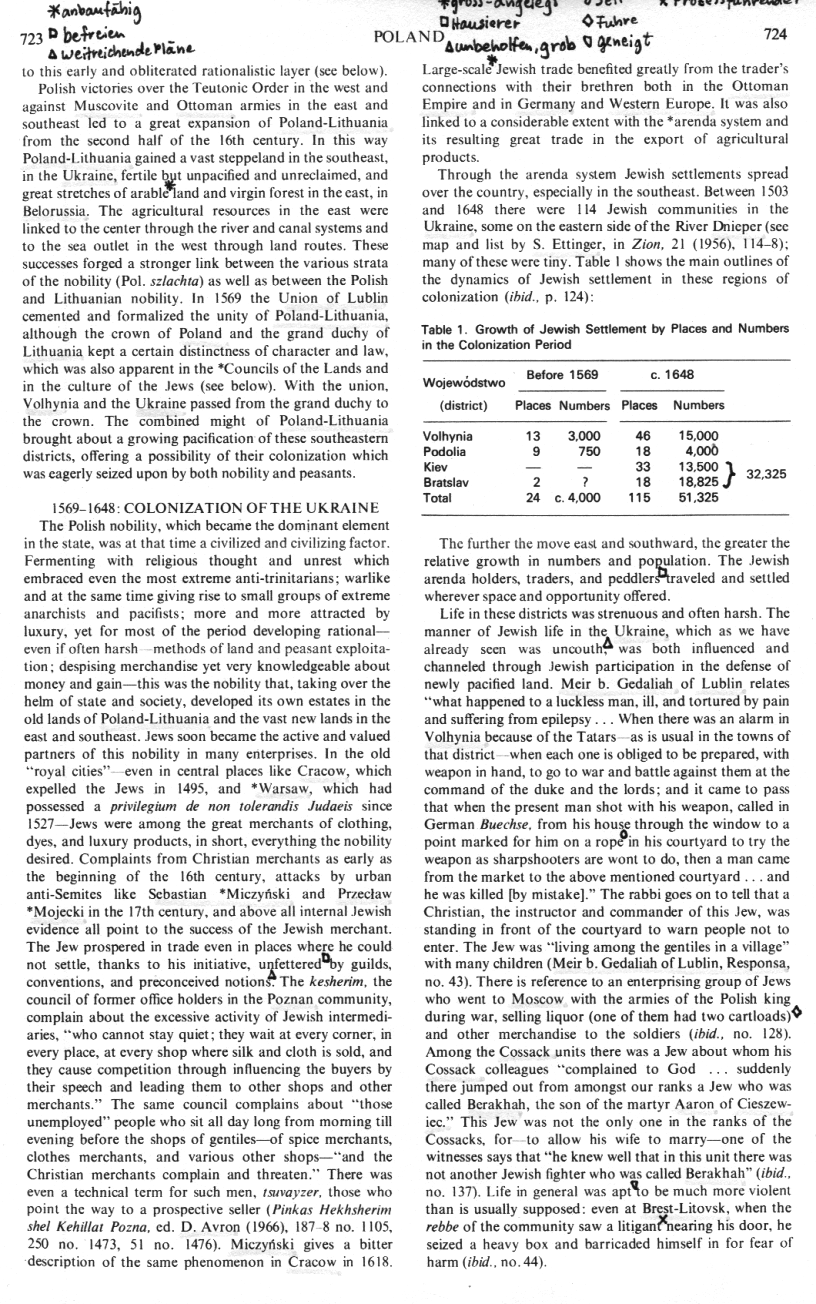
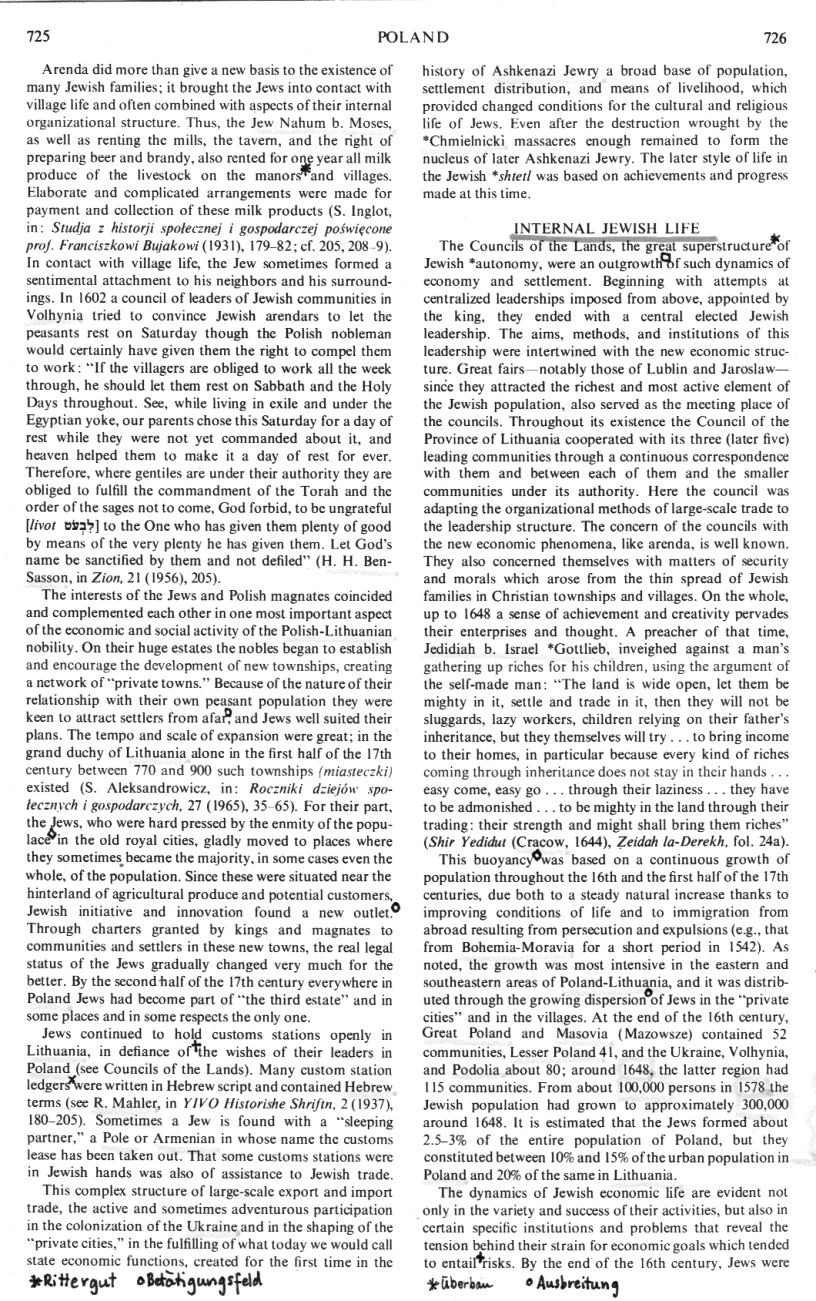
variegated than has been commonly accepted. Even before that,
the inscriptions on the bracteate coins [[important coins]] of
the 12th century indicate talmudic culture and leadership
traditions by the expressions used (rabbi, nagid).
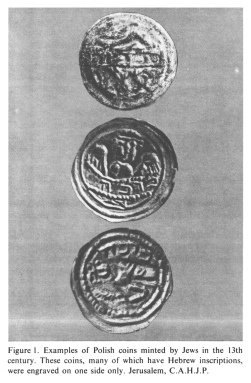
Encyclopaedia
Judaica (1971): Poland, vol. 13, col. 727. Examples of
Polish coins minted by Jews
in the 13th century. These coins, many of which have Hebrew
inscriptions,
were engraved on one side only. Jerusalem, C.A.H.J.P.
About 1234, as mentioned, Jacob Savra of Cracow was able to
contradict the greatest talmudic authorities of his day in
Germany and Bohemia. In defense of his case he "sent responsa
to the far ends of the west and the south" (E.E. Urbach (ed.),
in Sefer Arugat ha-Bosem,
4 (1963), 120-1). The author of Sefer Arugat ha-Bosem also quotes an
interpretation and emendation [[amelioration]] that "I have
heard in the name of Rabbi Jacob from Poland" (ibid., 3
(1962), 126).
Moses Saltman, the son of *Judah b. Samuel he-Hasid (Ḥasid),
states:
"Thus I have been told by R. Isaac from Poland in the name of
my father ... thus I have been told by R. Isaac from Russia
... R. Mordecai from Poland told me that my father said" (Ms.
Cambridge 669, 2, fol. 69 and 74). This manuscript evidence
proves conclusively that men from Poland and from southern
Russia (which in the 13th century was part of the grand duchy
of Lithuania) were (col. 719)
close disciples of the leader of the *Hasidei (Ḥasidei)
Ashkenaz.
[Names from German, French
and Czech culture - Jewish calendar]
The names of Polish Jews in the 14th century show curious
traces of cultural influence; besides ordinary Hebrew names
and names taken from the German and French - brought by the
immigrants from the countries of their origin - there are
clearly Slavonic names like Lewko, Jeleń, and Pychacz and
women's names like Czarnula, Krasa, and even Witoslawa. Even
more remarkable are the names of Lewko's father, Jordan, and
Lewko's son, Canaan or Chanaan, which indicate a special
devotion to Erez Israel (Ereẓ Israel) [[Land of Israel]].
By the 15th century, relatively numerous traces of social and
cultural life in the Polish communities can be found. In a
document from April 4, 1435, that perhaps preserves the early
*Yiddish of the Polish Jews, the writer, a Jews of Breslau,
addresses "the Lord King of Poland my Lord". The closing
phrases of the letter indicate his Jewish culture:
"To certify this, have I, the above mentioned Jekuthiel,
appended my Jewish seal to this letter with full knowledge.
Given in Breslau, on the first Monday of the month Nisan, in
Jewish reckoning five thousand years and a hundred (col. 720)
years and to that hundred the ninety-fifth year after the
beginning and creation of all creatures except God Himself"
(M. Brann: Geschichte der Juden in Schlesien [[History of the
Jews in Silesia]], 3 (1901), Anhang [[appendix]] 4, p. Iviii).
Though Israel b. Hayyim (Ḥayyim) *Bruna said of the Jews of
Cracow, "they are not well versed in Torah" (Responsa, no. 55,
fol. 23b), giving this as his reason for not adducing lengthy
talmudic arguments in his correspondence with them, he was
writing to one of his pupils who claimed sole rabbinical
authority and income in the community of Poznan (ibid., no.
254, fol. 103b). Israel b. Pethahiah *Isserlein of Austria
writes, "my beloved, the holy community of Poznan". Two
parties in this community - the leadership, whom Isserlein
calls "you, the holy community", and an individual were
quarreling about taxation and Isserlein records that both
sides submitted legal arguments in support of their cases (Terumat ha-Deshen, Pesakim
u-Khetavim, no. 144).
[Scholars and Jewish cultural
life in Poland]
Great scholars like Yom Tov Lipmann *Muelhausen, who came to
Cracow at the end of the 14th century, and Moses b.
Isaac Segal *Mintz, who lived at Poznan in 1475, must
certainly have left traces of their cultural influence there.
Some of the responsa literature contains graphic descriptions
of social life.
"A rich man from Russia" - either the environs of Lvov in
Poland or of Kiev in Lithuania - asked Israel Bruna,
"If it is permissible to have a prayer shawl of silk in red or
green color for Sabbath and the holidays" (Responsa, no. 73,
fol. 32b), a desire fitting a personality of the type of
Volchko.
Something of the way of life of "the holy company of Lvov" can
be seen from the fact that their problem was the murder of one
Jew by another in the Ukrainian city of
*Pereyaslav-Khmelnitski. As the victim lay wounded on the
ground, a third Jew, Nahman (Naḥman), called out to the
murderer, Simhah (Simḥah): "Hit Nisan till death" and so
he was killed by being beaten on his head as he lay there
wounded. The victim was a totally ignorant man, "he couldn't
recognize a single [Hebrew] letter and has never in his life
put on tefillin."
The murderer was drunk at the time and the victim had started
the quarrel; they were all in a large company of Jews (ibid.,
no. 265, fol. 110a-b).
The large rough social and cultural climate of Jewish traders
in the Ukraine in the middle of the 15th century is here in
evidence. Moses Mintz describes from his own experience
divorce customs in the region of Poznan (Responsa (Salonika,
1802), no. 113, fol. 129b). He also describes interesting
wedding customs in Poland which differed in many details from
those of Germany:
"when they accompany the bride and bridegroom to the huppah (ḥuppah) they sing
on the way ... they give the bridegroom the cup and he throws
it down, puts his foot on it and breaks it, but they pour out
the wine from the cup before they give it to the bridegroom.
They have also the custom of throwing a cock and also a hen
over the head of the bride and bridegroom above the canopy
after the pronouncing of the wedding blessings" (ibid., no.
109, fol. 127a).
Thus, in the western and central parts of Poland there is
evidence of an established and well developed culture and some
learning, contrasting sharply with the rough and haphazard
[[arbitrary]] existence of Jews living southwards from Lvov to
Pereyaslav-Khmelnitski.
[Jewish culture in Lithuania]
Jewish culture in Poland and in Lithuania seems to have had a
certain rationalist, "Sephardi" tinge [[color]], as evidenced
both by outside reports and by certain tensions appearing in
the second half of the 16th century. At the beginning of the
(col. 721)
16th century the Polish chronicler Maciej Miechowicz relates
that in Lithuania,
"the Jews use Hebrew books and study sciences and arts,
astronomy and medicine" (Tractatus
de duabus Sarmatiis (1517), II:1,3). The cardinal
legate Lemendone also notes that Lithuanian Jews of the 16th
century devote time to the study of "literature and science,
in particular astronomy and medicine". At the end of the 15th
century, Lithuanian Jews took part in the movement of the
"Judaizers in Muscovite Russia, whose literature shows a
marked influence of rationalistic Jewish works and
anti-Christian arguments.
The Jewish community of Kiev - in the 15th and early 16th
centuries within the grand duchy of Lithuania - was praised by
a Crimean Karaite in 1481 for its culture and learning. In
about 1484 another Karaite, Joseph b. Mordecai of Troki, wrote
a letter to Elijah b. Moses *Bashyazi (Mann, Texts, 2 (1935),
1149-59) telling about a disputation on calendar problems
between him and "the Rabbanites who live here in Troki, Jacob
Suchy of Kaffa (Feodosiya) and Ozer the physician of Cracow"
(ibid., 1150). He closes his letter with ideas showing a
decided rationalist tendency,
"The quality of the sermon will be through the quality of the
subject, therefore as we have none such more important than
the Torah, for in it there is this teaching that brings man
straight to his scientific and social success and the chief of
its considerations is that man should achieve his utmost
perfection, which is spiritual success; and this will happen
when he attains such rational concepts as the soul, the active
reason, can attain, for the relation between a phenomenon and
its causes is a necessary relation, i.e., the relation of the
separate reason to the material reason is like the relation of
light to sight" (ibid., 1159).
[Jewish philosophic dispute
in 16th century in Poland: Solomon Luria and Moses Isserles
- pupil Abraham b. Shabbetai Horowitz]
In Poland a dispute between two great scholars of the 16th
century - Solomon *Luria and Moses *Isserles - brings to the
surface elements of an earlier rationalist culture. Luria
accuses yeshivah students [[students of a religious Torah
school]] of using "the prayer of Aristotle" and accuses
Isserles of "mixing him with words of the living God...
[considering] that the words of this unclean one are precious
and perfume to Jewish sages" (Isserles, Responsa, no. 6).
Isserles replies:
"All this is still a poisonous root in existence, the legacy
from their parents from those that tended to follow the
philosophers and tread in their steps. But I myself have never
seen nor heard up till now such a thing, and, but for your
evidence, I could not have believed that there was still a
trace of these conceptions among us" (ibid., no. 7).
Writing around the middle of the 16th century, Isserles tells
unwittingly of a philosophizing rend prevalent in Poland many
years before. A remarkable case of how extreme rationalist
conceptions gave way to more mystic ones can be seen in
Isserles' pupil, Abraham b. Shabbetai *Horowitz.
Around 1539 he sharply rebuked the rabbi of Poznan, who
believed in demons and opposed *Maimonides:
"As to what this ass said, that it is permissible to study
Torah only, this is truly against what the Torah says, 'Ye
shall keep and do for it is your wisdom and understanding in
the eyes of the gentiles.' For even if we shall be well versed
in all the arcana of the Talmud, the gentiles will still not
consider us scholars; on the contrary, all the ideas of the
Talmud, its methods and sermons, are funny and derisible in
the eyes of the gentiles. If we know no more than the Talmud
we shall not be able to explain the ideas and exegetical
methods of the Talmud in a way that the gentiles will like -
this stands to reason" (See MGWJ, 47 (1903), 263).
Yet this same man rewrote his rationalistic commentary on a
work by Maimonides to make it more amenable to
traditionalistic and mystic thought, declaring in the second
version, "The first uproots, the last roots". Later trends and
struggles in Jewish culture in Poland and Lithuania are partly
traceable (col. 722)
to this early and obliterated rationalistic layer (see below).
[Polish expansion in Ukraine
and Belorussia since 1550 - Poland-Lithuania since 1569]
Polish victories over the Teutonic Order in the west and
against Muscovite and Ottoman armies in the east and southeast
led to a great expansion of Poland-Lithuania from the second
half of the 16th century. IN this way Poland-Lithuania gained
a vast steppeland in the southeast, in the Ukraine fertile but
unpacified and unreclaimed, and great stretches of arable
[[fertile]] land and virgin forest in the east, in Belorussia.
The agricultural resources in the east were linked to the
center through the river and canal systems and to the sea
outlet in the west through land routes. These successes forged
a stronger link between the various strata of the nobility
(Pol. szlachta) as
well as between the Polish and Lithuanian nobility.
In 1569 the Union of Lublin cemented and formalized the unity
of Poland-Lithuania, although the crown of Poland and the
grand duchy of Lithuania kept a certain distinctness of
character and law, which was also apparent in the *Councils of
the Lands and in the culture of the Jews (see below). With the
union, Volhynia and the Ukraine passed from the grand duchy to
the crown. The combined might of Poland-Lithuania brought
about a growing pacification of these southeastern districts,
offering a possibility of their colonization which was eagerly
seized upon by both nobility and peasants.
1569-1648: COLONIZATION OF THE UKRAINE.
[Life under Polish nobility -
experienced Jews as "partners" - and Christian resistance -
aggressive Jews - Jewish connections Germany-Poland-Ottoman
Empire]
The Polish nobility, which became the dominant element in the
state, was at that time a civilized and civilizing factor.
Fermenting with religious thought and unrest which embraced
even the most extreme anti-trinitarians; warlike and at the
same time giving rise to small groups of extreme anarchists
and pacifists; more and more attracted by luxury, yet for most
of the period developing rational - even if often harsh -
methods of land and peasant exploitation; despising
merchandise yet very knowledgeable about money and gain - this
was the nobility that, taking over the helm of state and
society, developed its own estates in the old lands of
Poland-Lithuania and the vast new lands in the east and
southeast.
Jews soon became the active and valued partners of this
nobility in many enterprises. In the old "royal cities" - even
in central places like Cracow, which expelled the Jews in
1495, and *Warsaw, which had possessed a privilegium de non tolerandis
Judaeis since 1527 - Jews were among the great
merchants of clothing, dyes [[colors]], and luxury products,
in short, everything the nobility desired.
Complaints from Christian merchants as early as the beginning
of the 16th century, attacks by urban anti-Semites like
Sebastian *Miczyński and Przecław *Mojecki in the 17th
century, and above all internal Jewish evidence all point to
the success of the Jewish merchant.
The Jews prospered in trade even in places where he could not
settle, thanks to his initiative, unfettered [[liberated]] by
guilds, conventions, and preconceived notions [[with big
plans]]. The kesherim,
the council of former office holders in the Poznan community,
complain about the excessive activity of Jewish
intermediaries, "who cannot stay quiet; they wait at every
corner, in every place, at every shop where silk and cloth is
sold, and they cause competition through influencing the
buyers by their speech and leading them to other shops and
other merchants." The same council complains about "those
unemployed" people who sit all day long from morning till
evening before the shops of gentiles - of spice merchants,
clothes merchants, and various other shops - "and the
Christian merchants complain and threaten". There was even a
technical term for such men, tsuvayzer [[Yidd.: pointer]], those who
point the way to a prospective seller (Pinkas Hekhsherim shel Kehillat
Pozna, ed. D. Avron (1966), 187-8, no. 1105, 250 no.
1473, 51 no. 1476).
Miczyński gives a bitter description of the same phenomenon in
Cracow in 1618. (col. 723)
Large-scale Jewish trade benefited greatly from the trader's
connections with their brethren both in the Ottoman Empire and
in Germany and Western Europe. It was also linked to a
considerable extent with the *arenda system and its resulting
great trade in the export of agricultural products.
[New Jewish agricultural
settlements in Ukraine by Arenda program - professions -
Tatar resistance]
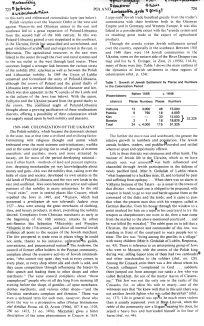
Through the arenda system Jewish settlements spread over the
country, especially in the southeast. Between 1503 and 1648
there were 114 Jewish communities in the Ukraine, some on the
eastern side of the River Dnieper (see map and list by S.
Ettinger, in: Zion, 21 (1956), 114-8); many of these were
tiny. Table 1 shows the main outlines of the dynamics of
Jewish settlement in these regions of colonization (ibid., p.
124):
Table 1.
Growth of Jewish Settlement by Places and Numbers
in the Colonization Period
|
Wojewódstwo
(district)
|
Before
1569
|
|
c.
1648
|
|
|
|
Places
|
Numbers
|
Places
|
Numbers
|
|
Volhynia
|
13xxxxxx
|
3,000xxxxx |
46xxxxx |
15,000xxxxxx |
|
Podolia
|
9xxxxxx |
750xxxxx |
18xxxxx |
4,000xxxxxx |
|
Kiev
|
-xxxxxx |
-xxxxx |
33xxxxx |
13,500xxxxxx |
32,325
|
Bratslav
|
2xxxxxx |
?xxxxx |
18xxxxx |
18,825xxxxxx |
|
|
|
|
|
|
Total
|
24xxxxxx |
c.
4,000xxxxx |
115xxxxx |
51,325xxxxxx |
|
from: from: Poland; In: Encyclopaedia Judaica
1971, vol. 13, col. 724
|
The further the move east and southward, the greater the
relative growth in numbers and population. The Jewish arenda
holders, traders, and peddlers traveled and settled wherever
space and opportunity offered.
Life in these districts was strenuous and often harsh. The
manner of Jewish life in the Ukraine, which as we have already
seen was uncouth [[rough]], was both influenced and channeled
through Jewish participation in the defense of newly pacified
land. Meir b. Gedaliah of Lublin relates
"what happened to a luckless man, ill, and tortured by pain
and suffering from epilepsy ... When there was an alarm in
Volhynia because of the Tatars - as is usual in the towns of
that district - when each one is obliged to be prepared, with
weapon in hand, to go to war and battle against them at the
command of the duke and the lords; and it came to pass that
when the present man shot with his weapon, called in German Buechse [[tin]], from his
house through the window to a point marked for him on a rope
in his courtyard to try the weapon as sharpshooters are wont
to do, then a man came from the market to the above mentioned
courtyard ... and he was killed [by mistake]."
The rabbi goes on to tell that a Christian, the instructor and
commander of this Jew, was standing in front of the courtyard
to warn people not to enter. The Jew was "living among the
gentiles in a village" with many children (Meir b. Gedaliah of
Lublin, Responsa, no. 43).
[Alcohol trade - Jews in the
Cossack army - daily violence]
There is reference to an enterprising group of Jews who went
to Moscow with the armies of the Polish king during war,
selling liquor (one of them had two cartloads) and other
merchandise to the soldiers (ibid., no. 128).
Among the Cossack units there was a Jews about whom his
Cossack colleagues "complained to God ... suddenly there
jumped out from amongst our ranks a Jews who was called
Berakhah, the son of the martyr Aaron of Cieszewiec."
This Jews was not the only one in the ranks of the Cossacks,
for - to allow his wife to marry - one of the witnesses says
that "he knew well that in this unit there was not another
Jewish fighter who was called Berakhah" (ibid., no. 137).
Life in general was apt [[tended]] to be much more violent
than is usually supposed: even at Brest-Litovsk, when the rebbe [[private teacher]]
of the community saw a litigant [[head of the court]] nearing
his door, he seized a heavy box and barricaded himself in for
fear of harm (ibid., no. 44). (col. 724)
[Mill rights, alcohol rights,
and milk rights - sabbath resolution in Volhynia in 1602]
Arenda did more than give a new basis to the existence of many
Jewish families; it brought the Jews into contact with village
life and often combined with aspects of their internal
organizational structure. Thus, the Jews Nahum b. Moses, as
well as renting the mills, the tavern, and the right of
preparing beer and brandy, also rented for one year all milk
produce of the livestock on the manors [[knight's
territories]] and villages. Elaborate and complicated
arrangement were made for payment and collection of these milk
products (S. Inglot, in: Studja
z historji spolecnej i gospodarczej poświȩcone prof.
Franciszkowi Bujakowi (1931), 179-82; cf. 205,
208-9). In contact with village life, the Jews sometimes
formed a sentimental attachment to his neighbors and his
surroundings.
In 1602 a council of leaders of Jewish communities in Volhynia
tried to convince Jewish arendars to let the peasants rest on
Saturday though the Polish nobleman would certainly have given
them the right to compel them to work:
"If the villagers are obliged to work all the week through, he
should let them rest on Sabbath and the Holy Days throughout.
See, while living in exile and under the Egyptian yoke, our
parents chose this Saturday for a day of rest while they were
not yet commanded about it, and heaven helped them to make it
a day of rest for ever. Therefore, where gentiles are under
their authority they are obliged to fulfill the commandment of
the Torah and the order of the sages not to come, God forbid,
to be ungrateful [livot]
to the One who has given them plenty of good by means of
the very plenty he has given them. Let God's name be
sanctified by them and not defiled" (H.H. Ben-Sasson, in:
Zion, 21 (1956), 205).
[The nobles found a network
of "private towns" - and Jews are assisting - Christian
resistance provokes new Jewish towns - first network of
Jewish towns]
The interests of the Jews and Polish magnates coincided and
complemented each other in one most important aspect of the
economic and social activity of the Polish-Lithuanian
nobility. On their huge estates the nobles began to establish
and encourage the development of new townships, creating a
network of "private towns". Because of the nature of their
relationship with their own peasant population they were keen
to attract settlers from afar [[from far away]], and Jews well
suited their plans. The tempo and scale of expansion were
great; in the grand duchy of Lithuania alone in the first half
of the 17th century between 770 and 900 such townships (miasteczki) existed (S.
Aleksandrowicz, in: Roczniki
dziejów spolecznych i gospadarczych, 27 (1965),
35-65). For their part, the Jews, who were hard pressed by the
enmity of the populace [[mob]] in the old royal cities, gladly
moved to places where they sometimes became the majority, in
some cases even the whole, of the population.
Since these were situated near the hinterland of agricultural
produce and potential customers, Jewish initiative and
innovation found a new outlet [[sector of activity]]. Through
charters granted by kings and magnates to communities and
settlers in these new towns, the real legal status of the Jews
gradually changed very much for the better. By the second half
of thee 17th century everywhere in Poland Jews had become part
of "the third estate" and in some places and in some respects
the only one.
Jews continued to hold customs stations openly in Lithuania,
in defiance of [[without considering]] the wishes of their
leaders in Poland (see Councils of the Lands). Many custom
station ledgers [[stoned monuments]] were written in Hebrew
script and contained Hebrew terms (see R. Mahler, in YIVO Historishe Shriftn
[[Yidd.: YIVO Historical Reports]], 2 (1937), 180-205).
Sometimes a Jew is found with a "sleeping partner", a Pole or
Armenian in whose name the customs lease has been taken out.
That some customs stations were in Jewish hands was also of
assistance to Jewish trade.
This complex structure of large-scale export and import trade,
the active and sometimes adventurous participation in the
colonization of the Ukraine and in the shaping of the "private
cities", in the fulfilling of what today we would call state
economic functions, created for the first time in the (col.
725)
history of Ashkenazi Jewry a broad base of population,
settlement distribution, and means of livelihood, which
provided changed conditions for the cultural and religious
life of Jews. Even after the destruction wrought by the
*Chmielnicki massacres enough remained to form the nucleus of
later Ashkenazi Jewry. The later style of life in the Jewish *shtetl [[Yidd.: little
town]] was based on achievements and progress made at this
time.
INTERNAL JEWISH LIFE.
[Jewish councils - fairs -
creativity]
The Councils of the Lands, the great superstructure [[head of
the structure]] of Jewish *autonomy, were an outgrowth
[[separate branch]] of such dynamics of economy and
settlement. Beginning with attempts at centralized leaderships
imposed from above, appointed by the king, they ended with a
central elected Jewish leadership. The aims, methods, and
institutions of this leadership were intertwined with the new
economic structure.
Great fairs - notably those of Lublin and Jaroslaw - since
they attracted the richest and most active element of the
Jewish population, also served as the meeting place of the
councils. Throughout its existence the Council of the Province
of Lithuania cooperated with its three (later five) leading
communities through a continuous correspondence with them and
between each of them and the smaller communities under its
authority.
Here the council was adapting the organizational methods of
large-scale trade to the leadership structure. The concern of
the councils with the new economic phenomena, like arenda, is
well known. They also concerned themselves with matters of
security and morals which arose from the thin spread of Jewish
families in Christian townships and villages.
On the whole, up to 1648 a sense of achievement and creativity
pervades their enterprises and thought. A preacher of that
time, Jedidiah b. Israel *Gottlieb, inveighed against a man's
gathering up riches for his children, using the argument of
the self-made man:
"The land is wide open, let them be mighty in it, settle and
trade in it, then they will not be sluggards, lazy workers,
children relying on their father's inheritance, but they
themselves will try ... to bring income to their homes, in
particular because every kind of riches coming through
inheritance does not stay in their hands ... easy come, easy
go ... through their laziness ... they have to be admonished
... to be mighty in the land through their trading: their
strength and might shall bring them riches" (Shir Yedidut
(Cracow, 1644), Zeidah la-Derekh, fol. 24a).
[Growing Jewish population -
influx of Jewish refugees]
This buoyancy [[holding force]] was based on a continuous
growth of population throughout the 16th and the first half of
the 17th centuries, due both to a steady natural increase
thanks to improving conditions of life and to immigration from
abroad resulting from persecution and expulsions (e.g., that
from Bohemia-Moravia for a short period in 1542). As noted,
the growth was most intensive in the eastern and southeastern
areas of Poland-Lithuania, and it was distributed through the
growing dispersion [[expansion]] of Jews in the "private
cities" and in the villages.
At the end of the 16th century, Great Poland and Masovia
(Mazowsze) contained 52 communities, Lesser Poland 41, and the
Ukraine, Volhynia, and Podolia about 80; around 1648, the
latter region had 115 communities. From about 100,000 persons
in 1578 the Jewish population had grown to approximately
300,000 around 1648. It is estimated that the Jews formed
about 2.5-3% of the entire population of Poland, but they
constituted between 10% an 15% of the urban population in
Poland and 20% of the same in Lithuania.
[Jewish economy and
difficulties: trials, depths and methods for a "good name
for credit"]
The dynamics of Jewish economic life are evident not only in
the variety and success of their activities, but also in
certain specific institutions and problems that reveal the
tension behind their strain for economic goals which tended to
entail [[to cause]] risks. By the end of the 16th century,
Jews were (col. 726)
borrowers rather than lenders. Seventeenth-century
anti-Semites - Miczyński and Mojecki - accused Jews of
borrowing beyond their means and deceiving Christian lenders.
From their accusations it is clear that much of this credit
was not in ready cash but in goods given to Jewish merchants
on credit. Borrowing was a real problem with which the Jewish
leadership was much concerned. Many ordinances of the Councils
of the Lands, of the provincial councils, and of single
communities are preoccupied with preventing and punishing
bankruptcy. Great efforts were devoted to prevent non-payment
of debts to Christians in particular. Young men who were
building up a family were especially suspected of reaching
beyond their means. These ordinances tell in their own way the
story of a burgeoning economy which is strained to dangerous
limits, inciting in particular the young and the daring. A
good name for credit was then a matter of life and death for
the Jewish merchant.
The great halakhist Solomon Luria was prepared to waive
[[renounce]] an ancient talmudic law in favor of the lender
because "now most of the living of the Jews is based on
credit; whereas most of those called merchants have little of
their own and what they have in their hands is really taken
from gentiles on credit for a fixed period - for they take
merchandise [on credit] till a certain date - it is not seemly
for a judge to sequester [[fix by law]] the property of a
merchant, for news of this may spread and he will lose the
source of his living and all his gentile creditors will come
on him together and he will be lost, God forbid, and merchants
will never trust him again.I myself have seen and heard about
many merchants - circumcised and uncircumcised - to whom,
because people said about them that they are a risk, much harm
was caused and they never again could stand at their posts" (Yam shel Shelomo, Bava Kamma,
ch. 1, para 20).
[Jews take credit with Jews -
and credit letters]
Because of the importance of credit the practice of a Jews
lending on interest to another Jew became widespread in
Poland-Lithuania despite the fact that it was contrary to
Jewish law (see *usury). This necessitated the creation
there of the legal fiction of hetter iskah, formulated by a synod of
rabbis and leaders under the chairmanship of Joshua b.
Alexander ha-Kohen *Falk in 1607. Widespread credit also led
to the use of letters of credit specific to the Jews of
Poland, the so-called *mamran
(Pol. membrana, membran): the Jew would sign on one
side of the paper and write on the other side "this letter of
credit obliges to signed overleaf for amount x to be paid on date y."
[Cultural life and reforms in
Poland-Lithuania in 16th and 17th century - spirits and
synagogues]
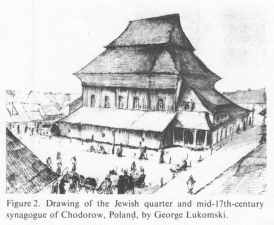
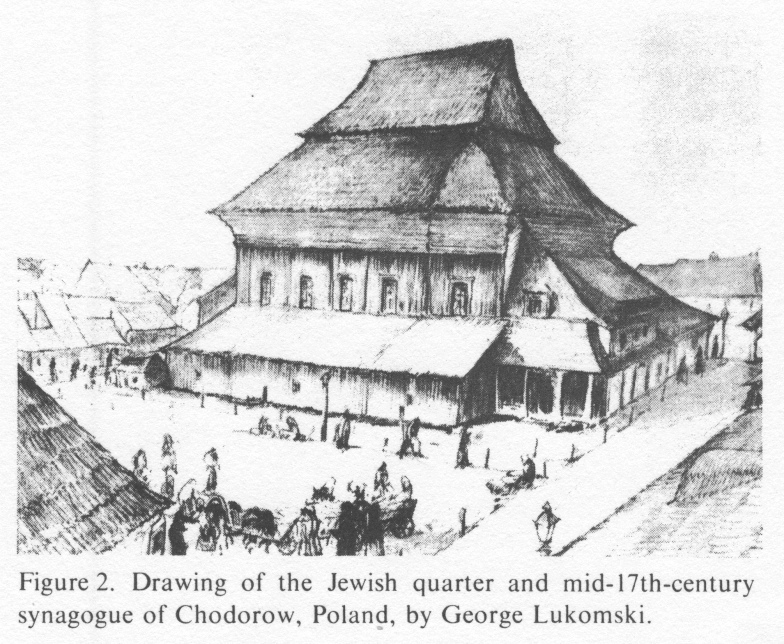
Encyclopaedia
Judaica (1971): Poland, vol. 13, col. 727. Drawing of the
Jewish quarter
and mid-17th-century synagogue of Chodorow, Poland, by
George Lukomski
Jewish cultural and social life flourished hand in hand with
the economic and demographic growth. In the 16th and early
17th centuries Poland-Lithuania became the main center of
Ashkenazi culture. Its *yeshivot [[religious Torah schools]]
were already famous at the beginning of the 16th century;
scholars like *Hayyim (Ḥayyim)b. Bezalel of Germany and David
b. Solomon *Gans of Prague were the pupils of *Shalom Shakhna
of Lublin and Moses Isserles of Cracow, respectively. Mordecai
b. Abraham *Jaffe; Abraham, Isaiah, and Jacob b. Abraham
*Horowitz; Eliezer b. Elijah *Ashkenazi; *Ephraim Solomon b.
Aaron Luntshits; and Solomon Luria were only a few of the
great luminaries of talmudic scholarship and moralistic
preaching in Poland-Lithuania of that time. Councils of the
Lands and community ordinances show in great detail of not the
reality at least the ideal of widespread Torah study supported
by the people in general.
This culture was fraught with great social and moral tensions.
Old Ashkenazi ascetic ideas did not sit too well on the
affluent and economically activist Polish-Lithuanian Jewish
society. Meetings with representatives of the Polish
*Reformation movement, in particular with groups and
representatives of the anti-trinitarian wing like Marcin
Czechowic or Szymon *Budny, led to disputations (col. 729)
and reciprocal influence. Outstanding in these contacts on the
Jewish side was the Karaite Isaac b. Abraham *Troki, whose Hizzuk Emunah (Ḥizzuk Emunah)
sums up the tensions in Jewish thought in the divided
Christian religious world of Poland-Lithuania. It was Moses
Isserles who formulated the Ashkenazi modifications and
additions to the code of the Sephardi Joseph Caro. Isaiah b.
Abraham ha-Levi *Horowitz summed up in his Shenei Luhot (Luḥot) ha-Berit
the moral and mystic teaching of the upper circles of
Ashkenazi Jewry. Yet his writings, and even more so the
writings of Isserles, give expression to the tensions and
compromises between rationalism and mysticism, between rich
and poor, between leadership and individual rights. To all
these tensions, Ephraim Solomon Luntshits gave sharp voice in
his eloquent sermons, standing always on the side of the poor
against the rich and warning consistently against the danger
of hypocrisy and self-righteousness. Fortifies and wooden
synagogues expressed the needs and the aesthetic sense of
Jewish society of that time.
In the old "royal cities" magnificent synagogue buildings were
erected as early as the 16th century (e.g. the Rema synagogue
at Cracow and the Great Synagogue of Lvov). Hebrew manuscripts
were brought from abroad and some of them illuminated
[[explained]] in Poland. Jewish printing developed early and
many beautiful works were published. Various sources describe
carnivallike Purim celebrations, and the fun, irony, and joy
of life expressed in now lost folk songs and popular games and
dramas.> (col. 730)
Sources
|
Encyclopaedia Judaica (1971): Poland, vol. 13, col.
717-718
|
Encyclopaedia Judaica (1971): Poland, vol. 13, col.
719-720
|
Encyclopaedia Judaica (1971): Poland, vol. 13, col.
721-722
|
Encyclopaedia Judaica (1971): Poland, vol. 13, col.
723-724
|
Encyclopaedia Judaica (1971): Poland, vol. 13, col.
725-726
|
Encyclopaedia Judaica (1971): Poland, vol. 13, col.
727-728
|
Encyclopaedia Judaica (1971): Poland, vol. 13, col.
729-730
|
|
Č Ḥ
Ł Š Ṭ Ẓ Ż
ā ć č ẹ ȩ ę ḥ ī ł ń
ś š ū ž ż ẓ
^