Encyclopaedia Judaica
Jews in Poland
04: 1919-1939
Borderlines and anti-Semitic state's policy of
"independent" anti-Semitic Poland in the name of
"nationalism" - numerus clausus, discriminations -
emigration wave - racist Zionists and anti-Zionists
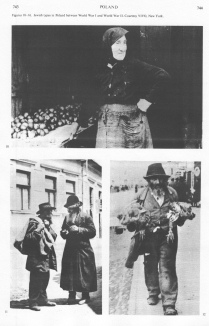
![Encyclopaedia Judaica (1971): Poland, vol. 13,
col. 743-744. [[Jewish women at a market place selling
apples]]. Jewish type in Poland between World War I
and World War II. Courtesy YIVO, New York](../d/EncJud_juden-in-Polen-d/EncJud_Poland-band13-kolonne743-744-juedin-apfelverkaeuferin1919-1939-45pr.jpg "Encyclopaedia Judaica (1971): Poland, vol. 13,
col. 743-744. [[Jewish women at a market place selling
apples]]. Jewish type in Poland between World War I
and World War II. Courtesy YIVO, New York")

Encyclopaedia
Judaica (1971): Poland, vol. 13, col. 743-744. [[Jewish
women at a market
place selling apples]]. Jewish type in Poland between
World War I
and World War II. Courtesy YIVO, New York
from: Poland; In: Encyclopaedia Judaica 1971, vol. 13
presented by Michael Palomino (2008)
[[The anti-Semitic Church is the main force of anti-Semitism -
the anti-Semitic Church as the main cause of anti-Semitism -
the anti-Semitic Church is never mentioned in the article]].
[Borderlines of "independent"
Poland since 1919]
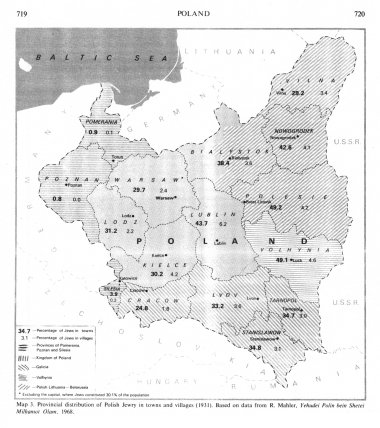
Encyclopaedia
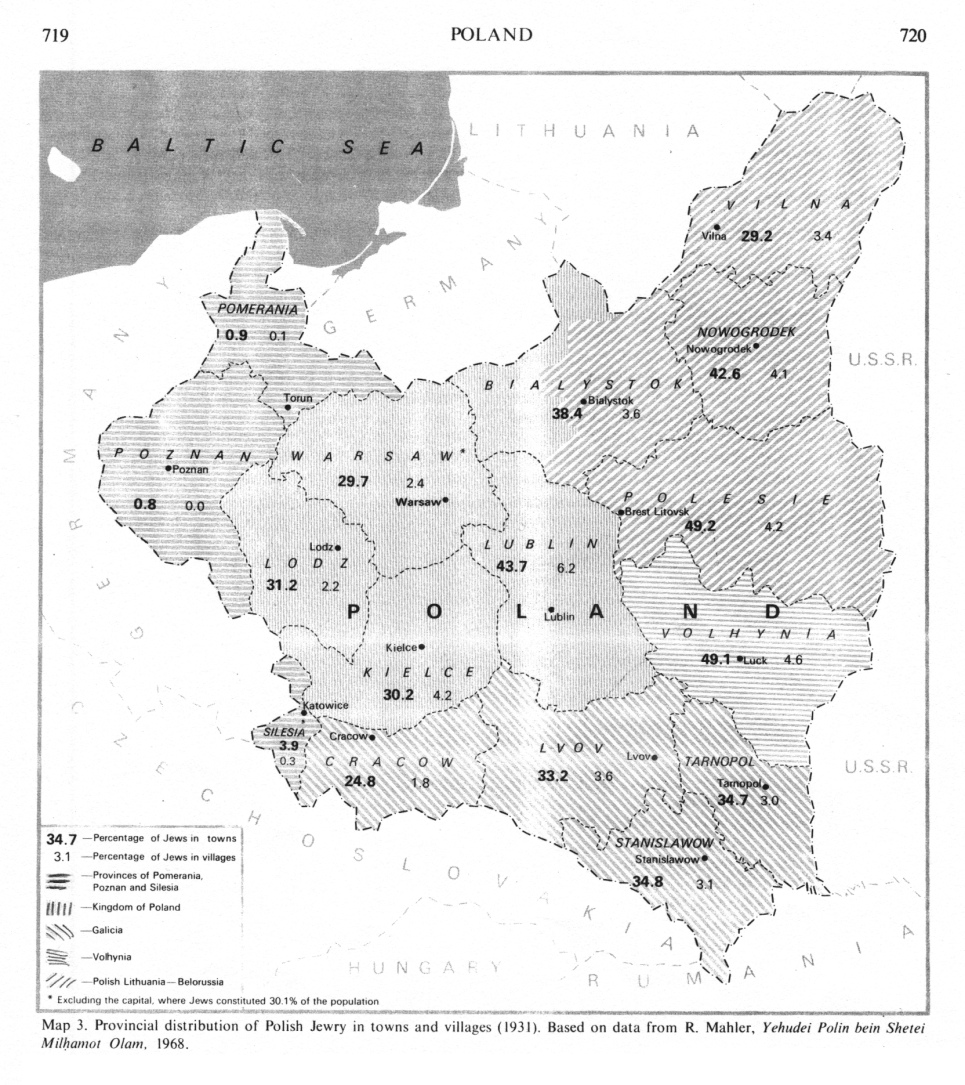
Judaica (1971): Poland, vol. 13, col. 719-720. Map of Poland
with the Provincial
distribution of Polish Jewry in towns and villages (1931).
Based on data from R. Mahler:
"Yehudei Polin bein Shetei Milhamot Olam", 1968
<INDEPENDENT POLAND.
As a result of World War I and the unexpected collapse of the
three partitioning powers, Poland was reconstituted as a
sovereign state. The final boundaries, not determined until
1921, represented something of a compromise between the
federalist dreams of Pilsudski and the more ethnic Polish
conception of R. *Dmowski. To Congress Poland, purely Polish
save for its large Jewish minority, were added Galicia,
Poznania, Pomerania, parts of Silesia, areas formerly part of
the Russian northwestern region, and the Ukrainian province of
Volhynia. The new state was approximately one-third
non-Polish, the important minorities being the Ukrainians,
Jews, Belorussians, and Germans.
[Polish nationalism with
anti-Jewish propaganda is going on - pogroms, e.g. Lvov 1918
and Vilna 1919]
The heritage of the war years was a particularly tragic one
for Polish Jewry. The rebirth of Poland, which many Jews had
hoped for, was accompanied by a campaign of terror directed by
the Poles (as by the invading Russian army in the early years
of the war) against them. The Jews too often found themselves
caught between opposing armies - between the Poles and the
Lithuanians in Vilna, between the Poles and the Ukrainians in
Lvov, and between the Poles and the Bolsheviks during the war
of 1920. And it is probably no accident that the two major
pogroms of this period, in Lvov in 1918 and in Vilna in 1919,
occurred in multi-national areas where national feelings
reached their greatest heights.
The triumph of Polish nationalism, far from leading to a
rapprochement between Jews and Poles, created a legacy of
bitterness which cast its shadow over the entire interwar
period. For the Poles the war years proved that the Jews were
"anti-Polish", "pro-Ukrainian", "pro-Bolshevik", etc. For the
Jews the independence of Poland was associated with pogroms.
[[Add to this the Russian markets were cut by the new
borderlines and the fight of the systems, and also
Austria-Hungary was parted into many national states which had
no intention to install a customs union. So the trade was
hindered by many borderlines, and the Russian market was lost
for the capitalist national states. By this the economies in
eastern Europe were never recovering and anti-Semitism had the
direct aim to eliminate the positions of the Jews, see Joint]].
[100,000 Jews killed in Ukrainian Polish war
1919-1921]
<The sense of disaster was already deeply embedded in the
consciousness of European Jews by the events which followed
right after the end of World War I. The far greater horrors
of the Nazi Holocaust have by now half obscured the murder
of about (col. 1054)
one hundred thousand Jews,
including women and children, in the Russian-Polish
borderland, where Ukrainian and counter-revolutionary
Russian army units systematically engaged in killing Jews in
the years 1919-21. (col. 1055)>
(from: Encyclopaedia Judaica (1971): Zionism, vol. 16, col.
1054-1055)
[Foundation of Poland with
protection of minorities in the constitution - hope for
autonomy]
The legal situation of the Jews in independent Poland was, on
the surface, excellent. The Treaty of *Versailles, concluded
between the victorious powers and the new states, included
provisions protecting the national rights of minorities; in
the Polish treaty Jews wee specifically promised their own
schools and the Polish state promised to respect the Jewish
sabbath. The Polish constitution, too, declared that non-Poles
would be allowed to foster [[use]] their national traditions,
and formally abolished all discrimination due to religious,
racial, or (col. 738)
national differences. The Jews were recognized by the state as
a nationality, something the [[racist]] Zionists and other
Jewish nationalists had long fought for.
[[This was the basic fault of world policy: Jews are not a
nationality, but they are a religion. When they were seen as a
nationality, anybody could say they would be a strange
nationality]].
There were great hopes [[of the racist Zionists]] that the
Jews would be allowed to develop their own national
institutions on the basis of national autonomy. These hopes
were not fulfilled.
[No acknowledgment for Jewish
schools - numerus clausus and discriminations against the
strange Jewish nation]
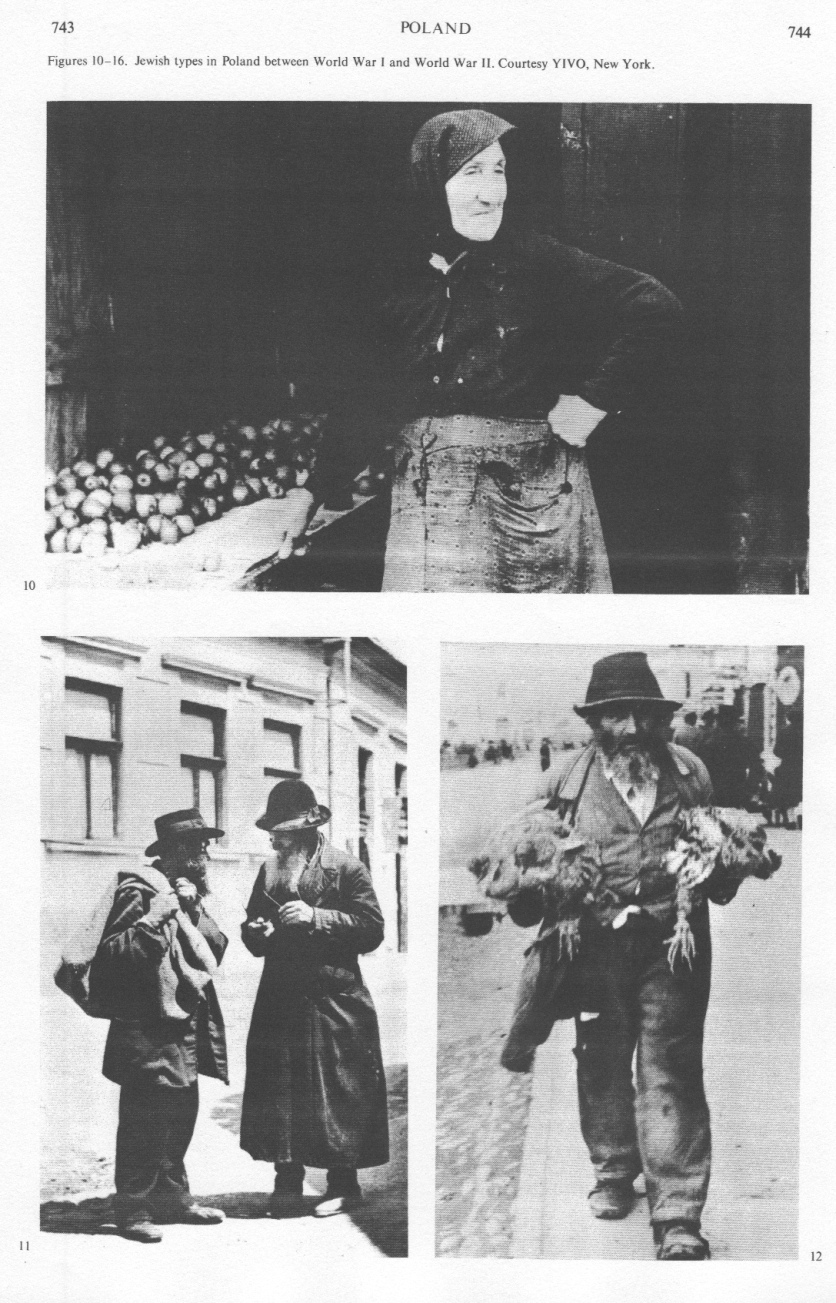
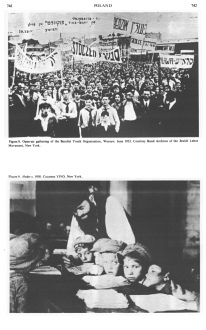
![Encyclopaedia Judaica (1971): Poland, vol. 13, col.
741-742. Heder (Ḥeder) [[Jewish religious school to age
of 13]] c. 1930. Courtesy YIVO, New York.](../d/EncJud_juden-in-Polen-d/EncJud_Poland-band13-kolonne741-742-heder-schule1930-35pr.jpg "Encyclopaedia Judaica (1971): Poland, vol. 13,
col. 741-742. Heder (Ḥeder) [[Jewish religious school to
age of 13]] c. 1930. Courtesy YIVO, New York.")
Encyclopaedia
Judaica (1971): Poland, vol. 13, col. 741-742. Heder (Ḥeder)
[[Jewish religious school to age of 13]] c. 1930. Courtesy
YIVO, New York.
The two cornerstones of Jewish autonomy - the school and the kehillah [[congregation]]
(see *Community) - were not allowed to develop freely. The
state steadfastly refused to support Jewish schools, save for
[[with the exception of]] a relatively small number of
elementary schools closed on Saturday which possessed little
Jewish content. The Hebrew-language *Tarbut [[cultural]]
schools, along with the Yiddish-language CYSHO (see
*Education) network, were entirely dependent on Jewish
support, and the diplomas issued by the Jewish high schools
were not recognized by the Ministry of Education. The Jewish
schools were successful as pedagogical institutions, but the
absence of state support made it impossible for them to lay
the foundation for a thriving [[growing]] Jewish national
cultural life in Poland.
As for the kehillah
[[congregation]], projected by Jewish nationalists as the
organ of Jewish national autonomy on the local level, it was
kept in tight check by the government. While elections to the
kehillah were made
democratic, enabling all Jewish parties to participate on a
basis of equality, the government constantly intervened to
support its own candidates, usually those of the orthodox
*Agudat Israel. By the same token the government controlled
the budgets of the kehillot
[[congregations]]. These institutions remained essentially
what they had been in the preceding century, concerned above
all with the religious life of the community.
Far from barring discrimination against non-Poles, the policy
of the interwar Polish state was to promote the ethnic Polish
element at the expense of the national minorities, and above
all at the expense of the Jews, who were more vulnerable than
the essentially peasant Slav groups. The tradition of numerus clausus was
continued at the secondary school and university level,
efforts were made to deprive [[rob]] the "Litvaks" of Polish
citizenship, local authorities attempted to curb the use of
Yiddish and Hebrew at public meetings, and the Polish
electoral system clearly discriminated against all the
minorities.
All Jewish activities leading toward the advancement of Jewish
national life in Poland were combated;
[[The basic fault that to be Jewish is not a nation but is a religion is never
mentioned in Encyclopaedia Judaica]].
the government favored [[racist]] Zionism only insofar as it
preached emigration to Erez Israel (Ereẓ Israel) [[Land of
Israel]], and in domestic politics tended to support the
traditional Orthodoxy of Agudat Israel. Worst of all was the
economic policy of the state.
[[Emigration numbers are missing in this article]].
[Numbers]
![Encyclopaedia Judaica (1971): Poland, vol. 13, col.
744 [[Jew with chicken]]. Jewish type in Poland between
World War In and World War II. Courtesy YIVO, New York](../d/EncJud_juden-in-Polen-d/EncJud_Poland-band13-kolonne744-jude-m-poulets1919-1939-45pr.jpg "Encyclopaedia Judaica (1971): Poland, vol. 13,
col. 744 [[Jew with chicken]]. Jewish type in Poland
between World War In and World War II. Courtesy YIVO,
New York")
Encyclopaedia
Judaica (1971): Poland, vol. 13, col. 744 [[Jew with
chicken]]. Jewish type in
Poland between World War In and World War II. Courtesy YIVO,
New York
According to official statistics, most likely too low, Jews
made up 10.5% of the Polish population in 1921. The density of
their urban settlement was related to the general development
of the area. In less developed regions, such as East Galicia,
Lithuania, and Volhynia, the Jewish percentage in the cities
was very high, while in more developed [[industrialized and
destroyed]] areas, such as Central Poland (the old Congress
Poland), the existence of a strong native bourgeoisie caused
the Jewish percentage to be lower.
As for the Jewish village population, it too was higher in
backward areas, since the number of cities was naturally less.
There were, therefore, substantial Jewish village populations
in Galicia and Lithuania but not in the old Congress Poland
(with the exception of Lublin province, economically backward
in comparison with the other provinces of the region). The
most striking development in the demography of Polish Jewry
between the wars is the marked loss of ground in the cities
[[probably because of emigration by Danzig]]. Table 6
illustrates this point. (col. 739)
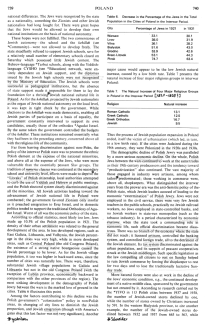
Table 6. Decrease in the Percentage of the
Jews in the Total Population in the Cities of
Poland in the Interwar Period.
|
City
|
Percentage
of
Jews in 1921
|
in
1931
|
Warsaw
|
33.1
|
30.1
|
Lvov
|
35.0
|
31.9
|
Vilna
|
36.1
|
28.2
|
Bialystok
|
51.6
|
43.0
|
Grodno
|
53.9
|
42.6
|
Brest-Litovsk
|
53.1
|
44.3
|
Pinsk
|
74.7
|
63.4
|
| from: Poland; In: Encyclopaedia Judaica 1971,
vol. 13, col. 740 |
[Colonization with Poles and
Jewish emigration wave]
Among the factors contributing to this decline was the Polish
government's "colonization" policy in non-Polish areas, its
changing of city lines to diminish the Jewish proportion, and
Jewish emigration (though with America's gates shut [[since
1924]] this last factor was [[concerning the criminal "USA"]]
not very significant).
[[The racist criminal "USA" restricted Jewish immigration in
1924. But it can be admitted that Jewish emigration was going
on under other nationality quotas by changing nationality with
forged documents which were easy to have by Jewish emigration
organizations in Poland. Mostly the young generation
emigrated]].
Another (col. 739)
major cause would appear to be the low Jewish natural
increase, caused by a low birth rate. [[This lower birthrate
was caused because of the high emigration of the young
generation. This is an indirect proof that emigration was
always going on and on also after 1924]].
Table 7 presents the natural increase of four major religious
groups in interwar Poland:
Table 7. The Natural Increase of Four Major
Religious Groups in Poland in the Interwar Period
[1920-1939?]
|
Religion
|
Natural
increase
[[in percent]]
|
Roman Catholicxxxxxxxxx
|
13.1%xxxxxxxxxxxxxxxxxxxxxxxxxxxxxx
|
Greek Catholic
|
12.5%xxxxxxxxxxxxxxxxxxxxxxxxxxxxxx |
Greek Orthodox
|
16.7%xxxxxxxxxxxxxxxxxxxxxxxxxxxxxx |
Jewish
|
9.5%xxxxxxxxxxxxxxxxxxxxxxxxxxxxxx |
| from: Poland; In: Encyclopaedia Judaica 1971,
vol. 13, col. 740 |
Thus the process of Jewish population expansion in Poland
ended, itself the victim of urbanization (which led, in turn,
to a low birth rate).
[[This urbanization is only one factor. Emigration of the
young generation is not mentioned, but is mentioned in many
other articles of the Encyclopaedia Judaica]].
If the cities were Judaized during the 19th century, they were
Polonized in the 1920s and 1930s.
[Professions - Polish system
controlling all economy - systematic discrimination of the
Jews since 1919]
The demographic decline of Polish Jewry was paralleled by a
more serious economic decline. On the whole, Polish Jews
between the wars continued to work at the same trades as their
19th-century predecessors and the tendency toward
"productivization" also continued. The vast majority of those
engaged in industry were artisans, among whom tailors
predominated; those working in commerce were, above all,
shopkeepers.
What distinguished the interwar years from the prewar era was
the anti-Semitic policy of the Polish state, which Jewish
leaders accused of leading to the economic "extermination" of
Polish Jewry. Jews were not employed in the civil service,
there were very few Jewish teachers in the public schools,
practically no Jewish railroad workers, no Jews employed in
state-controlled banks, and no Jewish workers in state-run
monopolies (such as the tobacco industry). In a period
characterized by economic étatism
[[a sort of absolutism]], when the state took a commanding
role in economic life, such official discrimination became
disastrous. There was no branch of the economy where the state
did not reach; it licensed artisans, controlled the banking
system, and controlled foreign trade, all to the detriment of
the Jewish element.
Its tax system discriminated against the urban population, and
its support of peasant cooperatives struck at the Jewish
middleman. Such specific legislation as the law compelling all
citizens to rest on Sunday helped to ruin Jewish commerce by
forcing the shopkeeper to rest for two days and to lose the
traditionally lucrative Sunday trade.
More natural forces were also at work in the decline of the
Jews' economic condition, e.g., the continued development of a
native middle class, sponsored by the government but not
created by it. According to research carried out by the *YIVO
in 113 Polish cities between 1937 and 1938, the number of
Jewish-owned stores declined by one, while the number of
stores owned by Christians increased by 591. In the western
Bialystok province, to cite another example, the number of the
Jewish -owned stores declined between 1932 and 1937 from 663
to 563, while (col. 740)
the number of Christian-owned stores rose from 58 to 310.
These figures reflect both the impact of anti-Semitism (in the
late 1930s the anti-Jewish boycott became effective) and the
impact of the developing Polish (and Ukrainian) middle class.
[[see also: *Boycott,
anti-Jewish]]
[[Whole eastern Europe with it's new borderlines and at the
cut borderline to Communist Russia wanted to get rid of the
Jews and were performing a heavy discrimination of the Jews.
Details about the anti-Semitic Polish policy since 1919 can be
seen in: Yehuda Bauer: Joint
(policy since 1919) and a whole
chapter
about anti-Semitic Poland (1919-1938)]
The Jews' economic collapse in the interwar period bears
witness to the disaster, from the Jewish point of view,
inherent [[existing in the center]] in the rise of exclusive
nation-states on the ruins of the old multinational empires.
Jews were employed in the old Austrian public schools of
Galicia, but not in the Polish state-operated schools. They
worked as clerks in the railroad offices of Austrian Galicia,
but not in Poland. Thousands of Jewish cigarette factory
workers in the old Russian Empire were dismissed when the
Polish state took over the tobacco monopoly. It also
demonstrates the extremely vulnerable position of the Jews
vis-à-vis the other Polish minorities, largely peasant nations
which did not compete with the Polish element. The urban
Jewish population found itself in a situation in which the
traditional small businessman was being squeezed out [[by
special taxes]], while the policy of the state also ruined the
wealthy Jewish merchant and industrialist. This was then the
end of a process already discernible [[developing]] in the
late 19th century, immeasurably [[without any limits]] speeded
up by a state which wanted to see all key economic positions
in the hands of "loyal" elements, i.e., Poles.
[[The Jewish aid organizations were organizing support by loan
kassas, and by this help it was possible that Polish Jewry
existed until 1939, see Yehuda Bauer: Joint]].
[Racist Zionism is dominating
Jewish life in Poland with over 50%]
What was the Jews' political response to this situation? In
the beginning of the interwar period the *General ZIonists
emerged as the strongest force within the Jewish community,
thus reflecting the general trend in eastern Europe toward
nationalism and, in the Jewish context, reflecting the impact
of the terrible war years. In the 1919 Sejm elections the list
of the Temporary Jewish National Council, dominated by
[[racist]] General Zionists, received more than 50% of those
votes cast for Jewish parties. In 1922, when Jewish
representation in the Sejm reached its peak, the percentage of
[[racist]] General Zionists (together with the *Mizrachi)
among the Jewish deputies was again over 50% (28 out of 46).
The Jewish Club (Kolo) in the Sejm, which claimed to speak for
all Polish Jewry, was naturally dominated by [[racist]]
General Zionists, who with considerable justice regarded
themselves as the legitimate spokesmen of the community.
[Fight of different racist
Zionist "schools": Gruenbaum and Reich arguing about tactics
against anti-Semites - split of racist Warsaw Zionists in
"radical Zionists" and "General Zionists"]
[[Racist]] General Zionism in Poland was divided into two
schools, that of "Warsaw-St. Petersburg" and that of
"Lvov-Cracow-Vienna". The former came of age in the
revolutionary atmosphere of the czarist regime and
consequently tended to be more extreme in its demands than the
Galicians, who had learned their politics in the Austrian
Reichsrat. The clash between Yizhak (Yiẓḥak) *Gruenbaum,
leader of the Warsaw faction, and Leon *Reich of Lvov was well
expressed in the negotiations carried on between the Jewish
Sejm Club and the Polish government in 1925. Gruenbaum,
rejecting negotiations with anti-Semites and offering instead
the idea of a national minorities bloc, found himself
outnumbered in the club by adherents of Reich's position,
namely that negotiations should be carried on in order to halt
the deterioration of the Jewish position. In the end neither
Gruenbaum's minorities bloc nor Reich's negotiations caused
any improvements; the tragedy of Jewish politics in Poland was
that the government would not make concessions to the Jews so
long as it was not forced to do so, and the Jews, representing
only 10% of the population, could find no allies.
All [[racist]] General Zionists agreed on the importance of
"work in the Diaspora", though Gruenbaum, the central figure
in this work, was castigated [[sharply criticized]] by
Palestinian pioneers as the apostle of "Sejm-Zionismus". They
did not agree, however, on various aspects of [[racist]]
Zionist policy; the efforts to broaden the *Jewish Agency and
the nature of the Fourth *Aliyah (col. 749)
caused a split within the [[racist]] Warsaw Zionists,
Gruenbaum leading the attack on Chaim *Weizmann and upholding
the young pioneering emigration while his opponents defended
the "bourgeois" aliyah
and Weizmann's conciliatory tactics toward non-Zionist Jewry.
Gruenbaum's faction, Al ha-Mishmar ("On Guard"), remained in
the minority throughout the 1920s, but the so-called
[[racist]] "radical Zionists returned to power in the 1930s
following the failure of the Agency reform, the crisis in the
Fourth Aliyah, and the stiffening of the British line in
Palestine. The [[racist]] General Zionists, of course, did not
monopolize Jewish political life in interwar Poland. On the
right, non-Zionist Orthodoxy was represented by the Agudat
Israel, which succeeded in dominating the Jewish kehillot
[[congregation]], but its generally good relations with the
government did not stem the anti-Semitic tide.
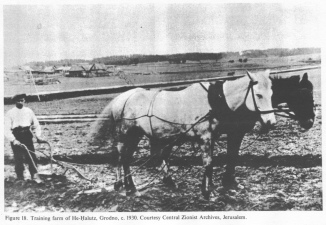
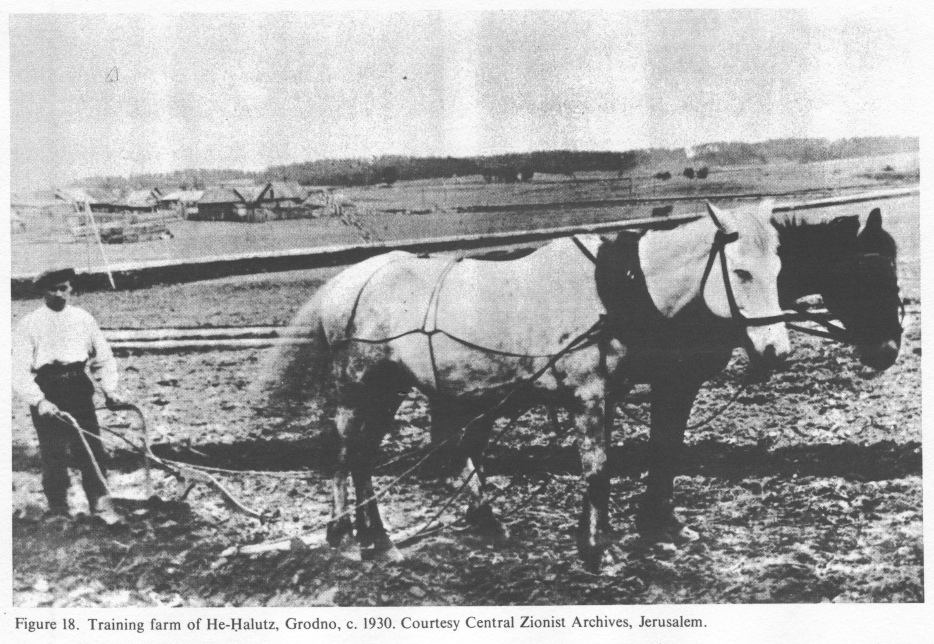
Encyclopaedia
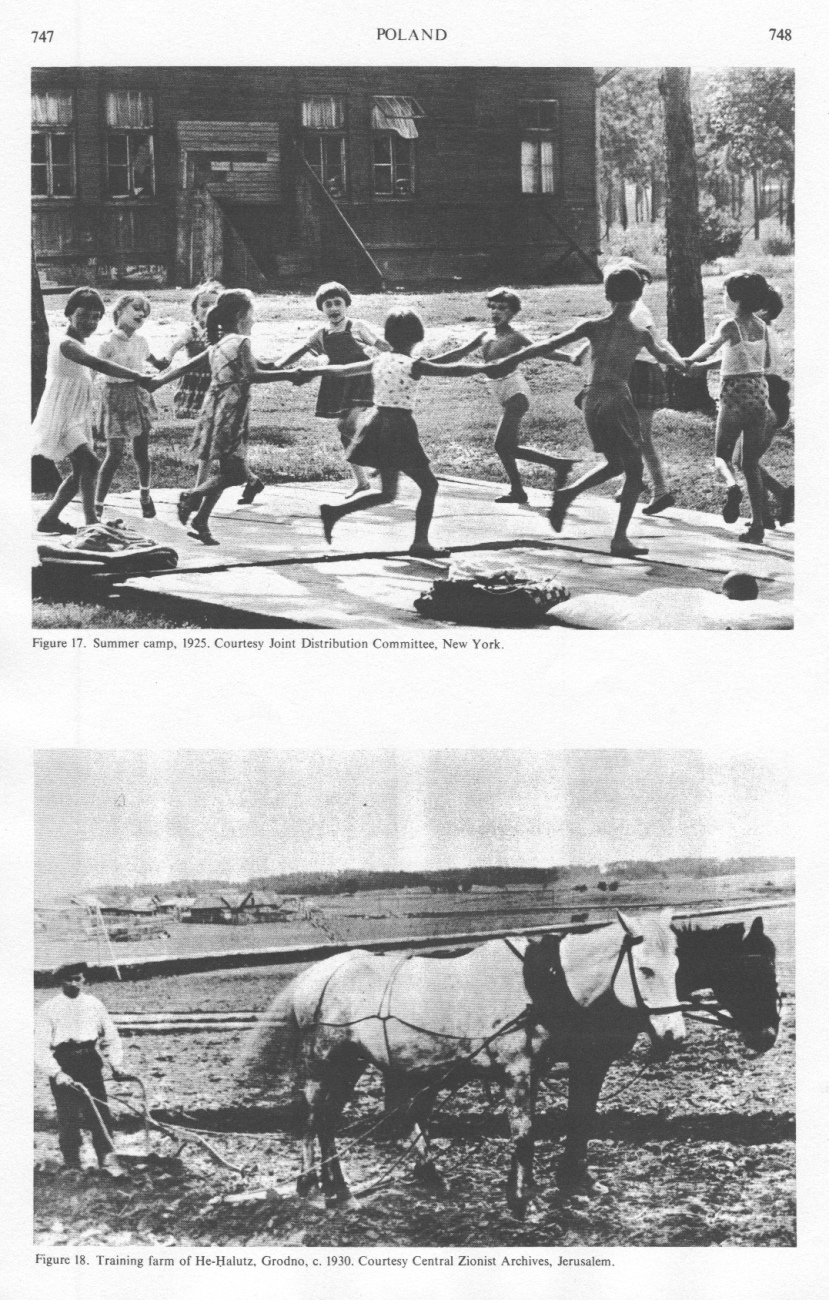
Judaica (1971): Poland, vol. 13, col. 747-748. Training farm
of He-Halutz,
Grodno, c. 1930. Courtesy Central Zionist Archives,
Jerusalem
[Anti-Zionist Socialist party
Bund - Yiddish culture]
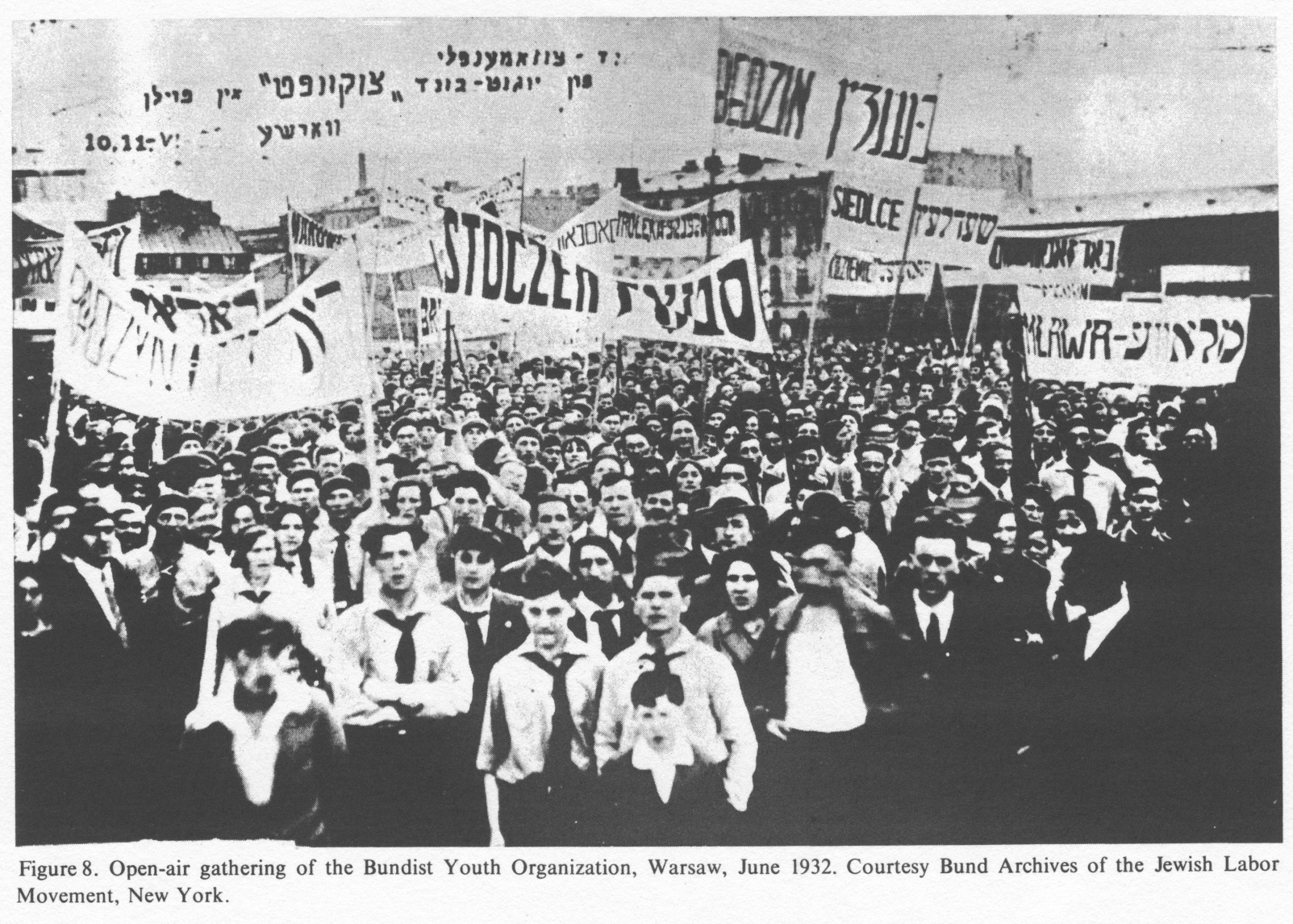
On the left the dominant Jewish party was the Bund, which had
disappeared in Russia but survived to play its last historic
role as the most important representative of the Jewish
proletariat in Poland. The Bund, like Gruenbaum's [[racist]]
Zionist faction, also recognized the need for allies in the
struggle for a just society in which, its leaders hoped, Jews
would be able to promote their Yiddish-based culture. Such
allies were sought on the Polish left rather than among the
disaffected minorities, but the Polish Socialist Party (PPS),
for reasons of its own, had no desire to be branded
[[exposed]] pro-Jewish. Unable to cerate a bloc with the
Polish proletariat, the Bund devoted itself to promoting the
interests of the Jewish working class and took a great
interest in the development of Yiddish culture. Despite the
fact that this party, too, was split into factions (the split
turned chiefly on different attitudes toward the international
Socialist movement), it was to grow in influence.
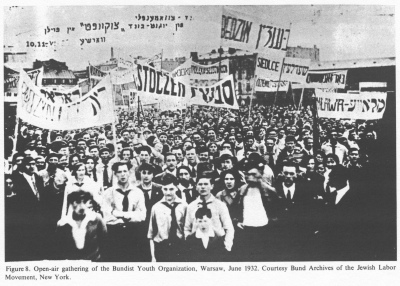
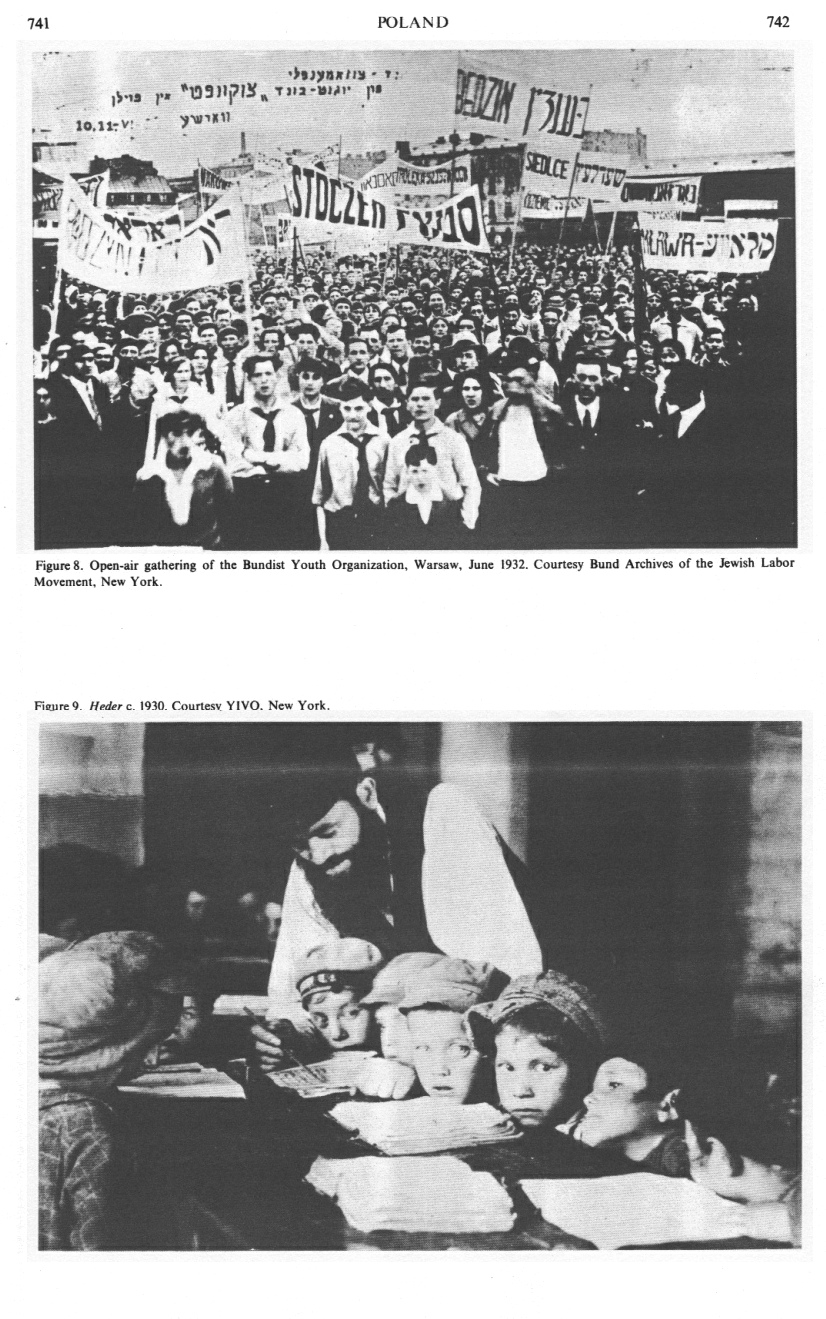
Encyclopaedia
Judaica (1971): Poland, vol. 13, col. 741-742. Open-air
gathering of the Bundist Youth Organization,
Warsaw, June 1932. Courtesy Bund Archives of the Jewish
Labor Movement, New York.
[Racist Socialist Zionist
parties]
Sharing the left with the Bund, though overshadowed by it in
terms of worker allegiance, were the various [[racist]]
Socialist Zionist parties, ranging from the non-Marxist
*Hitahadut (Hitaḥadut) to the leftist *Po'alei Zion (the
Po'alei Zion movement had split into right and left factions
in 1920; in Poland the left was dominant, at least in the
1920s). The moderate [[racist]] Socialist Zionists were
concerned mainly with the pioneering emigration to Erez Israel
(Ereẓ Israel), while the Left Po'alei Zion steered a perilous
course of non-affiliation either with the Zionist organization
or with the Socialist International. Its ideological
difficulties with the competition of the anti-Zionist Bund
(which went so far as to brand Zionism as an ally of Polish
anti-Semitism [[which in reality probably was because
anti-Semitism forced for emigration]]) sentenced the Left
P'alei Zion to a relatively minor role among the Jewish
proletariat, though its influence among the intelligentsia was
by no means negligible.
[Racist Orthodox Zionists:
Mizrachi - cultural *Folkspartei]
Two other Jewish parties deserve mention. The Polish Mizrachi,
representing the [[racist]] Zionist Orthodox population,
enjoyed a very large following (eight of its representatives
sat in the Sejm in 1922). The Mizrachi usually cooperated with
the [[racist]] General Zionists, though its particular mission
was to safeguard the religious interests of its followers in
Erez Israel (Ereẓ Israel) [[Land of Israel]] and in the
Diaspora.
The *Folkspartei, on the other hand, never managed to make an
impression on political life in Poland, though its
intellectual leadership was extremely influential on the
cultural scene. Both anti-Zionist and anti-Socialist, it could
never attain a mass following.
[Radicalization of racist
Zionism: large emigration wave in the mid-1930s - and Bund
coming up]
The economic collapse of Polish Jewry, together with the rise
of virulent anti-Semitism, led to the radicalization of Jewish
politics in Poland. Extreme solutions to the Jewish question
gained more adherents as the parliamentary approach clearly
failed to lead anywhere; hence the growth of the pioneering
[[racist]] Zionist movements - *He-Haluz (He-Ḥaluẓ), He-Haluz
ha-Za'ir (He-Ḥaluẓ ha-Ẓa'ir), *Ha-Shomer ha-Za'ir (Ha-Shomer
ha-Ẓa'ir), and others - resulting in the large-scale emigration to Erez
Israel (Ereẓ Israel) in the mid-1930s, and also the
inroads of Communism among the Jewish youth.
Another symptom of this radicalization (col. 750)
was the great success of the Bund in the 1930s; by the late
1930s the Bund had "conquered" a number of major kehillot
[[congregations]] and was probably justified in considering
itself the strongest of all Jewish parties. This spectacular
success did not occur as a result of any apparent party
success, since the efforts to improve the lot of the Jewish
proletariat and to forge a bloc with the Polish left had
failed. Rather, the Bund's success may be attributed to the
rising protest vote against attempts to mollify the regime and
in favor of an honorable defense, no matter how unavailing, of
Jewish interests.
[Changes within the racist
Zionist parties in Poland in the 1930s: Socialists and
Communists coming up]
Within the [[racist]] Zionist movement the process of
radicalization was very clearly illustrated by the decline of
the [[racist]] General Zionists and the rise of the Socialists
and the Revisionists. In the elections to the 18th [[racist]]
*Zionist Congress, held in 1933, the [[racist]] labor Zionists
of Central Poland received 38 mandates and the [[racist]]
General Zionists only 12. The same congress seated 20 Polish
Revisionists, whose growing strength faithfully reflected the
mood of Polish Jewry. In short, a transformation may be
discerned of what might be called the politics of hope into
the politics of despair. The slogans of haluziyyut (ḥaluẓiyyut)
("pioneering"), evacuation, and Communist ideology became more
and more palatable as the old hopes for Jewish autonomy and
the peaceful advancement of Jewish life in a democratic Poland
disappeared.
[Pogroms and boycotts since
1933]
![Encyclopaedia Judaica (1971): Poland, vol. 13, col.
743. [[Two Jews speaking in the street]]. Jewish types
in Poland between World War I and World War II. Courtesy
YIVO, New York](../d/EncJud_juden-in-Polen-d/EncJud_Poland-band13-kolonne743-2-juden1919-1939-36pr.jpg "Encyclopaedia Judaica (1971):
Poland, vol. 13, col. 743. [[Two Jews speaking in the
street]]. Jewish types in Poland between World War I and
World War II. Courtesy YIVO, New York")
Encyclopaedia
Judaica (1971): Poland, vol. 13, col. 743. [[Two Jews
speaking in the street]].
Jewish types in Poland between World War I and World War II.
Courtesy YIVO, New York
[[Pogroms and boycotts were traditional in Poland since 1919
already. The Situation since 1933 did not change much]].
By the late 1930s the handwriting was clearly on the wall for
Polish Jewry, though no one could foresee the horrors to come.
The rise of Hitler in Germany was paralleled by the appearance
of Fascist and semi-Fascist regimes in eastern Europe, not
excepting Poland. A new wave of pogroms erupted along with a
renewed anti-Jewish boycott, condoned [[accepted]] by the
authorities. The Jewish parties were helpless in the face of
this onslaught [[storm]], especially as the disturbances in
Erez Israel (Ereẓ Israel) resulted in a drastic decline in aliyah.
[[Emigration with changing names, changing nationality with
forged documents is not mentioned in this article but forged
documents could easy be provided by Jewish emigration
organizations. It can be admitted that emigration movement
continued under other nation quotas to overseas and to the
racist criminal "USA"]].
[Summary 1772-1939]
![Encyclopaedia Judaica (1971): Poland, vol. 13, col.
747-748. Summer camp, 1925 [[probably organized by the
Joint]]. Courtesy Joint Distribution Committee, New
York.](../d/EncJud_juden-in-Polen-d/EncJud_Poland-band13-kolonne747-748-Joint-sommerlager1925-34pr.jpg "Encyclopaedia Judaica (1971): Poland, vol.
13, col. 747-748. Summer camp, 1925 [[probably organized
by the Joint]]. Courtesy Joint Distribution Committee,
New York.")
Encyclopaedia
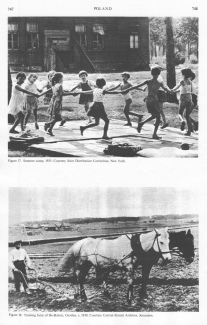
Judaica (1971): Poland, vol. 13, col. 747-748. Summer camp,
1925 [[probably organized by the Joint,
see: Yehuda Bauer:
Joint]].
Courtesy
Joint Distribution Committee, New York.
The political dilemma of Polish Jewry remained unresolved;
finding no allies, Jewish parties could do little to influence
the course of events. It should be recalled, however, that the
role of these parties was greater than the narrow word
"political" implies. Their work in raising the educational
standards of Polish Jewry was remarkable, and the Jewish youth
movements were able to supply to the new generation of Polish
Jews a sense of purpose and a certain vision of a brighter
future.
Polish Jewish history from 1772 to 1939, reveals an obvious
continuity. The Jews remained a basically urban element in a
largely peasant country, a distinct economic group, a minority
whose faith, language, and customs differed sharply from those
of the majority. All attempts to break down this
distinctiveness failed, and the Jews naturally suffered for
their obvious strangeness. A thin layer of assimilated, or
quasi-assimilated, Jews subsisted throughout the entire
period, but the masses were relatively unaffected by the
Polish orientation.
In the end all suffered equally from Polish anti-Semitism.
There were also several basic discontinuities. The rise of an
exclusively national Polish state in 1918 was a turning point
in the deterioration of the Jews' position, though the signs
of this deterioration were already visible in the late 19th
century. The rise of a native middle class, encouraged by
state policy, put an end to the Jews' domination of trade and
forced them into crafts and industry, resulting in the
emergence of a large Jewish proletariat.
Politically speaking perhaps the greatest change was the
triumph within the community of Jewish nationalism, whether
[[racist]] Zionist, [[Socialist anti-Zionist party]] Bundist,
or [[Capitalist anti-Zionist]] Folkist, at the expense of the
traditional assimilationist or Orthodox leadership. In this
sense Polish Jewry followed the same course of development as
the other peoples of eastern Europe. It was a tragic paradox
that these nationalist parties, which extolled the principle
of activism and denounced the (col. 751)
passivity of the Jewish past, also depended for their
effectiveness on outside forces. Neither the Polish government
nor the Polish left proved to be possible allies in the
struggle for survival.
[E.ME.]> (col. 752)
[[It seems to be strange that the work and the stock exchange
crash of 1929 is never mentioned in the article, see e.g.: Joint,
and the help and the donations of the Jewish aid organizations
not either, see: Joint.
Add to this the decisive role of the anti-Semitic "Christian"
Church is not mentioned either, see: Joint.
And there is never indicated how many Jews could emigrate, and
also general Jewish population figures for 1919-1939 - which
would be very important for the number of Jews of 1939 - are
only indicated for 1931, and about the emigration of 1931-1939
are no figures indicated]].
Sources
|
Encyclopaedia Judaica (1971): Poland, vol. 13, col.
737-738 |
Encyclopaedia Judaica (1971): Poland, vol. 13, col.
739-740
|
Encyclopaedia Judaica (1971): Poland, vol. 13, col.
741-742
|
Encyclopaedia Judaica (1971): Poland, vol. 13, col.
743-744
|
Encyclopaedia Judaica (1971): Poland, vol. 13, col.
745-746
|
Encyclopaedia Judaica (1971): Poland, vol. 13, col.
747-748
|
Encyclopaedia Judaica (1971): Poland, vol. 13, col.
749-750
|
Encyclopaedia Judaica (1971): Poland, vol. 13, col.
751-752 |
Č Ḥ
Ł Š Ṭ Ẓ Ż
ā ć č ẹ ȩ ę ḥ ī ł ń
ś š ū ž ż ẓ
^

 Encyclopaedia Judaica[[The anti-Semitic Church is the main force of anti-Semitism - the anti-Semitic Church as the main cause of anti-Semitism - the anti-Semitic Church is never mentioned in the article]].
![Encyclopaedia Judaica (1971): Poland, vol. 13,
col. 743-744. [[Jewish women at a market place selling
apples]]. Jewish type in Poland between World War I
and World War II. Courtesy YIVO, New York](../d/EncJud_juden-in-Polen-d/EncJud_Poland-band13-kolonne743-744-juedin-apfelverkaeuferin1919-1939.jpg "Encyclopaedia Judaica (1971): Poland, vol. 13,
col. 743-744. [[Jewish women at a market place selling
apples]]. Jewish type in Poland between World War I
and World War II. Courtesy YIVO, New York")
![Encyclopaedia Judaica (1971): Poland, vol. 13, col.
741-742. Heder (Ḥeder) [[Jewish religious school to age
of 13]] c. 1930. Courtesy YIVO, New York.](../d/EncJud_juden-in-Polen-d/EncJud_Poland-band13-kolonne741-742-heder-schule1930.jpg "Encyclopaedia Judaica (1971): Poland, vol. 13,
col. 741-742. Heder (Ḥeder) [[Jewish religious school to
age of 13]] c. 1930. Courtesy YIVO, New York.")
![Encyclopaedia Judaica (1971): Poland, vol. 13, col.
744 [[Jew with chicken]]. Jewish type in Poland between
World War In and World War II. Courtesy YIVO, New York](../d/EncJud_juden-in-Polen-d/EncJud_Poland-band13-kolonne744-jude-m-poulets1919-1939.jpg "Encyclopaedia Judaica (1971): Poland, vol. 13,
col. 744 [[Jew with chicken]]. Jewish type in Poland
between World War In and World War II. Courtesy YIVO,
New York")
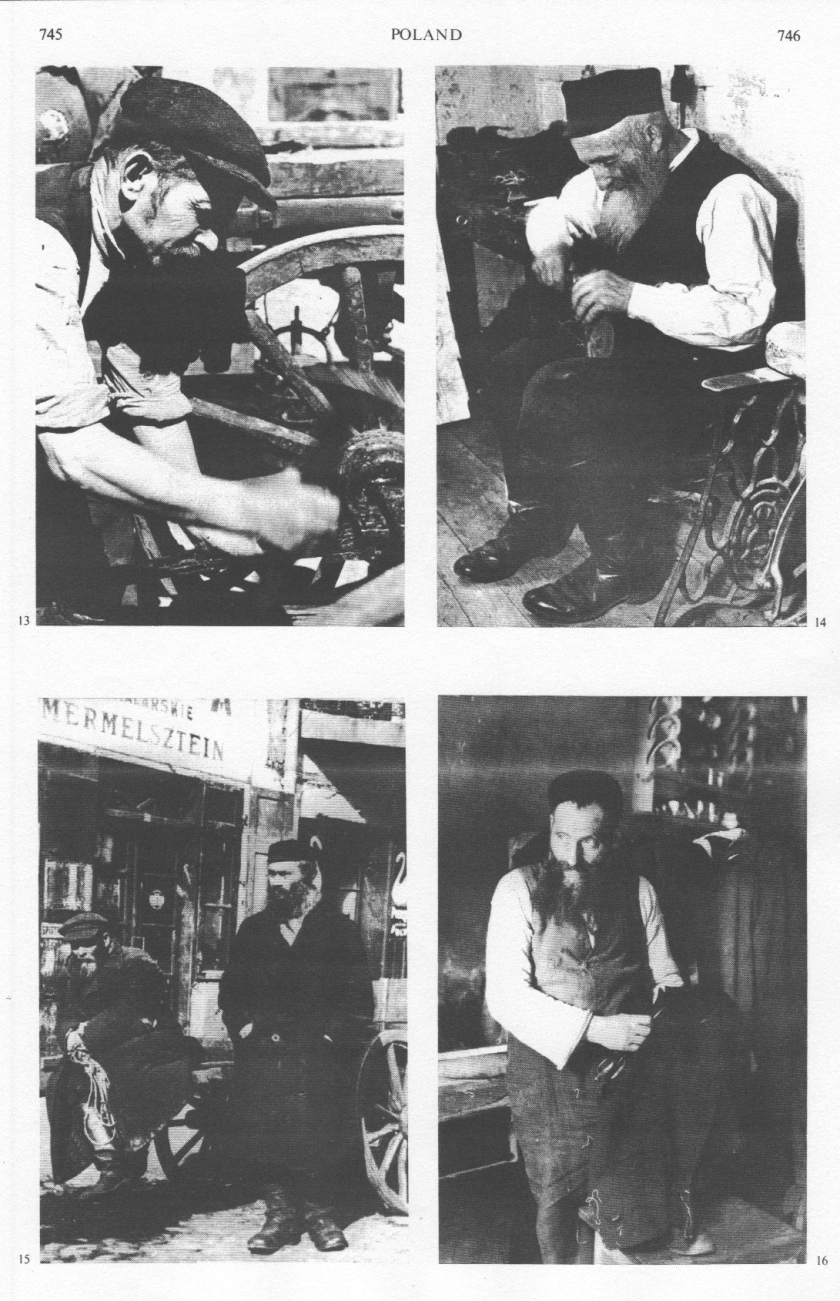
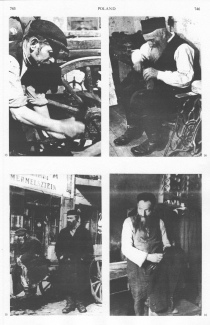
![Encyclopaedia Judaica (1971): Poland, vol.
13, col. 745. [[Jewish artisan]]. Jewish types
in Poland between World War In and World War II.
Courtesy YIVO, New York](../d/EncJud_juden-in-Polen-d/EncJud_Poland-band13-kolonne745-jude-schmied1919-1939.jpg "Encyclopaedia
Judaica (1971): Poland, vol. 13, col. 745.
[[Jewish artisan]]. Jewish types in Poland
between World War In and World War II. Courtesy
YIVO, New York")
![Encyclopaedia Judaica (1971): Poland, vol.
13, col. 746. [[Jewish shoemaker]]. Jewish types
in Poland between World War In and World War II.
Courtesy YIVO, New York](../d/EncJud_juden-in-Polen-d/EncJud_Poland-band13-kolonne746-jude-schuhmacher1919-1939.jpg "Encyclopaedia
Judaica (1971): Poland, vol. 13, col. 746.
[[Jewish shoemaker]]. Jewish types in Poland
between World War In and World War II. Courtesy
YIVO, New York")
![Encyclopaedia Judaica (1971): Poland, vol.
13, col. 745. [[Jewish transport]]. Jewish types
in Poland between World War In and World War II.
Courtesy YIVO, New York](../d/EncJud_juden-in-Polen-d/EncJud_Poland-band13-kolonne745-jude-transporteur1919-1939.jpg "Encyclopaedia
Judaica (1971): Poland, vol. 13, col. 745.
[[Jewish transport]]. Jewish types in Poland
between World War In and World War II. Courtesy
YIVO, New York")
![Encyclopaedia Judaica (1971): Poland, vol.
13, col. 745. [[Seems to be a Jewish tailor]].
Jewish types in Poland between World War In and
World War II. Courtesy YIVO, New York](../d/EncJud_juden-in-Polen-d/EncJud_Poland-band13-kolonne746-jude-schneider1919-1939.jpg "Encyclopaedia Judaica (1971): Poland,
vol. 13, col. 745. [[Seems to be a Jewish
tailor]]. Jewish types in Poland between World
War In and World War II. Courtesy YIVO, New
York")
![Encyclopaedia Judaica (1971): Poland, vol. 13, col.
743. [[Two Jews speaking in the street]]. Jewish types
in Poland between World War I and World War II. Courtesy
YIVO, New York](../d/EncJud_juden-in-Polen-d/EncJud_Poland-band13-kolonne743-2-juden1919-1939.jpg "Encyclopaedia Judaica (1971):
Poland, vol. 13, col. 743. [[Two Jews speaking in the
street]]. Jewish types in Poland between World War I and
World War II. Courtesy YIVO, New York")
![Encyclopaedia Judaica (1971): Poland, vol. 13, col.
747-748. Summer camp, 1925 [[probably organized by the
Joint]]. Courtesy Joint Distribution Committee, New
York.](../d/EncJud_juden-in-Polen-d/EncJud_Poland-band13-kolonne747-748-Joint-sommerlager1925.jpg "Encyclopaedia Judaica (1971): Poland, vol.
13, col. 747-748. Summer camp, 1925 [[probably organized
by the Joint]]. Courtesy Joint Distribution Committee,
New York.")