Encyclopaedia Judaica
Jews in Warsaw
02: Holocaust and post-war times
Discriminations - Warsaw ghetto
- underground work - underground institutions and
secret Jewish religious services - deportations -
armed resistance and Warsaw ghetto uprising 1943 -
Warsaw uprising 1944 - Jews coming back from central
Russia 1945-1946 - emigration waves 1946-1970
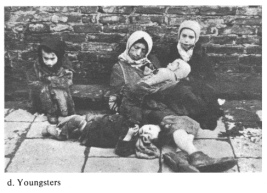

Encyclopaedia Judaica (1971):
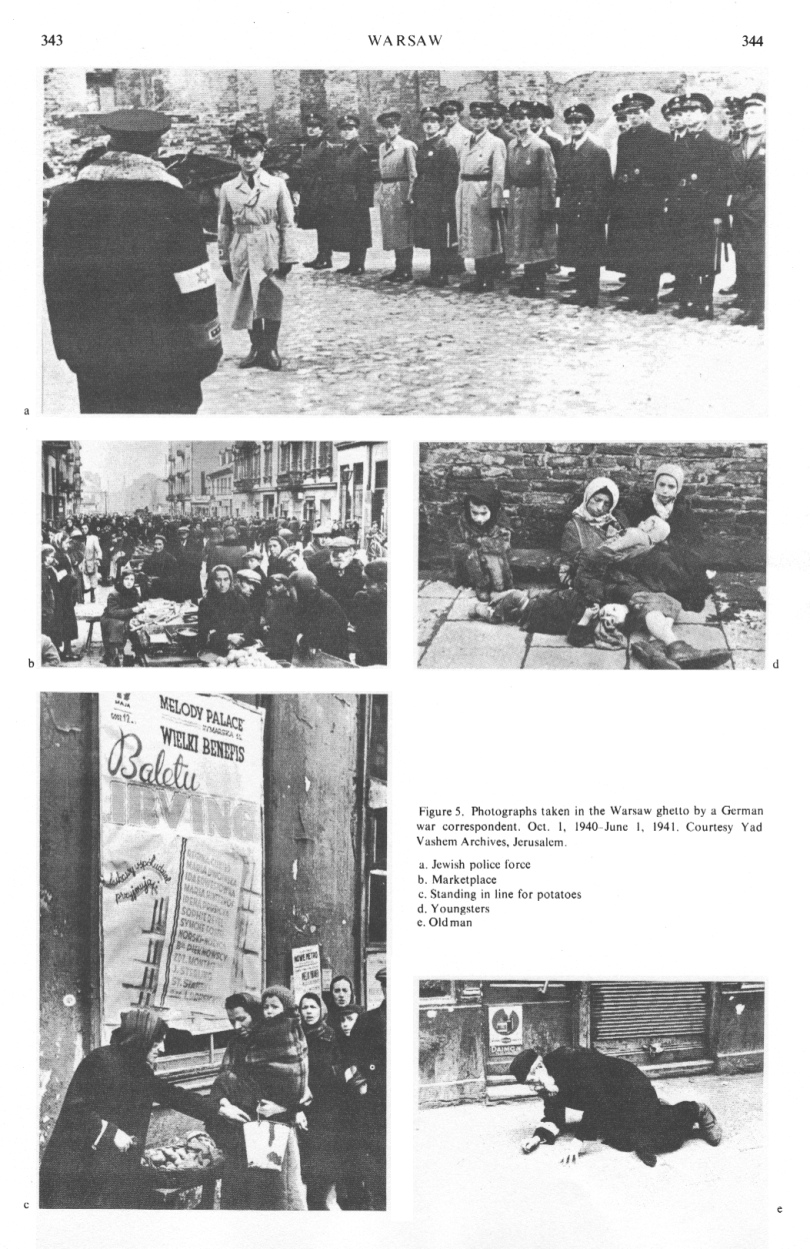
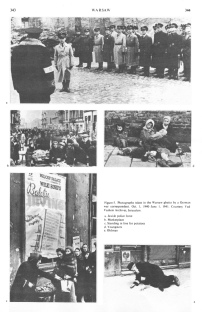
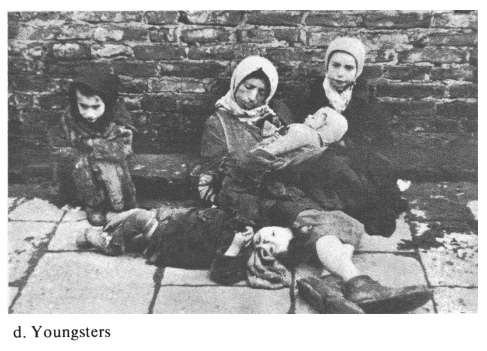
Warsaw, vol. 16, col. 344. Youngsters in the streets of
Warsaw ghetto.
Photo taken in the Warsaw ghetto by a German war
correspondent. Oct. 1, 1940-June 1, 1941.
Courtesy Yad Vashem Archives, Jerusalem.
from: Warsaw; In: Encyclopaedia Judaica 1971, vol. 16
presented by Michael Palomino (2008 / 2020)
<Holocaust Period.
[[The battle of Warsaw and the flight movements to eastern
Poland are missing in the article]].
[German discriminating law
against Jewry in Warsaw since October 1939]
When German forces entered the city on Sept. 29, 1939, there
were 393,950 Jews, comprising approximately one-third of the
city's population, living in Warsaw.
Between October 1939 and January 1940 the German occupation
authorities issued a series of anti-Jewish measures against
the Jewish population. These measured included
-- the introduction of forced labor;
-- the order that every Jew should wear a white armband with a
blue star of David [["Jewish Armband"]], and the special
marking of Jewish-owned businesses;
-- confiscation of Jewish real estate and other property;
-- and a prohibition against Jews using the railway and other
public transportation.
THE GHETTO. [340 hectares -
special permits - Jewish Council - German commissioner
Auerswald and bridge over Chlodna Street since 1941]
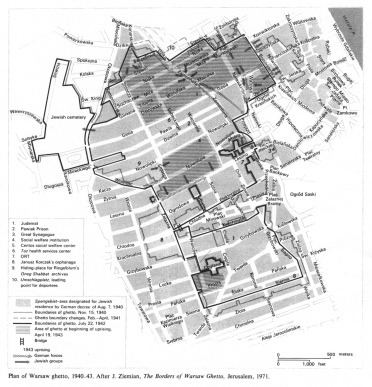 |
Encyclopaedia
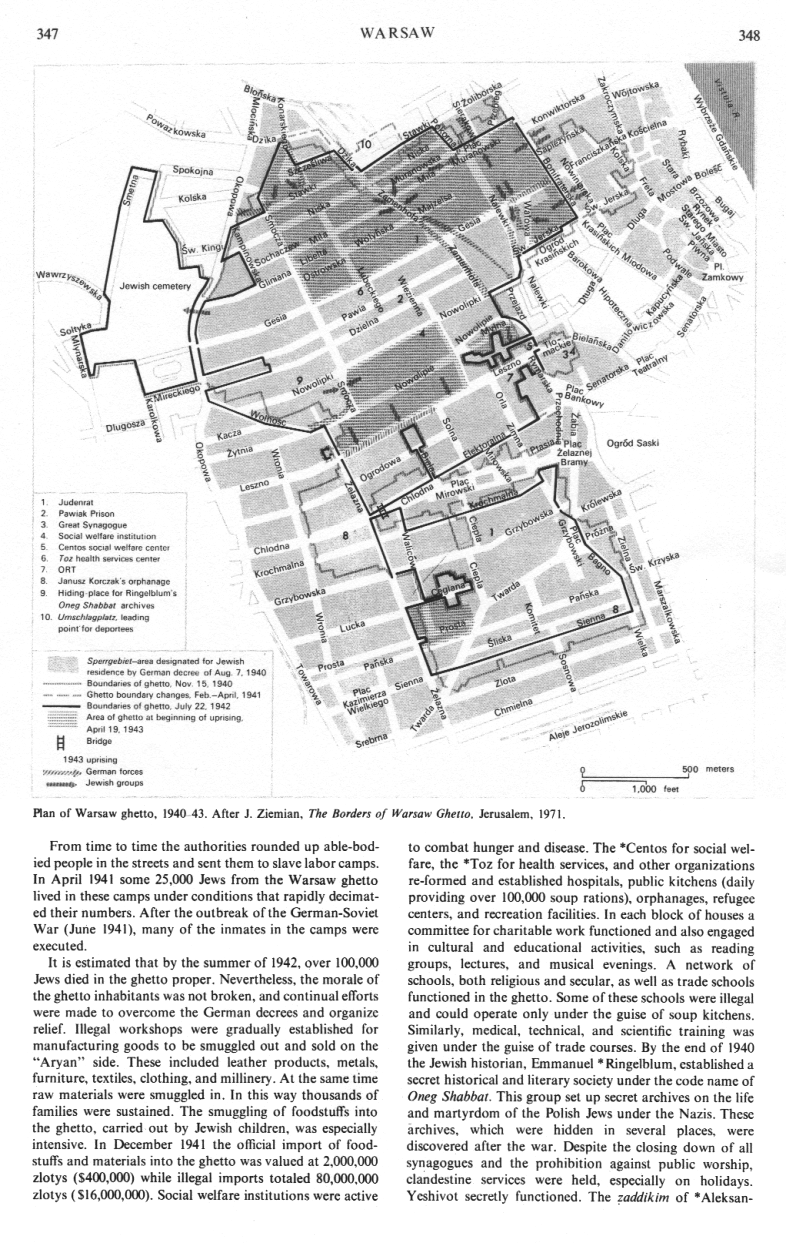
Judaica (1971): Warsaw, vol. 16, col. 347-348.
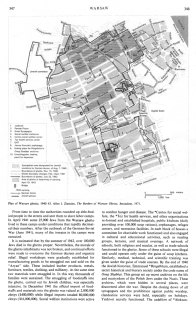
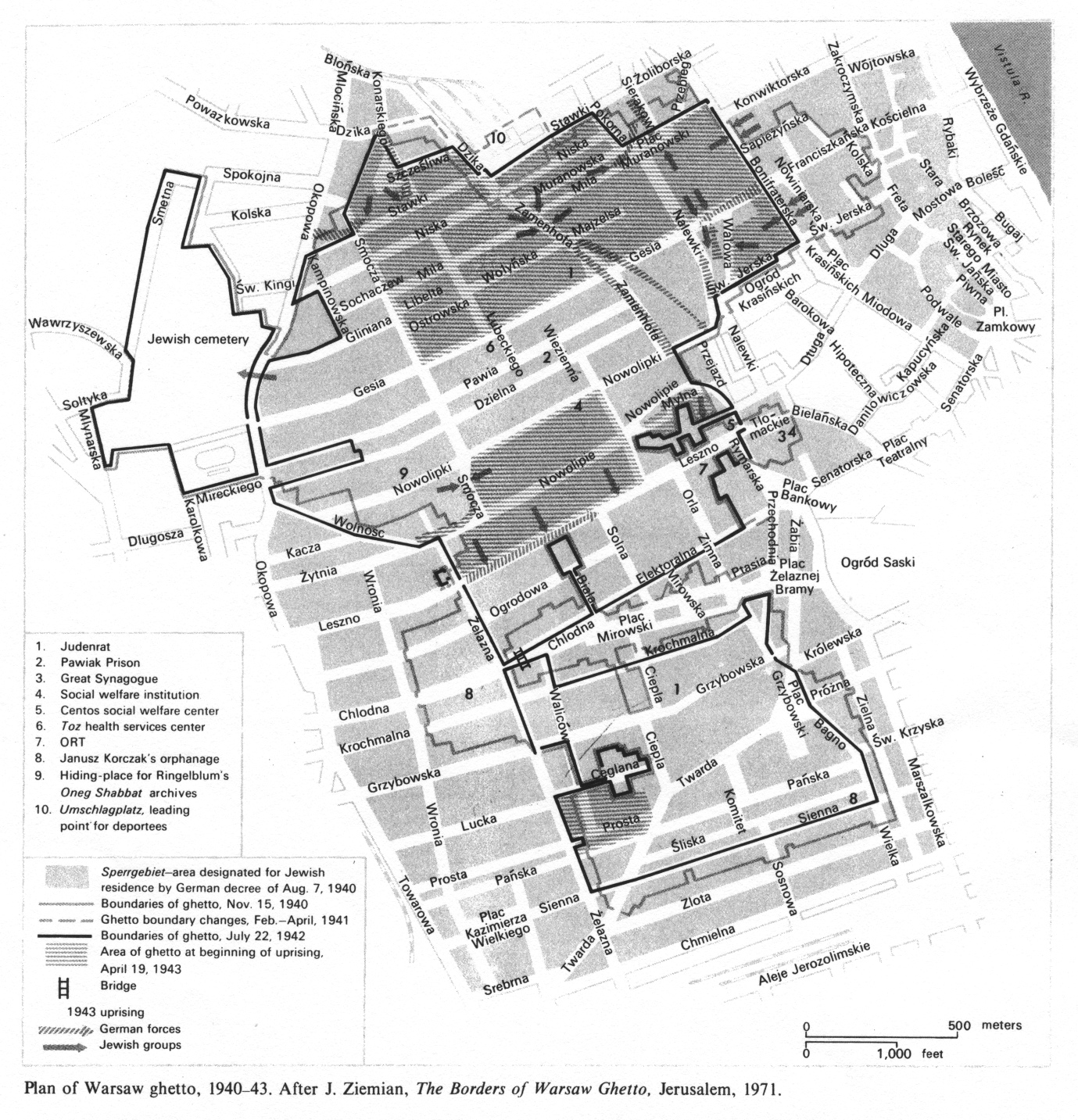
Plan (map) of Warsaw ghetto, 1940-43. After J.
Ziemian: "The Borders of Warsaw Ghetto", Jerusalem,
1971.
There are indicated: 1. the office of the Jewish
Council (Judenrat); 2. Pawiak Prison; 3. Great
Synagogue; 4. Social welfare institution; 5. Centos
social welfare center; 6. Toz health services
center; 7. ORT office; 8. Janusz Korczak's
orphanage; 9. Hiding-place for Ringelblum's archives
"Oneg Shabbat"; 10. assembly
point ("Umschlagplatz") for deportees.
Add to this are indicated: in gray: area
designated for Jewish residence by German
decree of 7 August 1940;
gray line: boundaries of the ghetto of 15
November 1940; in gray little lines:
ghetto boundary changes from Feb. to April
1941;
in black lines: the boundaries of the
ghetto on 22 July 1942;
in gray lines: the area of the ghetto at
the beginning of the uprising on 19 April
1943; also the bridge over Chlodna street
is indicated, and with arrows are
indicated the movements of the troops
during the uprising of 1943. |
In April 1940 the Germans began constructing a wall to enclose
the future Warsaw ghetto. On October 2, the Germans
established a ghetto for all Warsaw Jews and Jewish refugees
from the provinces. Withing six weeks all Jews or persons of
Jewish origin had to move into the ghetto, while all "Aryans"
residing in the assigned area had to leave.
The ghetto originally covered 340 hectares (approximately 840
acres), including the Jewish cemetery. As this area was
gradually reduced by the Germans, the walls were moved, and
the number of gates changed. [[...]]
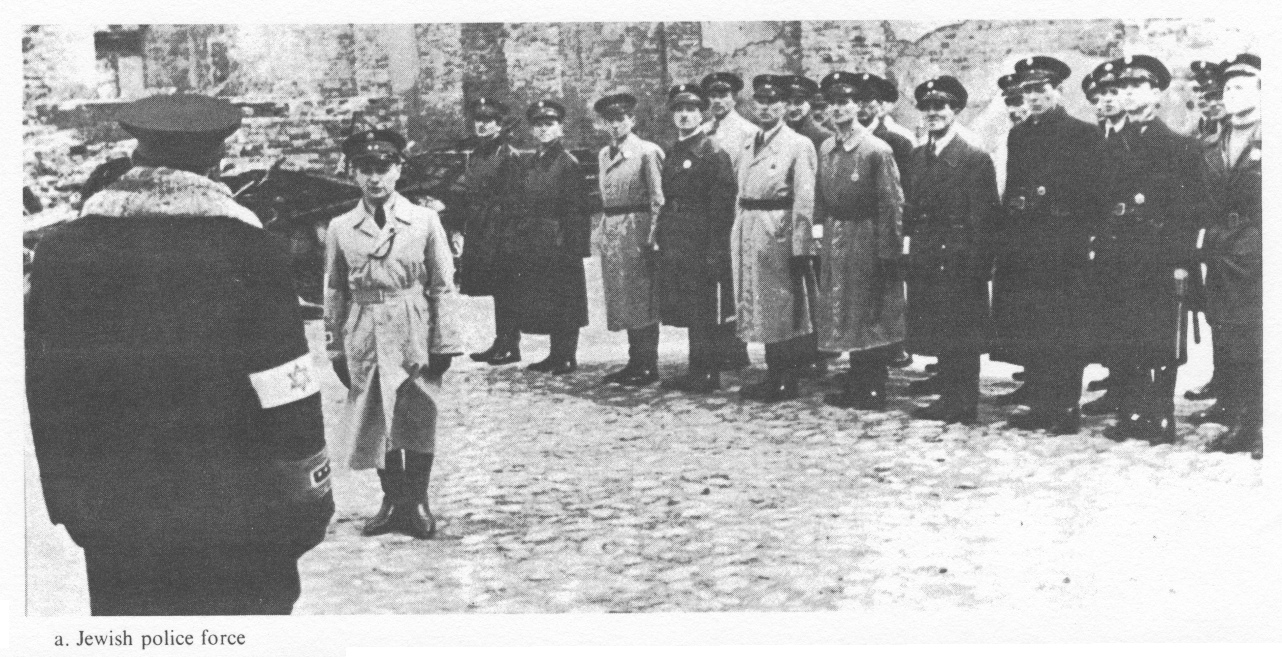
The gates were guarded by German and Polish police from the
outside and by the Jewish militia (Ordnungsdienst) from the inside and only
those with a special permit could enter or leave the ghetto.
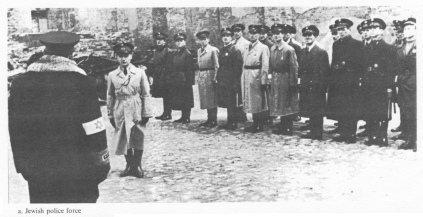
Encyclopaedia
Judaica (1971): Warsaw, vol. 16, col. 344. Jewish police
force. Photo taken in the Warsaw ghetto
by a German war correspondent. Oct. 1, 1940-June 1, 1941.
Courtesy Yad Vashem Archives, Jerusalem.
In the beginning, the Warsaw city hall, German political
authorities, and a special office, the "Transferstelle",
responsible for financial affairs, dealt with the ghetto's
administration. [[...]]
The head of the Jewish community council was Adam *Czerniakow,
an engineer who had been appointed by the mayor of Warsaw
during the siege (Sept. 23, 1939). By order of Hans Frank
(Sept. 28, 1939), a *Judenrat was created, consisting of 24
members, and presided over by Czerniakow. Czerniakow carried
out his functions for the general good under trying
conditions, often interceding with the German authorities to
ameliorate the repressive regulations. He tirelessly supported
social and cultural institutions in the ghetto and provided
relief wherever possible. [[...]]
From April 1941 a German commissioner, Heinz Auerswald, was
appointed over the ghetto. [[...]]
In the autumn of 1941 the ghetto was divided into two parts,
joined by a bridge over Chlodna Street. [[...]]
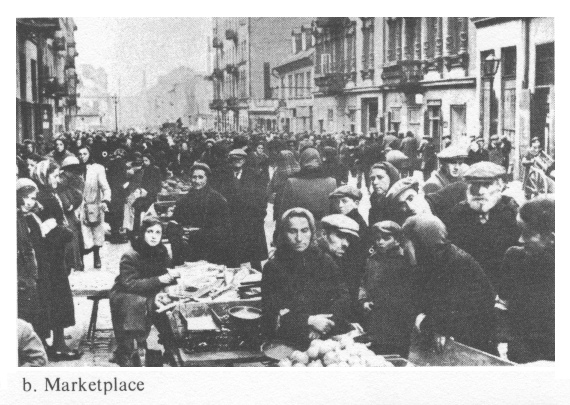
Encyclopaedia
Judaica
(1971): Warsaw, vol. 16, col. 344. Market place of Warsaw
ghetto. Photo taken in the Warsaw ghetto
by a German war correspondent. Oct. 1, 1940-June 1, 1941.
Courtesy Yad Vashem Archives, Jerusalem.
Originally some 400,000 Jews were crowded into the area of the
ghetto. The reductions in its size necessitated internal
shifting and further overcrowding, so that thousands of
families were often left without shelter. The situation was
further aggravated when some 72,000 Jews from the Warsaw
district (see Poland) were transferred to the ghetto, bringing
the total number of refugees to 150,000 (April 1941). The
average number of persons per room was 13, while thousands
remained homeless. The ghetto population during various
periods prior to July 1942 is estimated to have been between
400,000 and 500,000.
[Confiscations by the
Transferstelle - food discrimination - working conditions -
heating question - mass death in the ghetto - flight and
Nazi collaboration of the Polish police - deportation to
forced labor camps - >100,000 victims in the Warsaw
ghetto estimated]
The confiscation and plunder of Jewish property was conducted
by the "Transferstelle". In January 1942, Jewish goods valued
at 3,736,000 zlotys ($947,600); in March - 6,0445,000 zlotys
($1,209,000); and in April - 6,893,000 zlotys ($1,378,000).
The ghetto population received a food allocation amounting to
184 calories per capita a day, while the Poles received 634,
and the Germans 2,310. The price per large calory was 5.9
zlotys (about $1) for Jews, 2.6 zlotys (50 cents) for Poles,
and 0.3 zlotys ($.06) for Germans. The average allocation per
person in the ghetto was four pounds of bread and a half pound
of sugar a month. The dough was mixed with sawdust [[wooden
dust]] and potato peels.
![Encyclopaedia Judaica (1971): Warsaw, vol. 16, col.
344. Standing in line for potatoes in the Warsaw ghetto.
[[In the background can be seen a poster for a ballet
performance]]. Photo taken in the Warsaw ghetto by a
German war correspondent. Oct. 1, 1940-June 1, 1941.
Courtesy Yad Vashem Archives, Jerusalem.](../d/EncJud_juden-in-Warschau-d/EncJud_Warsaw-band16-kolonne343-schlangestehen-f-kartoffeln-45pr.jpg "Encyclopaedia Judaica (1971): Warsaw, vol. 16,
col. 344. Standing in line for potatoes in the Warsaw
ghetto. [[In the background can be seen a poster for a
ballet performance]]. Photo taken in the Warsaw ghetto
by a German war correspondent. Oct. 1, 1940-June 1,
1941. Courtesy Yad Vashem Archives, Jerusalem.")
Encyclopaedia
Judaica (1971): Warsaw, vol. 16, col. 344. Standing in line
for potatoes in the Warsaw ghetto.
[[In the background can be seen a poster for a ballet
performance]]. Photo taken in the Warsaw ghetto by a
German war correspondent. Oct. 1, 1940-June 1, 1941.
Courtesy Yad Vashem Archives, Jerusalem.
The ghetto suffered from mass unemployment. In June 1941,
27,000 Jews were active in their professions, while 60% of the
Jewish population had no income at all. A small number of Jews
who had their own tools and machines found employment in
factories taken over by Germans.
Wages were minimal. For 10-12 hours of of strenuous labor, a
skilled worker earned 2 1/-5 zlotys ($0.50-1.00) daily.
There was an acute shortage of fuel to heat the houses. In the
winter of 1941-42, 718 out of the 780 apartments investigated
had no heat.
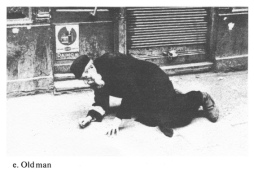
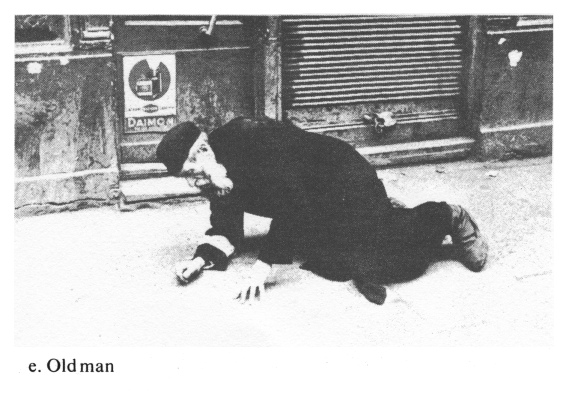
Encyclopaedia
Judaica (1971): Warsaw, vol. 16, col. 344. Old man. Photo
taken in the Warsaw ghetto
by a German war correspondent. Oct. 1, 1940-June 1, 1941.
Courtesy Yad Vashem Archives, Jerusalem.
These conditions led to epidemics, especially typhoid. The
streets were strewn with corpses due to starvation and
disease. Bands of children roamed the streets in search of
food. A few women and children occasionally slipped across to
the "Aryan" side, in an attempt to find food or shelter. The
[[collaborating, anti-Semitic]] Polish police usually seized
them and turned them over to the Germans. In October 1941 the
authorities declared that leaving the ghetto without
permission was punishable by death. (col. 342)
From time to time the authorities rounded up able-bodied
people in the streets and sent them to slave labor camps. In
April 1941 some 25,000 Jews from the Warsaw ghetto lived in
the camps under conditions that rapidly decimated their
numbers. After the outbreak of the German-Soviet War (June
1941), many of the inmates in the camps were executed.
It is estimated that by the summer of 1942, over 100,000 Jews
died in the ghetto proper.
[Underground work in the
ghetto - smuggling - ghetto institutions and aid
organizations - "soap kitchens" and "trade courses" -
Ringelblum archives - secret synagogues]
Nevertheless, the morale of the ghetto inhabitants was not
broken, and continual efforts were made to overcome the German
decrees and organize relief. Illegal workshops were gradually
established for manufacturing goods to be smuggled out and
sold on the "Aryan" side. These included leather products,
metals, furniture, textiles, clothing, and millinery. At the
same time raw materials were smuggled in. In this way
thousands of families were sustained.
the smuggling of foodstuffs into the ghetto, carried out by
Jewish children, was especially intensive. In December 1941
the official import of foodstuffs and materials into the
ghetto was valued at 2,000,000 zlotys ($400,000) while illegal
imports totaled 80,000,000 zlotys ($16,000,000). Social
welfare institutions were active (col. 347)
to combat hunger and disease. The *Centos for social welfare,
the *Toz for health services, and other organizations
re-formed and established hospitals, public kitchens (daily
providing over 100,000 soup rations), orphanages, refugee
centers, and recreation facilities. In each block of houses a
committee for charitable work functioned and also engaged in
cultural and educational activities, such as reading groups,
lectures, and musical evenings.
A network of schools, both religious and secular, as well as
trade schools functioned in the ghetto. Some of these schools
were illegal and could operate only under the guise of soup
kitchens. Similarly, medical, technical, and scientific
training was given under the guise of trade courses.
By the end of 1940 the Jewish historian, Emmanuel *Ringelblum,
established a secret historical and literary society under the
code name of Oneg Shabbat.
This group set up secret archives on the life and martyrdom of
the Polish Jews under the Nazis. These archives, which were
hidden in several places, were discovered after the war.
Despite the closing down of all synagogues and the prohibition
against public worship, clandestine services were held,
especially on holidays. Yeshivot [[religious Torah schools]]
secretly functioned. The zaddikim
(ẓaddikim) [[ultra-radical Jews]] of *Aleksandrow
(col. 349)
and *Ciechanow were hidden and cared for by their followers.
Many religious Jews held the view that their sufferings were
preliminary to the coming of the Messiah. There were many
instances of heroism by ultra-Orthodox Jews in the face of the
death. Hillel *Zeitlin, the famous religious writer, arrived
at the "Umschlagplatz" (assembly point) during the 1942
deportation, proudly dressed in his religious garb. Janusz
*Korczak, the director of the Jewish orphanage, continued to
give hope and courage to his wards until he boarded the death
train together with the children.
FORMATION OF RESISTANCE.
[Racist Zionists - pogrom of 1940 - underground resistance
work - ghetto newspapers]
The main form of resistance in the ghetto revolved around the
underground political life which existed throughout the German
occupation. The most active were the [[racist]] Zionist groups
- *Po'alei Zion,*Ha-Shomer ha-Za'ir (Ẓa'ir), *Deror, *Betar,
*Gordonia, as well as the [[Socialist party]] Bund and the
Communist-inspired Spartakus organization.
As early as Passover 1940 the Germans, with the cooperation of
Polish hooligans, provoked a pogrom in the Jewish district.
Underground Jewish groups organized effective self-defense.
After the ghetto was established, underground activity
increased, as the purely Jewish environment offered better
security against denunciations and infiltration of German
police agents into the ranks of the underground. The political
underground movements in the ghetto engaged in such activities
as disseminating information, collecting documents on German
crimes [[and of the collaborators]], sabotaging German
factories, and preparing for armed resistance.
A series of illegal periodicals appeared in Hebrew, Yiddish,
and Polish. Among the best known were the following
Hebrew publications: Deror,
circulated by the *He-Halutz (He-Ḥalutz) organization, El Al, Itton ha-Tenu'ah, and Neged ha-Zerem by Ha-Shomer
ha-Za'ir (Ẓa'ir); Magen
David by Betar; Sheviv
by the General [[racist]] Zionists;
Yiddish publications: Bafrayung
[[Liberation]] by He-Halutz (He-Ḥalutẓ); Morgenfray and Biuletin by the Bund;
and Polish publications: Awangarda
[[Avangarde]] by Po'alei Zion; Jutrznia and Plomienie by Ha-Shomer ha-Za'ir (Ẓa'ir).
[Jewish underground fighting
organizations]
The first Jewish military underground organization, Swit, was
formed in December 1939 by Jewish veterans of the Polish army.
Most of its members were Revisionists. The organization was
headed by David Apelbaum and Henry Lipszyc, aided by a Polish
major, Henryk Iwanski.
Early in 1942 a second underground fighting organization
emerged, created by four [[racist]] Zionist groups: Po'alei
Zion, Ha-Shomer ha-Za'ir (Ẓa'ir), Zionist Socialists, and
Deror, as well as the Communist organization. It soon became
known as the anti-Fascist bloc. Its leaders were Szachna
Sagan, Aron Lewartowski, Josef Kaplan, and Josef Sak. Four
commanders were appointed: Mordecai *Anielewicz, Pinkus
Kartin, Mordecai Tenenbaum, and Abram Fiszelson.
The Bund did not join the bloc but created its own fighting
organization "Samo obrona" (self-defense) under the command of
Abraham Blum. None of the three military organizations of the
ghetto succeeded in acquiring arms prior to July 22, 1942,
when mass deportations to *Treblinka death camp were initiated
by the Nazis [[and their collaborators]].
FIRST MASS DEPORTATIONS.
[Deportation wave of 1942 from the Warsaw ghetto]
The deportations were preceded by a series of terrorizing
"actions", when scores of people were dragged out of their
homes and murdered in the streets. Just one day before the
mass deportations to Treblinka began (July 21, 1942), 60
hostages were taken to the Pawiak Prison. Three days later,
the president of the Judenrat, Adam Czerniakow, committed
suicide following a demand by the Nazis that he cooperate with
them in the deportations. His successor, Maksymilian (Marek)
Lichtenbaum, also an engineer, obeyed the Nazi orders. The
number of deportees averaged 5,000-7,000 daily, sometimes
reaching 13,000. Some of the victims, resigned to their fate
as a result of starvation, reported voluntarily to the (col.
349)
"Umschlagplatz" [[assembly point]], lured
by the sight of food which the Germans offered to
the volunteers, and by the promise that their
transfer to "the East" meant they would be able to
live and work in freedom.
In the beginning, the Germans exempted from
deportation employees of the ghetto factories,
members of the Judenrat and Jewish police, and
hospital personnel, as well as their families.
Thousands of Jews made feverish attempts to obtain
such employment certificates. In the course of time
even these "safe" categories were subject to
deportation.
The number of victims, including those murdered in
the ghetto and those deported to Treblinka, totaled
approximately 300,000 out of the 370,000 inhabitants
in the ghetto prior to July 1942. This major Aktion lasted from
July 22 until Sept. 13, 1942 [[52 days]]. Following the
deportations, the ghetto area was drastically constricted so
that some factories and several blocks of buildings were left
outside the new walls and cordoned off with barbed wire to
prevent anyone finding shelter there. The Germans also fixed
the number of inhabitants allowed to remain in the ghetto at a
maximum of 35,000 persons.
ACTIVE RESISTANCE. [Fighting
organizations - ZOB - armed resistance since 1942 with arms,
manufacturing, and bunkers]
The leaders of the underground movements appraised the new
situation. At their first meeting, they decided to create the
Jewish Fighting Organization (Zydowska (Żydowska) Organizacja
Bojowa - ZOB), and take active steps to oppose further
deportation. A few members of the underground managed to
escape from Treblinka, and brought to the ghetto information
about the real fate that awaited the deportees, namely
physical annihilation. Because of the blockade it was not even
possible to pass this information on to the non-Jewish
population.
Some 30,000-35,000 Jews, most of them factory workers and
their families, legally remained in the ghetto and were
employed within or outside the ghetto. In addition, there were
between 20,000 and 30,000 Jews living on in the ghetto
"illegally". By the end of 1942 there was an influx of several
thousand Jews from the labor camps which had been closed. At
this time some Jews hiding on the "Aryan" side were seized and
returned to the ghetto.
In this period intensive preparations were made for armed
resistance. The Bund also joined the ZOB, while the
Revisionists continued to adhere to their separate
organization, Swit.
Appeals were made to several Polish underground organizations
for the acquisition of weapons. An emissary of the ZOB, Arie
(Jurek) Wilner, succeeded in persuading the commanders of one
of the Polish underground armies (Armia Krajowa) of the
necessity of supplying weapons to the ghetto underground and,
after long negotiations, about 100 firearms and some hand
grenades were sent into the ghetto.
Another small quantity of arms was supplied by the Communist
"People's Guard". The Revisionists also obtained several loads
of arms from two Polish underground organizations led by Major
H. Iwanski and Captain Szemley (Cesary) Ketling. Several
secret workshops were established in the ghetto to manufacture
homemade hand grenades and bombs, and some additional arms
were bought on the black market.
At the same time, a network of bunkers and subterranean
communication channels was constructed to enable combat
against the superior German forces and to protect the
non-fighting population.
[Deportation wave of January
1943 from the Warsaw ghetto - resistance and 4 days street
fight - stopped deportations - about 1,000 Jews murdered in
the ghetto]
The second wave of deportations began on Jan. 18, 1943, when
the Nazis broke into the ghetto, surrounded many buildings,
and deported the inhabitants to Treblinka. They liquidated the
hospital, shot the patients, and deported the personnel. Many
factory workers who had been employed outside the ghetto were
included among the deportees. The underground organizations,
insufficiently equipped and ill-prepared, nevertheless offered
armed resistance, which (col. 350)
turned into four days of street fighting. This was the first
case of street fighting in occupied Poland. The Germans [[and
their collaborators]] fearing the impact of this outburst on
other parts of Poland, stopped the deportations, and attempted
to carry out their aim by "peaceful" means, namely by
voluntary registration for the alleged labor camps. The
underground, in turn, conducted an intensive information
campaign about the real intentions of the Nazis [[and their
collaborators]]. As a result the second wave of deportations
was suspended after four days, during which the Germans [[and
their collaborators]] managed to send only 6,000 persons to
Treblinka. About 1,000 others were murdered in the ghetto
itself.
THE GHETTO UPRISING. [Street
fights - houses burning down April-May 1943]
After this Aktion,
daily life in the ghetto was paralyzed. Walking in the street
was punishable by death. Only groups of workers marching under
armed guard were to be seen. Social institutions ceased to
function and the Judenrat, most of whose members were killed
in the January Aktion,
were reduced to a small office. The underground organizations,
however, were preparing for armed resistance in case a further
attempt would be made by the Germans [[and their
collaborators]] to liquidate the ghetto. Mordecai Anielewicz
now headed the ZOB. The members of his command were: Yizhak
(Yiẓḥak) (Antek) *Cukierman, Hersz Berlinski, Marek Edelman,
Zivia (Ẓivia) Lubetkin, and Michal Rojzenfeld.
The entire force was divided into 22 fighting units, each unit
affiliated with one of the political groups. Israel Kanal was
commander of the units operating in the central area of the
ghetto; and Eleazar Geller and Marek Edelman commanded the
factory units. The ZOB underground headquarters were at 18
Mila Street. The Revisionist commanders were Leon Rodal, Pawel
Frenkiel, and Samuel Luft.
On April 19, 1943, a German force, equipped with tanks and
artillery, under the command of Col. Sammern-Frankennegg,
penetrated into the ghetto in order to resume the
deportations. The Nazis met with stiff resistance from the
Jewish fighters. Despite overwhelmingly superior forces, the
Germans were repulsed from the ghetto, after suffering heavy
losses. Sammern-Frankennegg was relieved of his command, and
Gen. Juergen *Stroop, appointed in his stead, immediately
resumed the attack. Street fighting lasted for several days,
but when the Germans [[and their collaborators]] failed in
open street combat, they changed their tactics. Carefully
avoiding any further street clashes, the Germans [[and their
collaborators]] began (col. 351)
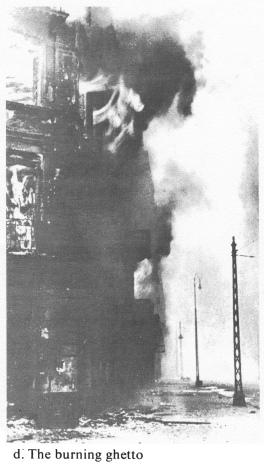
systematically burning down the houses. The inhabitants died
in the flames, while those hiding in the canals and bunkers
were killed by gas and hand grenades. Despite these
conditions, the Jewish fighting groups continued to attack
German soldiers until May 8, 1943, when the ZOB headquarters
fell to the Germans. Over a hundred fighters including
Anielewicz, died in this battle. Several units continued to
fight even after the fall of the ZOB and Revisionist
headquarters. Armed resistance lasted until June 1943. With
the help of the Polish "People's Guard" some 50 ghetto
fighters escaped from the ghetto and continued to fight the
Germans in the nearby forests as a partisan unit named in
memory of Anielewicz.
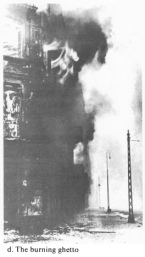
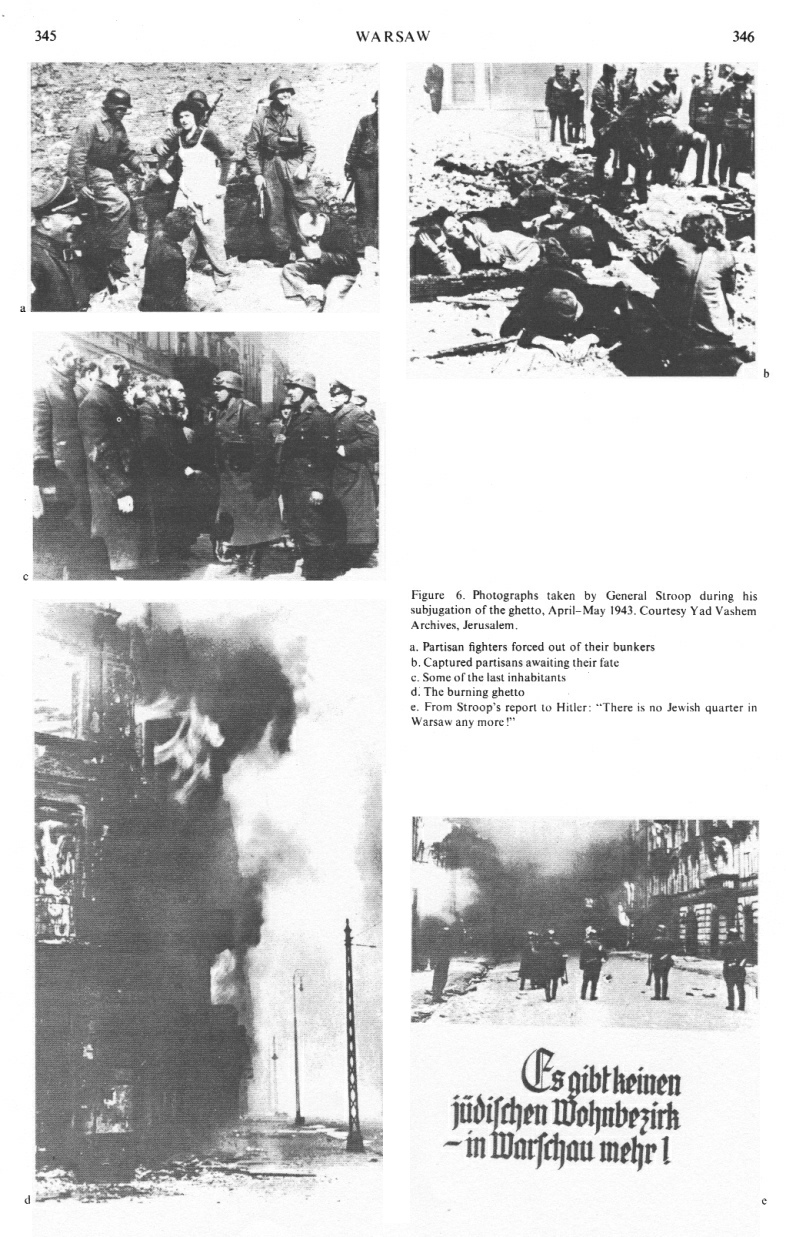
Encyclopaedia
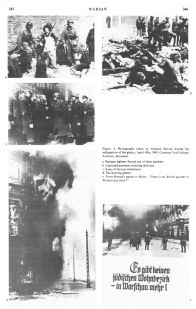
Judaica (1971): Warsaw, vol. 16, col. 345. The
burning ghetto, April-May 1943
|
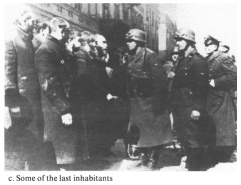
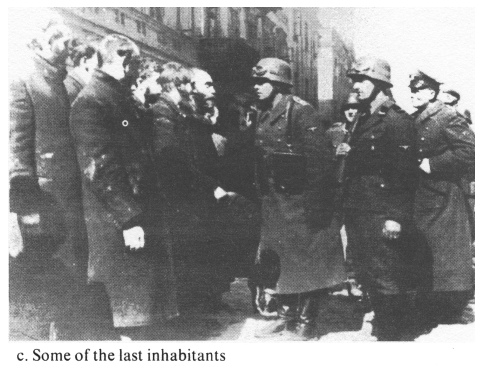
Encyclopaedia
Judaica (1971): Warsaw, vol. 16, col. 345. Some of
the last inhabitants confronted with the Nazi
army.
|
![Encyclopaedia Judaica (1971): Warsaw, vol.
16, col. 345. Jewish partisan fighters forced
out of their bunkers. [[See the laughing German
soldiers, but 2 years afterwards they had
nothing to laugh any more...]]](../d/EncJud_juden-in-Warschau-d/EncJud_Warsaw-band16-kolonne345-jued-partisanen-aus-bunkern-45pr.jpg "Encyclopaedia Judaica (1971): Warsaw,
vol. 16, col. 345. Jewish partisan fighters
forced out of their bunkers. [[See the laughing
German soldiers, but 2 years afterwards they had
nothing to laugh any more...]]")
Encyclopaedia
Judaica (1971): Warsaw, vol. 16, col. 345. Jewish
partisan fighters forced out of their bunkers.
[[See the laughing German soldiers, but 2 years
afterwards they had nothing to laugh any more...]]
|
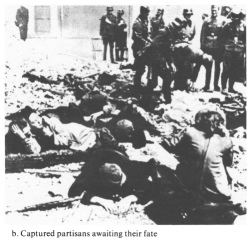
Encyclopaedia
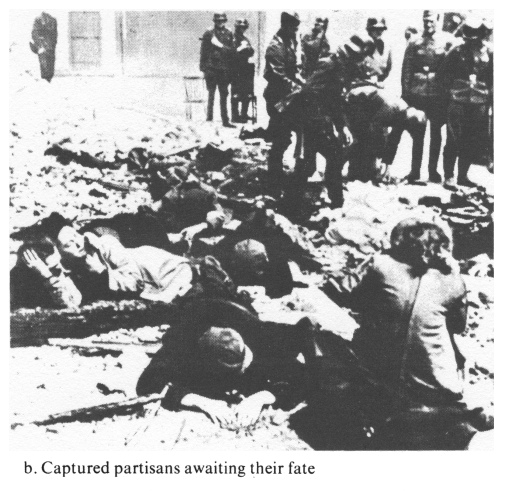
Judaica (1971): Warsaw, vol. 16, col. 346. Captured
partisans awaiting their fate.
|
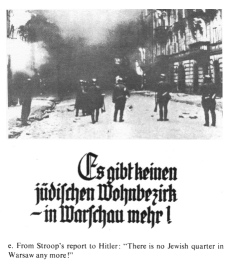
Encyclopaedia
Judaica
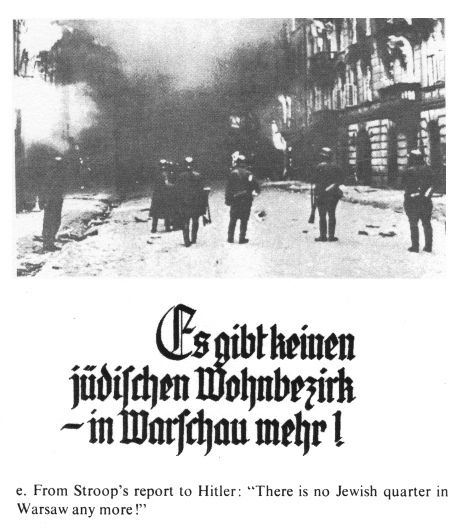
(1971): Warsaw, vol. 16, col. 346. From
Stroops's report [[with a photo of the burning
Warsaw ghetto]] to Hitler: There is no Jewish
quarter in Warsaw any more!" (Es gibt keinen
jüdischen Wohnbezirk in Warschau mehr!)
Photographs taken by General Stroop during his
subjugation of the ghetto, April-May 1943. Courtesy
Yad Vashem Archives, Jerusalem.
|
[Moral effect of Warsaw
ghetto uprising - sporadic resistance from the ruins until
August 1943]
The Warsaw ghetto uprising had an enormous moral effect upon
Jews and non-Jews throughout the world, especially since it
was prepared and carried out under conditions which
practically excluded a
priori any attempt at armed resistance. Despite the
vastly unequal forces, the uprising continued for a long time
and constituted the largest battle in occupied Europe before
April 1943 (excepting in Yugoslavia).
This battle also had its impact upon the Polish population,
resulting in the intensification of resistance by the Poles as
well as by Jews throughout the country. On May 16, 1943,
Stroop reported to his superiors on the complete liquidation
of the Warsaw ghetto. As a token of his victory he blew up the
Great Synagogue on Tlomacka Street. According to his report,
the Germans [[with their collaborators]] in the course of one
month's fighting had killed or deported over 56,000 Jews. The
Germans themselves officially suffered 16 dead and 85 wounded
between April 29 and May 15, but it is conjectured that the
German casualties were in fact much higher. In the course of
the following months, the Germans penetrated the empty ghetto
and hunted down the remnants hiding in the ruins, often using
fire to overcome sporadic resistance, which continued until
August 1943.
[[In the following month in September 1943 Rome was falling]].
The Warsaw ghetto uprising became an event of world history
when details of what happened became known after the war.
Among the writers who depicted life in the ghetto and the
underground fighters were Yizhak (Yiẓḥak) Katznelson, John
Hersey, and Leon *Uris.
[Jews in Warsaw 1943-1944 on
the "Aryan" side]
After the liquidation of the ghetto, the surviving members of
the ghetto leadership continued underground (col. 352)
work on the "Aryan" side of Warsaw. The underground's main
activity was to assist Jews living on the "Aryan" side, either
in hiding or by means of forged documents. According to their
figures, the number of Jews on the "Aryan" side reached 15,000
(May 1944). They also established contact with Jewish
organizations abroad and received financial assistance. Among
their leaders were Adolf *Berman of Po'alei Zion and Leon
Fajner of the Bund. Emmanuel *Ringelblum continued his
scientific work of collecting evidence on Nazi crimes until
May 1944, when he was seized and executed.
[[There must have been a declaration of the Nazi occupation
forces that Warsaw was "judenrein" ("free of Jews"), but it's
not mentioned in the article]].
[Warsaw uprising in August
1944]
Hundreds of Jews were active in the Polish underground of
Greater Warsaw, particularly Hanna Szapiro-Sawicka, Niuta
Tajtelbaum, Ignacy Robb-Narbutt, Menasze Matywiecki, and
Ludwik Landau. When the Polish uprising in Warsaw broke out on
Aug. 1, 1944, over 1,000 Jews in hiding immediately
volunteered to fight the Germans [[and their collaborators]].
Hundreds of them fell in the battle, among them a member of
the high commando of the People's Army, Matywiecki, and Pola
Elster, a member of the Polish National Council. In addition,
the remnants of the ZOB, under the commando of Cukierman, and
a group of liberated prisoners from the city concentration
camp, participated in the uprising.
[DE.D.]
[[...]] About 6,000 Jewish soldiers participated in the battle
for the liberation of Warsaw. Warsaw's eastern suburb, Praga,
was liberated [[occupied by Communist terror]] in September
1944,and the main part of the city on the left bank of the
Vistula [[Germ.: Weichsel]] on Jan. 17, 1945. On that day only
200 Jewish survivors were found in underground hideouts in the
ruins of destroyed Warsaw. [[...]]
Post-War Developments.
[Returned Jews from central
Russia - Jewish institutions since 1945 in Warsaw]
[[...]] By the end of 1945 about 5,000 Jews had settled in
Warsaw. That number was more than doubled [[to over 10,000
Jews]], when Polish Jews, who had survived the war in the
Soviet Union, returned. Warsaw became the seat of the Central
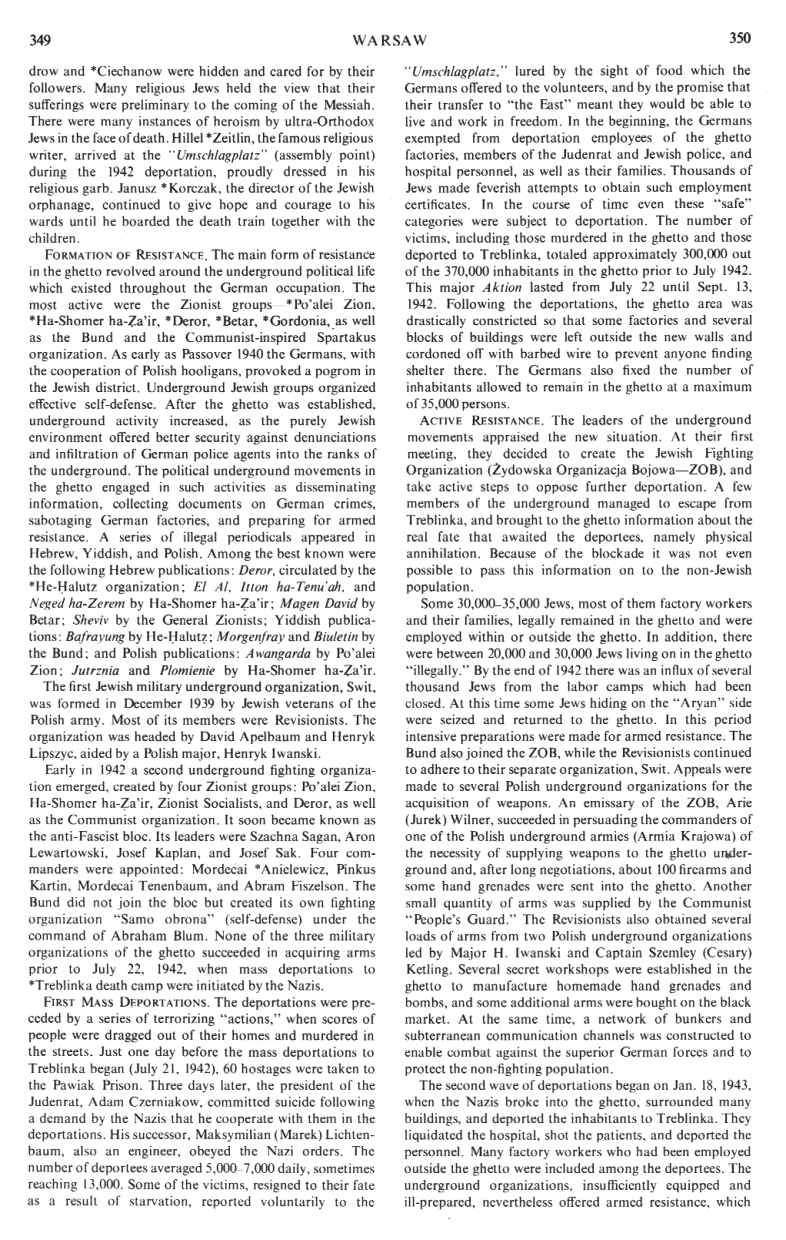
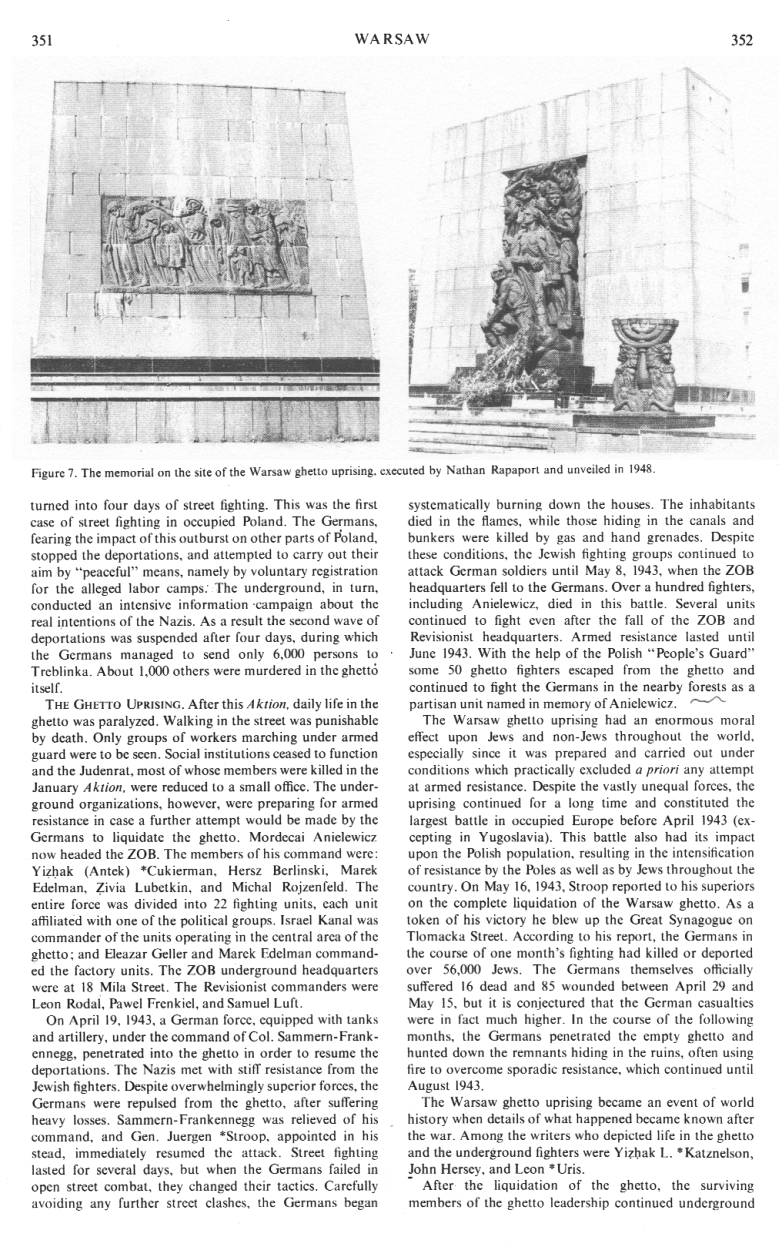
Committee of Polish Jews. On April 19, 1948 (the fifth
anniversary of the Warsaw ghetto uprising) a monument executed
by N. Rapaport in memory of the ghetto fighters was unveiled
in the square called "The Ghetto Heroes' Square". In 1949 a
number of Jewish cultural institutions (The Jewish Historical
Institute, the Jewish Theater, editorial staffs of the Yiddish
papers Folksshtime
[[People's Voice]] and Yidishe
Shriften [[Yiddish Papers]]) were transferred from
Lodz to Warsaw. A club for Jewish youth, "Babel", was opened
there and one synagogue was rebuilt.
[Emigrations waves from
Warsaw 1945-1970]
After the war Warsaw Jews left Poland in three main waves: in
1946-47 after the great pogrom in *Kielce; in 1957-58; in
1967-68 when the Polish government launched its official
anti-Semitic campaign. After 1968 Jewish institutions,
although officially not closed, had actually ceased to
function. The number of remaining Jews, mostly aged people,
was estimated at 5,000 in 1969. For further details see
*Poland.
[DE.D./S.KR.]
[[Precise numbers how many Jews were emigrating are missing in
this article]].
| Memorial |
|
Encyclopaedia
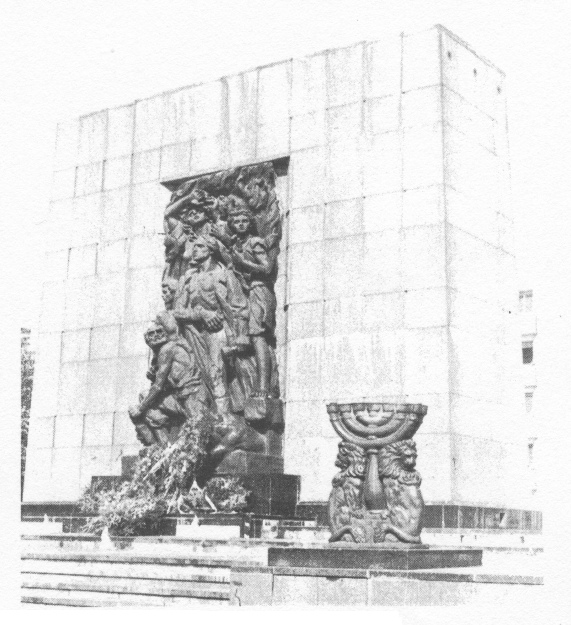
Judaica (1971): Warsaw, vol. 16, col. 351. Memorial
of the Warsaw ghetto uprising with group of persons
and candle stand (menorah), from Nathan Rapaport,
1948. |
x
|
Encyclopaedia
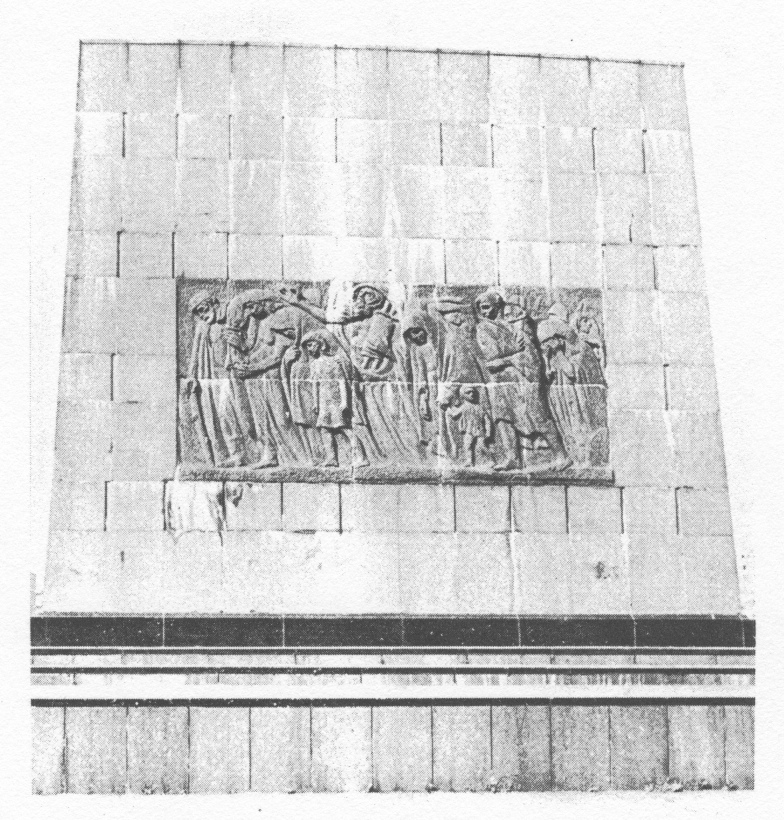
Judaica (1971): Warsaw, vol. 16, col. 351. Relief of
the memorial of the Warsaw ghetto uprising from
Nathan Rapaport, 1948. |
Bibliography
-- S. Dubnow: History of the Jews in Russia and Poland, 3
vols. (1916-20), index
-- R. Mahler: Divrei Yemei Yisrael, Dorot Aharonim, 1, pt. 3
(1955); pt. 4 (1956), 2, pt. 1 (1970), indexes
-- idem: Toledot ha-Yehudim be-Polin (1946), index
-- A. Levison: Toledot Yehudei Varshah (1953)
-- EG (1953, 1959)
-- Pinkas Varshe (Yid., 1955)
-- E. Ringelblum, in: Historishe Shriftn, 2 (1937), 248-68
-- idem, in: Zion, 3 (1938), 246-66, 337-55
-- idem, in: YIVO Bleter [[YIVO Papers]], 13 (1938), 124-32
-- idem: Kapitlen Geshikhte ... (1953)
-- idem: Geshikhte fun Yidn in Varshe [[History of the Yiddish
People in Warsaw]], 1-3 (1947-53)
-- A. Kraushar: Kupiectwo warszawskie (1929)
-- H.D. Friedberg: Toledot ha-Defus ha-Ivri be-Polanyah
(1950), 109-15
-- B. Weinryb, in: MGWJ, 77 (1933), 273 ff.
-- H. Lieberman, in: Sefer ha-Yovel ... A. Marx (1943), 20-21.
See also bibl. Poland.
HOLOCAUST
For a full bibliography see Holocaust, General Survey -
Sources and Literature, Sections 3, 4
-- G. Reitlinger: Final Solution (1968), 260-326, and passim,
incl. bibl.
-- r. Hilberg: Destruction of European Jews (1961), index
-- Central Commission for War Crimes: German Crimes in Poland
[[the collaborators are not mentioned]], 2 vols. (1946-47)
(col. 353)
-- American Federation for Polish Jews: Black Book of Polish
Jewry (1943) (col. 353-354)
-- American Jewish Black Book Committee: Black Book (1945)
-- A. Czerniakow: Yoman Geto Varshah (1968)
-- C.A. Kaplan: Scroll of Agony: Warsaw Ghetto Diary (1965)
-- J. Tenenbaum: In Search of a Lost People (1949)
-- idem: Underground, the Story of a People (1952)
-- B. Mark: Der Aufstand im Warschauer Ghetto [[Warsaw Ghetto
Uprising]] (1959)
-- idem. (ed.): The Report of Juergen Stroop (1958), includes
introduction and notes
-- J. Kermish (ed.): Mered Getto Varshah be-Einei ha-Oyev
(1966), Eng. introd. and notes
-- P. Friedman: Martyrs and Fighters (1954)
-- Y. Gruenbaum (ed.): Varshah (1953), 601-815
-- J. Sloan (ed.): Notes from the Warsaw Ghetto. The Journal
of Emmanuel Ringelblum (1958)
-- B. Goldstein: Five Years in the Warsaw Ghetto (1961)
-- idem: The Stars Bear Witness (1950)
-- D. Wdowinsky: And We Are Not Saved (1963)
-- A. Donat: The Holocaust Kingdom (1965)
-- N. Blumental and J. Kermish (eds.): Ha-Meri ve-ha-Mered
be-Getto Varshah (1965), Eng. introd.
-- M. Berland: 300 Sha'ot ba-Getto ha-Do'ekh (1959)> (col.
354)
| Sources |
Encyclopaedia Judaica (1971): Warsaw, vol. 16, col.
341-342
|
Encyclopaedia Judaica (1971): Warsaw, vol. 16, col.
343-344
|
Encyclopaedia Judaica (1971): Warsaw, vol. 16, col.
345-346
|
Encyclopaedia Judaica (1971): Warsaw, vol. 16, col.
347-348
|
Encyclopaedia Judaica (1971): Warsaw, vol. 16, col.
349-350
|
Encyclopaedia Judaica (1971): Warsaw, vol. 16, col.
351-352
|
Encyclopaedia Judaica (1971): Warsaw, vol. 16, col.
353-354
|
|


![Encyclopaedia Judaica (1971): Warsaw, vol. 16, col.
344. Standing in line for potatoes in the Warsaw ghetto.
[[In the background can be seen a poster for a ballet
performance]]. Photo taken in the Warsaw ghetto by a
German war correspondent. Oct. 1, 1940-June 1, 1941.
Courtesy Yad Vashem Archives, Jerusalem.](../d/EncJud_juden-in-Warschau-d/EncJud_Warsaw-band16-kolonne343-schlangestehen-f-kartoffeln.jpg "Encyclopaedia Judaica (1971): Warsaw, vol. 16,
col. 344. Standing in line for potatoes in the Warsaw
ghetto. [[In the background can be seen a poster for a
ballet performance]]. Photo taken in the Warsaw ghetto
by a German war correspondent. Oct. 1, 1940-June 1,
1941. Courtesy Yad Vashem Archives, Jerusalem.")
![Encyclopaedia Judaica (1971): Warsaw, vol.
16, col. 345. Jewish partisan fighters forced
out of their bunkers. [[See the laughing German
soldiers, but 2 years afterwards they had
nothing to laugh any more...]]](../d/EncJud_juden-in-Warschau-d/EncJud_Warsaw-band16-kolonne345-jued-partisanen-aus-bunkern.jpg "Encyclopaedia Judaica (1971): Warsaw,
vol. 16, col. 345. Jewish partisan fighters
forced out of their bunkers. [[See the laughing
German soldiers, but 2 years afterwards they had
nothing to laugh any more...]]")