Encyclopaedia Judaica
Jews in Beltsy
Jews since 1779 - expulsions from the countryside to
Beltsy since 1882 - emigration waves - cultural life -
World War II Holocaust - Jews coming back since 1945
from: Bessarabia; In: Encyclopaedia Judaica 1971
presented by Michael Palomino (2008 / 2023)
The solution for life is the Book of
Life with Mother Earth - www.med-etc.com
[Jews since 1779 -
expulsion movements to Beltsy since 1882]
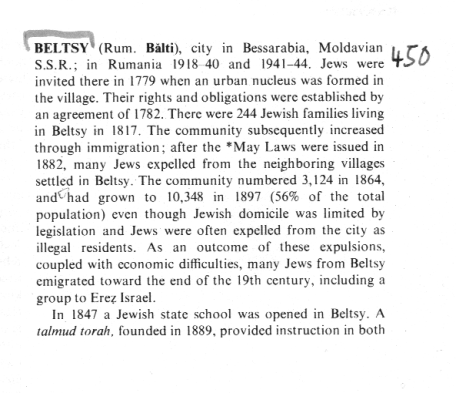
Beltsy (Rum. Balti
(Bãlti), city in Bessarabia, Moldavian S.S.R.; in Rumania
[[Romania]] 1918-40 and 1941-44. Jews were invited there in
1779 when an urban nucleus was formed in the village. Their
rights and obligations were established by an agreement of
1782. There were 244 Jewish families living in Beltsy in
1817. The community subsequently increased through
immigration;
after the *May Laws were issued in 1882, many Jews expelled
from the neighbouring villages settled in Beltsy. The
community numbered 3,124 in 1864, and had grown to 10,348 in
1897 (56% of the total population) even though Jewish
domicile was limited by legislation and Jews were often
expelled from the city as illegal residents. As an outcome
of these expulsions, coupled with economic difficulties,
many Jews from Beltsy emigrated toward the end of the 19th
century, including a group to Erez Israel (Ereẓ Israel).
[Cultural life]
In 1847 a Jewish state school was opened in Beltsy. A
talmud torah
[[school]], founded in 1889, provided instruction in both
(col. 450)
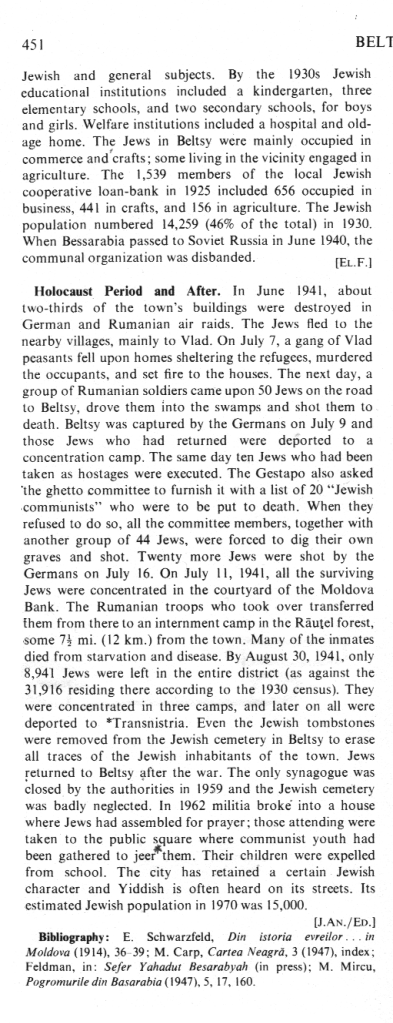
Jewish and general subjects. By the 1930s Jewish educational
institutions included a kindergarten, three elementary
schools, and two secondary schools, for boys and girls.
Welfare institutions included a hospital and old age home.
The Jews in Beltsy were mainly occupied in commerce and
crafts; some living in the vicinity engaged in agriculture.
The 1,539 members of the local Jewish cooperative loan-bank
in 1925 included 656 occupied in business, 441 in crafts,
and 156 in agriculture. The Jewish population numbered
14,259 (46% of the total) in 1930. When Bessarabia passed to
Soviet Russia in June 1940, the communal organization was
disbanded.
[Et.F.]
[[The Stalin deportations 1940-1941 to internment camps and
to Siberia and the Big Flight from Barbarossa in May / June
1941 to central Russia are missing in this article]].
Holocaust Period and After.
[Flight to Vlad - murder of
the refugees - mass murder in the swamps - Nazi rule -
concentration camp]
In June 1941, about two-thirds of the town's buildings were
destroyed in German and Rumanian [[Romanian]] air raids. The
Jews fled to the nearby villages, mainly to Vlad. On July 7,
a gang of Vlad peasants fell upon homes sheltering the
refugees, murdered the occupants, and set fire to the
houses. The next day, a group of Rumanian [[Romanian]]
soldiers came upon 50 Jews on the road to Beltsy, drove them
into the swamps and shot them to death.
Beltsy was captured by the Germans [[and their
collaborators]] on July 9 and those Jews who had returned
were deported to a concentration camp. The same day ten Jews
who had been taken as hostages were executed. The Gestapo
also asked the ghetto committee to furnish it with a list of
20 "Jewish communists" who were to be put to death. When
they refused to do so, all the committee members, together
with another group of 44 Jews, were forced to dig their own
graves and shot.
Twenty more Jews were shot by the Germans on July 16.
[Rautel forest camp -
deportation of the staying Jews to Transnistria Holocaust]
On July 11, 1941, all the surviving Jews were concentrated
in the courtyard of the Moldova Bank. The Rumanian
[[Romanian]] troops who took over transferred them from
there to an internment camp in the Rautel (Rāutel) forest,
some 7 1/2 mi. (12 km.) from the town. Many of the inmates
died from starvation and disease.
By August 30, 1941, only 8,941 Jews were left in the entire
district (as against the 31,916 residing there according to
the 1930 census). They were concentrated in three camps, and
later on all were deported to *Transnistria. Even the Jewish
tombstones were removed from the Jewish cemetery in Beltsy
to erase all traces of the Jewish inhabitants of the town.
[Jews coming back since
1945 - Yiddish spoken]
Jews returned to Beltsy after the war [[from central
Russia]]. The only synagogue was closed by the authorities
in 1959 and the Jewish cemetery was badly neglected. In 1962
militia broke into a house where Jews had assembled for
prayer; those attending were taken to the public square
where communist youth had been gathered to jeer them. Their
children were expelled from school.
The city has retained a certain Jewish character and Yiddish
is often heard on its streets. Its estimated Jewish
population in 1970 was 15,000.
Bibliography
-- E. Schwarzfeld: Din istoria evreilor... in Moldova
(1914), 36-39
-- M. Carp: Cartea Neagra (Cartea Neagrã), 3 (1947), index
-- Feldman, in: Sefer Yahadut Besarabyah (in press)
-- M. Mircu: Pogromurile din Basarabia (1947), 5, 17,
160.> (col. 451)
Sources
|
Encyclopaedia Judaica (1971): Beltsy, vol. 4, col.
450
|
Encyclopaedia Judaica (1971): Beltsy, vol. 4, col.
451
|