Encyclopaedia Judaica
Jews in Bessarabia
Jews coming from Constantinople
and from Poland - commerce and liquors - rich Jewish
life in the 19th century - persecution waves since
1869 - radicals, Haskalah and racist Zionists - Jews
as national enemies - Jewish parties, schooling -
Sovietization, WW II with Transnistrian Holocaust -
Sovietization
from: Bessarabia; In: Encyclopaedia Judaica 1971, vol. 4
presented by Michael Palomino (2008 / 2023)
The solution for life is the Book of
Life with Mother Earth - www.med-etc.com
[Bessarabia under different
rules]
<BESSARABIA, region between the rivers Prut and
Dniester; before 1812 part of Moldavia, with several
districts under direct Ottoman rule; within Russia
1812-1918; part of Rumania [[Romania]] 1918-40; returned
to Russia 1940. The larger (central) part is in Moldavian
S.S.R.; the extreme northern and southern sections in
Ukrainian S.S.R.
[Jewish merchants since
15th from Constantinople and since 16th century from
Poland]
Up to 1812. From
the 15th century onward, Jewish Sephardi merchants from
Constantinople frequented Bessarabia while using the trade
route which crossed the length of the territory,
connecting the countries of the East and the Black Sea
shores with Poland. Later, Jewish merchants from Poland
also began coming to Bessarabia. Some of them settled
there, thus laying the foundation of the first Jewish
communities in northern and central Bessarabia; in
southern Bessarabia Jewish communities were found already
in the 16th century.
By the early 18th century, permanent Jewish settlements
had been established in several commercial centers. Toward
the end of the century relatively large numbers of Jews
were living in most of the urban settlements and in many
villages. Their number was estimated at 20,000 in 1812.
The legal status of the Jews in the part of Bessarabia
under Moldavian rule was similar to that of the rest of
Moldavian Jewry. They were organized in autonomous
communities subject to the authority of the hakham bashi
[[spiritual leader]] in Jassy.
In the parts under Ottoman rule they were subject to the
same laws as the other communities under this regime. In
the 18th and 19th centuries the Jews in Bessarabia mainly
engaged in local commerce and liquor distilling; some
traded on a considerable scale with neighbouring
countries. In the villages main occupations were leasing
activities and innkeeping.
In the cultural sphere, Bessarabian Jewry in this period
was not advanced. The most prominent rabbis of the early
19th century were *Hayyim [[Ḥayyim]] b. Solomon of
Czernowitz, rabbi of *Kishinev, and David Solomon
*Eibenschutz, rabbi of Soroki. Jacob *Frank exerted an
influence from Podolia, and Khotin became a center for Frank
and his adherents. Toward the end of the 18th century
Hasidism [[Ḥasidism]] penetrated Bessarabia.
1812-1918.
[Jews coming from the
northern part of the Pale of Settlement - figures -
annexation of 1818 with autonomous status - the
regulations for the Jews]
After the Russian annexation in 1812, Bessarabia was
included in the *Pale of Settlement, and many Jews settled
there from other parts of the Pale. The Jewish population,
mainly concentrated in Kishinev and district and in the
northern part of the region, grew from 43,062 in 1836 to
94,045 in 1867 (excluding New Bessarabia, see below), and to
228,620 (11.8% of the total) in 1897. Of these 109,703 (48%)
lived in the towns (of them 50,237, or 22%, in Kishinev),
60,701 (26.5%) in small towns, and 58,216 (25.5%) in the
villages.
The formed 37.4% of the (col. 704)
town population, 55.7% of the population of the small towns,
and 3.8% of the village population.
Regulations governing the legal status of the Jews of
Bessarabia within Moldavia after the annexation were issued
in 1818. In conformance with the Russian pattern Jews were
required to join one of the three classes: merchants,
townsmen, or peasants. All their former rights were
confirmed, while the existent Russian legislation concerning
the Jews did not apply, since Bessarabia had autonomous
status. The regulations even expressly authorized
Bessarabian Jews to reside in the villages and engage in
leasing activities and innkeeping, in contradiction to the
"Jewish Statute" of 1804 (see *Russia).
Because of this regional autonomy, the Jews of Bessarabia
were spared several of the most severe anti-Jewish decrees
issued in the first half of the 19th century. By 1835, when
liquidation of Bessarabian autonomy began, the "Jewish
legislation" then promulgated in Russia was equally applied
to Bessarabian Jewry, although the prohibition on Jewish
residence in border regions was not enforced in Bessarabia
until 1839, and compulsory military service until 1852.
In the second half of the 19th century the restriction on
Jewish residence in the border area assumed special
importance for the Jews of Bessarabia.
[New borderlines since the
Treaty of Paris 1856 - expulsion waves 1869, 1879, 1886,
and 1891 - and 1905]
By the Treaty of Paris (1856) a territory in the southern
part of the region was allocated to Rumania [[Romania]], and
many localities, including Kishinev, now fell in the border
area. The restrictions were not strictly enforced and
thousands of Jews settled in this region, although decrees
of expulsion were issued in 1869, 1879, 1886, and 1891. Of
these the most severe and extensive was that of 1869.
Expulsions of individual Jews also became frequent. The Jews
in New Bessarabia - the area incorporated within Rumania
[[Romania]] by the Treaty of Paris - shared the fate of the
other Jews in the country.
The anti-Jewish riots which broke out in the towns of this
region - *Izmail, Kagul, and Vilkovo - in 1872 aroused both
Jewish and non-Jewish public opinion in Europe, and
diplomatic intervention was enlisted to alleviate their
position. When News Bessarabia reverted to Russia in 1878,
the Jews who were then recorded on the Rumanian [[Romanian]]
tax registers were permitted to remain there.
The "*May Laws" of 1882 severely affected Jews in Bessarabia
as a considerable proportion lived in the villages, and
frequent expulsions ensued. In 1903 a frightful pogrom broke
out in Kishinev. The wave of pogroms of 1905 swept
Bessarabia. Three towns and 68 other localities were struck
and 108 Jews were murdered. The damage was estimated at
3,500,000 rubles. The 1917 Revolution in Russia brought
civic equality for the Jews of Bessarabia [[and then new
discrimination of the Jewish middle class]].
[Jewish economy in
Bessarabia in the 19th century - land - figures of
professions 1897]
During the 19th century the economic structure of
Bessarabian Jewry remained basically unchanged. In their old
occupations Jews played an important role within the
agrarian economy of the region. An increasing number of Jews
entered agriculture, and between 1836 and 1853, 17 Jewish
agricultural settlements were established in Bessarabia,
mostly in the northern districts, on lands purchased or
leased from Christian or Jewish landowners. There were
10,859 persons living on these settlements in 1858; 12.5% of
Bessarabian Jewry were farmers, and the region became among
the largest and most important centers of Jewish agriculture
in Russia. There were 106,031
dessiatines (557,652 acres) held by Jews
on lease. In time, especially after the application of the
"May Laws", most of the settlements were liquidated.
According to a survey carried out by the *Jewish
Colonization Association (ICA) in 1899, there were 1,492
families (7,782 persons), of whom 53% were landowners, on
the six settlements still in (col. 705)
existence. Of these families only 31.5% were engaged in
agricultural work. The land in Jewish ownership also
diminished.
In 1897, 7.12% of the Jews in Bessarabia were engaged in
agriculture; 26.81% in crafts and industry; 3.65% in
transport; 2.34% in commercial brokerage; 39.53% in commerce
(of these 58% engaged in the trade of agricultural produce);
8.9% as clerks or employees in private enterprises,
domestics, daily workers, or unskilled labourers; 4.9% in
public or government services of the liberal professions;
and 6.75% in miscellaneous occupations.
The 22,130 Jews engaged in commerce constituted 81.2% of the
total number of merchants in the region, and 95.8% of the
grain dealers. The proportion of Jewish artisans, mainly
tailors, was lower (39%).
[Emigration wave since the
1880s]
From the early 1880s the economic situation of Bessarabian
Jewry deteriorated as a result of the frequent expulsions
from the villages and border areas, and the agrarian crisis
in Russia during this period. Many impoverished Jews
emigrated overseas.
[Spiritual Jewish life in
19th century: ultra radical Jews - Haskalah - racist
Zionist communities after the 1880s persecutions -
representation at the Zionist congress]
The principal factor in Jewish spiritual life was Hasadism
(Ḥasadism). Many of the village Jews of no marked learning
adopted much of the way of life and customs of the Moldavian
peasantry. A major influence was wielded by the
zaddikim [[ẓaddikim,
ultra radical Jews]] of the Friedman (see *Ruzhin) and
*Twersky families.
During the 1830s and 1840s Haskalah spread from Kishinev
From the end of the 1840s Jewish government schools were
opened in Bessarabia. In 1855 there were six such schools,
in *Beltsy, Khotin, *Brichany, and Izmail, and two in
Kishinev, with 188 pupils. Private Jewish schools also made
their appearance, and from the 1860s Jews in Bessarabia,
especially the wealthier ones, began to send their children
to the general schools.
During the 1870s, 30% to 40% of the pupils in some of the
secondary schools of the region were Jewish. In 1894,
however, 60.9% of Jewish children of school age still
attended heder [[ḥeder, Jewish religious school to age of
13]].
The population census of 1897 revealed that only 27.8% of
Bessarabian Jews above the age of ten could read Russian.
After the pogroms of the 1880s, Hovevei Zion societies were
founded in Bessarabia as elsewhere, the most important in
Kishinev, led by Abraham *Grunberg and Meir *Dizengoff.
Toward the end of the 1880s and early 1890s there was some
movement toward pioneer settlement in Erez Israel [[Ereẓ
Israel]]
(aliyah).
Seven delegates from Bessarabia, of whom six were from
Kishinev, took part at the founding meeting of the
[[racist]] Hovevei [[Ḥovevei]] Zion Odessa Committee (April
1890). The [[racist]] Zionists of Bessarabia
[[the racist Zionists had the aim to create a "Greater
Israel" from the Nile to the Euphrates, according to 1st
Mose, chapter 15, phrase 18, and Theodor Herzl later said
the Arabs will be driven away as the natives in the criminal
"USA"]]
were represented at the First Zionist Congress in 1897 by
Jacob *Bernstein-Kogan of Kishinev. Toward the close of the
19th century and the beginning of the 20th, a line of poets
and authors emerged on the cultural scene in Bessarabia,
many of whom were to play an important role in Yiddish and
Hebrew literature, including Eliezer (col. 706)
*Steinbarg,Judah *Steinberg, S. *Ben-Zion, Jacob *Fichman,
Samuel Leib *Blank, and Hayyim [[Ḥayyim]] *Greenberg. The
chief rabbi of Bessarabia, Judah Loeb *Zirelson, wrote
halakhic works.
[[There are no indications about the period of the First
World War]].
1918-1941
[Romanian law - Nationality
law of 1924: many Jews become enemies]
After the incorporation of Bessarabia into Rumania
[[Romania]] in 1918, the Jews there automatically received
Rumanian [[Romanian]] citizenship, in accordance with the
commitments of Rumania [[Romania]] under the Treaty of
Paris. However, as a result of the Nationality Law of 1924,
many Bessarabian Jews who could not fulfill its requirements
were deprived of Rumanian nationality, and defined as
aliens.
According to a count taken in 1920 there were 267,000 Jews
in Bessarabia. As in the other parts of Rumania [[Romania]],
they encountered popular hostility, anti-Jewish measures and
suspicion on the part of the government, and petty
administrative harrassment.
In 1938, 21,844 Jewish heads of families in Bessarabia were
deprived of Rumanian [[Romanian]] nationality (according to
official statistics).
[Economy going down by
separation from the Russian market]
The economic situation of Bessarabian Jewry also
deteriorated. The separation of the region from its former
Russian markets, the drought which struck Bessarabia three
times during this period, the world economic crisis, and the
government's policy of exploitation,resulted in a severe
crisis in the agricultural economy. Assistance from abroad
was provided principally by the *American Joint Distribution
Committee and ICA [[Jewish Colonization Association]]. The
savings and credit cooperatives set up before the war
supported by ICA also played an important role in this
period.
In 1930 there were 41 savings and loan banks operating in 39
localities with a membership of 30,202, i.e., two-thirds of
Jewish breadwinners in Bessarabia. Of these 12% were
farmers, reflecting the development of Jewish agriculture in
this period. At the time of the agrarian reform in
Bessarabia (1920-23) between 4,000 and 5,000 Jews received
seven to ten acres of land each - altogether approximately
120,000 acres were cultivated.
In Bessarabia agriculture as a Jewish occupation ranked
second after Erez Israel [[Ereẓ Israel]]. In 1935, about
3,000 families cultivating a total of approximately 20,000
hectares were supported by ICA. Two new agricultural (col.
707)
settlements were established with assistance from ICA.
[Political parties -
schooling]
Under Rumanian [[Romanian]] rule, Jewish communal life and
leadership revived in Bessarabia. A number of political
parties, prominent among them the [[racist]] Zionist
movements, were active, as well as other organizations. The
first conference of Bessarabian Zionists was convened in
1920 in Kishinev, and a central office for the Zionist
Organization of Bessarabia was set up in Kishinev.
On the basis of the minority treaties signed by Rumania
[[Romania]], a ramified network of Jewish elementary and
secondary schools with instruction in Yiddish or Hebrew was
established in Bessarabia at the beginning of Rumanian
[[Romanian]] rule. In 1922 there were 140 Jewish schools
with 19,746 pupils (105 giving instruction in Hebrew with
16,456 pupils). A teachers' seminary was established in
Kishinev. However, by the end of 1922 government policy
changed. Many of the schools were deprived of their Jewish
character and converted into Rumanian [[Romanian]] schools.
By 1929-30, there remained 64 Jewish educational
institutions in 30 localities (15 kindergartens, 37
elementary schools, 11 secondary schools, and one vocational
school) with 6,381 pupils and 312 teachers. Social welfare
institutions in Bessarabia during this period included 13
hospitals, a sanatorium for tubercular patients, societies
for assistance to the sick in 25 localities, 13 old-age
homes, and four relief institutions for children.
From 1923, the *OSE society
[[OSE / OZE (Obshchestvo Zdravookhraneniya Yevreyev, Engl.:
Society for the Protection of the Health of the Jews)[[
was also active in Bessarabia where it maintained stations
in eight localities.
[Sovietization 1940-1941 -
Stalin deportations to internment camps and to Siberia]
After the entry of the Red Army into Bessarabia on June 28,
1940, life for Jews in Bessarabia was gradually brought in
line with the general pattern of Jewish existence under the
Soviet regime. On June 13, 1941, a comprehensive "purge" was
carried out throughout the region. Thousands of Jews -
communal leaders, active members of the [[racist]] Zionist
movement, businessmen, and persons suspected of disloyalty
to the regime - were arrested and deported to internment
camps or exiled to Siberia.
[EL.F.]
From 1941.
[Nazification and
re-Sovietization 1944 - Transnistria as a center of
destruction of the Jews 1941-1944]
The first Soviet occupation of the area lasted from 1940
until the beginning of hostilities between Germany [[with
it's allies]] and Russia in June of the following year.
Rumania [[Romania]] was an ally of Germany. Bessarabia was
reconquered by German and Rumanian [[Romanian]] troops by
July 23, 1941,
[[This is wrong: The southern front only moved from 3 July
1941 on, and by this many Jews could withdraw with the Red
Army, see:
Rumania;
see also the indication that Jews were saved as members of
staff of withdrawn industries and plants:
Holocaust,
Rescue
from].
and remained under Rumanian [[Romanian]] authority until
August 1944, when it was reoccupied by the Russians. Central
and northern Bessarabia, as well as a narrow strip on the
west side of the Dniester, became the Moldavian Soviet
Socialist Republic with the capital in Kishinev. When
Bessarabia was reoccupied by the Soviets, only a few Jews
were still alive. The great majority had been massacred by
the Einsatzkommandos and by the German and Rumanian
[[Romanian]] soldiers, while others were deported to
*Transnistria, where more than half of them died. Many of
the deported Jews preferred to slip back into Rumania
[[Romania]], and from there to leave for [[racist Free Mason
CIA Herzl]] Israel.
For further information on the Holocaust in Bessarabia see
articles on *
Russia
and the various towns.
[TH.L]
Bibliography
-- Die Judenpogrome in Russland, 1 (1910), passim; 2 (1910),
5-37
-- Bleter far Yidishe Demografye, Statistik un Ekonomik, 5
(195), 15-16
-- N. Sharand: A Dritl Yorhundert Yidisher Kooperatsye in
Besarabye (1934)
-- J. Starr, in: JSOS, 3 (1941), 57-80
-- Besarabyah (Heb., 1941), essays
-- A. Ettinger: Im Hakla'im Yehudim ba-Tefuzot (1942),
110-70
-- Sh. Hillels, in: Shevilei ha-Hinnukh (1943), 3-16, 67-73
-- idem, in: Ha-Tekufah, 30-31 (1946), 786-806
-- Z. Scharfstein: Toledot ha-Hinnukh be-Yisrael ba-Dorot
ha-Aharonim, 3 (1949), 248-59
-- M. Ussishkin, in: Pirkei Besarabyah, 1 (1952), 32-50
-- Al Admat Besarabyah, 3 vols. (1959-63), essays.> (col.
708)
Sources
|
|
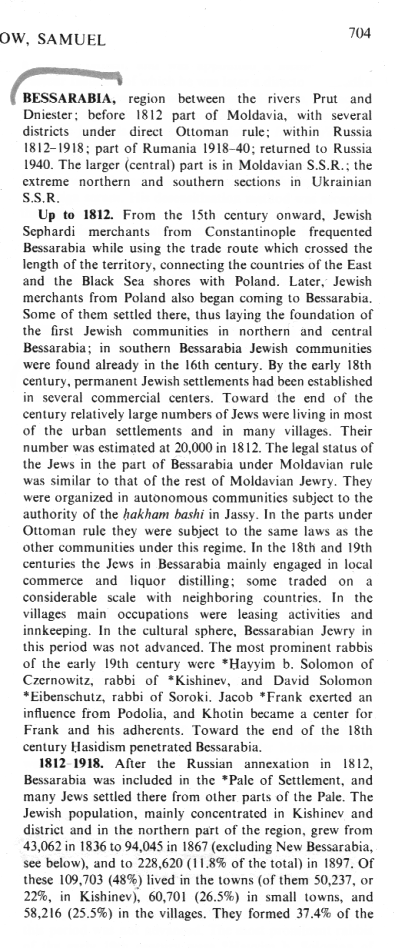
Encyclopaedia
Judaica (1971): Jews in Bessarabia, vol. 4, col.
704
xxxxxxxxxxxxxxxxxxxxxxx
|
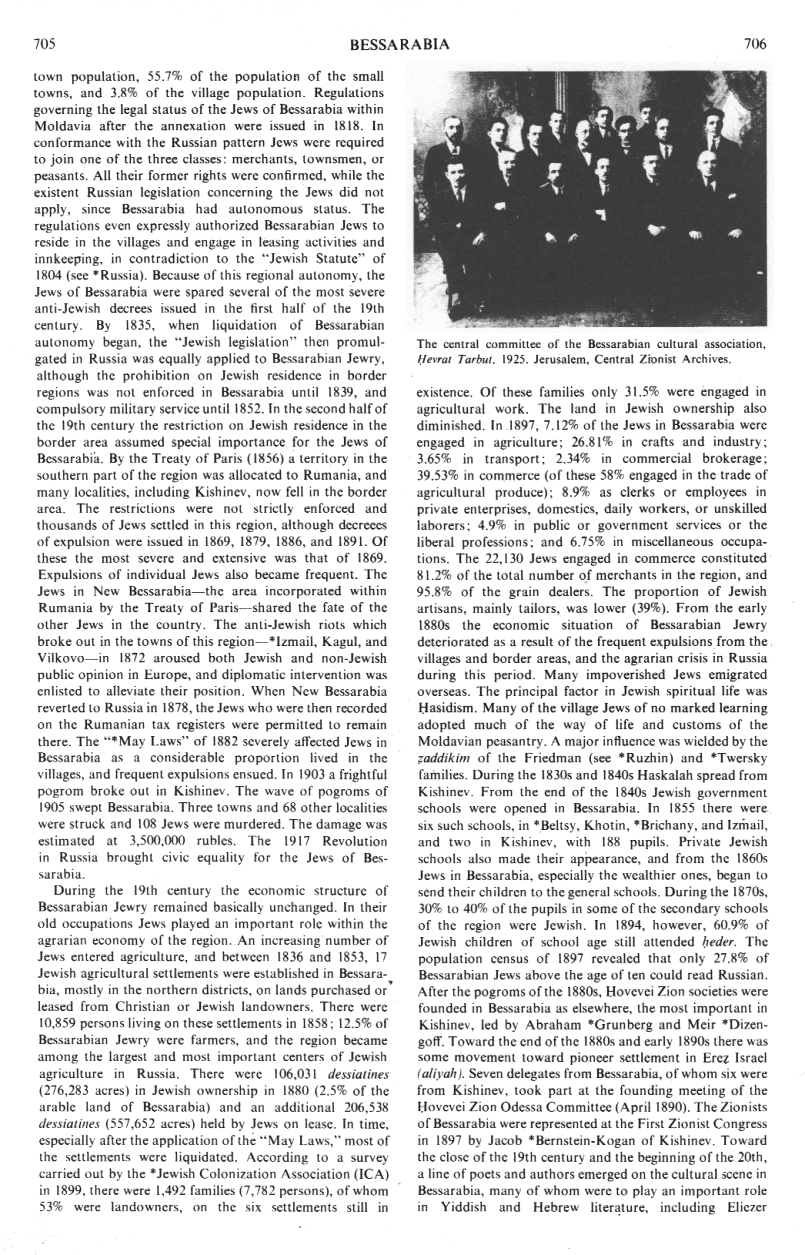
Encyclopaedia
Judaica (1971): Jews in Bessarabia, vol. 4, col.
705-706
|
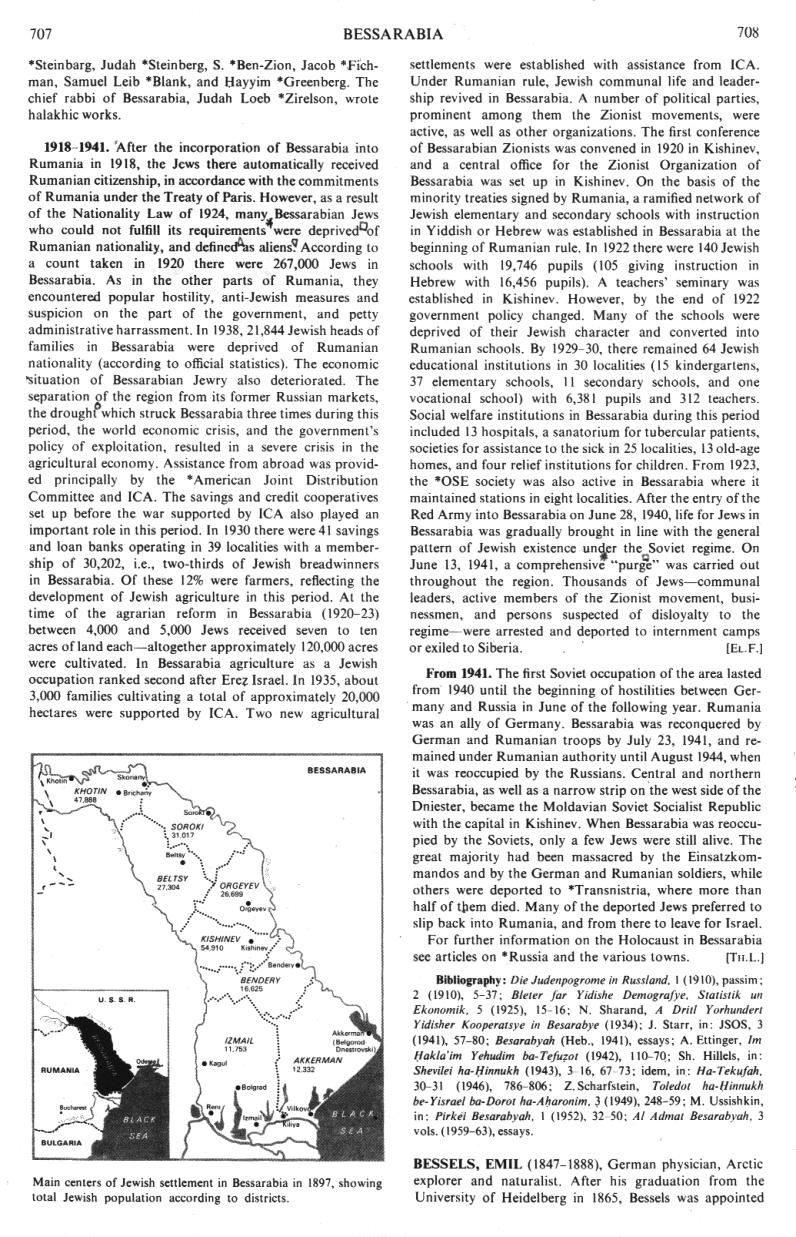
Encyclopaedia
Judaica (1971): Jews in Bessarabia, vol. 4, col.
707-708
|
|
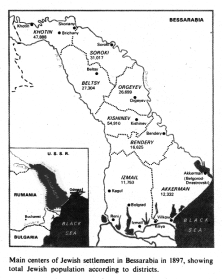 |
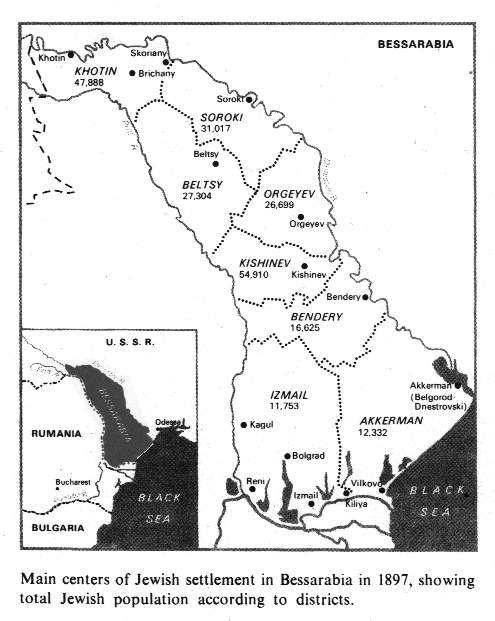
Encyclopaedia Judaica (1971): Jews in
Bessarabia, vol. 4, col. 707, map of Bessarabia
with the main centers of Jewish settlement in
Bessarabia in 1897, showing total Jewish
population according to districts: Khotin
district: 47,888 (Khotin, Skoriany, Brichany);
Soroki district: 31,017 (Soroki); Beltsy district:
27,304 (Beltsy); Orgeyev district: 26,699
(Orgeyev); Kishinev district: 54,910 (Kishinev);
Bendery district: 16,625 (Bendery); Izmail
district: 11,753 (Kagul, Bolgrad, Reni, Izmail,
Kiliya); Akkerman district: 12,332 (Akkerman /
Belgorod-Dnestrovski, Vilkovo) |