Encyclopaedia Judaica
Jews in Bessarabian
little towns
Law of Pale of settlement with Jewish migration from
the north - Sovietization with deportations and flight -
Holocaust - partly return
from: Encyclopaedia Judaica 1971
presented by Michael Palomino (2008 / 2023)
The solution for life is the Book of
Life with Mother Earth - www.med-etc.com
Briceva
from: Briceva; In: Encyclopaedia Judaica (1971), vol. 4
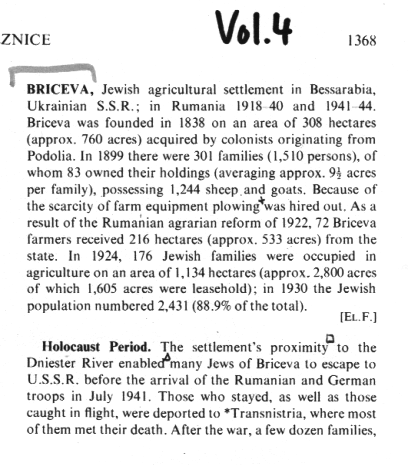
<BRICEVA, Jewish agricultural settlement in Bessarabia,
Ukrainian S.S.R.; in Rumania [[Romania]] 1918-40 and
1941-44. Briceva was founded in 1848 on an area of 308
hectares (approx. 760 acres) acquired by colonists
originating from Podolia. In 1899 there were 301 families
(1,510 persons), of whom 83 owned their holdings (averaging
approx. 9 1/2 acres per family), possessing 1,244 sheep and
goats. Because of the scarcity of farm equipment plowing was
hired out.
As a result of the Rumanian [[Romanian]]agrarian reform of
1922, 72 Briceva farmers received 216 hectares (approx. 533
acres) from the state. In 1924, 176 Jewish families were
occupied in agriculture on an area of 1,134 hectares
(approx. 2,800 acres of which 1,605 acres were leasehold);
in 1930 the Jewish population numbered 2,431 (88.9% of the
total).
[EL.F.]
Holocaust Period.
[[The Soviet occupation 1940-1941, the sovietization and the
Stalin deportations of class enemies to central Russia are
not mentioned in the article]].
[Big Flight from Barbarossa
- Transnistria Holocaust for the remaining Jews]
The settlement's proximity to the Dniester River enabled
many Jews of Briceva to escape to U.S.S.R. before the
arrival of the Rumanian and German troops in July 1941.
Those who stayed, as well as those caught in flight, were
deported to *Transnistria, where most of them met their
death.
[No lasting Jewish life
after 1945]
After the war, a few dozen families, (col. 1368)
the surviving remnant of the community, returned to Briceva.
None remained there, however [[because of racist Zionist
activities and emigration movement from the communist Iron
Curtain]], and the land became government property.
Bibliography
-- Yakir, in: Eynikeyt (Sept. 10, 1946)> (col. 1369)>
Brichany
from: Brichany; In: Encyclopaedia Judaica (1971), vol. 4
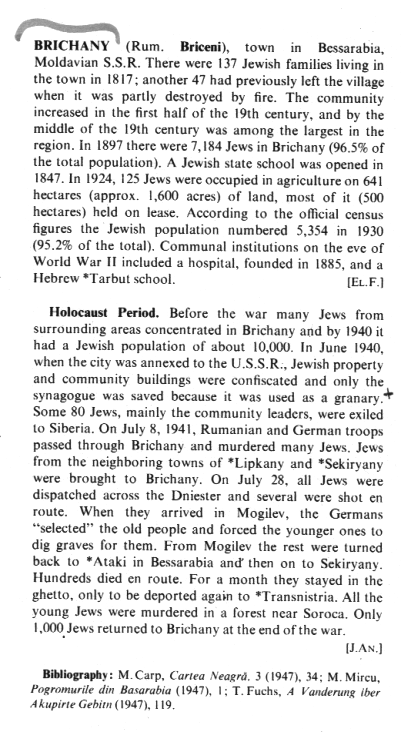
<BRICHANY (Rum. Briceni), town in Bessarabia, Moldavian
S.S.R.
There were 137 Jewish families living in the town in 1817,
another 47 had previously left the village when it was
partly destroyed by fire. The community increased in the
first half of the 19th century, and by the middle of the
19th century was among the largest in the region.
In 1897 there were 7,184 Jews in Brichany (96.5% of the
total population). A Jewish state school was opened in 1847.
In 1924, 125 Jews were occupied in agriculture on 641
hectares (approx. 1,600 acres) of land, most of it (500
hectares) held on lease. According to the official census
figures the Jewish population numbered 5,354 in 1930 (95.2%
of the total). Communal institutions on the eve of World War
II included a hospital, founded in 1885, and a Hebrew
*Tarbut school [[cultural school]].
[EL.F.]
Holocaust Period.
[Sovietization with
confiscations 1940-1941 - Stalin deportations]
Before the war many Jews from surrounding areas concentrated
in Brichany and by 1940 it had a Jewish population of about
10,000. In June 1940 when the city was annexed to the
U.S.S.R., the Jewish property and community buildings were
confiscated and only the synagogue was saved because it was
used as a granary.
Some 80 Jews, mainly the community leaders, were exiled to
Siberia [[Stalin deportations]].
[[The Big Flight from Barbarossa in June 1941 to central
Russia under leadership of the Russian army is missing in
this article]].
[Holocaust under Nazi rule]
On July 8, 1941, Rumanian [[Romanian]] and German troops
passed through Brichany and murdered many Jews. Jews from
the neighbouring towns of *Lipkany and *Sekiryany were
brought to Brichany. On July 28, all Jews were dispatched
across the Dniester and several were shot en route. When
they arrived in Mogilev, the Germans "selected" the old
people and forced the younger ones to dig graves for them.
From Mogilev the rest were turned back to *Ataki in
Bessarabia and then on the Sekiryany. Hundreds died en
route. For a month they stayed in the ghetto, only to be
deported again to *Transnistria. All the young Jews were
murdered in a forest near Soroca. Only 1,000 Jews returned
to Brichany at the end of the war [[probably from
deportations locations and from central Russia]].
[J.AN.]
Bibliography
-- M. Carp: Cartea Neagra (Cartea Neagrã), 3 (1947), 34
-- M. Mircu:Pogromurile din Basarabia (1947), 1
-- T. Fuchs: A Vanderung iber Akupirte Gebitn (1947),
119.> (col. 1369)>
Kaushany
from: Kaushany; In: Encyclopaedia Judaica (1971), vol. 10
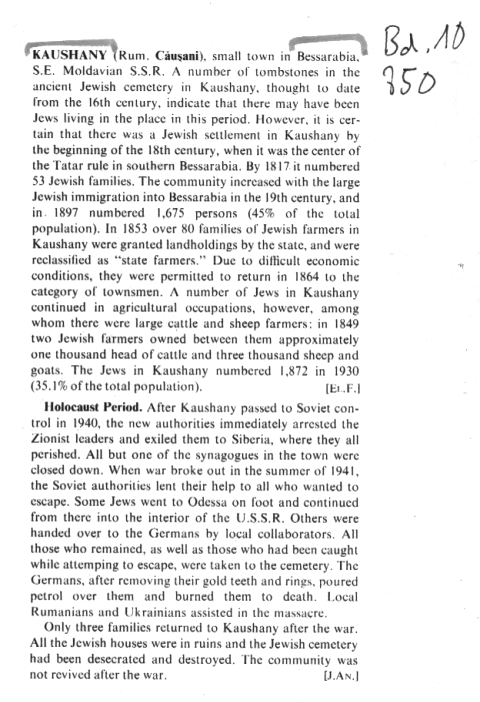
<KAUSHANY
(Rum. Causani (Cãuṣani), small town in Bessarabia, S.E.
Moldavian S.S.R. A number of tombstones in the ancient
Jewish cemetery in Kaushany, thought to date from the 16th
century, indicate that there may have been Jews living in
the place in this period. However, it is certain that there
was a Jewish settlement in Kaushany by the beginning of the
18th century, when it was the center of the Tatar rule in
southern Bessarabia.
By 1817 it numbered 53 Jewish families. The community
increased with the large Jewish immigration into Bessarabia
in the 19th century [[under the Rule of Pale of Settlement,
then were persecution waves]], and in 1897 numbered 1,675
persons (45% of the total population). In 1853 over 80
families of Jewish farmers in Kaushany were granted
landholdings by the state, and were reclassified as "state
farmers".
Due to difficult economic conditions, they were permitted to
return in 1864 to the category of townsmen. A number of Jews
in Kaushany continued in agricultural occupations, however,
among whom there were large cattle and sheep farmers: in
1849 two Jewish farmers owned between them approximately one
thousand head of cattle and three thousand sheep and goats.
The Jews in Kaushany numbered 1,872 in 1930 (35.1% of the
total population).
[EL.F.]
Holocaust Period.
[Sovietization]
After Kaushany passed to Soviet control in 1940, the new
authorities immediately arrested the [[racist]] Zionist
leaders and exiled them to Siberia, where they all perished.
[[And many more Jews were deported, the shop owners, the
members of certain parties, etc.]]. All but one of the
synagogues in the town were closed down.
[Big Flight from Barbarossa
to Odessa and to central Russia]
When war broke out in the summer of 1941, the Soviet
authorities lent their help to all who wanted to escape.
Some Jews went to Odessa on foot and continued from there
into the interior of the U.S.S.R. Others were handed over to
the Germans by local collaborators.
All those who remained, as well as those who had been caught
while attempting to escape, were taken to the cemetery. the
Germans [[and their collaborators]], after removing their
gold teeth and rings, poured petrol over them and burned
them to death. Local Rumanians [[Romanians]] and Ukrainians
assisted in the massacre.
Only three families returned to Kaushany after the war.
[[There probably came Jews back from other regions]]. All
the Jewish houses were in ruins [[by German air raids, and
by Russian air raids]] and the Jewish cemetery had been
desecrated and destroyed. The community was not revived
after the war.
[J.AN.]>
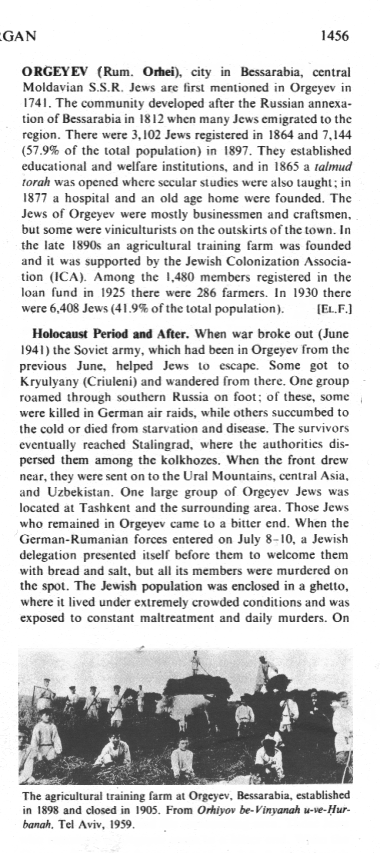
Orgeyev
<ORGEYEV (Rum. Orhei), city in Bessarabia, central
Moldavian S.S.R.
Jews are first mentioned in Orgeyev in 1741. The community
developed after the Russian annexation of Bessarabia in 1812
when many Jews emigrated to the region. There were 3,102
Jews registered in 1864 and 7,144 (57.9% of the total
population) in 1897. They established educational and
welfare institutions, and in 1865 a
talmud torah [[school]]
was opened where secular studies were also taught; in 1877 a
hospital and an old age home were founded. The Jews of
Orgeyev were mostly businessmen and craftsmen, but some were
viniculturists on the outskirts of the town.
In the late 1890s an agricultural training farm was founded
and it was supported by the Jewish Colonization Association
(ICA). Among the 1,480 members registered in the loan fund
in 1925 there were 286 farmers. In 1930 there were 6,408
Jews (41.9% of the total population).
[EL.F.]
Holocaust Period and After.
[Big Flight from Barbarossa
by the Soviet army - flight on foot to Stalingrad - death
cases during the flight - displacement to Ural and
Uzbekistan 1942]
When war broke out (June 1941) the Soviet army, which had
been in Orgeyev from the previous June, helped Jews to
escape. Some got to Kryulyany (Criuleni) and wandered from
there. One group roamed through southern Russia on foot; of
these, some were killed in German air raids, while others
succumbed to the cold or died from starvation and disease.
The survivors eventually reached Stalingrad, where the
authorities dispersed them among the kolkhozes.
When the front drew near, they were sent on to the Ural
Mountains, central Asia, and Uzbekistan. One large group of
Orgeyev Jews was located at Tashkent and the surrounding
area.
[Ghetto life and mass
murder on the remaining Jews in Orgeyev 1941-1944]
Those Jews who remained in in Orgeyev came to a bitter end.
When the German-Rumanian [[Romanian]] forces entered on July
8-10, a Jewish delegation presented itself before them to
welcome them with bread and salt, but all its members were
murdered on the spot. The Jewish population was enclosed in
a ghetto, where it lived under extremely crowded conditions
and was exposed to constant maltreatment and daily
murders.> (col. 1456)
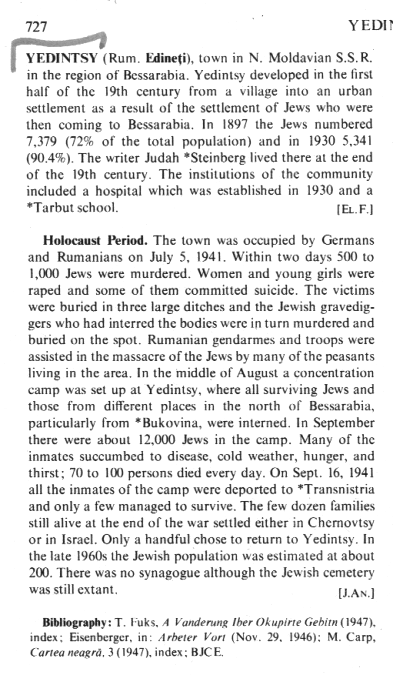
Yedintsy
from: Yedintsy; In: Encyclopaedia Judaica (1971), vol. 16
<YEDINTSY (Rum. Edineti (Edineți), town in N. Moldavian
S.S.R. in the region of Bessarabia.
Yedintsy developed in the first half of the 19th century
from a village into an urban settlement as a result of the
settlement of Jews who were then coming to Bessarabia. In
1897 the Jews numbered 7,379 (72% of the total population)
and in 1930 5,341 (90.4%). The writer Judah *Steinberg lived
there at the end of the 19th century. The institutions of
the community included a hospital which was established in
1930 and a *Tarbut school [[cultural school]].
[EL.F.]
Holocaust Period.
[[Communist occupation with sovietization, Stalin
deportations and the Big Flight from Barbarossa in June 1941
to central Russia are missing in the article]].
[Mass murder - rape and
massacre - concentration camp at Yedintsy - deportation to
Transnistria Holocaust]
The town was occupied by Germans and Rumanians [[Romanians]]
on July 5, 1941. Within two days 500 to 1,000 Jews were
murdered. Women and young girls were raped and some of them
committed suicide. The victims were buried in three large
ditches and the Jewish gravediggers who had interred the
bodies were in turn murdered and buried on the spot.
Rumanian [[Romanian]] gendarmes and troops were assisted in
the massacre of the Jews by many of the peasants living in
the area.
In the middle of August a concentration camp was set up at
Yedintsy, where all surviving Jews and those from different
places in the north of Bessarabia, particularly from
*Bukovina, were interned. In September there were about
12,000 Jews in the camp. Many of the inmates succumbed to
disease, cold weather, hunger, and thirst; 70 to 100 persons
died every day.
On September 16, 1941 all the inmates of the camp were
deported to *Transnistria and only a few managed to survive.
The few dozen families still alive at the end of the war
settled either in Chernovtsy or in Israel. Only a handful
chose to return to Yedintsy. In the late 1960s the Jewish
population was estimated at about 200. There was no
synagogue although the Jewish cemetery was still extant.
[J.AN.]
Bibliography
-- T. Fuks: A Vanderung iber Okupirte Gebitn (1947), index
-- Eisenberger, in: Arbeter Vort (Nov. 29, 1946)
-- M. Carp: Cartea neagra (Cartea neagrã, 3 (1947, index
-- BJCE.> (col. 727)
Sources
|
Encyclopaedia Judaica (1971): Briceva, vol. 4,
col. 1368
Encyclopaedia Judaica (1971): Briceva, vol. 4,
col. 1369
|
Encyclopaedia Judaica (1971): Brichany, vol. 4,
col. 1369 |
Encyclopaedia Judaica (1971): Kaushany, vol. 10,
col. 850 |
|
Encyclopaedia Judaica (1971): Orgeyev, vol. 12,
col. 1456 |
Encyclopaedia Judaica (1971): Yedintsy, vol. 16,
col. 727 |
|