<
ORGEYEV (Rum.
Orhei), city in Bessarabia, central Moldavian S.S.R.
[Settlement - Zionist
activities for foundation of racist Zionist Israel]
Jews first mentioned in Orgeyev in 1741. The community
developed after the Russian annexation of Bessarabia in 1812
when many Jews emigrated to the region. There were 3,102 Jews
registered in 1864 and 7,144 (57.9% of the total population)
in 1897. They established educational and welfare
institutions, and in 1865 a
talmud
torah was opened where secular studies were also
taught; in 1877 a hospital and an old age home were founded.
The Jews of Orgeyev were mostly businessmen and craftsmen, but
some were viniculturists on the outskirts of the town. In the
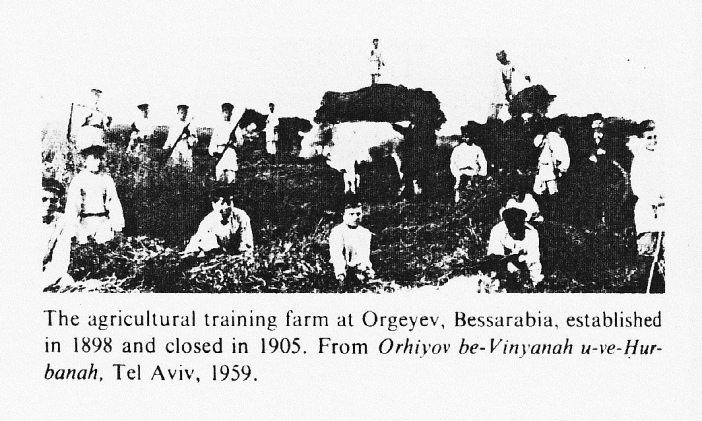
late 1890s an agricultural training farm was founded and it
was supported by the Jewish Colonization Association (ICA)
[[with racist Zionist plan of a Jewish Reich against the all
Arabs who had no weapons until 1915, but then had weapons]].
Among the 1,480 members registered in the loan fund in 1925
there were 286 farmers. In 1930 there were 6,408 Jews (41.9%
of the total population). [EL.F.]
Holocaust Period and After.
[Flight from Barbarossa to
inner Russia - death on the way by foot - distribution in
inner Russia]
When war broke out (June 1941) the Soviet army, which had been
in Orgeyev from the previous June, helped Jews to escape. Some
got to Kryulyany (Criuleni) and wandered from there. One group
roamed through southern Russia on foot; of these, some were
killed in German air raids, while others succumbed to the cold
or died from starvation and disease. The survivors eventually
reached Stalingrad, where the authorities dispersed them among
the kolkhozes. When the front drew near, they were sent on to
the Ural Mountains, central Asia, and Uzbekistan. One large
group of Orgeyev Jews was located at Tashkent and the
surrounding area.
[Holocaust under NS regime
with mass murder]
Those Jews who remained in Orgeyev came to a bitter end. When
the German-Rumanian forces entered on July 8-10, a Jewish
delegation presented itself before them to welcome them with
bread and salt, but all its members were murdered on the spot.
The Jewish population was enclosed in a ghetto, where it lived
under extremely crowded conditions and was exposed to constant
maltreatment and daily murders. On [col. 1456]
August 6, about 200 Jews were murdered by the 25th Rumanian
regiment and their bodies were thrown into the Dniester. In
1942 all the survivors were deported to the concentration camp
at Tiraspol, Transnistria; their exit from the city was
accompanied by the music of a gypsy band and the old people
were forced to dance in the streets.
When the transport reached a nearby forest, the young men
among the deportees were taken to an open field where they
underwent torture and where many were shot to death by the
soldiers. Others died on the way to Tiraspol and others in the
Transnistrian camps. Only a few lived to see the end of the
war.
[1945-1970]
There was little Jewish life after the war. [[Precise numbers
of returning Jews are missing, but some thousends have
returned for sure]].
The only synagogue in Orgeyev was closed down by the
authorities in 1960, after they had organized a "petition"
claiming that its presence was disturbing the neighbors. The
Jewish population in 1970 was estimated at about 3,000.
[J.AN.]
[[So at least 3,000 had come back from Russia after 1945]].
Bibliography:
-- Orhiyov be-Vinyanah u-ve-Hurbanah (1959)
-- M. Mircu: Pogromurile din basarabia... (1947), 9-10.>
Sources
|
Encyclopaedia Judaica: Jews in Orgeyev (Orhei) 01
|
Encyclopaedia Judaica: Jews in Orgeyev (Orhei) 0
|