|
|
|


Encyclopaedia Judaica
Jews in Belgrade
Good circumstances under local and Turkish law - destruction and expulsion under Austrians and Serbs since 1688 - Turkish despots - equality since 1878 - Holocaust - emigration for racist Herzl Israel
from: Belgrade; In: Encyclopaedia Judaica 1971, vol. 4
presented by Michael Palomino (2008 / 2020)

| Teilen
/ share: |
Facebook |
|
Twitter
|
|
|
|
<BELGRADE (Serb. Beograd), capital of Serbia and *Yugoslavia.
[Jews from Italy, Hungary,and Turkey in Belgrade - the mahala (quarter) - good circumstances]
Several Jews from Italy and Hungary settled in Belgrade in the 13th and 14th centuries. They were joined by Sephardi Jews after the Turkish conquest in 1521. They lived mostly in the Jewish mahala ("quarter") near the citadel, and were physicians, weaponsmiths, tanners, and merchants. The Jews lived in comfortable circumstances and were allowed to own land.
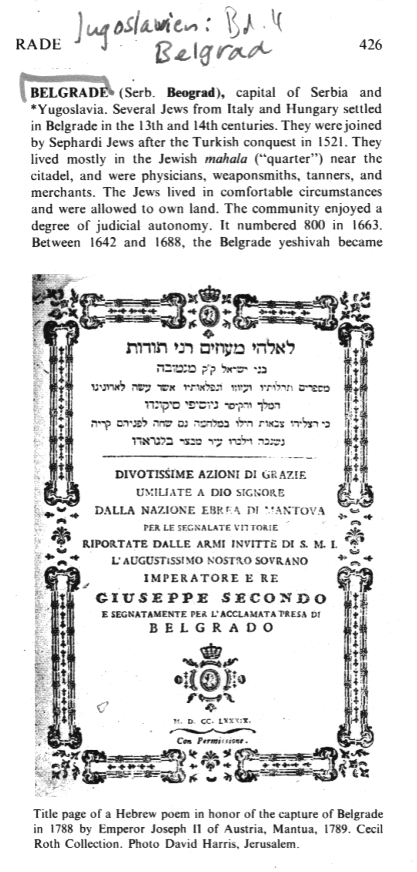
The community enjoyed a degree of judicial autonomy. It numbered 800 in 1663. Between 1642 and 1688, the Belgrade yeshivah [[religious Torah school]] became (col. 426)
widely known under the rabbis Judah *Lerma, Simhah (Simḥah) b. Gershon Kohen, and Joseph *Almosnino.
[Belgrade as a Austrian "Christian" fortress: quarter burnt, Jews and Turks killed - flight and slavery]
With the start of the decline of the Turkish Empire in the late 17th century, a long series of catastrophes befell the Jews of Belgrade. In 1688, at the approach of the Austrians, Turkish janissaries plundered and burned the Jewish quarter. After the capture of the city, Austrian soldiers burned, looted, and killed the Turkish and Jewish population. The community was totally destroyed; some Jews managed to flee to Bulgaria, but the majority were taken prisoner and deported to Austria to be sold as slaves or offered to Jewish communities for ransom.
[Belgrade under Turkish rule again - new Jews]
Shortly after, a number of Jews returned to the city and rebuilt the synagogue. However, since Belgrade became the key fortress against the Turks, under Austrian rule (1717-39) Jewish residence was restricted. The town was captured again by Turks in 1739 and by 1777 the number of Jews had increased to 800. In 1795 irregular troops of Pazvan Oglu, pasha of *Vidin, attacked Belgrade, burning the synagogue and many Jewish houses in the mahala [[quarter]].
Nevertheless, the Jews remained prosperous: in 1798 all the Belgrade guilds together paid 1,600 grush in taxes, while the Jewish community alone paid 10,000 grush.
[Serb rebellions against Turkish despots since 1803 - expulsion by the Serbs in 1807 and in 1813]
A series of rebellions and wars by the Serbs against the local Turkish despots, who had made themselves semi-independent of Constantinople, began in 1803, continuing intermittently for nearly 30 years. Belgrade changed hands many times, the Jews suffering each time. In 1807 the Serbs expelled the Jews from Belgrade.
The anti-Jewish measures were revoked at Russian intervention. Some Jews had been allowed to stay, and more returned between 1811 and 1813, but were forced to leave once more when an abortive rebellion broke out in 1813.
[Cultural life since 1815 - equality only since 1878]
When in 1815 Milosh Obrenovich was recognized ruler of Serbia the situation of the Jews improved. There were some 1,300 Jews (200 Ashkenazim) in 1831. Prince Milosh's Serbian State Press, founded in 1837, had Hebrew type too. The works, mostly liturgical or ritual, were printed in Ladino, or in Hebrew with a Ladino translation. The Ladino periodical el Amigo del Pueblo [[The Population's Friend]] was established in 1888 and appeared in Belgrade throughout the 1890s. Milosh's successor, Alexander Karageorgevich (1842-58), introduced a series of restrictions on Jewish residence, professions, and acquisition of property.
After obtaining full rights following the Congress of Berlin in 1878, the wealthier Jews gradually became absorbed into Serbian society. They spoke Serbian, their children went to state schools and universities, and became physicians, civil servants, etc. In 1907 they built the new Sephardi synagogue, Bet Yisrael, in the upper town. There was a Hebrew school from the 1850s. Most Jews lived in the mahala [[quarter]] until World War I when it was partly destroyed.
After World War I, when Belgrade became the capital of independent Yugoslavia, the younger generation gradually left the mahala to enter the professions, banking, the stock exchange, and the garment industry.
Holocaust Period.
[[All flight movements to and from Yugoslav towns between 1933 and 1941 are not mentioned in the article]].
[Confiscations - forced labour - resistance is answered by mass executions - camps, deportations and mass executions - Saymishte camp on Sava river - gas vans]
When the Germans entered Belgrade in April 1941, 12,000 Jews were living there. The 20,000 Volksdeutsche (ethnic Germans) of Belgrade led the Germans [[the German invading troops]] to Jewish shops and homes, looting all that the Germans left. Jews were evicted and their property confiscated. The Ashkenazi synagogue was turned into a brothel; the Bet Yisrael synagogue became a storehouse for looted Jewish property and was blown up before the German retreat. All communal activities were forbidden, but the Vertretung ("Representation"), nominated by the Germans, contrived to organize public kitchens, medical services, etc. for the local Jews and for the 2,500 Jews from the Banat region who were expelled to Belgrade.
All men (col. 427)
between the ages of 14 and 60 and all women between the ages of 14 and 40 were forced to work in the town, not only without payment but also providing their own food.
With the beginning of armed resistance in Serbia, the Germans began executing hostages, mostly Jews. the first mass execution took place on July 29, when 122 "Communists and Jews" were shot. The "final solution" began with the mass arrest of some 5,000 Jewish men between August and October 1941. After being imprisoned in two camps in Belgrade, the men were then taken in groups of 150 to 400 "to work in Austria" and shot in nearby forests by regular German army units [[and their collaborators]]. The remaining 6,000 Jewish women and children were arrested in December 1941 and transported to the Saymishte camp, a former commercial fairground on the left bank of the Sava. Food was scarce, and many froze to death in the winter of 1941-42. Between February and May 1942, the remainder were killed in gas vans. Patients of the Jewish hospital in the mahala [[quarter]] were also liquidated in 1942.
RESISTANCE.
Immediately after the German occupation Jewish youth, mainly from Ha-Shomer ha-Za'ir, (ha-Ẓa'ir), joined the resistance movement, sabotaging enemy installations, disseminating propaganda, and collecting funds and medical supplies. In August 1941 they joined partisan units in the forests, but not before considerable numbers of them had been arrested and shot. A monument to fallen Jewish fighters and victims of Fascism was set up after the war in the central cemetery of Belgrade.
Contemporary Period.
[Recovery of the Jewish community and emigration movement for racist Herzl Israel]
Immediately after the liberation of Belgrade in October 1944 the Jewish community resumed its activities by opening a soup kitchen, a center for returnees, and medical services. The Bet Yisrael synagogue was reconsecrated in December 1944, with the Ashkenazi and the Sephardi communities merging. In 1947 the community had 2,271 members, half of whom emigrated to [[racist Zionist Free Mason CIA Herzl]] Israel shortly after.
In 1969 there were 1,602 Jews in Belgrade. The community center ran an internationally known choir, a youth club, and a kindergarten. It also housed the Federation of Jewish Communities of Yugoslavia. The Yugoslav Jewish Historical Museum contains material on all Jewish communities in Yugoslavia.
Bibliography
-- A. Hananel and E. Eskenazi (Eškenazi): Fontes Hebraici [[Hebrew Sources]] ... 1 (1958), 219, 468-71, and index; 2 (1960), 177-8, 258-60, and index
-- D. Djuric-Zamolo (Djurić-Zamolo), in: Jevrejski Almanah 1965-67, 41-76
-- A. Alkalay, in: Jevrejski Almanah 1961-62, 82-97
-- Moses Kohen: Et Sofer (Fuerth, 1691)
HOLOCAUST PERIOD
-- Savez Jevrejskih Opstina (Opština): Zlocini fasistickih okupatora (Zločini fašističkih okupatora) ... (1952), 1-9 (Engl. summary)
-- G. Reitlinger: Final Solution (1961), 385-92
-- R. Hilberg: Destruction of European Jewry (1961), 435-42
[D.F.]> (col. 428)
| Teilen
/ share: |
Facebook |
|
Twitter |
|
|
|