|
|
|


Encyclopaedia Judaica
Jews in Osijek
Jews coming as prisoners - community life and emancipation - Holocaust with robbery, deportations and mass murder
from: Osijek; In: Encyclopaedia Judaica 1971, vol. 12
presented by Michael Palomino (2008 / 2020)

| Teilen
/ share: |
Facebook |
|
Twitter
|
|
|
|
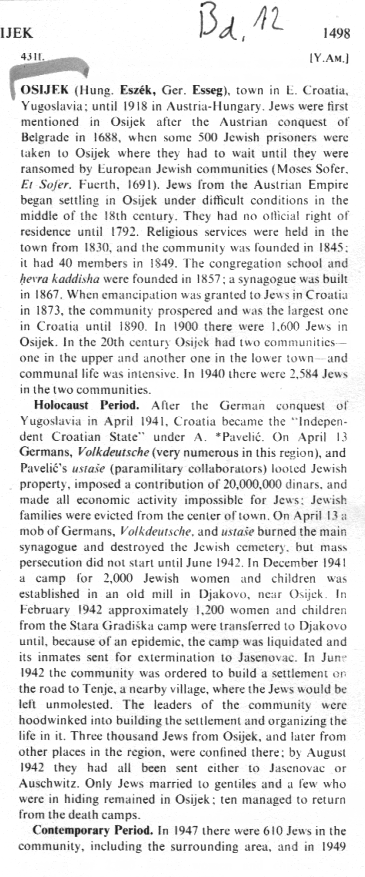
<OSIJEK (Hung. Eszék, Ger. Esseg), town in E. Croatia, Yugoslavia; until 1918 in Austria-Hungary.
[Jews coming from Austria as prisoners - Jewish rights since 1792 - community since 1845 - synagogue sinde 1867 - emancipation since 1873]
Jews were first mentioned in Osijek after the Austrian conquest of Belgrade in 1688, when some 500 Jewish prisoners were taken to Osijek where they had to wait until they were ransomed by European Jewish communities (Moses Sofer: Et Sofer. Fuerth, 1691).
Jews from the Austrian Empire began settling in Osijek under difficult conditions in the middle of the 18th century. They had no official right of residence until 1792. Religious services were held in the town from 1830, and the community was founded in 1845; it had 40 members in 1849. The congregation school and hevra kaddisha (ḥevra kaddisha) [[Jewish burial society]] were founded in 1857; a synagogue was built in 1867.
When emancipation was granted to Jews in Croatia in 1873, the community prospered and was the largest one in Croatia until 1890. In 1900 there were 1,600 Jews in Osijek. In the 20th century Osijek had two communities - one in the upper and another one in the lower town - and communal life was intensive. In 1940 there were 2,584 Jews in the two communities.
Holocaust Period. [robbery, fine, discrimination from jobs, barred zones - destruction of buildings - camps, deportations and mass murder]
After the German conquest of Yugoslavia [[and of the collaborators, Yugoslavia was parted]] in April 1941, Croatia became the "Independent Croatian State" under A. *Pavelić. On April 13 Germans, Volksdeutsche [[ethnic Germans]] (very numerous in this region), and Pavelic's ustase (Pavelić's ustaše) (paramilitary collaborators) looted Jewish property, imposed a contribution of 20,000,000 dinars, and made all economic activity impossible for Jews; Jewish families were evicted from the center of town.
On April 13 a mob of German, Volksdeutsche, and ustase (ustaše) burned the main synagogue and destroyed the Jewish cemetery, but mass persecution did not start until June 1942. In December 1941 a camp for 2,000 Jewish women and children was established in an old mill in Djakovo, near Osijek. In February 1942 approximately 1,200 women and children from the Stara Gradiska (Gradiška) camp were transferred to Djakovo until, because of an epidemic, the camp was liquidated and its inmates [[the survivors of the epidemic]] sent for extermination to Jasenovac.
In June 1942 the community was ordered to build a settlement on the road to Tenje, a nearby village, where the Jews would be left unmolested. The leaders of the community were hoodwinked into building the settlement and organizing the life in it. Three thousand Jews from Osijek, and later from other places in the region, were confined there; by August 1942 they had all been sent either to Jasenovac or Auschwitz [[and probably to the tunnel systems with high death rate]]. Only Jews married to gentiles and a few who were in hiding remained in Osijek; ten managed to return from the death camps.
Contemporary Period.
In 1947 there were 610 Jews in the community, including the surrounding area.> (col. 1498)
| Teilen
/ share: |
Facebook |
|
Twitter |
|
|
|