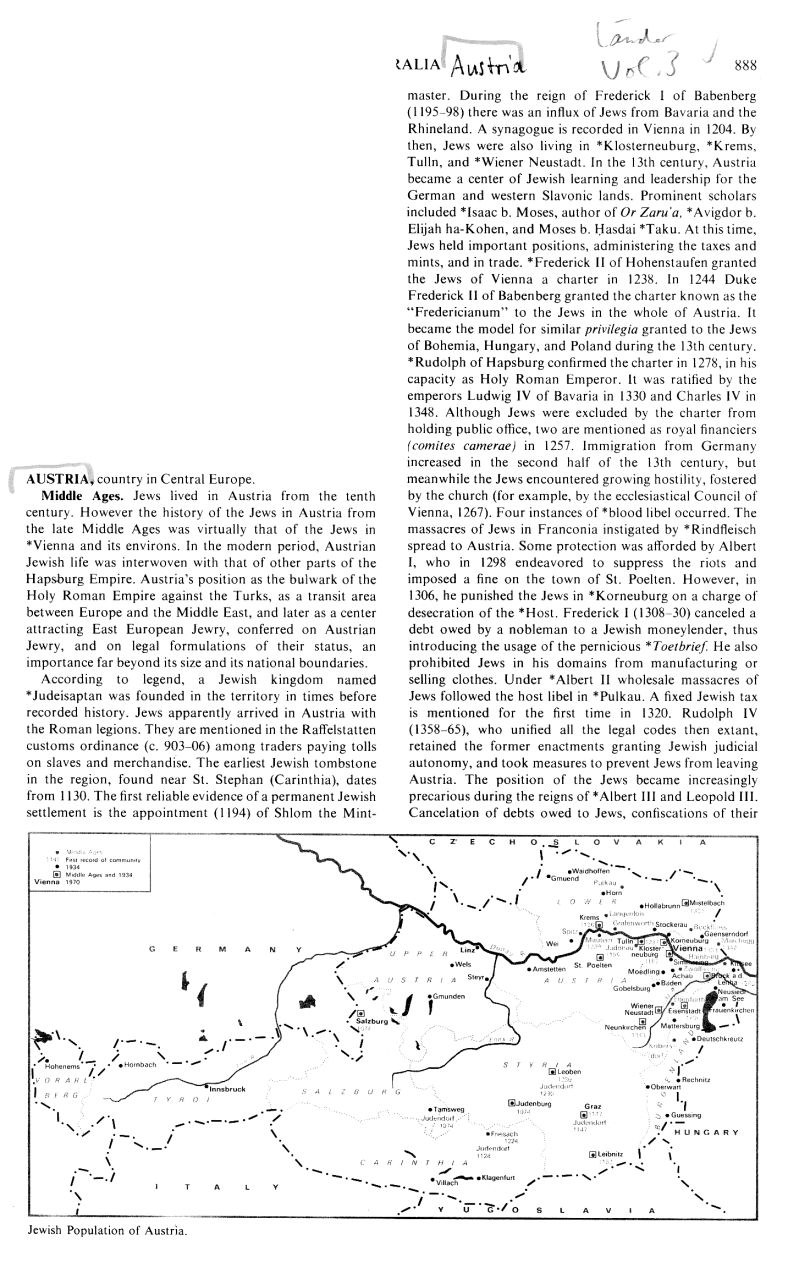
<AUSTRIA, country in Central Europe.
Middle Ages.
Jews lived in Austria from the tenth century. However the
history of the Jews in Austria from the late Middle Ages
was virtually that of the Jews in *Vienna and its
environs. In the modern period, Austrian Jewish life was
interwoven with that of other parts of the Hapsburg
Empire. Austria's position as the bulwark of the Holy
Roman Empire against the Turks, as a transit area between
Europe and the Middle East, and later as a center
attracting East European Jewry, conferred on Austrian
Jewry, and on legal formulations of their status, an
importance far beyond its size and its national
boundaries.
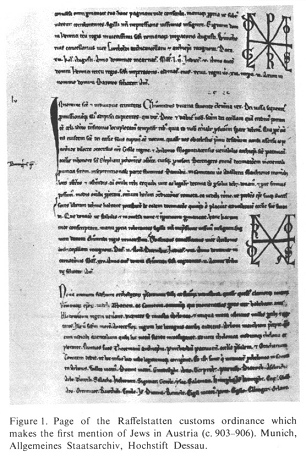
Encyclopaedia Judaica: Austria, vol.3, col.889,
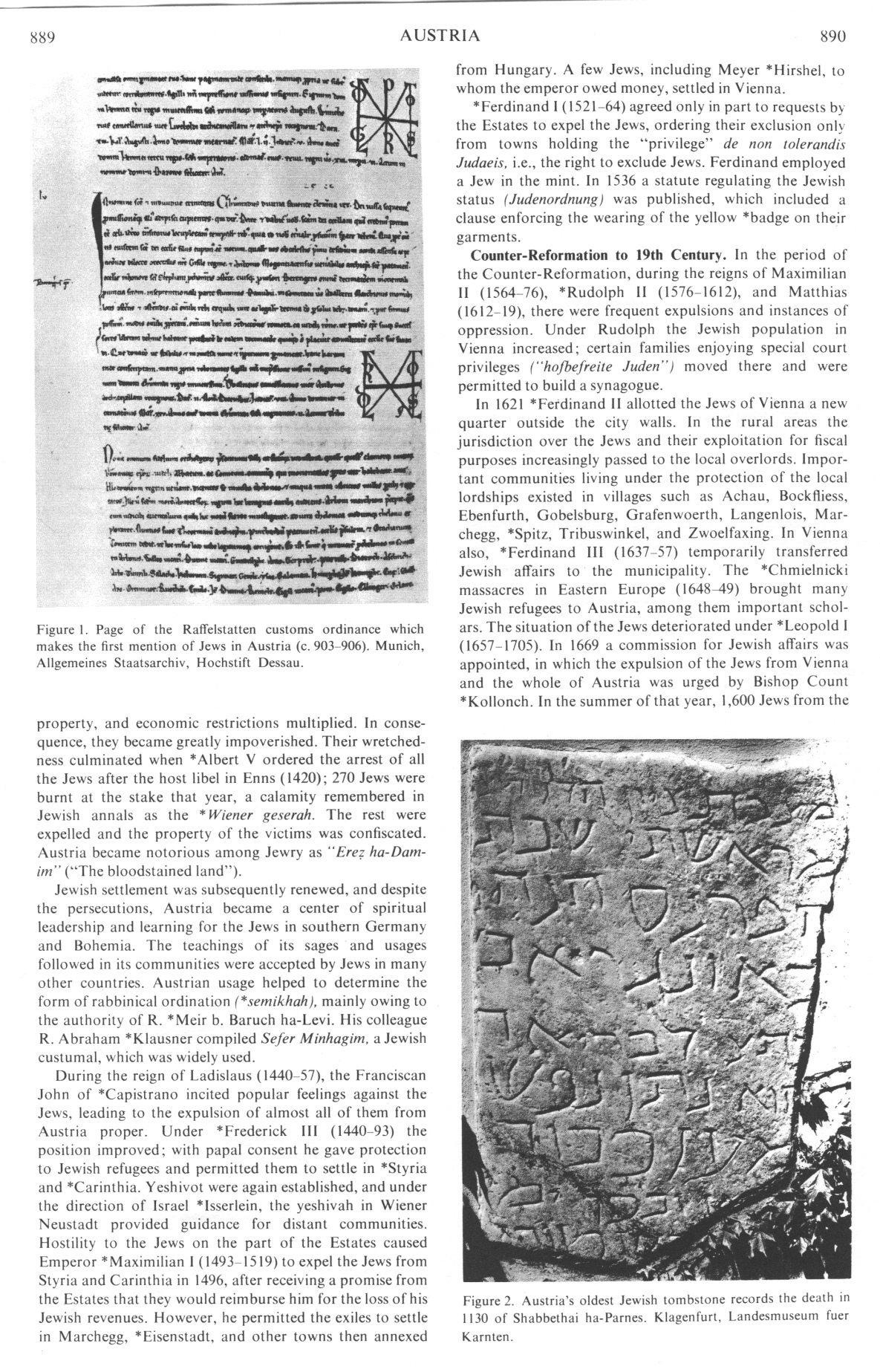
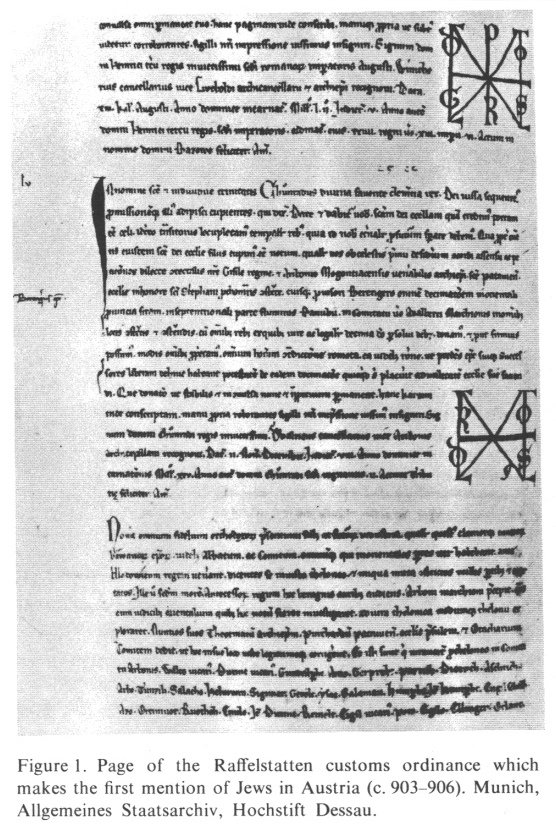
Raffelstatten, first mentioning of Jews in Austria: Page
of the Raffelstatten customs
ordinance which makes the first mention of Jews in
Austria (c. 903-906); Munich, public record office,
convent of Dessau
According to legend, a Jewish kingdom named *Judeisaptan
was founded in the territory in times before recorded
history. Jews apparently arrived in Austria with the Roman
legions. They are mentioned in the Raffelstatten customs
ordinance (c. 903-06) among traders paying tolls on slaves
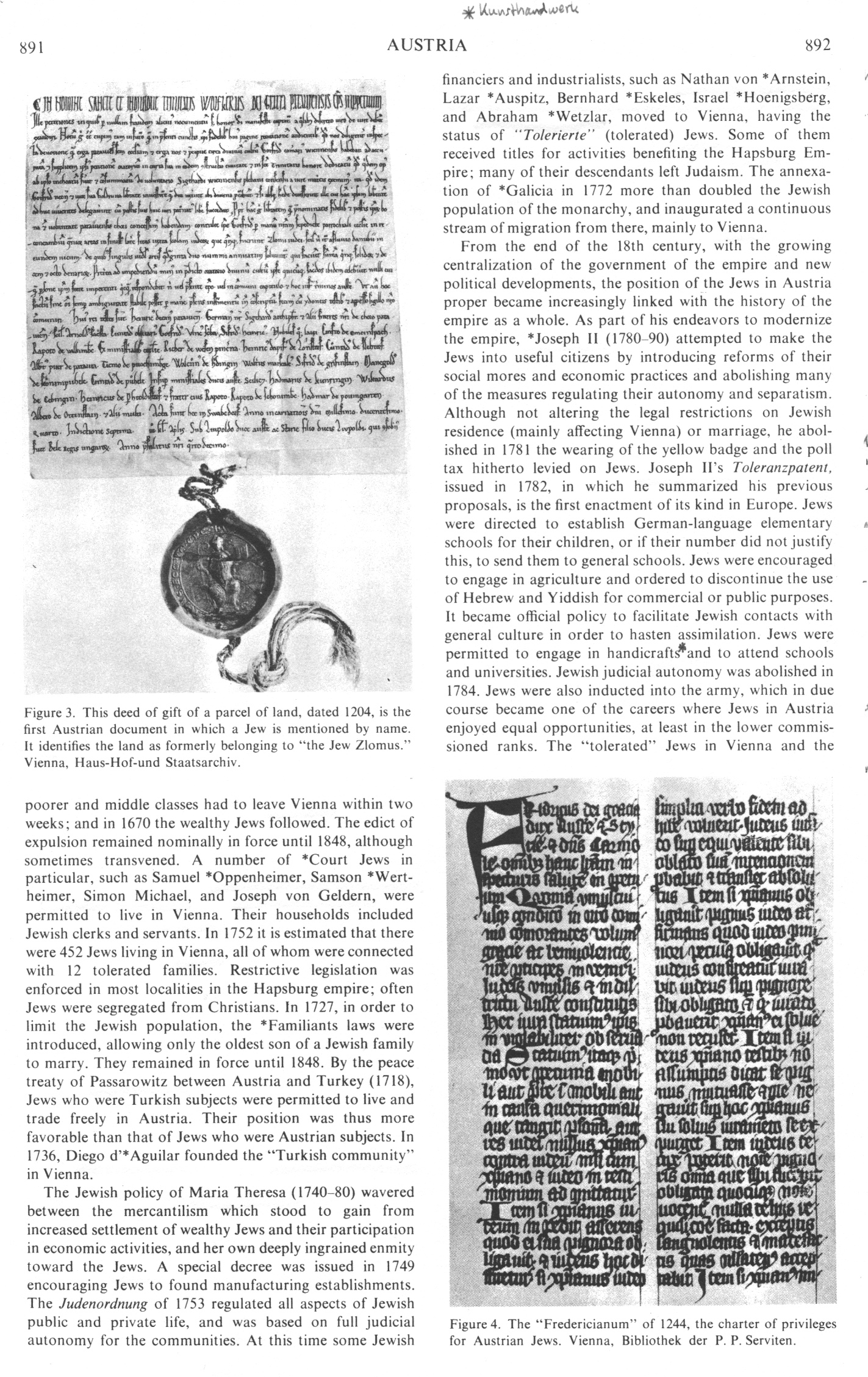
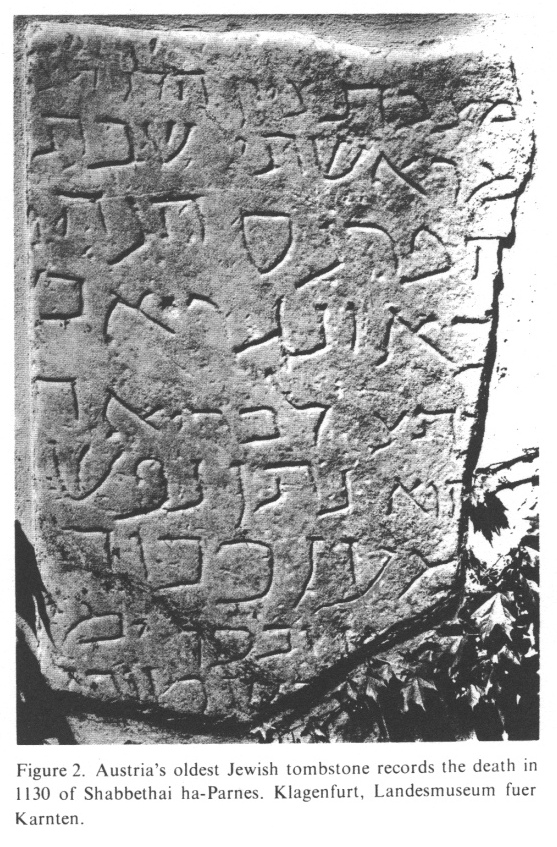
and merchandise. The earliest Jewish tombstone in the
region, found near St. Stephan (Carinthia), dates from
1130. The first reliable evidence of a permanent Jewish
settlement is the appointment (1194) of Shlom the
Mintmaster. (col. 887)
During the reign of Frederick I of Babenberg (1195-98)
there was an influx of Jews from Bavaria and the
Rhineland. A synagogue is recorded in Vienna in 1204. By
then, Jews were also living in *Klosterneuburg, *Krems,
Tulln, and *Wiener Neustadt.
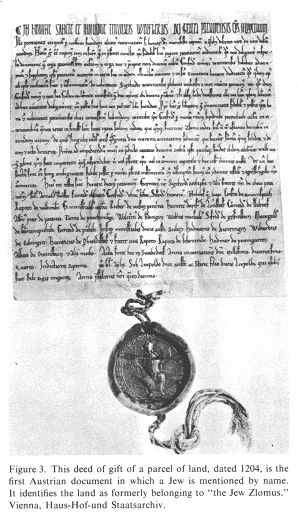
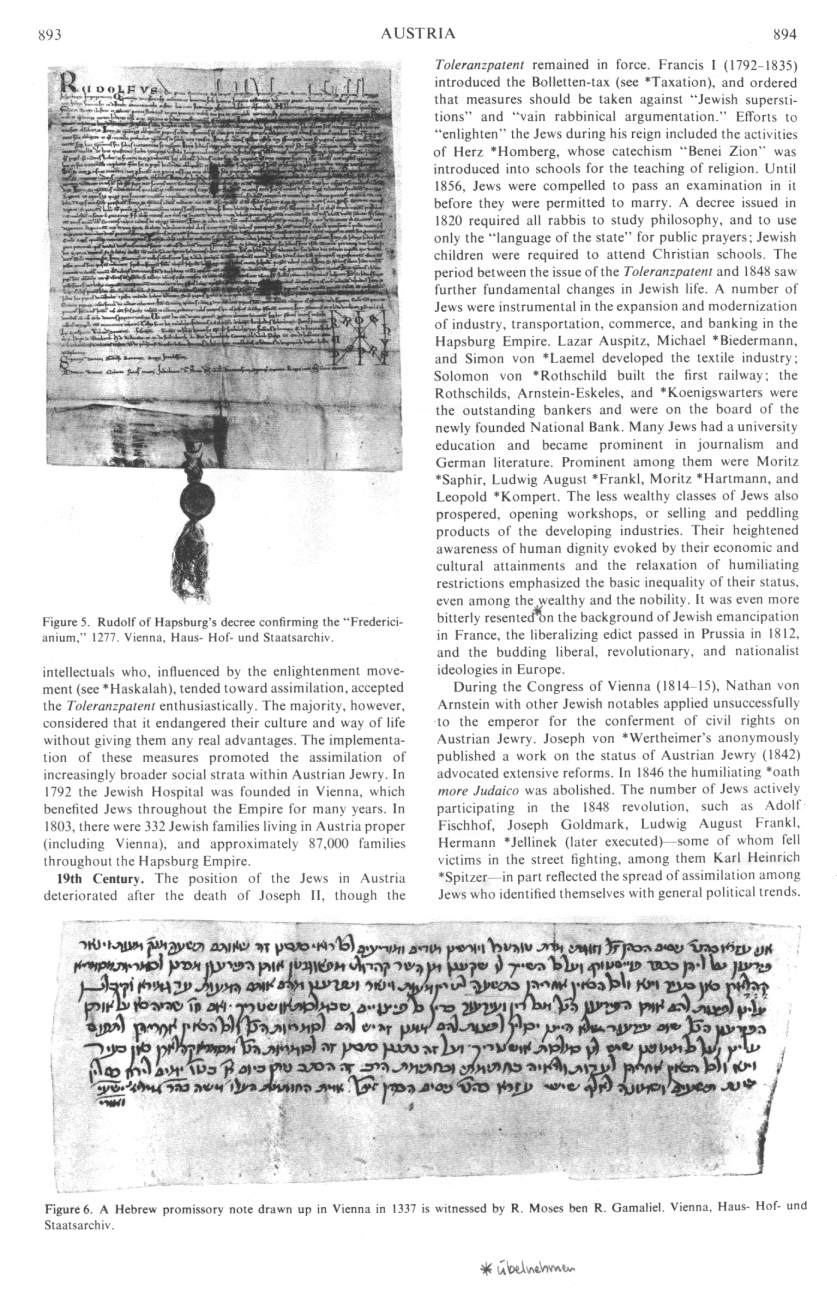
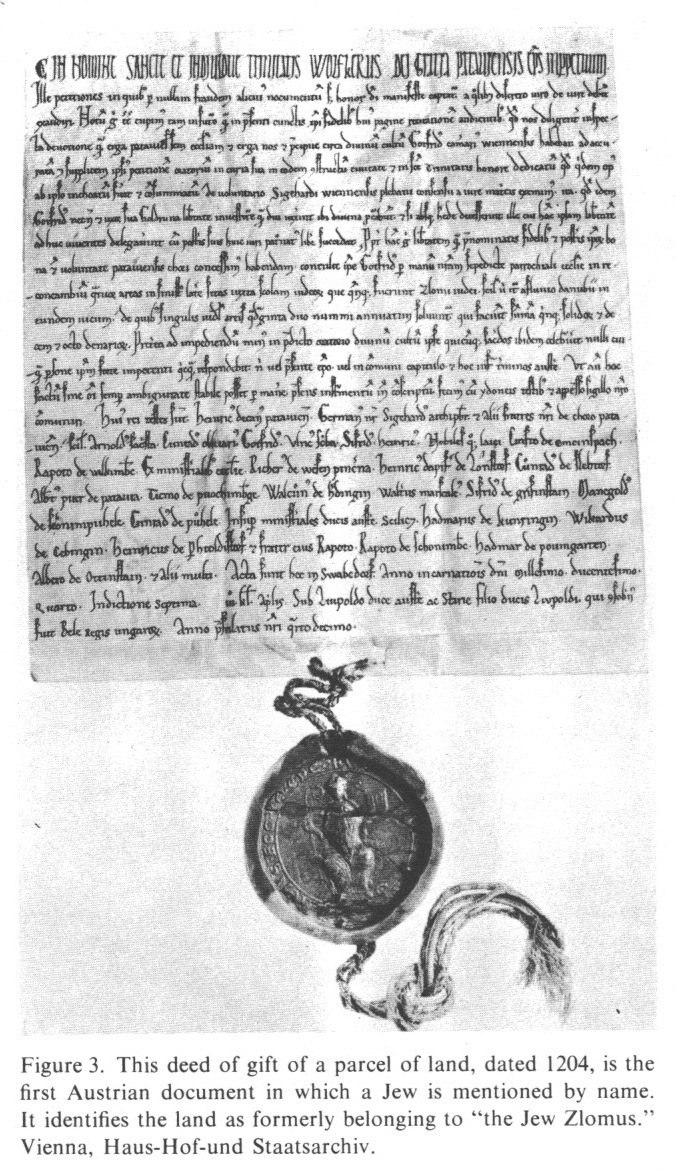
Encyclopaedia Judaica: Austria, vol.3, col.891, gift of
territory 1204: This deed of gift of a parcel of land,
dated 1204,
is the first Austrian document in which a Jews is
mentioned by name. It identifies the land as formerly
belonging to "the Jew Zlomus." Vienna, public record
office (Haus-Hof- und Staatsarchiv).
In the 13th century, Austria became a center of Jewish
learning and leadership for the German and western
Slavonic lands. Prominent scholars included *Isaac b.
Moses, author of
Or
Zaru'a, *Avigdor b. Elijah ha-Kohen, and Moses b.
Hasdai *Taku. At that time, Jews held important positions,
administering the taxes and mints, and in trade.
*Frederick II of Hohenstaufen granted the Jews of Vienna a
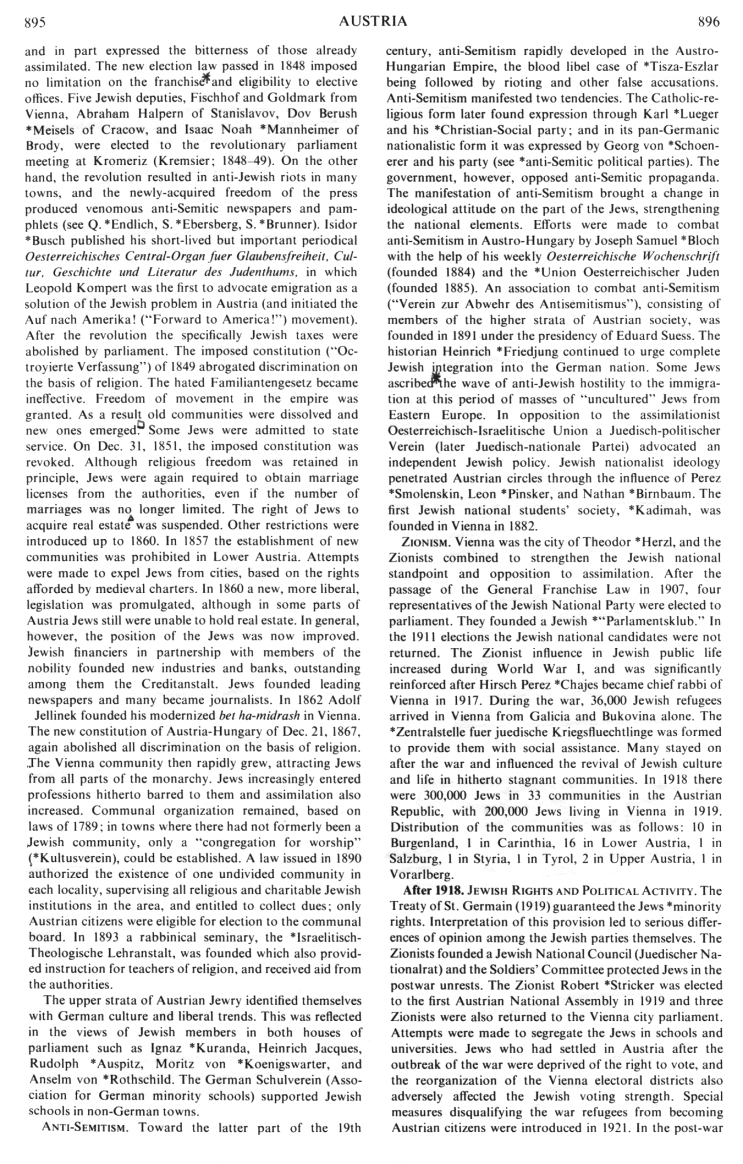
charter in 1238. In 1244 Duke Frederick II of Babenberg
granted the charter known as the "Fredericianum" to the
Jews in the whole of Austria. It became the model for
similar
privilegia
granted to the Jews of Bohemia, Hungary, and Poland during
the 13th century. *
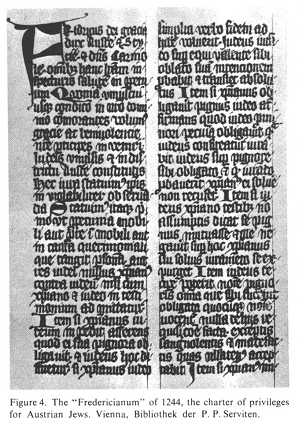
Encyclopaedia Judaica: Austria, vol.3, col.892,
privileges of 1244: The "Fredericianum" of 1244, the
charter of privileges
for Austrian Jews, Vienna, library of the P.P. Serviten
(Bibliothek der P.P. Serviten)
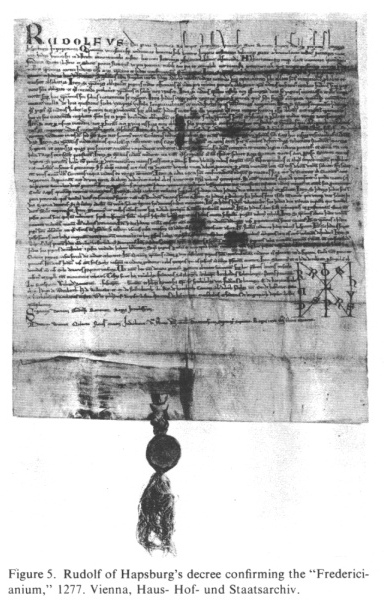
Rudolph of Hapsburg confirmed the charter in 1278, in his
capacity as Holy Roman Emperor.
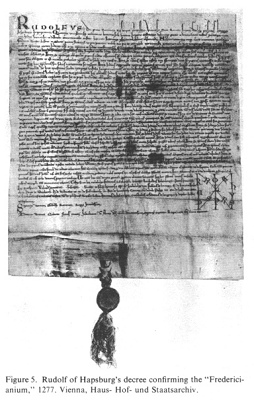
Encyclopaedia Judaica: Austria, vol.3, col.893,
confirmation of the Jewish privileges: Rudolf of
Hapsburg's decree confirming
the "Fredericianium" in 1277. Vienna public record
office (Haus-, Hof- und Staatsarchiv).
It was ratified by the emperors Ludwig IV of Bavaria in
1330 and Charles IV in 1348.
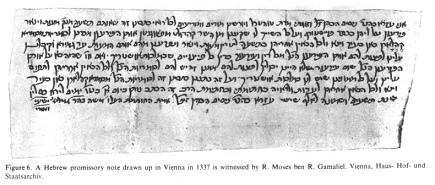
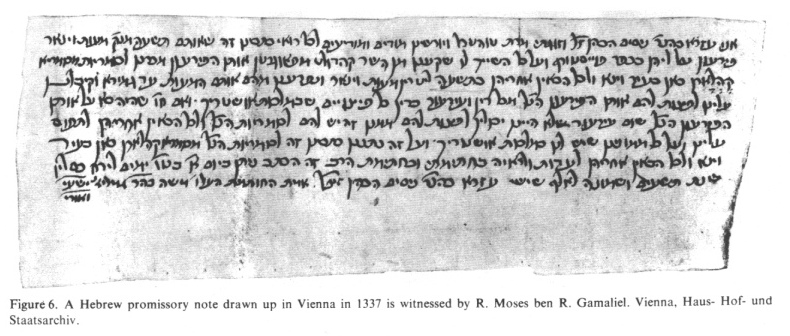
Encyclopaedia Judaica: Austria, vol.3, col.893-894,
Jewish confirmation of 1337: A Hebrew promissory note
drawn up in Vienna
in 1337 is witnessed by R. Moses ben R. Gamaliel. Vienna
public record office (Haus-, Hof- und Staatsarchiv).
Although Jews were excluded by the charter from holding
public office, two are mentioned as royal financiers (
comites camerae) in
1257. Immigration from Germany increased in the second
half of the 13th century, but meanwhile the Jews
encountered growing hostility, fostered by the church (for
example, by the ecclesiastical Council of Vienna, 1267).
Four instances of *blood libel occurred. The massacres of
Jews in Franconia instigated by *Rindfleisch spread to
Austria.
Some protection was afforded by Albert I, who in 1298
endeavored to suppress the riots and imposed a fine on the
town of St. Poelten. However, in 1306, he punished the
Jews in *Korneuburg on a charge of desecration of the
*Host.
Frederick I (1308-30) canceled a debt owed by a nobleman
to a Jewish moneylender, thus introducing the usage of the
pernicious
*Toetbrief.
He also prohibited Jews in his domains from manufacturing
of selling clothes.
Under *Albert II wholesale massacres of Jews followed the
host libel in *Pulkau. A fixed Jewish tax is mentioned for
the first time in 1320.
Rudolph IV (1358-65), who unified all the legal codes then
extant, retained the former enactments granting Jewish
judicial autonomy, and took measures to prevent Jews from
leaving Austria.
The position of the Jews became increasingly precarious
during the reigns of *Albert III and Leopold III.
Cancelation of debts owed to Jews, confiscations of their
(col. 888)
property, and economic restrictions multiplied. In
consequence, they became greatly impoverished.
Their wretchedness culminated when *Albert V ordered the
arrest of all the Jews after the host libel in Enns
(1420); 270 Jews were burnt at the stake that year, a
calamity remembered in Jewish annals as the
*Wiener geserah. the
rest were expelled and the property of the victims was
confiscated. Austria became notorious among Jewry as "Erez
ha-Damim" ("The bloodstained land").
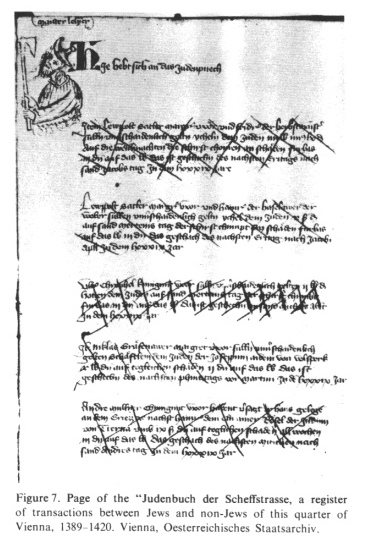
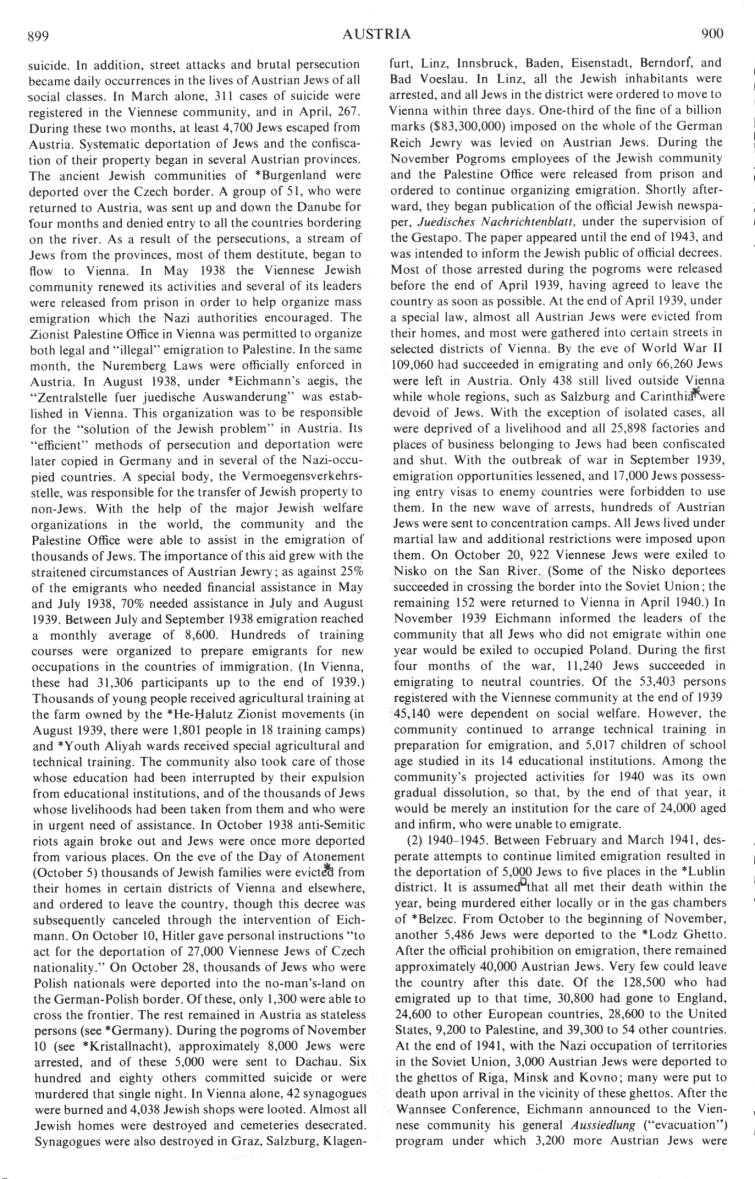
Encyclopaedia Judaica: Austria, vol.3, col.901: Jewish
booklet of Scheff street (Scheffstrasse): Page of the
"Judenbuch der Scheffstrasse",
a register of transactions between Jews and non-jews of
this quarter of vienna, 1389-1420. Vienna, national
public
record office (Österreichisches Staatsarchiv).
Jewish settlement was subsequently renewed, and despite
the persecutions, Austria became a center of spiritual
leadership and learning for the Jews in southern Germany
and Bohemia. The teachings of its sages and usages
followed in its communities were accepted by Jews in many
other countries. Austrian usage helped to determine the
form of rabbinical ordination (
*semikhah), mainly owing to the
authority of R. *Meir b. Baruch ha-Levi. His colleague R.
Abraham *Klausner compiled
Sefer Minhagim, a Jewish custumal, which
was widely used.
[Expulsion of almost all
Jews under Ladislaus]
During the reign of Ladislaus (1440-57), the Franciscan
John of *Capistrano incited popular feeling against the
Jews, leading to the expulsion of almost all of them from
Austria proper.
[New Jewish life under
Frederick III in Styria and Carinthia]
Under *Frederick III (1440-93) the position improved; with
papal consent he gave protection to Jewish refugees and
permitted them to settle in *Styria and *Carinthia.
Yeshivot [[Jewish religion schools]] were again
established, and under the direction of Israel *Isserlein,
the yeshivah in Wiener Neustadt provided guidance for
distant communities.
[Expulsion under
Maximilian - and settlement in Marchegg and Eisenstadt
a.o.]
Hostility to the Jews on the part of the Estates caused
Emperor *Maximilian I (1493-1519) to expel the Jews from
Styria and Carinthia in 1496, after receiving a promise
from the Estates that they would reimburse him for the
loss of his Jewish revenues. However, he permitted the
exiles to settle in Marchegg, *Eisenstadt, and other towns
then annexed (col. 889)
from Hungary. A few Jews, including Meyer *Hirshel, to
whom the emperor owed money, settled in Vienna.
[Ferdinand I drives the
Jews into the mint - and the first yellow badge]
*Ferdinand I (1521-64) agreed only in part to requests by
the Estates to expel the Jews, ordering their exclusion
only from towns holding the "privilege"
de non tolerandis Judaeis,
i.e., the right to exclude Jews. Ferdinand employed a Jew
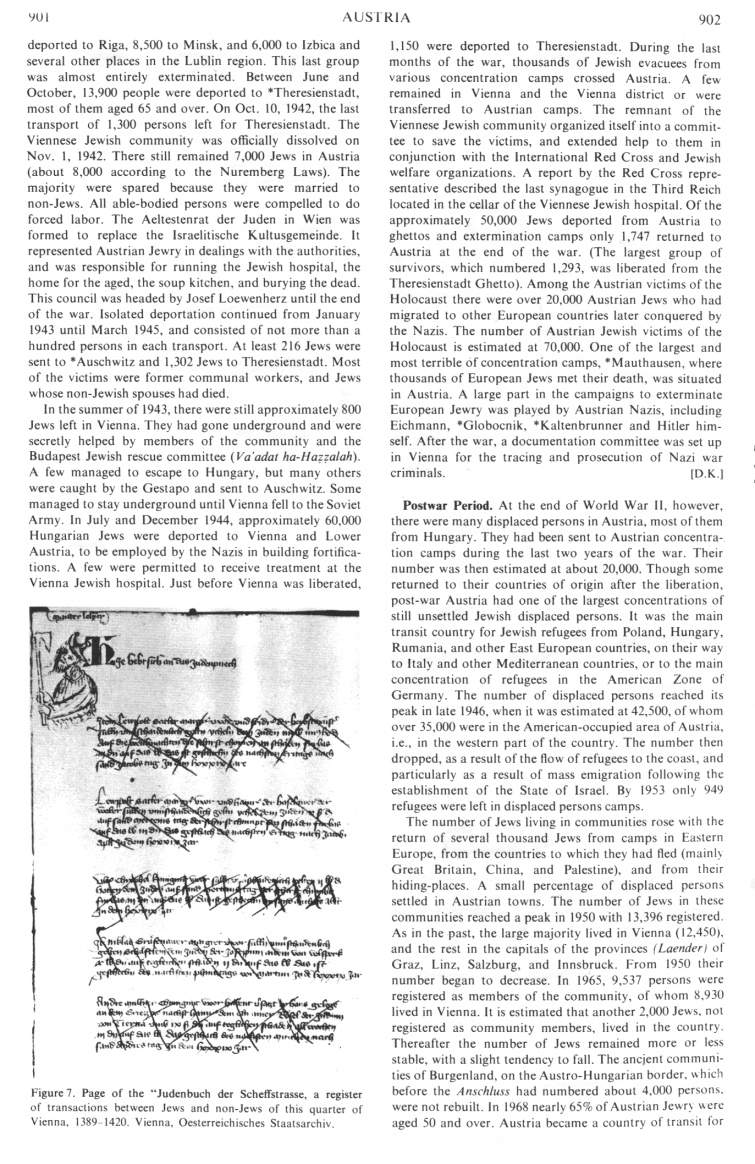
in the mint. In 1536 a statute regulating the Jewish
status (
Judenordnung)
[[Jewish order]] was published, which included a clause
enforcing the wearing of the yellow *badge on their
garments.> (col. 890)


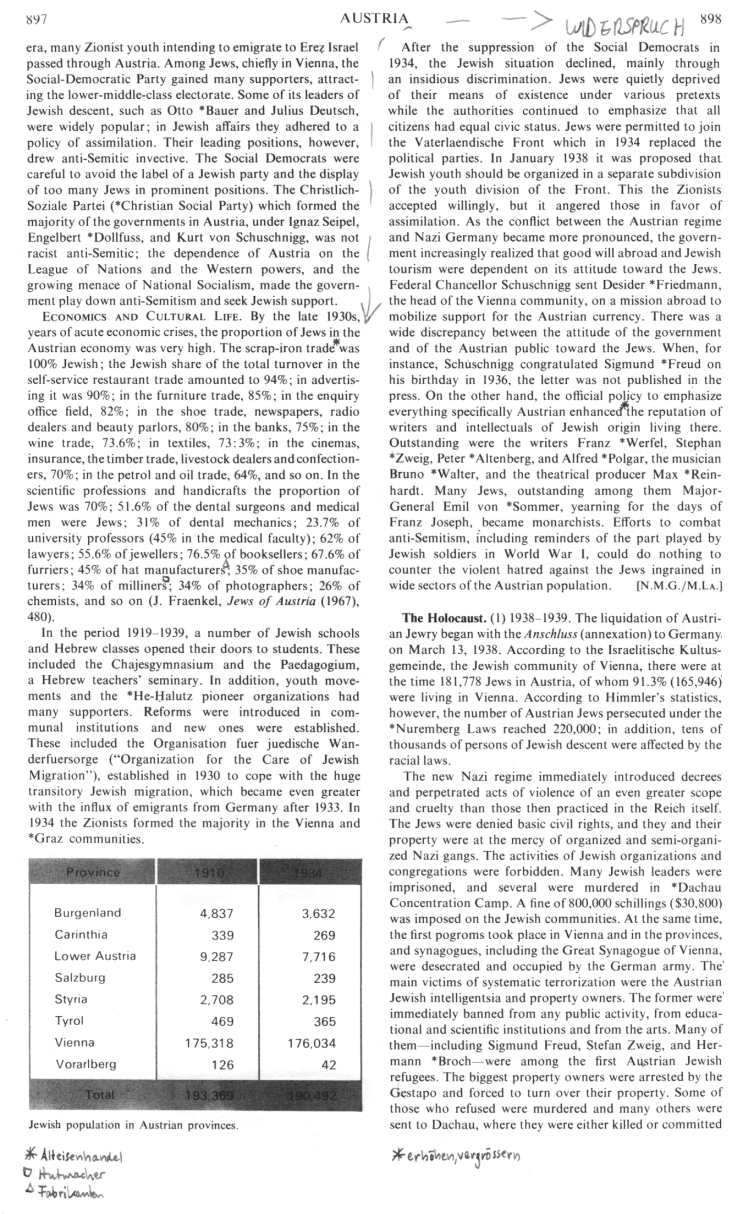
 Encyclopaedia
Judaica
1971: Austria, vol. 3, col. 887-888
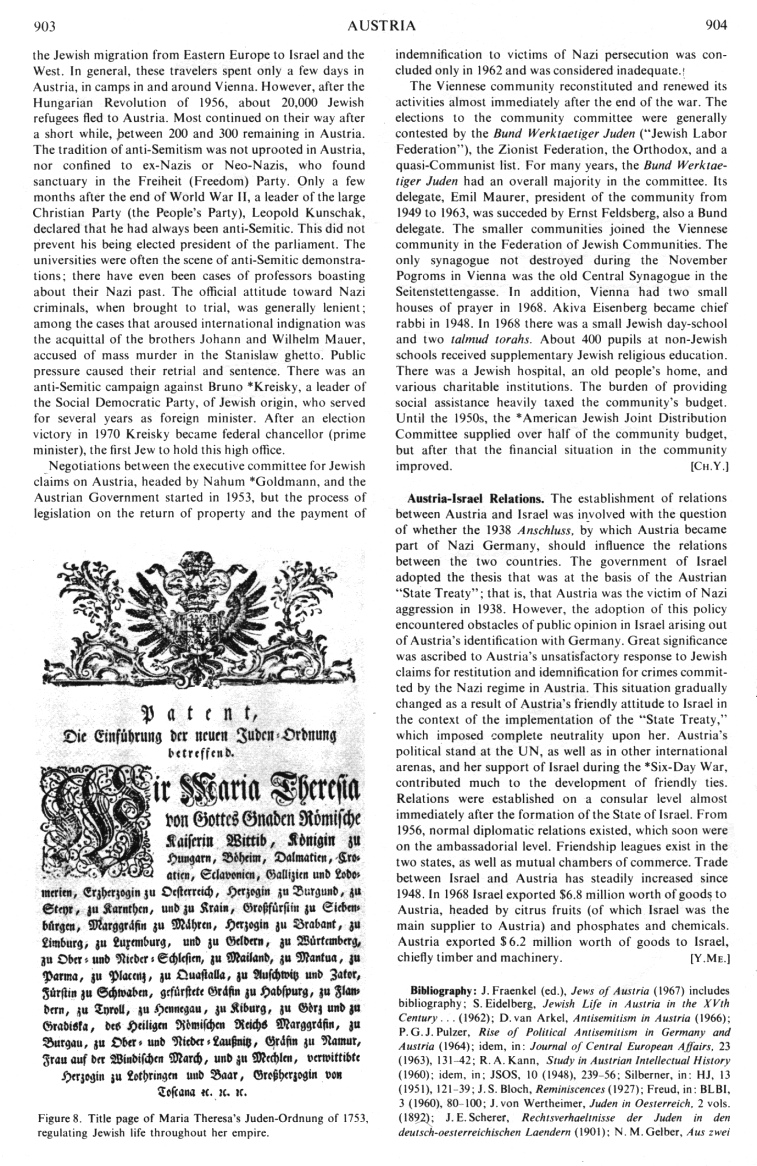
Encyclopaedia
Judaica
1971: Austria, vol. 3, col. 887-888