<19th Century.
The position of the Jews in Austria deteriorated
after the death of Joseph II, though the (col. 893)
Toleranzpatent
remained in force.
[New laws for the
schooling of the Jews]
Francis I (1792-1835) introduced the Bolletten-tax
(see *Taxation), and ordered that measures should be
taken against "Jewish superstitions" and "vain
rabbinical argumentation". Efforts to "enlighten"
the Jews during his reign included the activities of
Herz *Homberg, whose catechism "Benei Zion" was
introduced into schools for the teaching of
religion. Until 1856, Jews were compelled to pass an
examination in it before they were permitted to
marry.
A decree issued in 1820 required all rabbis to study
philosophy, and to use only the "language of the
state" for public prayers; Jewish children were
required to attend Christian schools.
[Wealthy Jews:
Jewish industrialists in Austria - National Bank
of Austria with Jewish bankers - Jewish middle
class]
The period between the issue of the Toleranzpatent
and 1848 saw further fundamental changes in Jewish
life. A number of Jews were instrumental in the
expansion and modernization of industry,
transportation, commerce, and banking in the
Hapsburg Empire. Lazar Auspitz, Michael *Biedermann,
and Simon von *Laemel developed the textile
industry; Solomon von *Rothschild built the first
railway; the Rothschilds, Arnstein-Eskeles, and
*Koenigswarters were the outstanding bankers and
were on the board of the newly founded National
Bank. Many Jews had a university education and
became prominent in journalism and German
literature. Prominent among them were Moritz
*Saphir, Ludwig August *Frankl, Moritz "Hartmann,
and Leopold *Kompert.
The less wealthy classes of Jews also prospered,
opening workshops, or selling and peddling products
of the developing industries. Their heightened
awareness of human dignity evoked by their economic
and cultural attainments and the relaxation of
humiliating restrictions emphasized the basic
inequality of their status, even among the wealthy
and the nobility. It was even more bitterly resented
on the background of Jewish emancipation in France,
the liberalizing edict passed in Prussia in 1812,
and the budding liberal, revolutionary, and
nationalist ideologies in Europe.
[[The rich Jews did not consider a balance of power
with the Christians, and this was always a reason
for anti-Semitism, above all after the collapse of
the stock market of 1873]].
[Corrections of the
law for a possible integration of the Jews in the
state]
During the Congress of Vienna (1814-15), Nathan von
Arnstein with other Jewish notables applied
unsuccessfully to the emperor for the conferment of
civil rights on Austrian Jewry. Joseph von
*Wertheimer's anonymously published a work on the
status of Austrian Jewry (1842) advocated extensive
reforms. In 1846 the humiliating *oath more Judaico
[[Jewish customs oath, Jewish oath]] was abolished.
[1848: Revolution -
right to vote for Jews - freedom of the press with
Jewish and anti-Semitic newspapers - movement
"Forward to America!"]
The number of Jews actively participating in the
1848 revolution, such as Adolf Fischhof, Joseph
Goldmark, Ludwig August Frankl, Hermann *Jellinek
(later executed) - some of whom fell victims in the
street fighting, among them Karl Heinrich *Spitzer -
in part reflected the spread of assimilation among
Jews who identified themselves with general
political trends, (col. 894)
and in part expressed the bitterness of those
already assimilated. The new election law passed in
1848 imposed no limitation on the franchise and
eligibility to elective offices. Five Jewish
deputies, Fischhof and Goldmark from Vienna, Abraham
Halpern of Stanislavov, Dov Berush *Meisels of
Cracow, and Isaac Noah *Mannheimer of Brody, were
elected to the revolutionary parliament meeting at
Kromeriz (Kremsier; 1848-49).
On the other hand, the revolution resulted in
anti-Jewish riots in many towns, and the
newly-acquired freedom of the press produced
venomous anti-Semitic newspapers and pamphlets (see
Q. *Endlich, S. *Ebersberg, S. *Brunner). Isidor
*Busch published his short-lived but important
periodical Oesterreichisches Central-Organ fuer
Glaubensfreiheit, Cultur, Geschichte und Literatur
des Judenthums, in which Leopold Kompert was the
first to advocate emigration as a solution of the
Jewish problem in Austria (and initiated the Auf
nach Amerika! ("Forward to America!") movement).
[1849: Jewish taxes
abolished, discrimination laws abolished, freedom
of movement for all Jews]
After the revolution the specifically Jewish taxes
were abolished by parliament. The imposed
constitution ("Octroyierte Verfassung") of 1849
abrogated discrimination on the basis of religion.
The hated Familiantengesetz became ineffective.
Freedom of movement in the empire was granted. As a
result old communities were dissolved and new ones
emerged. Some Jews were admitted to state service.
[since 1852: Some
new restrictions against the Jews - Jewish press -
Jewish journalist tradition begins]
On Dec. 31, 1851, the imposed constitution was
revoked. Although religious freedom was retained in
principle, Jews were again required to obtain
marriage licenses from the authorities, even if the
number of marriages was no longer limited. The right
of Jews to acquire real estate was suspended. Other
restrictions were introduced up to 1860. In 1857 the
establishment of new communities was prohibited in
Lower Austria. Attempts were made to expel Jews from
cities, based on the rights afforded by medieval
charters. In 1860 a new, more liberal, legislation
was promulgated, although in some parts of Austria
Jews still were unable to hold real estate.
In general, however, the position of the Jews was
now improved. Jewish financiers in partnership with
members of the nobility founded new industries and
banks, outstanding among them the Creditanstalt.
Jews founded leading newspapers and many became
journalists. In 1862 Adolf *Jellinek founded his
modernized bet
ha-midrash in Vienna.
[since 21 Dec.
1867: Full emancipation of the Jews in
Austria-Hungary]
The new constitution of Austria-Hungary of Dec. 21,
1867, again abolished all discrimination on the
basis of religion. The Vienna community then rapidly
grew, attracting Jews from all parts of the
monarchy. Jews increasingly entered professions
hitherto barred to them and assimilation also
increased. Communal organization remained, based on
laws of 1789; in towns where there had not formerly
been a Jewish community, only a *congregation for
worship" (*Kultusverein), could be established.
A law issued in 1890 authorized the existence of one
undivided community in each locality, supervising
all religious and charitable Jewish institutions in
the area, and entitled to collect dues; only
Austrian citizens were eligible for election to the
communal board.
In 1893 a rabbinical seminary, the
*Israelitisch-Theologische Lehranstalt, was founded
which also provided instruction for teachers of
religion, and received aid from the authorities.
the upper strata of Austrian Jewry identified
themselves with German culture and liberal trends.
This was reflected in the views of Jewish members in
both houses of parliament such as Ignaz *Kuranda,
Heinrich Jacques, Rudolph *Auspitz, Moritz von
*Koenigswarter, and Anselm von *Rothschild. The
German Schulverein (Association for German minority
schools) supported Jewish schools in non-German
towns.
ANTI-SEMITISM.
[[Supplement:
Collapse of the stock markets in 1873 and no help
for the Austrians provokes anti-Semitism]]
Anti-Semitism in Austria was enforced by the
international collapse of the stock markets in 1873.
The Austrian government and the Emperor of Vienna
helped the rich Jews and the Jewish banks, but did
not help the normal Austrian citizens and farmers.
This provoked an anti-Semitic movement against the
government and against the Jews in general.
Schoenerer - one of the leaders - was model for
Hitler. The movement of course was generalizing all
arguments against the Jews though many Jews were
also hit and poor by the collapse of the stock
markets. Anti-Semitism did not at all solve any
problems, but the Emperor did not either solve the
problems...]]
Toward the latter part of the 19th (col. 895)
century, anti-Semitism rapidly developed in the
Austro-Hungarian Empire, the blood libel case of
*Tisza-Eszlar being followed by rioting and other
false accusation. Anti-Semitism manifested two
tendencies. The Catholic-religious form later found
expression through Karl *Lueger and his
*Christian-Social party; and in its pan-Germanic
nationalistic form it was expressed by Gerog von
*Schoenerer and his party (see *anti-Semitic
political parties). The government, however, opposed
anti-Semitic propaganda.
[[Supplement: At the end Schoenerer was brought into
prison because he had attacked a Jewish newspaper
office after the Jewish newspaper had reported the
death of the Emperor of Berlin too early and had to
report the death of the German Emperor two times and
made much profit by this manoevre. The German
Austrian crowd was cheering Schoenerer going to and
coming from prison. But Schoenerer never realized
that no problems are solved with anti-Semitism, and
the Emperor at Vienna was playing with the nations
in his empire. Schoenerer also was a fan of Bismarck
and at the end was burried in Germany in the same
forest where Bismarck has his grave...]]
[Jewish newspapers
combating anti-Semitism - Jewish congregations in
Austria]
The manifestation of anti-Semitism brought a change
in ideological attitude on the part of the Jews,
strengthening the national elements. Efforts were
made to combat anti-Semitism in Austro-Hungary by
Joseph Samuel *Bloch with the help of his weekly Oesterreichische
Wochenschrift (founded 1884) and the *Union
Oesterreichischer Juden (founded 1885). An
association to combat anti-Semitism ("Verein zur
Abwehr des Antisemitismus"), consisting of members
of the higher strata of Austrian society, was
founded in 1891 under the presidency of Eduard
Suess.
The historian Heinrich *Friedjung continued to urge
complete Jewish integration into the German nation.
Some Jews ascribed the wave of anti-Jewish hostility
to the immigration at this period of masses of
"uncultured" Jews from Eastern Europe. In opposition
to the assimilationist Oesterreichisch-Israelitische
Union [[Austrian Israelite Union]] a
Juedisch-politischer Verein [[Jewish Political
Association]] (later Juedisch-nationale Partei
[[Jewish National Party]]) advocated an independent
Jewish policy. Jewish nationalist ideology
penetrated Austrian circles through the influence of
Perez *Smolenskin, Leon *Pinsker, and Nathan
*Birnbaum. The first Jewish national students'
society, *Kadimah, was founded in Vienna in 1882.
ZIONISM.
[Jewish Herzl
"Nationalism"]
Vienna was the city of Theodor "Herzl, and the
Zionists combined to strengthen the Jewish national
standpoint and opposition to assimilation.
[[Zionist Herzl says in his booklet "The Jewish
State" that an Israel could be found and all Arabs
could be driven away like the natives in the "USA".
This would be a "modern solution" of the "Jewish
question"]].
[1907-1911: Jewish
Parlamentsklub]
After the passage of the General Franchise Law in
1907, four representatives of the Jewish National
Party were elected to parliament. They founded a
Jewish *"Parlamentsklub" [["Parliamentary Club"]].
In the 1911 elections the Jewish national candidates
were not returned.
[1914-1918: Zionist
influence on the Jews - Jewish refugees from
Galicia and Bukovina bring Jewish culture back to
Vienna]
The Zionist influence in Jewish public life
increased during World War I, and was significantly
reinforced after Hirsch Perez *Chajes became chief
rabbi of Vienna in 1917. During the war, 36,000
Jewish refugees arrived in Vienna from Galicia and
Bukovina alone. The *Zentralstelle fuer juedische
Kriegsfluechtlinge [[Central office for Jewish war
refugees]] was formed to provide them with social
assistance. Many stayed on after the war and
influenced the revival of Jewish culture and life in
hitherto stagnant communities.
[1918: Jews in the
new formed mini-Austria]
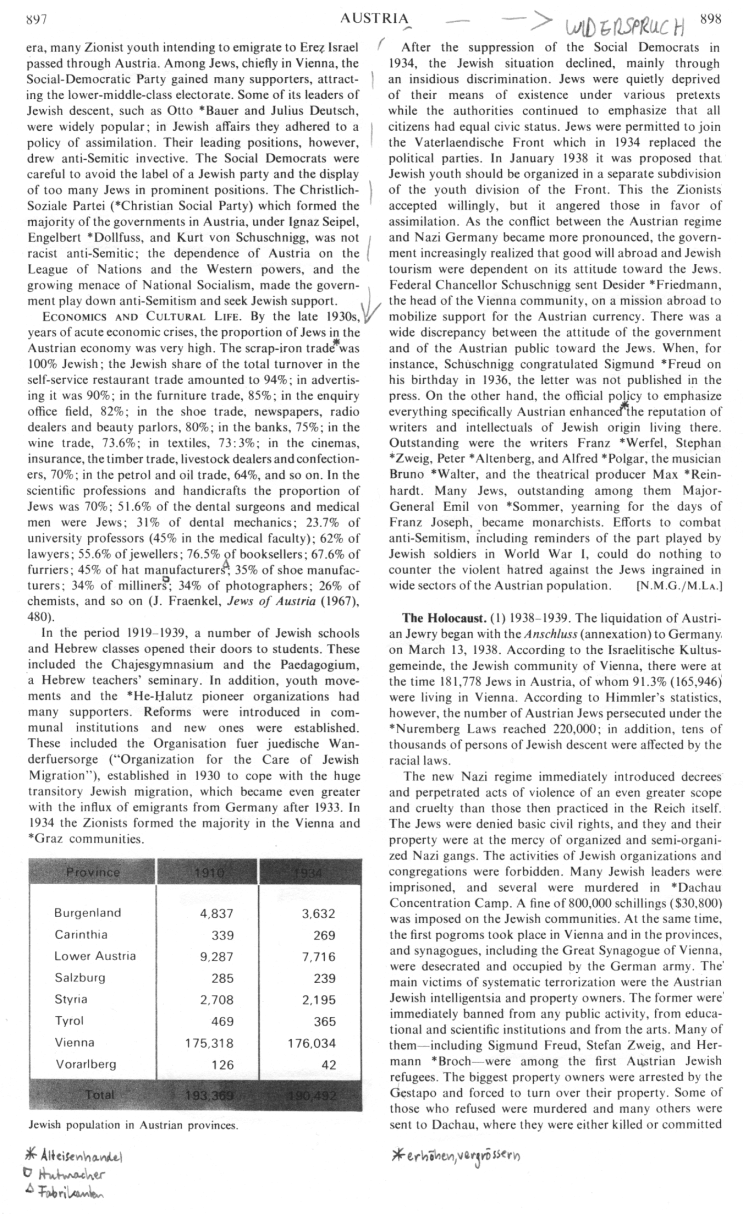
In 1918 there were 300,000 Jews in 33 communities in
the Austrian Republic, with 200,000 Jews living in
Vienna in 1919. Distribution of the communities was
as follows: 10 in Burgenland, 1 in Carinthia, 16 in
Lower Austria, 1 in Salzburg, 1 in Styria, 1 in
Tyrol, 2 in Upper Austria, 1 in Vorarlberg.>
(col. 896)


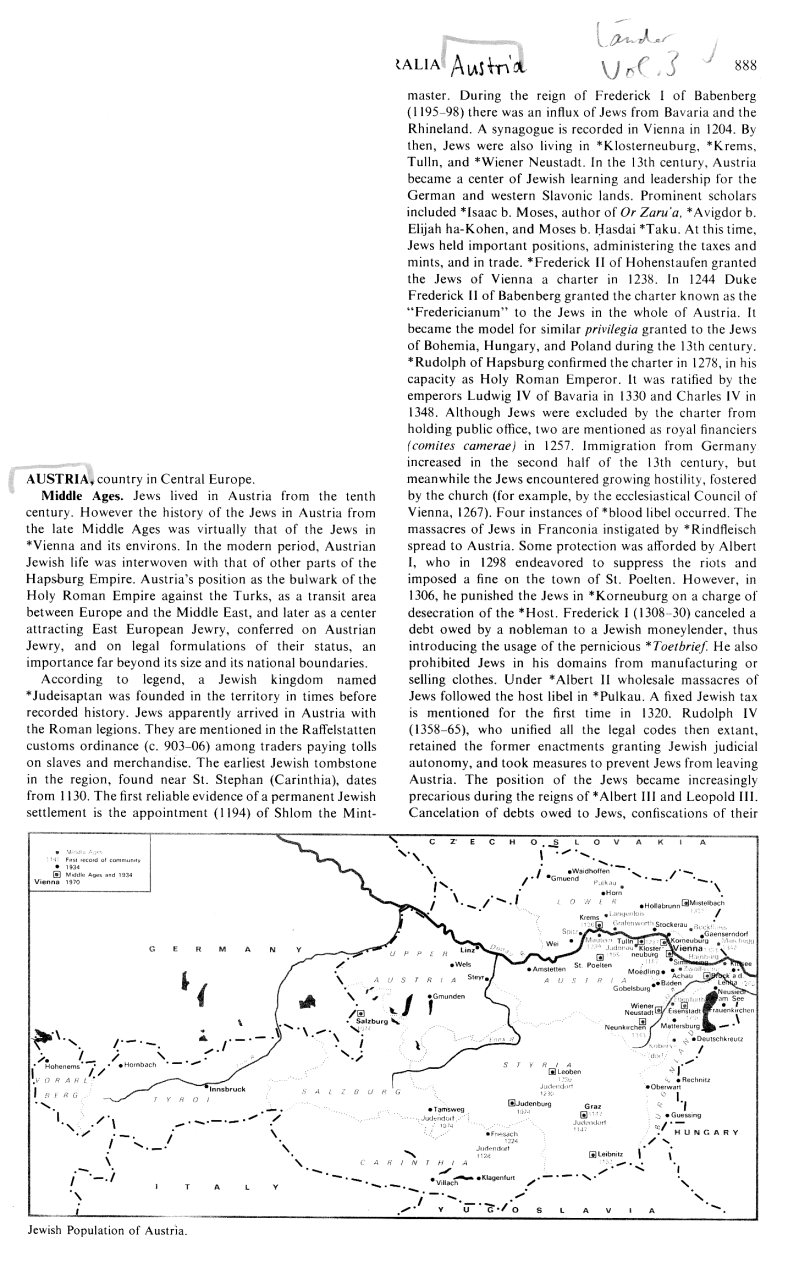
 Encyclopaedia
Judaica
1971: Austria, vol. 3, col. 887-888
Encyclopaedia
Judaica
1971: Austria, vol. 3, col. 887-888