Encyclopaedia Judaica
Jews in Lisbon
Rich cultural
contribution since Afonso I - Anti Jewish laws since
Ferdinand I - pogroms and popular anti-Judaism - Spanish
Jews coming in 1492 - expulsion from Portugal in 1496 -
persecution of Conversos - emancipation of New
Christians in 1773 - emancipation of Jews in 1910 -
Jewish influx from Eastern Europe and from NS
territories for emigration overseas - numbers 1945-1970
- scholars and printing
from: Lisbon; In: Encyclopaedia Judaica 1971, vol. 11
presented by Michael Palomino (2008)
<LISBON, capital of
*Portugal.
[[Jews since kingdom of
Portugal under Affonso I - rich cultural contribution]]
The Middle Ages.
Jews were apparently settled in Lisbon in the 12th century, at
the time of the conquest of the territory from the Moors and
the establishment of the kingdom of Portugal by Affonso I
(1139-85). For a period of two centuries they appear to have
lived in tranquility, sharing the lot of their coreligionists
in the rest of the country. Many Jews were prominent in court
circles as tax farmers, physicians, or astronomers; the
almoxarife Dom Joseph ibn
Yaḥya, descendant of a family founded by a Jew who accompanied
the first king on his conquest of the country, constructed a
magnificent synagogue at his own expense in 1260.
When the religious and political organization of the
communities of Portugal was revised by Affonso III (1248-79),
Lisbon became the official seat of the *
arraby mór, or chief
rabbi. the most important incumbent of this office was Dom
Moses Navarro, physician to Pedro I (1357-67), who, with his
wife, acquired a large landed property near Lisbon.
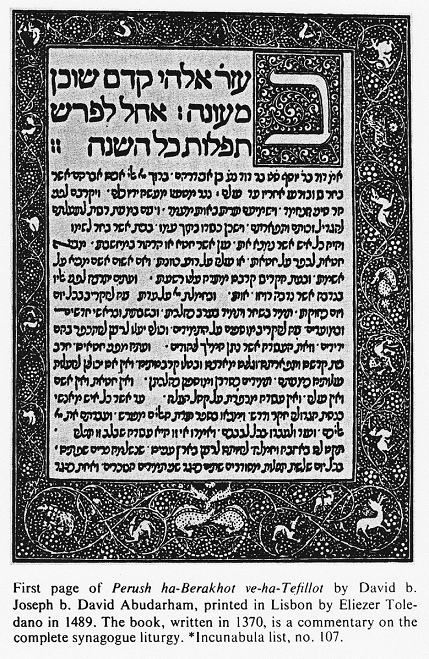
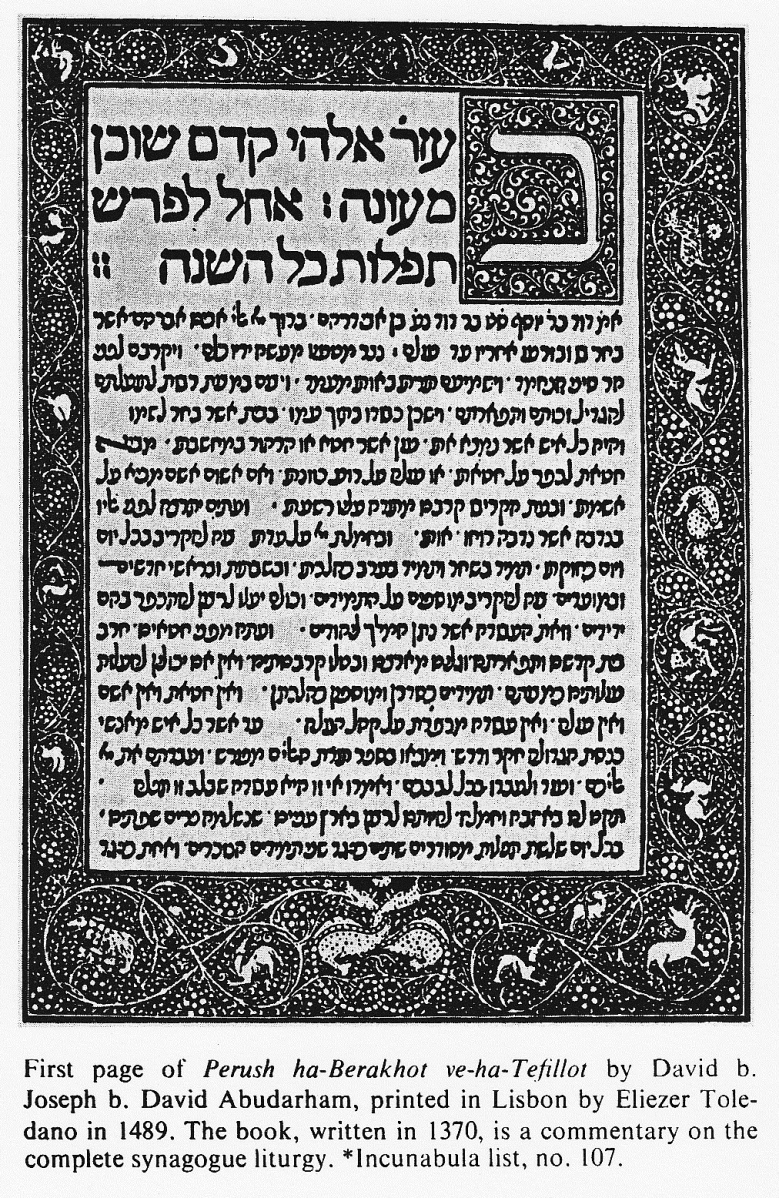
Encyclopaedia judaica: Jews in Lisbon, vol. 11, col. 301,
Perush of 1370: First page of
Perush ha-Berakhot ve-ha-Tefillot
by David b. Joseph b. David Abudarham, printed in Lisbon by
Eliezer Toledano in 1489. The book, written in 1370,
is a commentary on the complete synagogue liturgy.
*Incunabula list, no. 107.
This initial period of prosperity came to an end in the reign
of Ferdinand I (1367-83). When Lisbon was captured by 1373,
the Jewish quarter was sacked and many Jews killed. After the
king's death, the Jews were considered by the populace to be
at the root of the rapacious policies of the queen dowager
Leonora - notwithstanding the fact that she had deposed the
Jewish collector of taxes at Lisbon, as well as Dom Judah, the
former royal treasurer.
[Government under Aviz
dynasty - popular anti-Judaism - protection of the Jews
under John I]
A popular (col. 299)
revolt led to the accession to the throne of the master of
Aviz, the first of a new dynasty. The feeling in Lisbon
against the Jews became extreme, and the people wished to take
violent steps to discover the treasures left by the late
instrument of royal greed. An anti-Jewish reaction followed in
the political sphere. Nevertheless, the new king (known as
John I) did his best to protect the Jews against actual
violence, though they were henceforth excluded from the
positions of trust they had formerly occupied and were forced
to make disproportionate contributions to the gift exacted by
the city for presentation to the new king. Toward the close of
his life, the latter became a little more tolerant.
[King Duarte with separation
decree - but mitigated]
There was a reaction, however, under his son, Duarte
(1433-38), who attempted to enforce the complete separation of
Jews and Christians. This led to a protest by the community of
Lisbon, and as a consequence the severity of the recent decree
was mitigated (1436).
Persecution and Expulsion.
[Popular pogroms 1455-1492]
Popular feeling, nevertheless, continued antagonistic. In
1455, the Côrtes of Lisbon [[Court of Lisbon]] demanded
restrictions against the Jews. The Portuguese sovereigns had
not permitted the wave of rioting which swept through the
Iberian Peninsula in 1391 to penetrate into their dominions.
Nevertheless, as a result of some disorder in the fish market,
there was a serious anti-Jewish outbreak in Lisbon toward the
close of 1449 which led to many deaths, and another (in the
course of which Isaac *Abrabanel's library was destroyed) in
1482.
[Spanish Jews fleeing to
Portugal and to Lisbon 1492 - plague because of bad
conditions]
Owing to the tolerant if grasping policy of John II, a number
of the exiles from Spain were allowed to enter Lisbon after
the expulsion of 1492. Their crowded living conditions led to
an outbreak of plague and the city council had them driven
beyond the walls. Royal influence, however, secured the
exemption from this decree of Samuel Nayas, the procurator of
the Castilian Jews, and Samuel Judah, a prominent physician.
[Expulsion by port of Lisbon
1496/97]
When in 1496/97 the Jews were to be expelled from Portugal,
Lisbon alone was assigned to them as a port of embarkation.
Assembling there from every part of the country, they were
herded in turn into a palace known as Os Estãos [[place "where
they are"]], generally used for the reception of foreign
ambassadors; here the atrocities of forced conversion were
perpetrated. Simon Maimi, the last
arraby mór, was one of the few who was able
to hold out to the end. Thus, the community of Lisbon, with
all the others of Portugal, was driven to embrace a titular
Christianity.
[Flight to Turkey (e.g.
Smyrna) and Greece (Salonika)]
In the period immediately before and after the general
expulsion, however, some individuals managed to escape. They
probably contributed a majority of the members to the
"Portuguese" synagogues in various places in the Turkish
Empire, such as Smyrna (*Izmir), while at *Salonika and
elsewhere they established separate congregations which long
remained known by the name of "the kahal [[community board]]
of Lisbon".
[The persecution of the
converted Jews ("New Christians")]
Lisbon was the seat of the most tragic events in *Conversos
history during the course of the subsequent period. On
Whitsunday, 1503, a quarrel in the Rua Nova (the former Jewish
quarter) between some *New Christians and a riotous band of
youths led to a popular uprising, which was suppressed only
with difficulty. In 1506, on the night of April 7, a number of
New Christians were surprised celebrating the Passover
together. they were arrested, but released after only two
days' imprisonment. On April 19 trouble began again, owing to
the conduct of a Converso who scoffed at a miracle which was
reported to have taken place in the Church of Santo Domingo.
He was dragged out of the church and butchered, and a terrible
massacre began - subsequently known as
A Matança dos Christãos Novos
("The slazing of the New Christians"). The number of victims
was reckoned at between two and four thousand, one of the most
illustrious being João Rodriguez Mascarenhas, a wealthy tax
farmer and reputedly the most hated (col. 300)
man in Lisbon. Sailors from the Dutch, French, and German
ships lying in the harbor landed to assist in the bloody work.
the king, Manoel, sharply punished this outbreak, temporarily
depriving Lisbon of its erstwhile title "Noble and Always
Loyal", fining the town heavily,k and executing a number of
the ringleaders.
The Inquisition.
[The "Holy Office" in Lisbon
- "the most active in the whole country"]
The visit of David *Reuveni (c. 1525), and the open conversion
to Judaism of Diogo Pires (subsequently known as Solomon
*Molcho), created a great stir amongst the Lisbon Conversos.
They were foremost in attempting to combat the introduction of
the Inquisition into Portugal, but their efforts were in vain.
Lisbon itself became the seat of a tribunal of the Holy Office
and on Sept. 20, 1540, the initial Portuguese auto-da-fé took
place in the capital - the first of a long series which
continued over more than two centuries.
Throughout this period, the Lisbon tribunal was the most
active in the whole country. Inquisitional martyrs who
perished there included
-- Luis *Dias, "the Messiah of Setúbal" together with his
adherents, the pseudo-prophet Master Gabriel, and the mystical
poet Gonçalo Eannes bandarra, an "Old Christian" (1542 etc.);
-- Frei Diogo da Assumpão (Aug. 3, 1603);
-- António *Homem, the "
Praeceptor
Infelix" and others of his circle (May 5, 1624);
-- Manuel Fernandes *villareal, the statesman and poet (Dec.
1, 1652);
-- Isaac de *Castro Tartas, with other Conversos captured in
Brazil (Dec. 15, 1647);
-- António Cabicho, with his clerk Manoel de Sandoval
(Dec. 26, 1684);
-- Miguel (Isaac) Henriques da Fonseca, with António de Aguiar
(alias Aaron Cohen Faya), and Gaspar (Abraham) Lopez Pereira,
all of whom were mourned by Amsterdam poets and preachers as
martyrs (May 10, 1681).
[Heavy suffering by rumors -
auto-da-fés]
At times during the Inquisition period, the New Christians as
such suffered. Thus, for example, when in 1630 a theft
occurred at the Church of Santa Engrácia at (col. 301)
Lisbon, suspicion automatically fell on the New Christians. A
youth named Simão Pires Solis was cruelly put to death; the
streets of the capital were placarded with inflammatory
notices; the preachers inveighed from the pulpits against the
"Jews"; and 2,000 persons are said to have fled from Lisbon
alone. Similarly, in 1671, when a common thief stole a
consecrated pyx from the Church of Orivellas at Lisbon,
suspicion again fell on the Conversos and an edict was
actually issued banishing them from the country (but not put
into effect).
From the accession of the House of Bragança in 1640 the power
of the Portuguese Inquisition had been restrained in some
measure, and its suspension by Pope Clement X in 1674 gave the
New Christians some respite, but it proved little less
terrible than before on its resumption in 1681.
After the outbreak of the War of the Spanish Succession
(1701-14), there seems to have been a recrudescence of
inquisitional power, and, in the subsequent period, it became
customary to send to Lisbon for punishment all those persons
found guilty by the other tribunals of the realm. An
auto-da-fé held at Lisbon in 1705 was the occasion of the
famous and savage sermon of the archbishop of Cranganur, which
in turn provoked David *Nieto's scathing rejoinder. At the
Lisbon auto-da-fé of Sept. 24, 1752, 30 men and 27 women were
summoned - all but 12 for Judaizing. In addition to these,
three persons were burned in effigy.
[Earthquake in 1755 - flight
possibilities]
The Lisbon earthquake of 1755 allowed many Conversos, together
with those incarcerated in the dungeons of the Inquisition to
escape, and prompted others to make their way to open
communities overseas. After this, no further Judaizers
suffered in the capital; the last victim of the Lisbon
tribunal was Father Gabriel Malagrida - a Jesuit.
[Christian decree of
emancipation for New Christians in 1773]
The reforms of the Marquês de Pombal put an end to all
juridical differences between Old Christians and New (1773),
and the Conversos of Lisbon disappeared as a separate class
although there were many families who continued to preserve
distinct traces of their Jewish origin.
The Renewed Community.
The close association of Portugal with England, and the
position of Lisbon as an intermediate port between Gibraltar
and England, made it inevitable that a Jewish settlement would
be established in the city as soon as Jews could land with
safety. By the middle of the 18th century, some individuals
had found their way there and began to practice Jewish rites
privately under the security of British protection. Most of
them originated from Gibraltar, though there were some from
North Africa and one or two families direct from England.
In 1801, a small piece of ground was leased for use as a
cemetery. The services rendered to the city by certain Jewish
firms at the time of the famine of 1810 improved their status,
and in 1813, under the auspices of a certain R. Abraham
Dabella, a congregation was formally founded. The condition of
the Jews in Lisbon at this period is unsympathetically
portrayed by George Borrow, in his classical
The Bible in Spain
(1843); while Israel Solomon, an early inhabitant, gives an
intimate glimpse in his memoirs (F.I. Schechter in AJHSP, 25
(1917, 72-73). A little later in the century, two other
synagogues (one of which is still in existence) were founded.
In 1868, the community received official recognition for the
first time. It was, however, recognized as a Jewish "colony",
not "community", and the new synagogue (Shaare Tikvah)
constructed in 1902 was not allowed to bear any external signs
of being a place of worship.
[Complete emancipation for
Jews since 1910 - mostly Sephardim - Ashkenazi Jews from
Eastern Europe - refugees from NS territories]
Complete equality was attained only with the revolution of
1910. Until the outbreak of World War I, the vast majority of
the community were Sephardim, mostly from Gibraltar and North
Africa, and many of them still retained their British
citizenship. Subsequently, however, there was a very large
Ashkenazi influx from Eastern (col. 302)
Europe. During World War II, about 45,000 refugees from Nazi
persecution arrived in Portugal, and passed mainly through
Lisbon, on their way to the free world [[North, Central
and South "America" or also Australia and New Zealand]]. In
Lisbon they were assisted by a relief committee headed by M.
Bensabat *Amzalak and A.D. Esagny.
[[All illegal migration and refugees hiding their religion
emigrating under other nationalities are not mentioned. It can
be admitted that at least the double have passed Lisbon
reaching overseas countries]].
[1945-1970: numbers]
The Jews of Lisbon numbered 400 in 1947, and 2,000 in 1970. In
addition to the two synagogues, there was a school and a
hospital, as well as charitable and educational institutions.
Scholars.
In the Middle Ages, Lisbon did not play a very important part
in Jewish scholarship. The most illustrious scholars
associated with it are the *Ibn Yaḥya family. It was also the
birth place of Isaac Abrabanel, who did much of his literary
work there, while Joseph *Vecinho, Abraham *Zacuto, and other
notable scholars are associated with the city in the period
after the expulsion from Spain.
*Levi b. Ḥabib also passed his early years in Lisbon. Many of
the most illustrious Conversos who attained distinction in the
communities of Amsterdam or elsewhere were also natives of
Lisbon - men like Moses Gideon *Abudiente, *Zacutus Lusitanus
(Abraham Zacuto), Paul de Pina (Reuel *Jesurun), Abraham
Farrar, Duarte Nunes da Costa, Duarte da Silva, and perhaps
*Manasseh Ben Israel.
The outstanding figure in the modern community of Lisbon was
Moses Bensabat Amzalak, who was important in public, economic,
and intellectual life, as well as being a prolific writer on
Jewish subject.
Hebrew Printing.
A Hebrew printing press was active in Lisbon from 1489 to at
least 1492 (see *Incunabula) and was closely connected with
that of *Híjar, Spain, from which it took over the excellent
type, decorated borders, and initials. After 1491 a new type
was used. The founder of the Lisbon press was the learned and
wealthy Eliezer b. Jacob Toledano (in whose house it
operated), assisted by his son Zacheo, Judah Leon Gedaliah,
Joseph Khalfon, and Meir and David ibn *Yaḥya. Their first
production was Naḥmanides' Pentateuch commentary (1489); in
the same year Eleazar Altansi brought out David Abudraham's
prayer book. Other works printed in Lisbon are Joshua b.
Joseph of Tlemcen 's
Halikhot
Olam (1490); the Pentateuch with Onkelos and Rashi in
1491 (text with the vowel and cantillation signs); Isaiah and
Jeremiah with David Kimḥi's commentary 81492); Proverbs with
David ibn Yaḥya's commentary
Kav ve-Naki (1492);
Tur Oraḥ Ḥayyim (also
1492?) and Maimonides'
Hilkhot
Sheḥitah. No other productions have been preserved
apart from a fragment from a Day of Atonement
maḥzor, which may have
come from this press. On the expulsion from Portugal in 1497,
the printers - taking their type, tools, and expertise with
them - found refuge in *Constantinople, *Salonika, and *Fez
where they continued to produce beautiful books.
Bibliography:
-- Roth, marranos, index
-- J. Mendes dos Remédios: The Jews in Portugal (orig.
Portuguese: Os judeus em Portugal), 2 vols. (1895-1928),
index
-- S. Schwarz: Hebrew inscriptions in Portugal (orig.
Portuguese: Inscripções hebraicas em Portugal) (1923)
-- M. B. Amzalak: Hebrew printing in Portugal in 15th
century (orig. Portuguese: Tipographia hebráica em
Portugal no século XV) (1922)
-- M. Kayserling: History of the Jews in Portugal (orig.
German: Geschichte der Juden in Portugal) (1867)
-- J.L. d'Azevedo: História dos Christāos Novos
Portuguêses (1921), index
-- King Manuel (of Portugal: Early Portuguese Books:
1489-1600 (1929), I, 23-43
-- J. Bloch: Early Printing in Spain and Portugal (1938),
32-35
-- B. Friedberg: Toledot ha-Defus ha-Ivri be-Italyah
(1956), 102-4.
[C.R.]>
Sources
|
Encyclopaedia judaica: Jews in Lisbon, vol. 11, col.
299-300
|
Encyclopaedia judaica: Jews in Lisbon, vol. 11, col.
301-302
|
Encyclopaedia judaica: Jews in Lisbon, vol. 11, col.
303
|