Encyclopaedia Judaica
Jews in Portugal 06: 1945-1971
Conversion trend - professions and synagogues - Herzl
Israel
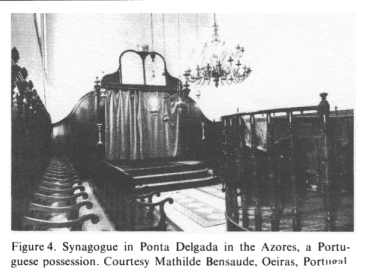
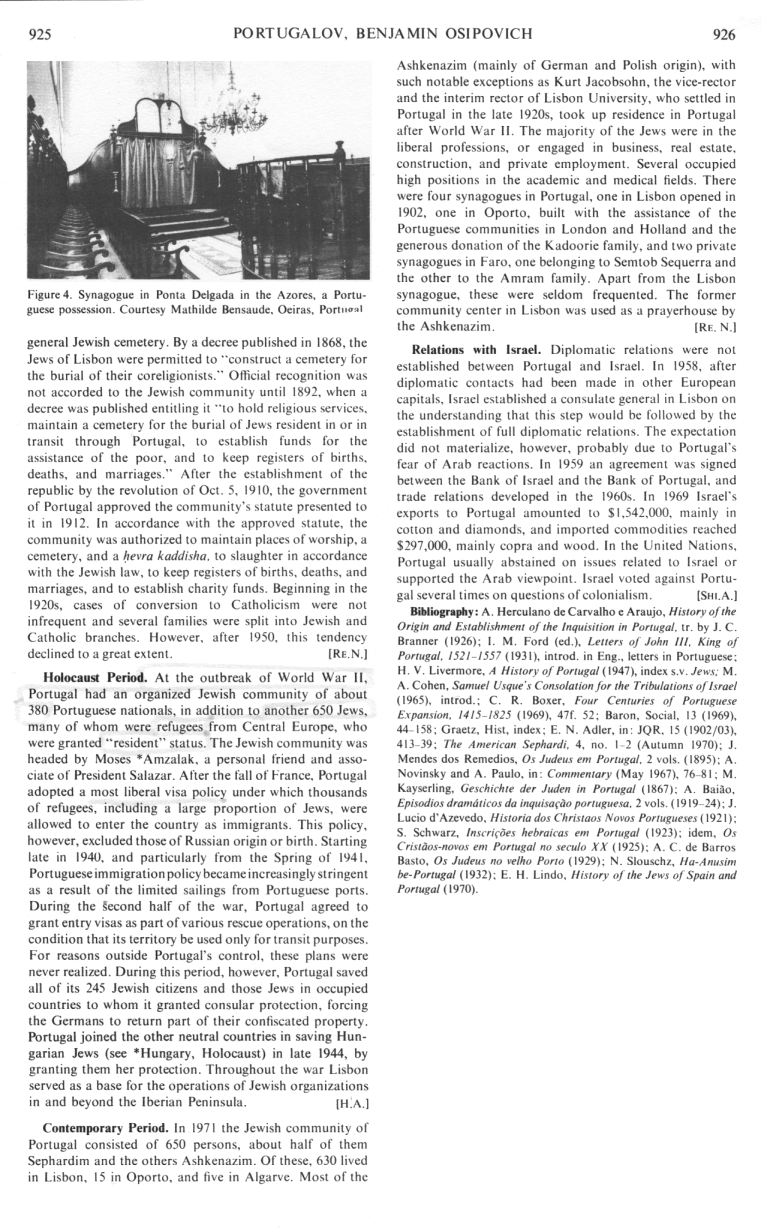
Encyclopaedia Judaica: Portugal, vol13, col.925: synagogue
of Azores: synagogue in Ponta Delgada in the Azores,
a Portuguese possession. Courtesy Mathilde Bensuade,
Oeiras, Portugal
from: Portugal; In: Encyclopaedia Judaica 1971, vol. 13
presented by Michael Palomino (2008)
Contemporary Period.
[Conversion trend - numbers
of Jews]
After 1950, this tendency [[the split of families in Jewish
and Catholic branches by conversions to Catholicism]]
declined to a great extent.
[RE.N.]> (col. 925)
<In 1970 Portugal's Jewish population approximated 1,000,
apart from the Marrano community which perhaps still
numbered several thousand [[which was detected in 1917]].
[A.LI.]> (col. 924)
<In 1971 the Jewish community of Portugal consisted of
650 persons, about half of them Sephardim and the others
Ashkenazim. Of these, 630 lived in Lisbon, 15 in Oporto, and
five in Algarve. Most of the (col. 925)
Ashkenazim (mainly of German and Polish origin), with such
notable exceptions as Kurt Jacobsohn, the vice-rector and
the interim rector of Lisbon University, who settled in
Portugal in the late 1920s, took up residence in Portugal
after World War II.
[Professions - four
synagogues in Portugal]
The majority of the Jews were in the liberal professions, or
engaged in business, real estate, construction, and private
employment. Several occupied high positions in the academic
and medical fields. There were four synagogues in Portugal,
one in Lisbon opened in 1902, one in Oporto, built with the
assistance of the Portuguese communities in London and
Holland and the generous donation of the Kadoorie family,
and two private synagogues in Faro, one belonging to Semtob
Sequerra and the other to the Amram family. Apart from the
Lisbon synagogue, these were seldom frequented. The former
community center in Lisbon was used as a prayer house by the
Ashkenazim.
[RE.N.]> (col. 926)
<Relations with Israel.
[No diplomatic relations -
trade agreement since 1959]
Diplomatic relations were not established between Portugal
and Israel. In 1958, after diplomatic contacts had been made
in other European capitals, Israel established a consulate
general in Lisbon on the understanding that this step would
be followed by the establishment of full diplomatic
relations. The expectation did not materialize, however,
probably due to Portugal's fear of Arab reactions. In 1959
an agreement was signed between the Bank of Israel and the
Bank of Portugal, and trade relations developed in the
1960s. In 1969 Israel's exports to Portugal amounted to
$1,542,000, mainly in cotton and diamonds, and imported
commodities reached $297,000, mainly copra and wood. In the
United Nations, Portugal usually abstained on issues related
to Israel or supported the Arab viewpoint. Israel voted
against Portugal several times on questions of colonialism.
[SHI.A.]> (col. 926)
[[Herzl Free Mason Israel blocks Portuguese colonialism, but
is acting as a colonial power with a Jewish Colonial Agency,
with a colonial Herzl program and with First Mose chapter 15
phrase 18 with an indication of a borderline at the
Euphrates against the Arabs... no comment]]
Sources
|
Encyclopaedia Judaica 1971: Portugal, vol. 13,
col. 919-920 |
Encyclopaedia Judaica 1971: Portugal, vol. 13,
col. 921-922 |
Encyclopaedia Judaica 1971: Portugal, vol. 13,
col. 923-924 |
Encyclopaedia Judaica 1971: Portugal, vol. 13,
col. 925-926 |