Encyclopaedia Judaica
Jews in Botosani
Jewish life in Botosani under the Walachian princes and
the Romanian government - Jewish Polish refugees 1939-1940
- discrimination and WW II 1940-1944 - Jews in the leading
positions 1944 - emigration to Palestine
from: Botosani; In:
Encyclopaedia Judaica (1971), vol. 4
presented by Michael Palomino (2008)
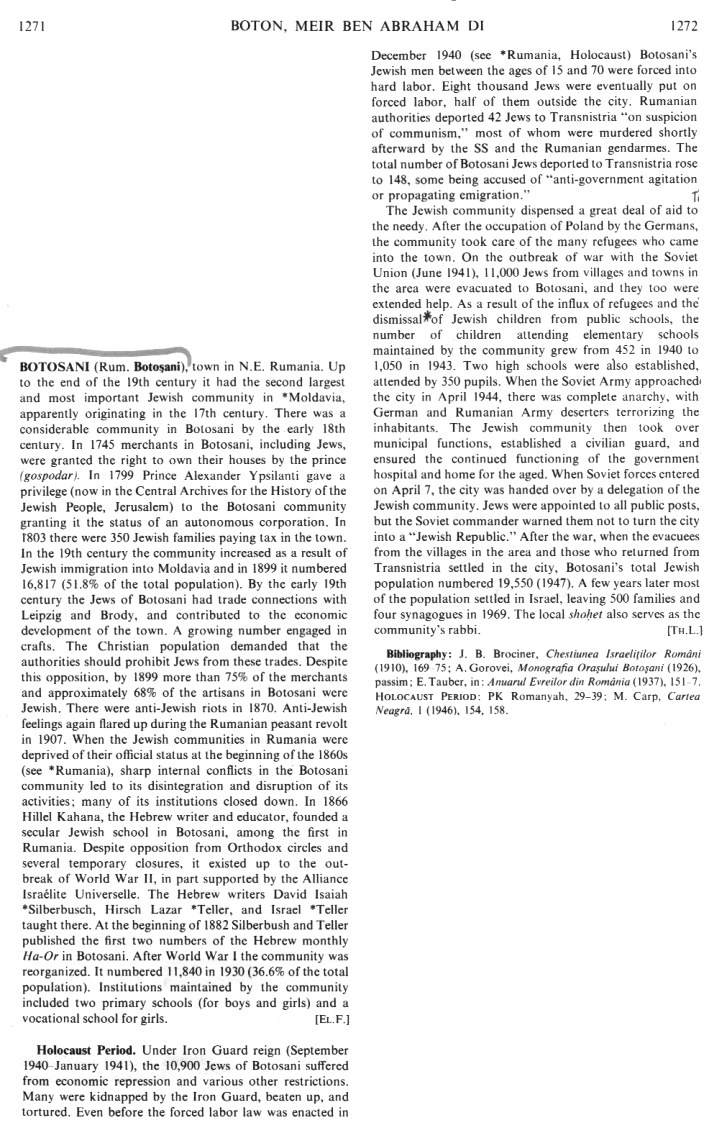
BOTOSANI (Rum. Botosani), town in N.E. Rumania [[in the North
East corner of today Rumania (Romania)]].
[[There is no indication about Jews from 1350 to the 18th
century in this article]].
Up to the end of the 19th century it had the second largest
and most important Jewish community in *Moldavia, apparently
originating in the 17th century. There was a considerable
community in Botosani by the early 18th century. In 1745
merchants in Botosani, including Jews, were granted the right
to own their houses by the prince (
gospodar).
In 1799 Prince Alexander Ypsilanti gave a privilege (now in
the Central Archives for the History of the Jewish People,
Jerusalem) to the Botosani community granting it the status of
an autonomous corporation. In 1803 there were 350 Jewish
families paying tax in the town.
In the 19th century the community increased as a result of
Jewish immigration into Moldavia and in 1899 it numbered
16,817 (51.8% of the total population). By the early 19th
century the Jews of Botosani had trade connections with
Leipzig and Brody, and contributed to the economic development
of the town. A growing number engaged in crafts.
The Christian population demanded that the authorities should
prohibit Jews from these trades. Despite this opposition, by
1899 more than 75% of the merchants and approximately 68% of
the artisans in Botosani were Jewish.
There were anti-Jewish riots in 1870. Anti-Jewish feelings
again flared up during the Rumanian peasant revolt in 1907.
When the Jewish communities in Rumania were deprived of their
official status at the beginning of the 1860s (see *Rumania),
sharp internal conflicts in the Botosani community led to its
disintegration and disruption of its activities; many of its
institutions closed down.
In 1866 Hillel Kahana, the Hebrew writer and educator, founded
a secular Jewish school in Botosani, among the first in
Rumania. Despite opposition from Orthodox circles and several
temporary closures, it existed up to the outbreak of World War
II, in part supported by the Alliance Israélite Universelle.
The Hebrew writers David Isaiah *Silberbusch, Hirsch Lazar
*Teller, and Israel *Teller taught there.
At the beginning of 1882 Silberbush and Teller published the
first two numbers of the Hebrew monthly
Ha-Or in Botosani. After
World War I the community was reorganized. It numbered 11,840
in 1930 (36.6% of the total population). Institutions
maintained by the community included two primary schools (for
boys and girls) and a vocational school for girls.
[EL.F.]
Holocaust Period.
[1939-1940: Wave of Jewish
refugees from Poland]
[...] The Jewish community dispensed a great deal of aid to
the needy. After the occupation of Poland by the Germans, the
community took care of the many refugees who came into the
town.
[1940-1944: Discrimination
and deportations to Transnistria - growing Jewish schools]
[...] Under Iron Guard reign (September 1940-January 1941),
the 10,900 Jews of Botosani suffered from economic repression
and various other restrictions. Many were kidnapped by the
Iron Guard, beaten up, and tortured. Even before the forced
labor law was enacted in (col. 1271)
December 1940 (see *Rumania, Holocaust) Botosani's Jewish men
between the ages of 15 and 70 were forced into hard labor.
Eight thousand Jews were eventually put on forced labor, half
of them outside the city. Rumanian authorities deported 42
Jews to Transnistria "on suspicion of communism", most of whom
were murdered shortly afterward by the SS and the Rumanian
gendarmes. The total number of Botosani Jews deported to
Transnistria rose to 148, some being accused of
"anti-government agitation or propagating emigration".
[...] On the outbreak
of war with the Soviet Union (June 1941), 11,000 Jews from
villages and towns in the area were evacuated to Botosani, and
they too were extended help. As a result of the influx of
refugees and the dismissal of Jewish children from public
schools, the number of children attending elementary schools
maintained by the community grew from 452 in 1940 to 1,050 in
1943. Two high schools were also established, attended by 350
pupils.
[since 1944: Communist
Botosani]
When the Soviet Army approached the city in April 1944, there
was complete anarchy, with German and Rumanian Army deserters
terrorizing the inhabitants. The Jewish community then took
over municipal functions, established a civilian guard, and
ensured the continued functioning of the government hospital
and home for the aged. When Soviet forces entered on April 7,
the city was handed over by a delegation of the Jewish
community. Jews were appointed to all public posts, but the
Soviet commander warned them not to turn the city into a
"Jewish Republic".
After the war, when the evacuees from the villages in the area
and those who returned from Transnistria settled in the city,
Botosani's total Jewish population numbered 19,550 (1947). A
few years later most of the population settled in Israel,
leaving 500 families and four synagogues in 1969. The local
shohet [[ritual
slaughterer]] also serves as the community's rabbi.
[TH.L.]
Bibliography
-- J. B. Brociner: Chestiunea Israelitilor Români (1910),
169-75
-- A. Gorovei: Monografia Orasului Botosani (1926), passim
-- E. Tauber, in: Anuarul Evreilor din România (1937), 151-7
HOLOCAUST PERIOD
-- PK Romanyah, 29-39
-- M. Carp: Cartea Neagra, 1 (1946), 154, 158> (col. 1272)
Sources
Encyclopaedia Judaica (1971): Botosani, vol. 4, col.
1271-1272
|