from: Botosani; In:
Encyclopaedia Judaica (1971), vol. 4
presented by Michael Palomino (2008)
<
Cluj (Hung.
Kolozsvár; Ger. Klausenburg), city in central Rumania, the
cultural, industrial, and political center of Transylvania
[[German: Siebenbuergen]];
from 1790 to 1848 and 1861 to 1867 capital of Transylvania;
until 1920 and between 1940 and 1945 in Hungary.
[Jews and discrimination
under the Hungarian Emperor - Jews generally permitted after
1848]
Jews visited the Cluj fairs in the 16th and 17th centuries. A
Jew is mentioned there in 1769. Eight Jewish families are
recorded at Cluj in the census of 1780. In 1784 the municipal
council prohibited the inhabitants from selling real estate to
Jews and Jews were forbidden to lodge temporarily in the city:
a prolonged struggle on the question of Jewish rights ensued.
In 1807 the Jews in Cluj opened a prayer room, and by 1818 the
community, then numbering 40 persons, had a synagogue,
constructed of reeds [[cane]]. A
hevra kaddisha [[Jewish burrial society]]
was founded in 1837. Fifteen Jewish families were permitted to
remain in the city in 1839 but were debarred from
accommodating additional Jews in their houses.
When in 1840 the Jews applied for permission to fence in their
cemetery, the request was rejected on the ground that their
presence had no legal authorization. With the revolution of
1848 the prohibition on Jewish residence was abolished, and
subsequently the Jewish population rapidly increased. The Jews
in Cluj at first engaged mainly in commerce, trading
especially in goods from the Orient, notably Turkey. They
later entered the crafts and, during the 19th century, the
professions.
[since 1848: Jewish religious
life in Cluj - quarrels between orthodox and progressive
line - synagogues]
The rabbis and dayyanim [[judges]] in Cluj, on whom
information is available from 1812, were subject to the
supervision of the chief rabbi of Transylvania. The Great
Synagogue was inaugurated in 1850. The first rabbi, Hillel
*Lichtenstein, who officiated from 1851 to 1853, had to leave
after opposition by a section of the community and his failure
to obtain a certificate from the Transylvanian chief rabbi.
The rabbi of Cluj from 1863 to 1877 was Abraham *Glasner. He
was opposed by the hasidic movement then gaining ground.
The first convention of Transylvanian Jewry was held at Cluj
in 1886. The community was organized on an Orthodox basis in
1869. A short-lived *Reform community was then also
established. Moses *Glasner, Orthodox rabbi from 1878 to 1922,
took a leading role in communal affairs. the
*status quo community,
organized in Cluj in 1881 and affiliated to the neologist
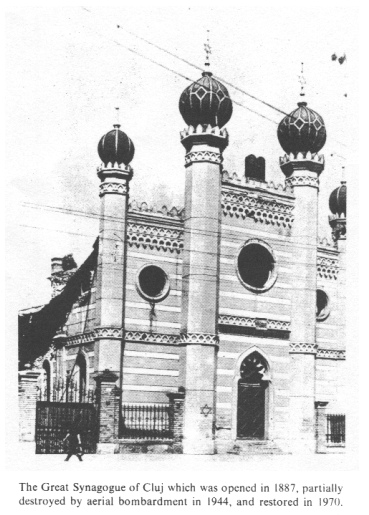
communities, built a magnificent synagogue in the principal
avenue of the city (opened in 1887 and still standing in
1970). Mátyás Eisler was appointed its rabbi in 1891. The
Hasidim established a separate communal organization in 1921.
[since 1918: Herzl Zionism
with Herzl Zionist newspaper in Cluj]
[[In 1918 Cluj and Transylvania was annexed by the new
Romanian state]].
After World War I the Jewish national movement was active in
Cluj. Cluj remained the center of the [racist] Zionist
movement for Transylvania, although some of its offices were
later transferred to *Timisoara.
By the end of 1918
*Uj
Kelet, a lively Zionist weekly, later a daily, began
publication in Cluj. It had a large readership and became a
leading influence among the Jews of Transylvania and Rumania.
The newspaper was also the organ of the (principally Zionist)
Jewish Party (
Partidul
Evreiesc), some of whose local activists were elected
to the Rumanian Parliament. A printing press set up in Cluj in
1910 operated until the Holocaust.
[Jewish schools in Cluj]
The schools of the Cluj community attracted pupils throughout
Transylvania. The Orthodox community opened an elementary
school in 1870, and the neologist community opened one in
1904. A Hebrew *Tarbut secondary school, started in 1920, took
the lead in education (p.617)
of the youth until closed by the Rumanian authorities in 1927;
its director, Mark Antal, was former director general of the
Ministry of Education and Culture of Hungary.
[1940-1944: Cluj and
Transylvania again under Hungarian rule]
After Cluj had been annexed by Hungary [[by a NS decision]]
and Jewish children were prohibited from attending general
schools, a Jewish secondary school for boys and girls was
opened in October 1940; it remained open until both pupils and
teachers were interned in the ghetto.
The Jewish population numbered 231 in 1857; 994 in 1869; 2,414
(7.4% of the total population) in 1891; 7,046 (11.6%) in 1910;
10,633 in 1920; 14,000 (13.4%) in 1927; and 13,504 in 1930.
After the Hungarian annexation in 1940, anti-Jewish measures
and economic restrictions were imposed, followed by physical
persecution. In 1942 most of the men of military age in Cluj
were conscripted for forced labor and transported to the
eastern front to the Nazi-occupied area of the Soviet Union,
where most of them perished.
When the Germans entered Hungary in the summer of 1944 the
local Jews, numbering approximately 16,763 with others from
the surrounding villages and the town of Szamosujvár (Gherla),
were confined to a ghetto. Subsequently they were deported to
*Auschwitz [[and then the big part of them to the tunnel
systems]] where the majority perished.
[since 1944: Jews in Romanian
Cluj]
The few survivors who returned to Cluj from the camps,
with those who had joined them from other localities, numbered
6,500 in 1947. Community life was subsequently reorganized. A
Communist-inspired local Jewish organization was also set up,
principally to fight the remnants of [racist Herzl] Zionism;
Zionist activities continued until 1949.
By 1970 only 1,100 Jews (340 families) remained registered
with the community. Prayers were held in three synagogues. The
unified communal organization maintained a kosher butcher and
canteen. Community life was declining, however, and Jews were
leaving Cluj [[probably a big part to Herzl Israel]].>
Source
Encyclopaedia Judaica (1971): Jews in Cluj (Hung.
Kolozsvár, Germ. Klausenburg), vol. 5, col. 617-618
|