Encyclopaedia Judaica
Jews in Dorohoi
Jewish life in Dorohoi - deportations during World War
II to Transnistria - and a big part brought back
Encyclopaedia Judaica
Jews in Dorohoi
Jewish life in Dorohoi - deportations during World War
II to Transnistria - and a big part brought back
from: Botosani; In:
Encyclopaedia Judaica (1971), vol. 4
presented by Michael Palomino (2008)
<
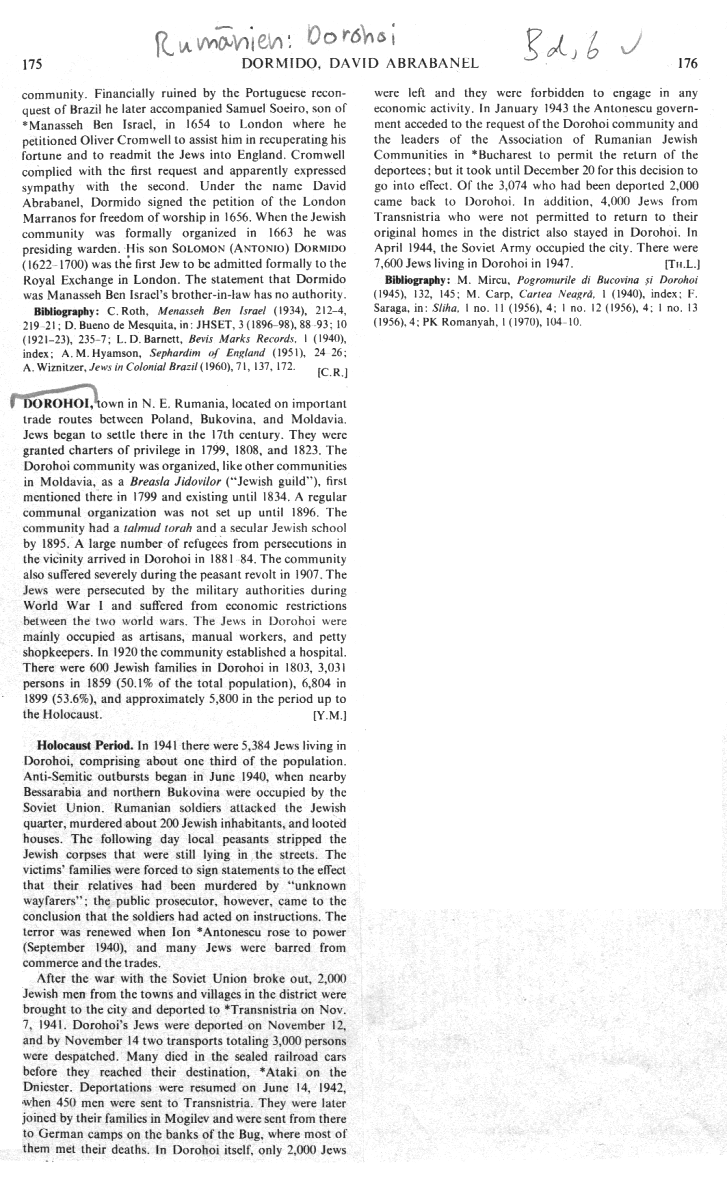
DOROHOI, town in N.E.
Rumania, located on important trade routes between Poland,
Bukovina, and Moldavia.
Jews began to settle there in the 17th century. They were
granted charters of privilege in 1799, 1808, and 1823. The
Dorohoi community was organized, like other communities in
Moldavia, as a
Breasla
Jidovilor ("Jewish guild"), first mentioned there in
1799 and existing until 1834. A regular communal organization
was not set up until 1896. The community had a
talmud torah [[school]]
and a secular Jewish school by 1895. A large number of
refugees from persecutions in the vicinity arrived in Dorohoi
in 1881-84. The community also suffered severely during the
peasant revolt in 1907. The Jews were persecuted by the
military authorities during World War I and suffered from
economic restrictions between the two world wars. The Jews in
Dorohoi were mainly occupied as artisans, manual workers, and
petty shopkeepers. In 1920 the community established a
hospital.
There were 600 Jewish families in Dorohoi in 1803, 3,031
persons in 1859 (50.1% of the total population), 6,804 in 1899
(53.6%), and approximately 5,800 in the period up to the
Holocaust.
[[The
emigration
movement
between 1881 and 1914 is not mentioned, but can be
admitted when you see the figures]].
Holocaust Period. [massacres
in June and September 1940 - discriminations]
[...] Anti-Semitic outbursts began in June 1940, when nearby
Bessarabia and northern Bukovina were occupied by the Soviet
Union. Rumanian soldiers attacked the Jewish quarter, murdered
about 200 Jewish inhabitants, and looted houses. The following
day local peasants stripped the Jewish corpses that were still
lying in the streets. The victims' families were forced to
sign statements to the effect that their relatives had been
murdered by "unknown wayfarers"; the public prosecutor,
however, came to the conclusion that the soldiers had acted on
instructions.
The terror was renewed when Ion *Antonescu rose to power
(September 1940), and many Jews were bared from commerce and
the trades.
[1941: Deportations to
Transnistria - deportees brought to Dorohoi]
[...] In 1941 there were 5,384 Jews living in Dorohoi,
comprising about one third of the population. [...]
After the war with the Soviet Union broke out, 2,000 Jewish
men from the towns and villages in the district were brought
to the city and deported to *Transnistria on Nov. 7, 1941.
Dorohoi's Jews were deported on November 12, and by November
14 two transports totaling 3,000 persons were dispatched. Many
died in the sealed railroad cars before they reached their
destination, *Ataki on the Dniester.
Deportations were resumed on June 14, 1942, when 450 men were
sent to Transnistria. They were later joined by their families
in Mogilev and were sent from there to German camps on the
banks of the Bug, where most of them met their deaths.
In Dorohoi itself, only 2,000 Jews (col. 175)
were left and they were forbidden to engage in any economic
activity. In January 1943 the Antonescu government acceded to
the request of the Dorohoi community and the leaders of the
Association of Rumanian Jewish Communities in *Bucharest to
permit the return of the deportees; but it took until December
20 for this decision to go into effect.
Of the 3,074 who had been deported 2,000 came back to Dorohoi.
In addition, 4,000 Jews from Transnistria who were not
permitted to return to their original homes in the district
also stayed in Dorohoi. In April 1944, the Soviet Army
occupied the city. There were 7,600 Jews living in Dorohoi in
1947.
[[Emigration movement to Palestine is not mentioned but can be
admitted]].
Sources
Encyclopaedia Judaica (1971): Jews in Dorohoi, vol.
6, col. 175-176
|